Dr. Alhassan Iddrisu

208 posts

Dr. Alhassan Iddrisu banner
Dr. Alhassan Iddrisu

Dr. Alhassan Iddrisu

@daiddrisu

This is the official account of Dr. Alhassan Iddrisu, Government Statistician, Ghana Statistical Service

Accra, Ghana 参加日 Kasım 2024
116 フォロー中219 フォロワー
Dr. Alhassan Iddrisu
Dr. Alhassan Iddrisu@daiddrisu·
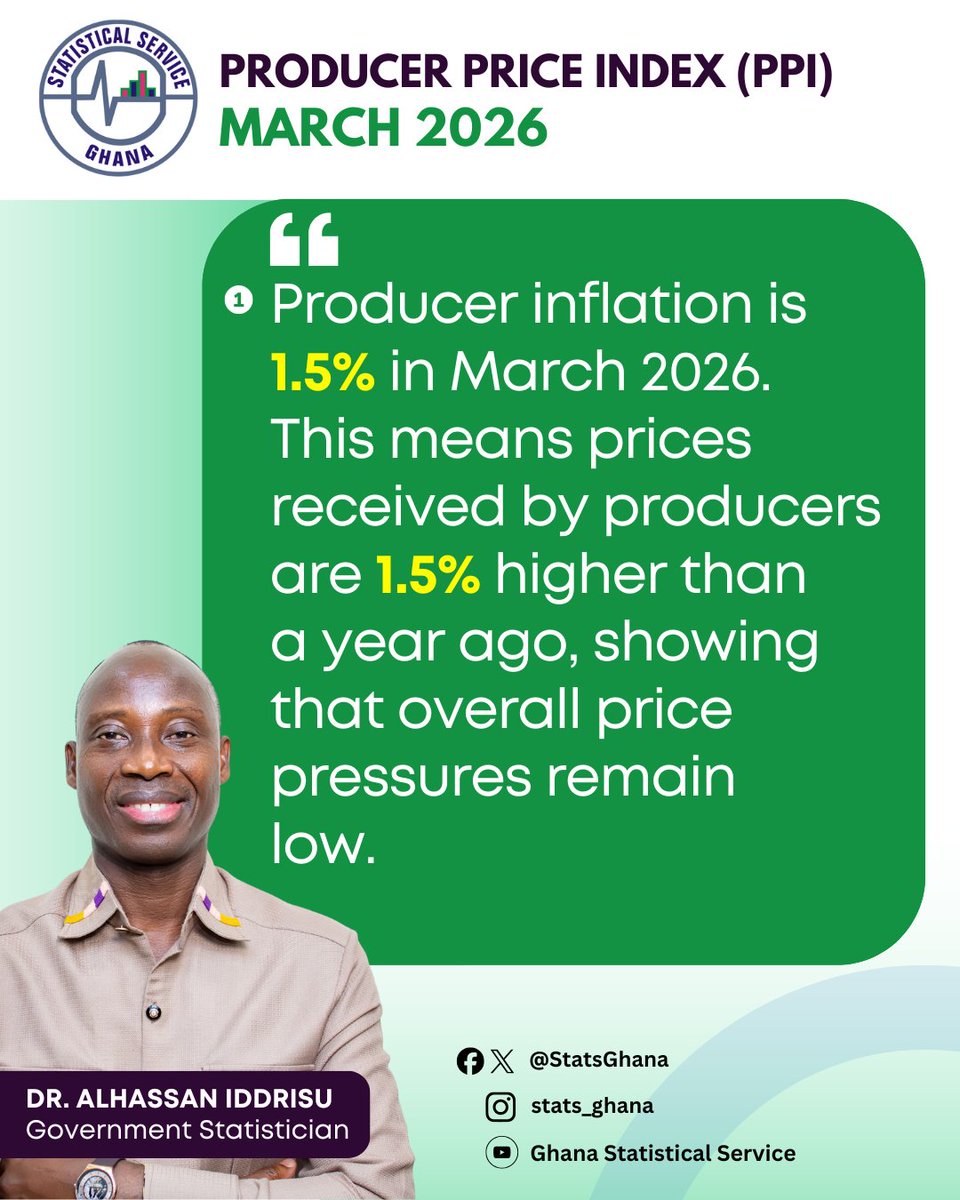
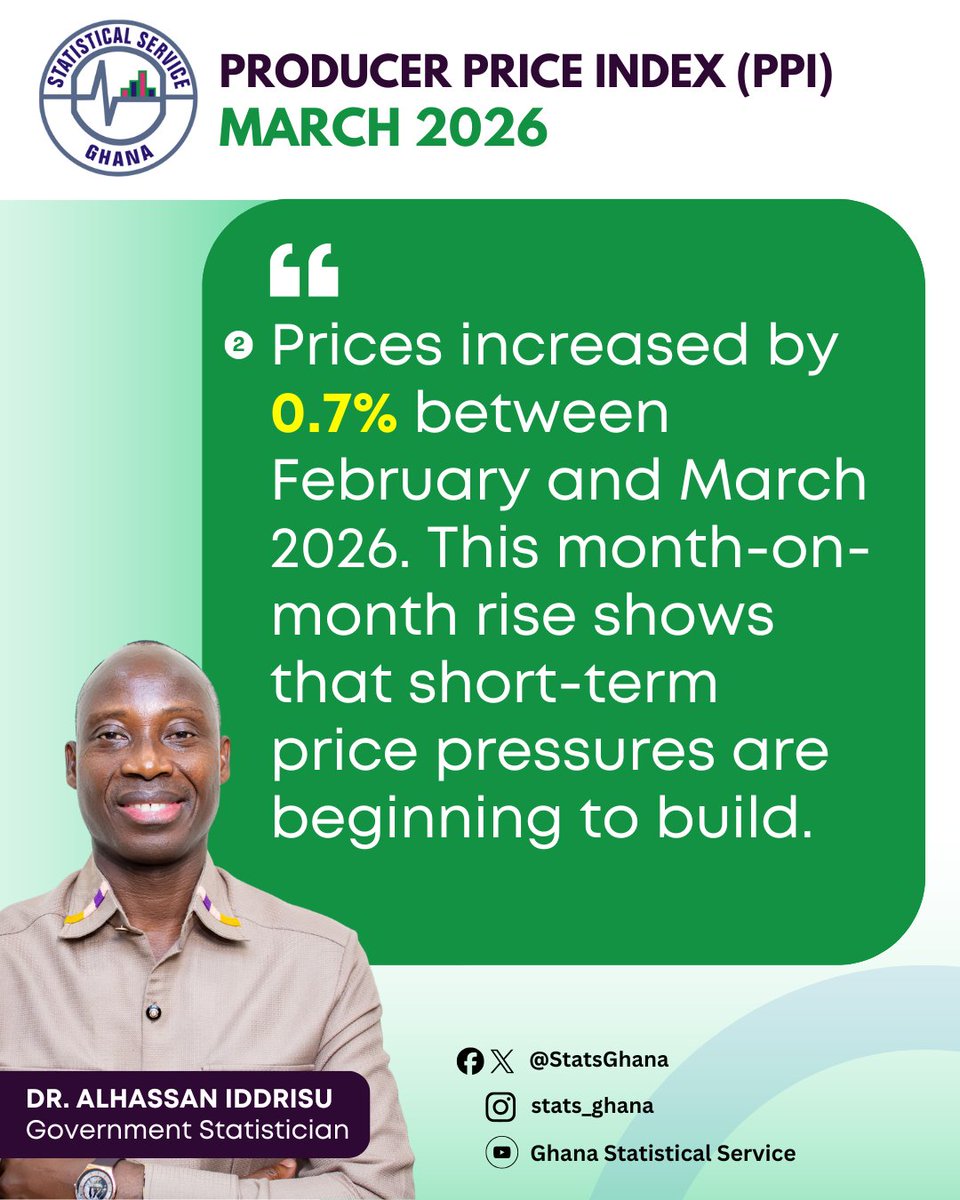
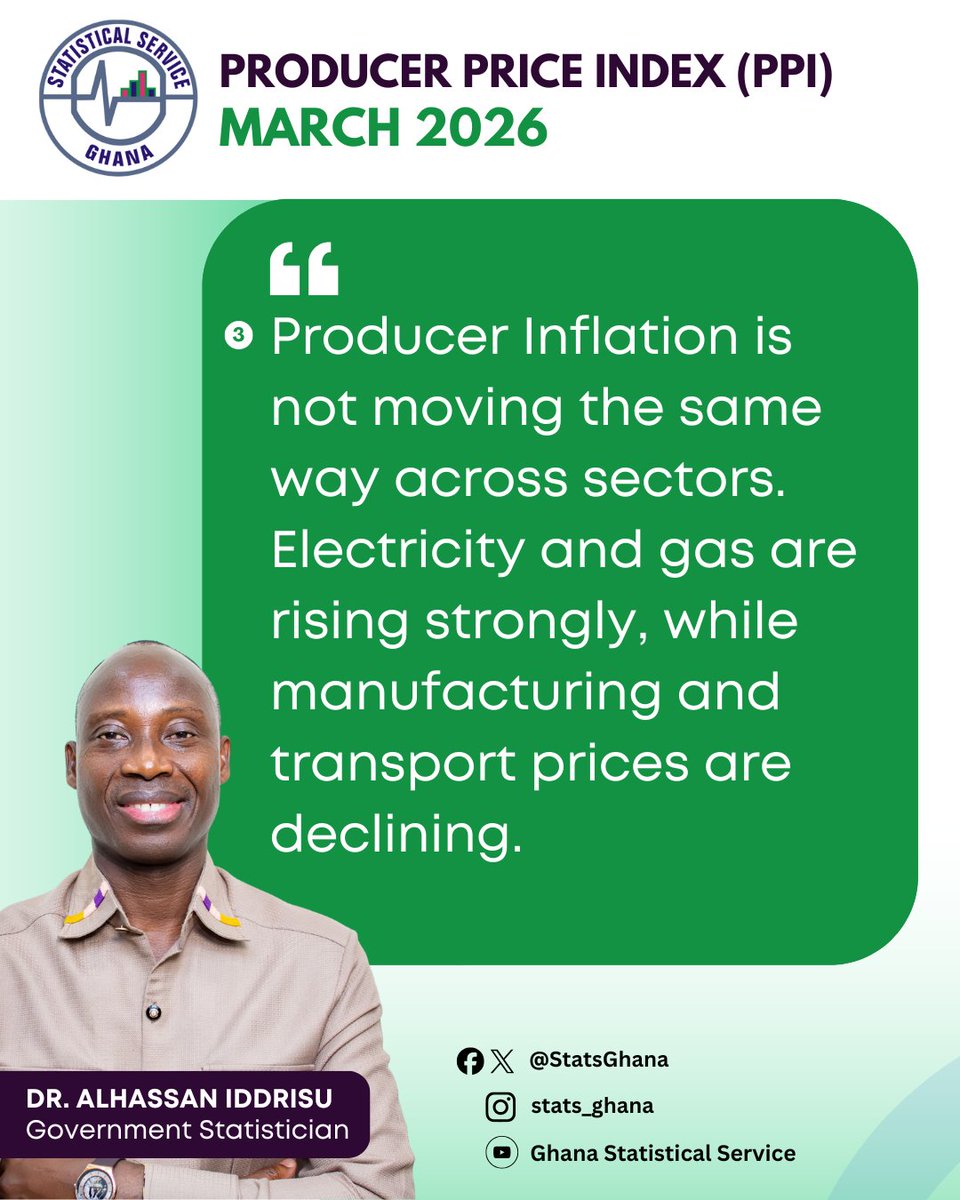
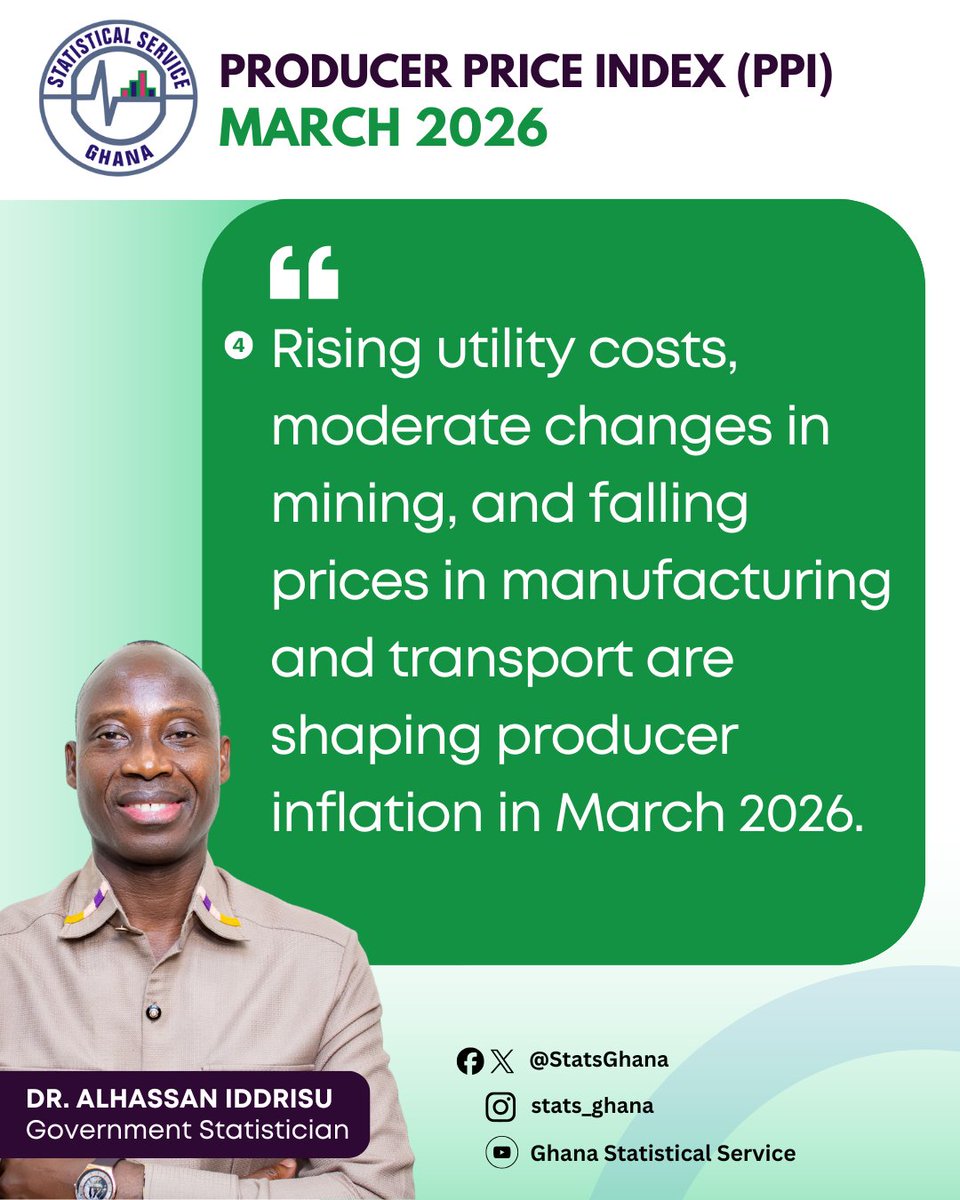
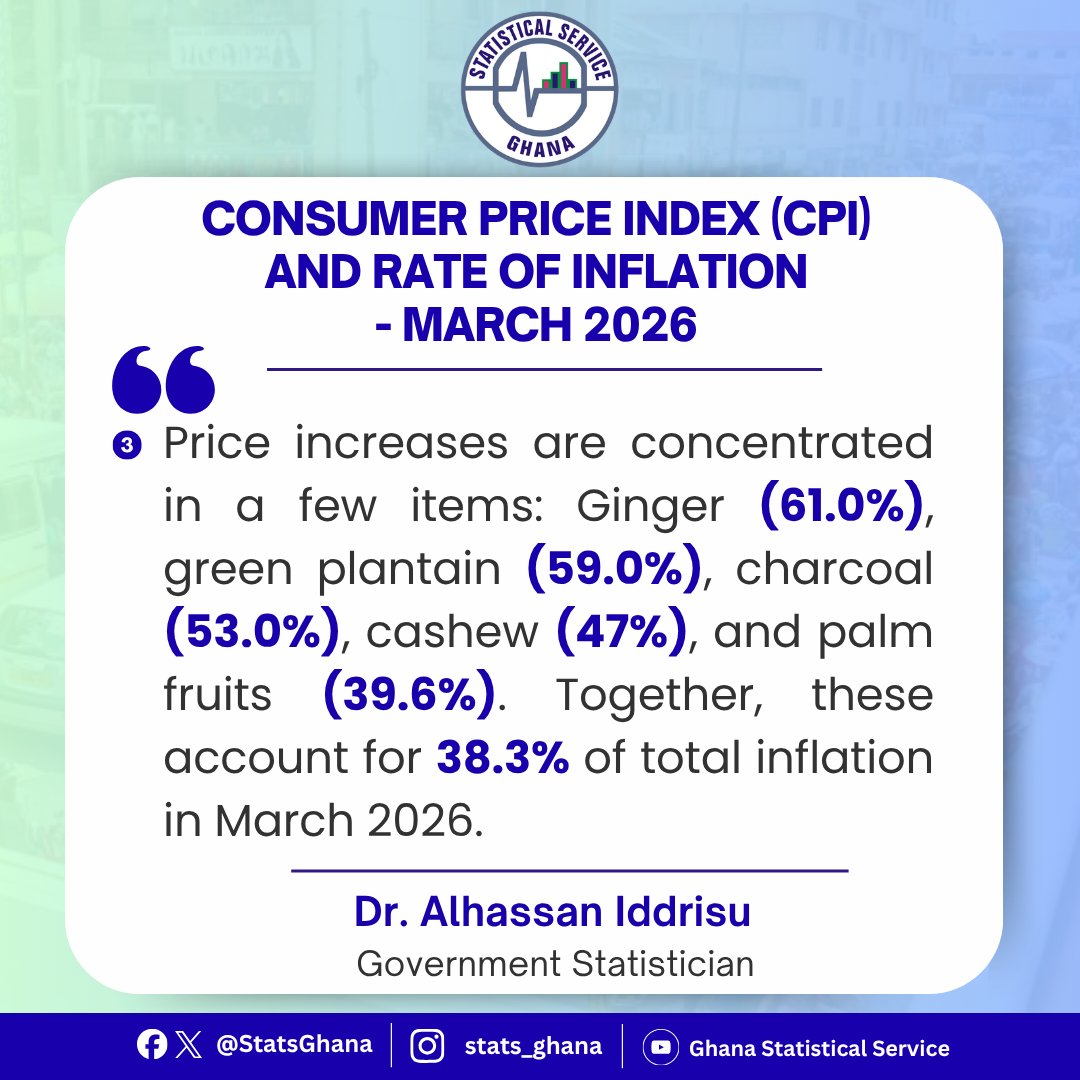
Producer inflation stands at 1.5% in March 2026, with 0.7% monthly changes signaling that overall price pressures remain low but also shows emerging short-term pressures. The quote cards break this down clearly - what the numbers mean, where changes are happening, and why they matter for households, businesses, and policy. We thank market players, data users, and our dedicated staff at the Ghana Statistical Service for their commitment and support. Together, we continue to deliver reliable statistics that inform decisions and drive national development. #GSS #ProducerPriceInflation #PPI #March2026PPI #GhanaEconomy #DataForDevelopment #EvidenceBasedPolicy
Dr. Alhassan Iddrisu tweet mediaDr. Alhassan Iddrisu tweet mediaDr. Alhassan Iddrisu tweet media
English
0
2
2
78
Dr. Alhassan Iddrisu
Dr. Alhassan Iddrisu@daiddrisu·
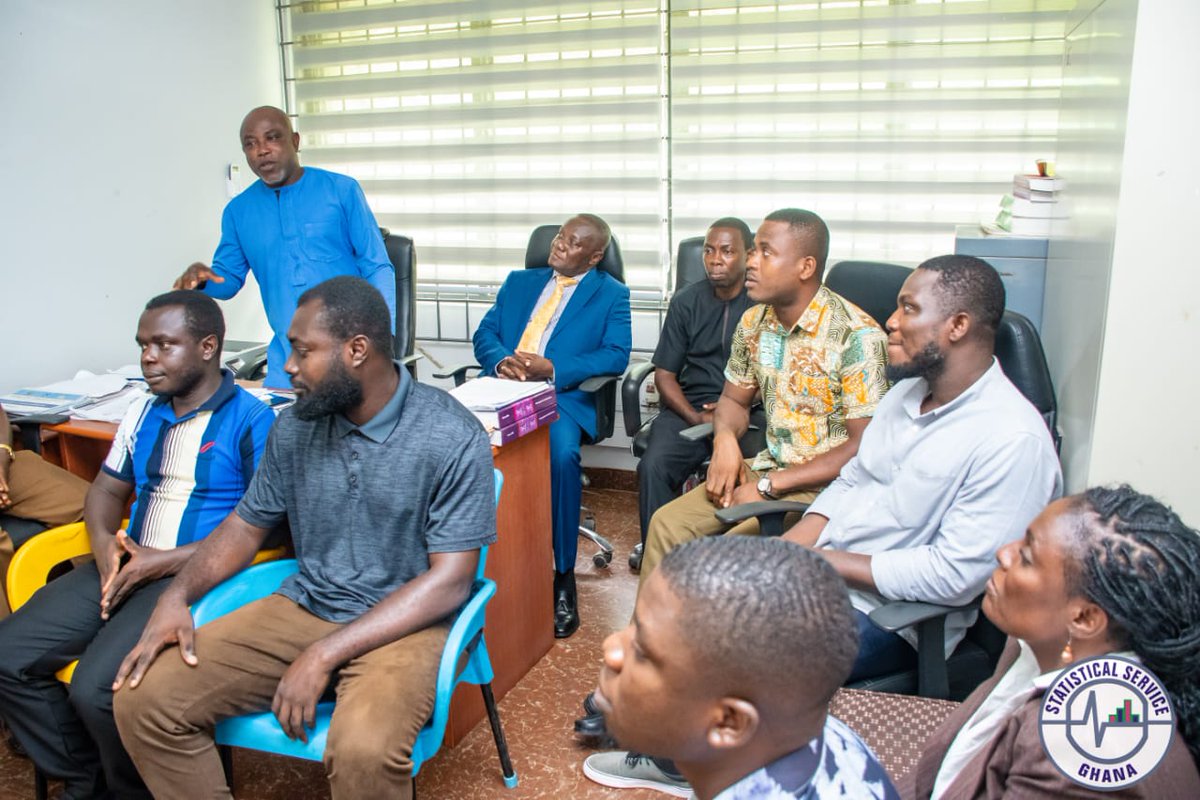
Today, I spent time with the Ghana Statistical Service team in the Eastern Region as part of my visit to all 16 GSS regional offices. Here’s what stood out: the people on the ground are doing serious work. They collect the numbers we all depend on including on prices, surveys, and real-life data from communities. Without them, national decisions would be guesswork. I want to thank the Eastern Regional Statistician, Bright Worlanyo Neku, his team, and our district statisticians working with local government. Your dedication is not hidden, it is the backbone of our statistics. I would also like to thank our market players and other stakeholders who provide the data we collect to inform decision-making for national development. We had honest conversations. Staff shared real challenges. They also brought forward practical ideas to improve how we work. That is exactly what we need. Let me be clear about one thing: Data quality is non-negotiable. If the data is wrong, the decisions will be wrong. And people will feel it. As we transform the Ghana Statistical Service into a World-Class institution, we will fix what needs fixing, from staff welfare to tools and technical support. Not someday. Step by step, with urgency. I have directed that the issues raised be treated as priorities. Regional offices must be strong, supported, and fully aligned with where we are going. This is a team effort. When our regions are strong, our data is strong. And when our data is strong, Ghana moves forward with confidence. We are building a service that works, for today and for the future. The visits to our other regional offices will follow shortly. #GSS #DataQuality #TransformationAgenda #StatisticsForDevelopment
Dr. Alhassan Iddrisu tweet mediaDr. Alhassan Iddrisu tweet mediaDr. Alhassan Iddrisu tweet media
English
2
2
8
343
Dr. Alhassan Iddrisu
Dr. Alhassan Iddrisu@daiddrisu·
Today, I had the privilege of sharing thoughts at the WAMI Management Board retreat on how WAMI can build a stronger, brighter economic future for all of us in West Africa Monetary Zone (WAMZ). Here’s the honest truth: WAMI is at a crossroads, and crossroads are powerful moments. They force you to choose, move forward with purpose, or drift into irrelevance. We discussed a clear shift: From talking about convergence to making convergence real and the role WAMI can play to support WAMZ member countries in this journey. This means WAMI needs to be our main engine, helping everyone go faster, stay steady, and connect better. To make this happen, I shared seven key ideas, like a new game plan: 1.Be the Best Coach: Re-anchoring WAMI as the Convergence Engine of the WAMZ including supporting member countries with practical, country-specific solutions; 2.Our Data Superpower: Building strong data systems that everyone can trust is a must. If the numbers are wrong, the decisions will be wrong. If the decisions are wrong, trust disappears. That’s why statistical systems must sit at the heart of this journey; 3.Early Warning Lookout: WAMI needs to be like a wise lookout, spotting any economic challenges or storms heading our way, so we can prepare and prevent problems before they get big; 4.Team Skill Building: Help all our countries learn and grow stronger in managing their economies. A team is only as strong as its weakest player, so let's help everyone shine; 5.Leading the Way with Smart Ideas: WAMI should be the go-to expert, researching new ideas and giving really helpful, independent advice to our leaders; 6.Planning for Tomorrow: Let's think beyond today and plan how WAMI will support keep our money system strong and stable for many, many years, even after our single currency arrives; and 7.Embracing Cool Tech: We need to use amazing new tools like Artificial Intelligence (AI) and digital money to make our financial systems super modern and efficient. This is a must-do to stay relevant and powerful! To succeed in this grand adventure, we need three key things: •Discipline: Sticking to our goals with steady effort; •Trusted Data: Numbers that are always honest and clear. •Team Willpower: Everyone, from leaders to citizens, committed to our shared dream. As I shared, sometimes it feels like we need to rush, but it's crucial to prioritize credibility over speed. Doing things right, with integrity and quality, will build a stronger, more stable countries in the zone.The next five years are critical. WAMI must seize this moment to redefine its role, sharpen its priorities, and commit to execution. Let’s work together to make this vision a reality, building a more integrated and prosperous WAMZ zone! #WAMI #WestAfrica #EconomicIntegration #FutureOfFinance #DataForDevelopment #TeamAfrica #CredibilityOverSpeed
Dr. Alhassan Iddrisu tweet mediaDr. Alhassan Iddrisu tweet mediaDr. Alhassan Iddrisu tweet mediaDr. Alhassan Iddrisu tweet media
English
1
1
4
89
Dr. Alhassan Iddrisu
Dr. Alhassan Iddrisu@daiddrisu·
In January 2026, economic activity expanded by 7.5 percent. The Monthly Indicator of Economic Growth (MIEG) data shows that growth is steady, driven mainly by services, while industry and agriculture show changing momentum. Here is what this means for key stakeholders #MIEG #GhanaEconomy #Jan2026 #GSS #EconomicGrowth #DataDriven
English
1
1
8
214
Dr. Alhassan Iddrisu
Dr. Alhassan Iddrisu@daiddrisu·
In January 2026, economic activity expanded by 7.5 percent. The Monthly Indicator of Economic Growth (MIEG) data shows that growth is steady, driven mainly by services, while industry and agriculture show changing momentum. Here is what this means for key stakeholders #MIEG #GhanaEconomy #Jan2026 #GSS #EconomicGrowth #DataDriven
English
1
1
9
85
Dr. Alhassan Iddrisu
Dr. Alhassan Iddrisu@daiddrisu·
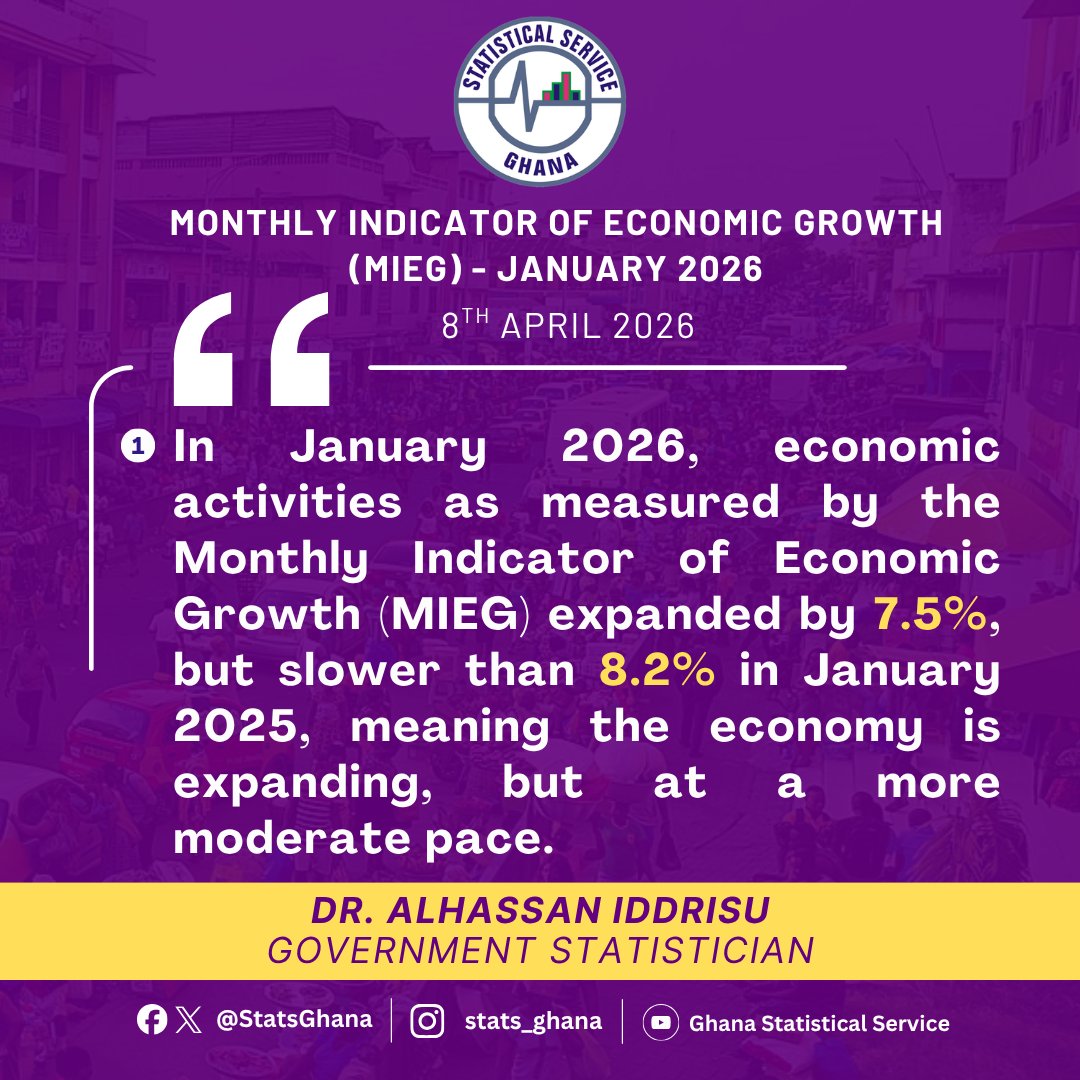
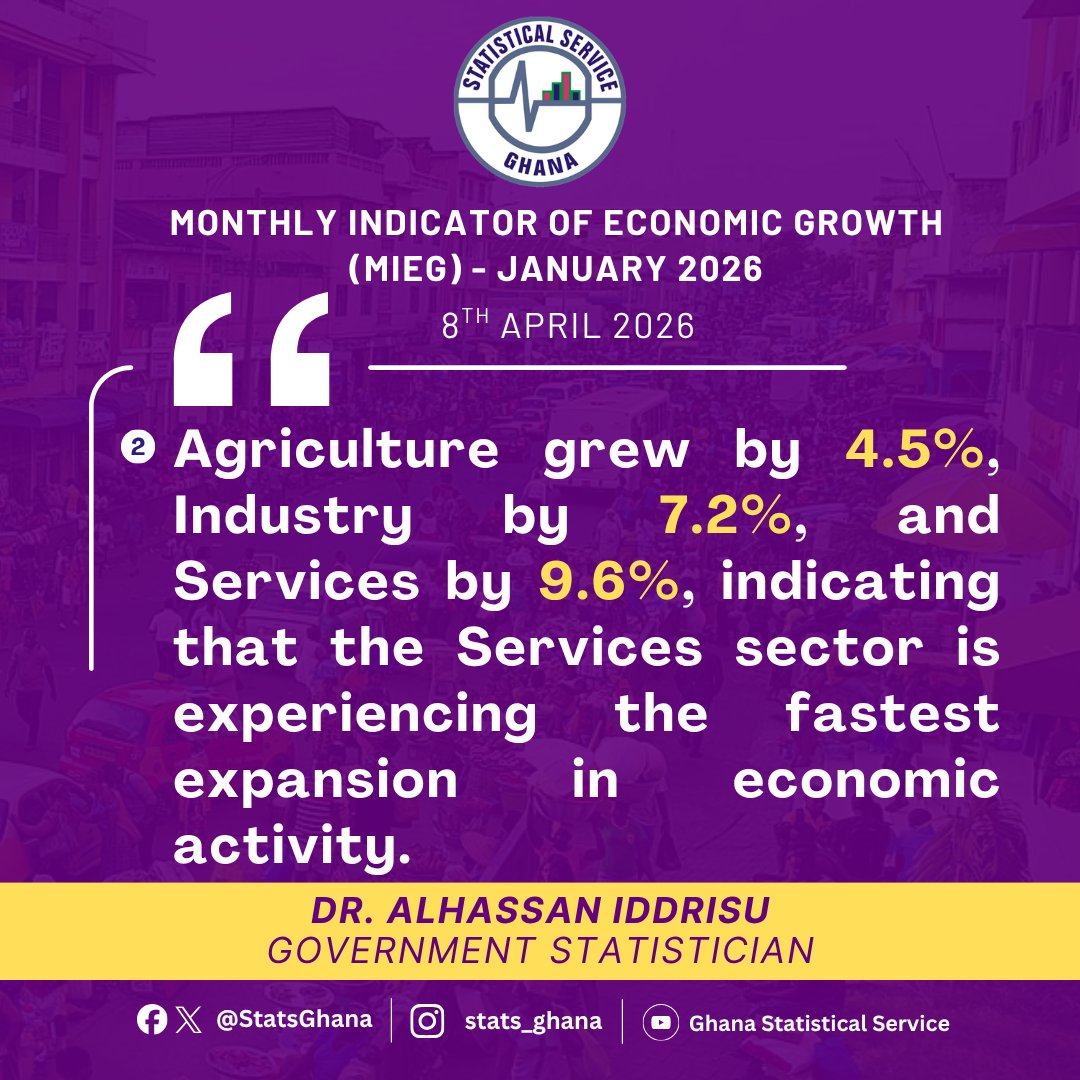
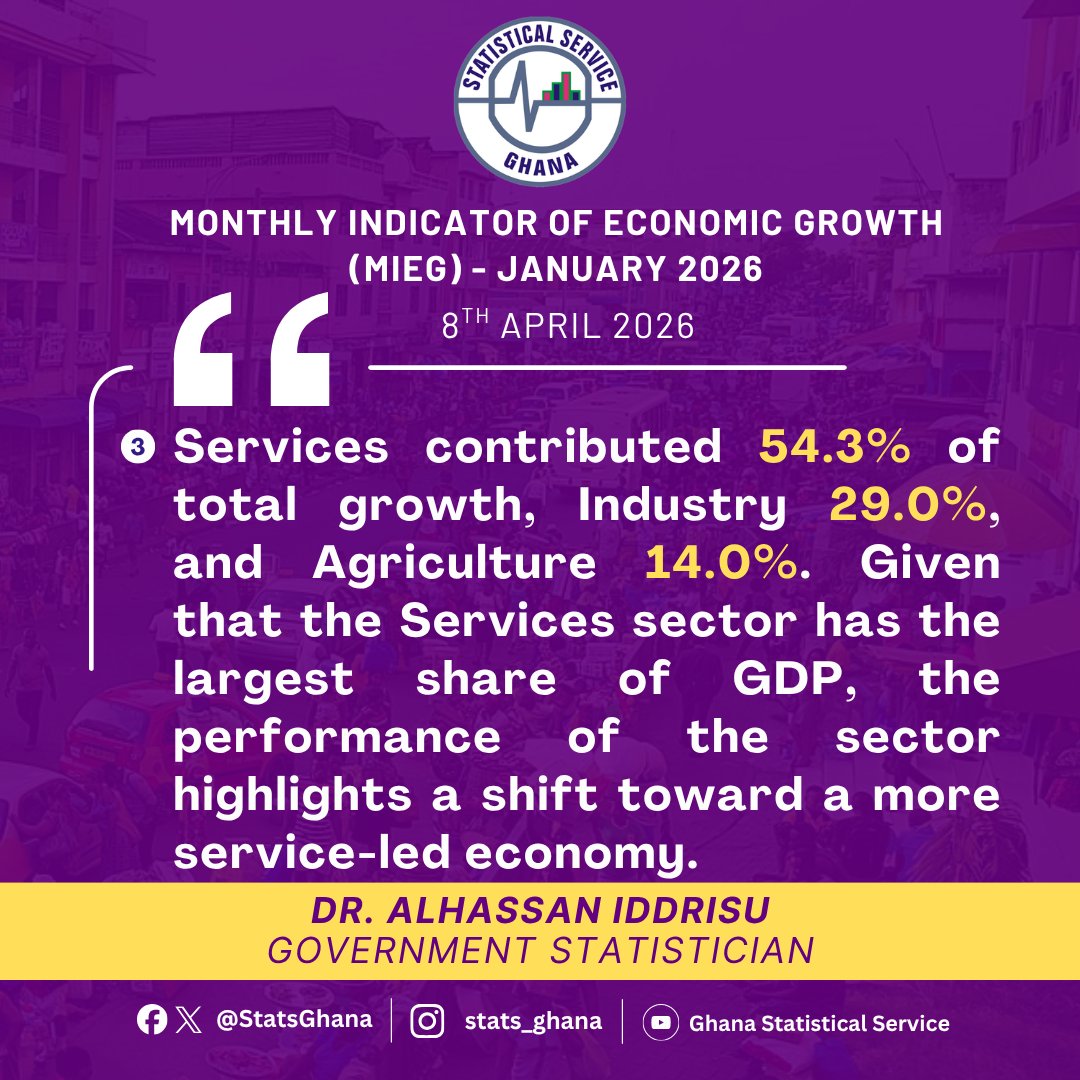
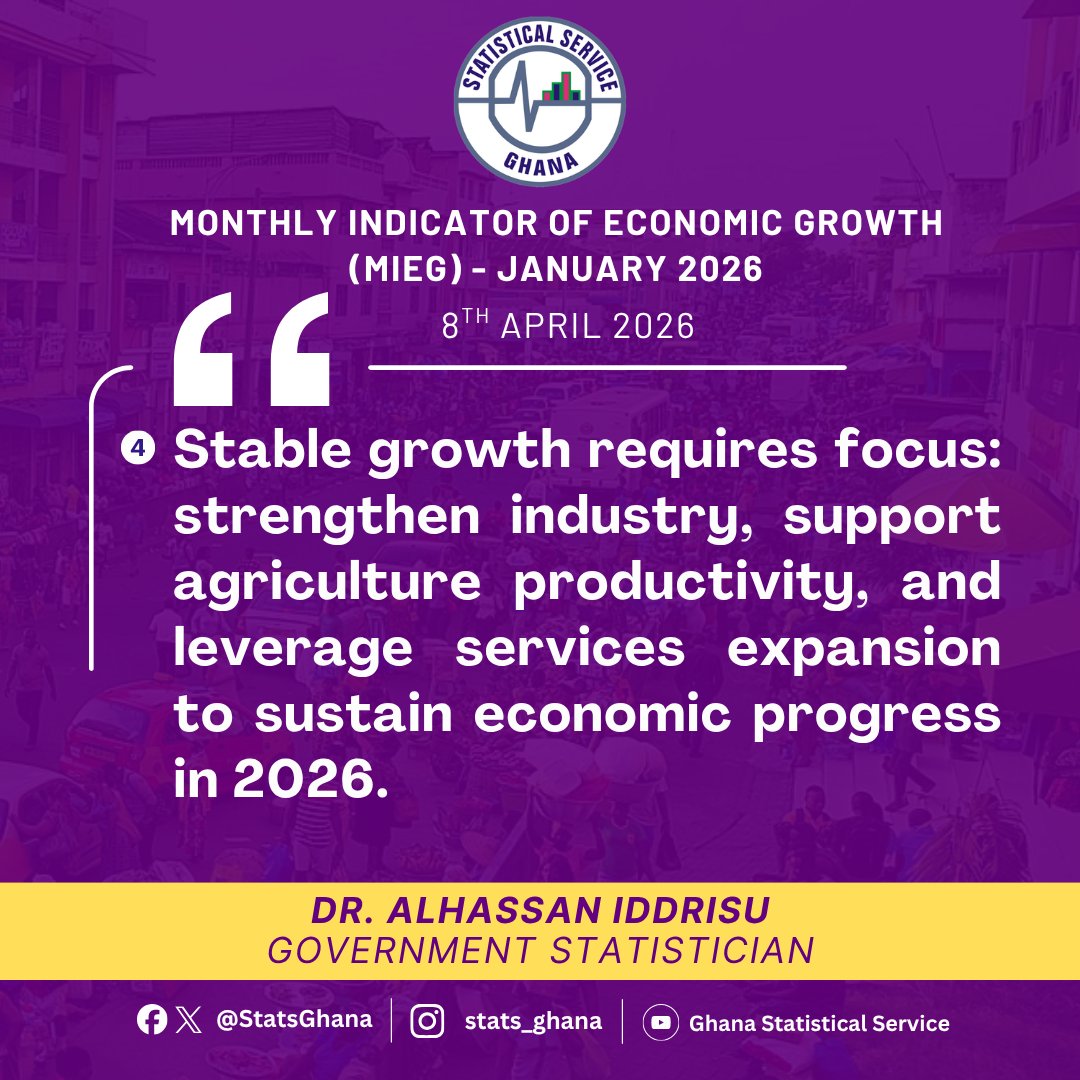
Ghana’s economy is growing, and the latest data shows where that growth is coming from. In January 2026, economic activity expanded by 7.5 percent. Growth is steady, driven mainly by services, while industry and agriculture show changing momentum. What this means is clear: the economy is moving forward, but this is the time to act with focus and purpose. The quote cards that follow break this down into simple, clear insights for everyone, from households to policymakers and investors. We thank all our data partners and the dedicated staff of the Ghana Statistical Service for making this possible. Reliable data is a shared effort, and it is what helps us make better decisions for Ghana. #MIEG #GhanaEconomy #Jan2026 #GSS #EconomicGrowth DataDriven
Dr. Alhassan Iddrisu tweet mediaDr. Alhassan Iddrisu tweet mediaDr. Alhassan Iddrisu tweet mediaDr. Alhassan Iddrisu tweet media
English
0
1
4
55
Dr. Alhassan Iddrisu
Dr. Alhassan Iddrisu@daiddrisu·
Resetting How We Measure Our Economy I joined fellow Statistician-Generals, Central Bank leaders, and global partners to discuss the roll out of the System of National Accounts 2025 (SNA 2025) and Balance of Payments Manual 7 (BPM7) - the new standards that will redefine economic measurement. Here's the truth: The economy has changed. Our statistics must catch up. If we measure wrong, we govern wrong. Key takeaways: GDP measurement using 2008 SNA is no longer enough: We must capture the digital economy, informal sector, mobile money, debt risks, and natural resources. This is not a one-off reform. It's a system transformation. The old lens is too narrow. Hard lessons from the past: SNA 2008 and BPM6 showed us what fails: i) Weak coordination ii) Outdated systems iii) Underinvestment iv) "Tick-box" implementation What will determine success: i) A clear roadmap (no roadmap, no results) ii) Serious stakeholder engagement (miss this and everything fails) iii) Investment in people, systems, and data iv) Clear communication to build trust v) Realistic timelines and prioritisation What's changing: We move from measuring output to measuring real value and sustainability: i) Data as an asset ii) Digital economy and global flows iii) Inequality and who benefits from growth iv) Natural resource depletion What this means for Ghana We must act decisively: i) Build a strong national roadmap ii) Fix coordination across institutions iii) Capture the informal and digital economy iv) Invest in modern data systems and skills v) Engage all stakeholders, from government to private sector Global partners are ready to support, but countries must lead. The bottom line is that: Better data → Better decisions → Better lives. Statistics are not just numbers. They are the foundation of economic transformation. Let's get this right. Let's measure Ghana right. #GhanaStats #SNA2025 #BPM7 #DataForDevelopment
Dr. Alhassan Iddrisu tweet media
English
1
1
9
112
Dr. Alhassan Iddrisu
Dr. Alhassan Iddrisu@daiddrisu·
Inflation eased to 3.2% in March 2026, down from 3.3% in February 2026 and 22.4% a year earlier, marking the fifteenth consecutive month of decline. This video highlights what is driving these numbers and what they mean for households, businesses, and policymakers. #GhanaInflation #CPI #GSS #Mar2026CPI
English
0
2
5
99
Dr. Alhassan Iddrisu
Dr. Alhassan Iddrisu@daiddrisu·
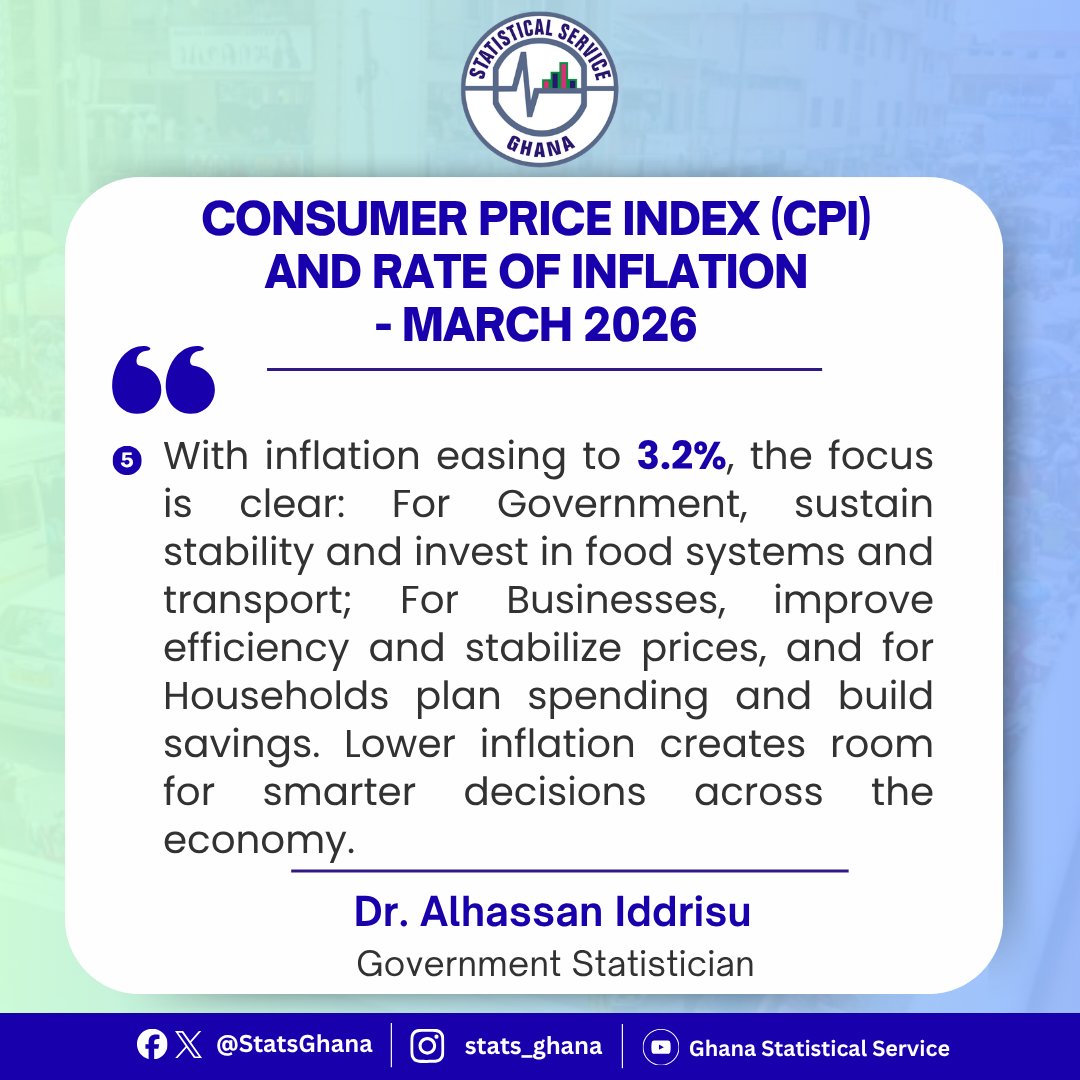
Inflation in Ghana continues to ease, with the year-on-year rate declining to 3.2% in March 2026, down from 22.4% a year ago. Monthly price increases are at 0.1%, showing that price pressures are not only lower, but slowing in real time. What the data clearly shows is that inflation today is not broad-based. It is being driven by a few key areas, namely, housing and utilities, food, and education, while prices in other sectors are stabilizing or even declining. This means that while overall conditions are improving, the cost pressures households feel are concentrated in essential areas of daily life. The quote cards shared here break down these trends into clear, simple insights to support informed decisions by households, businesses, and policymakers. On behalf of the Ghana Statistical Service, I would like to express our sincere appreciation to market traders and data providers, the media, and our dedicated staff, whose commitment and professionalism make this work possible. We remain committed to delivering timely, accurate, and credible statistics to support evidence-based decision-making and national development. #GhanaInflation #CPI #EconomicData #GSS #Mar2026CPI #DataForDevelopment
Dr. Alhassan Iddrisu tweet mediaDr. Alhassan Iddrisu tweet mediaDr. Alhassan Iddrisu tweet media
English
0
2
8
91
Dr. Alhassan Iddrisu
Dr. Alhassan Iddrisu@daiddrisu·
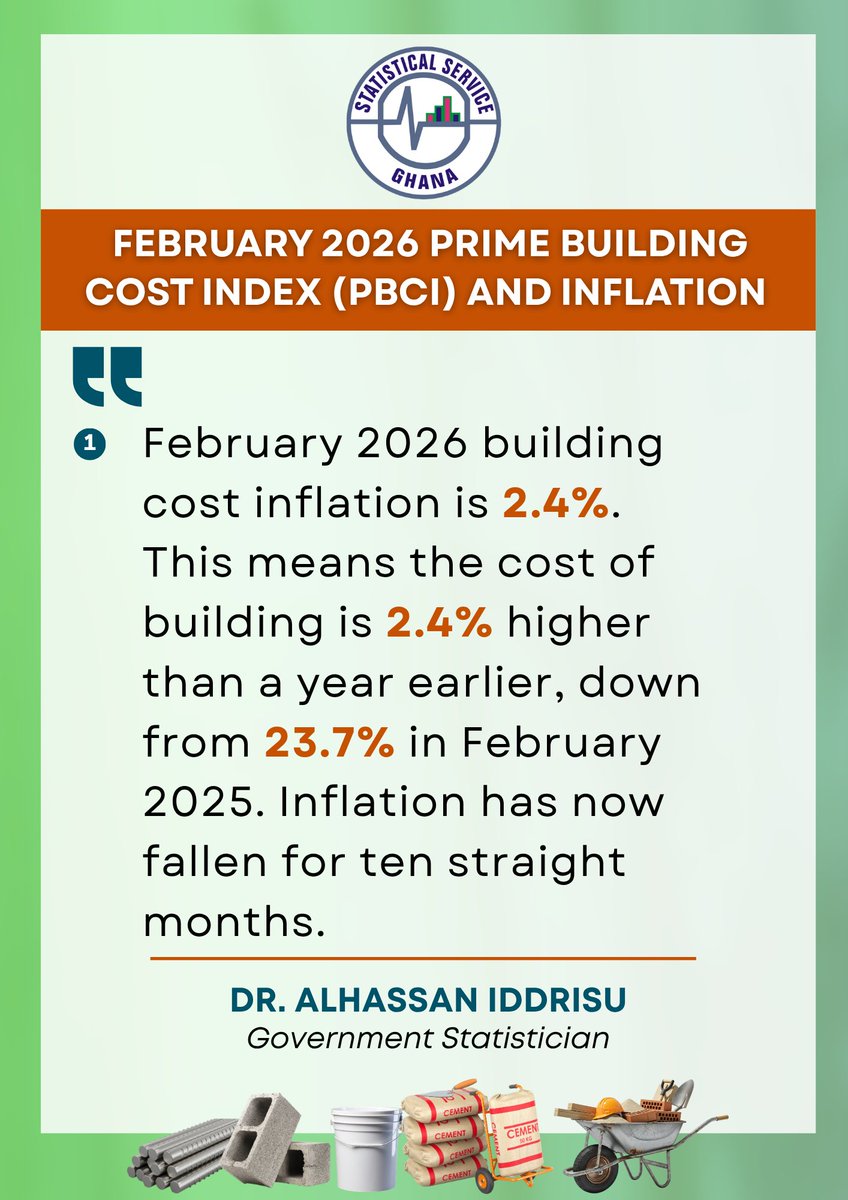
Building cost pressures continue to ease. In February 2026, building inflation slowed further to 2.4% year-on-year, marking the 10th consecutive decline, while prices rose by 0.4% between January and February. Key insights from the February 2026 Prime Building Cost Index (PBCI) release are summarised in this video. #PBCI #BuildingInflation #ConstructionCosts #GSS #GhanaStatistics
English
0
1
4
88
Dr. Alhassan Iddrisu
Dr. Alhassan Iddrisu@daiddrisu·
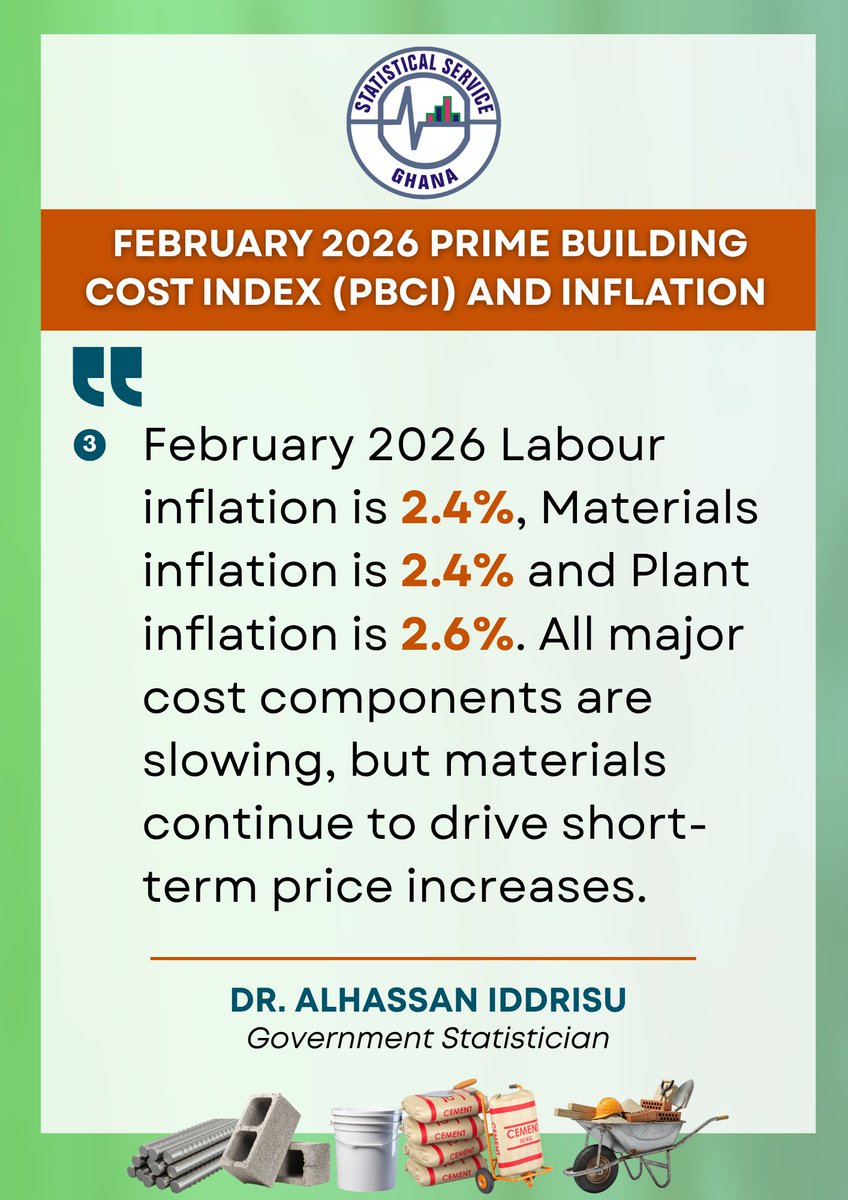
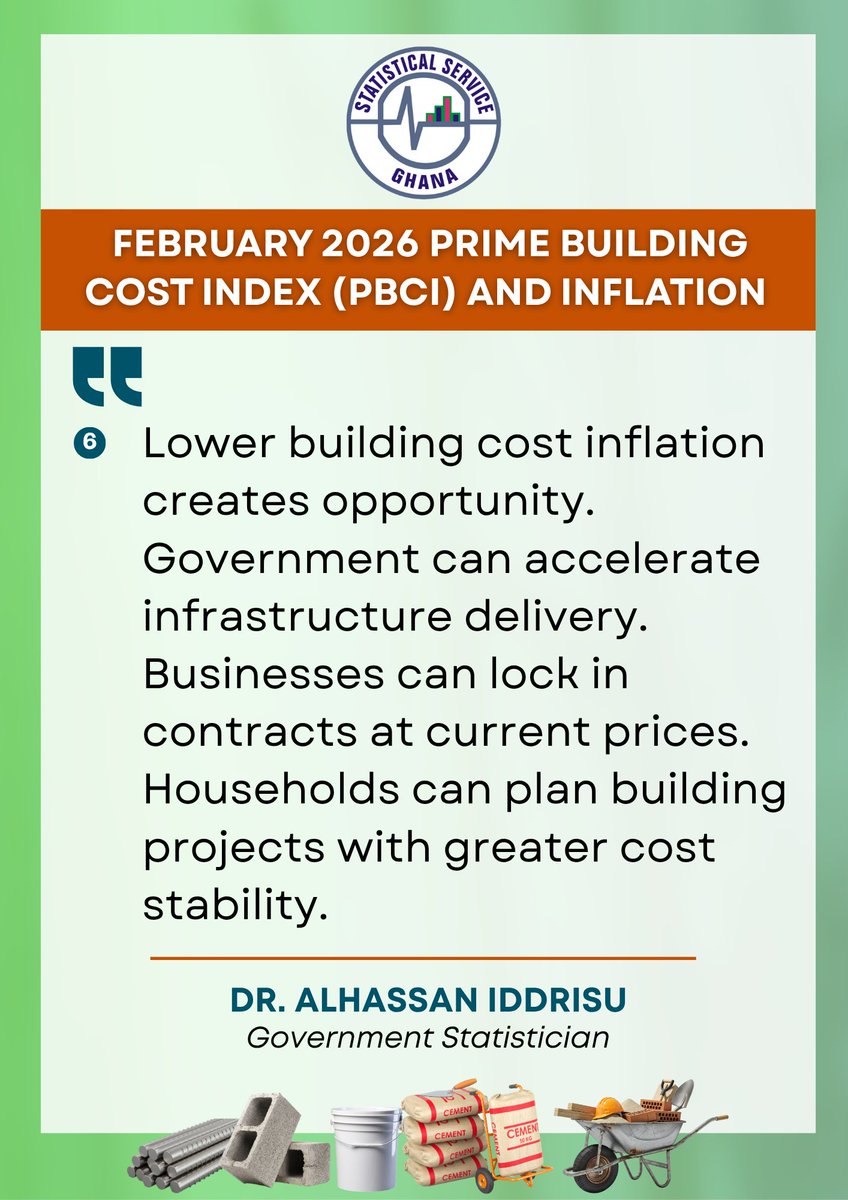
Ghana’s building cost pressures continue to ease, and the latest data tells a clear story. In February 2026, inflation in the building industry slowed further to 2.4% year-on-year, marking the 10th consecutive decline. At the same time, prices rose by 0.4% between January and February 2026. What this means is simple: costs are still increasing, but at a much slower and more stable pace than we saw a year ago. Across the key drivers, labour, materials, and plant all show easing trends, although some items continue to rise while others fall. This mixed movement is important. It tells us that decisions today must be informed, targeted, and timely. These quote cards provide some more insights on February 2026 building inflation. At the Ghana Statistical Service, we remain focused on turning data into clear, usable insights for everyone. We extend our sincere appreciation to market players, data providers, industry stakeholders, and all who engage with and use these statistics. We also recognize the dedication and professionalism of our hardworking staff, whose efforts make this work possible every month. Reliable data builds strong decisions. And strong decisions build a stronger Ghana. #PBCI #BuildingInflation #ConstructionCosts #DataForDevelopment #GSS #EvidenceBasedPolicy #GhanaStatistics
Dr. Alhassan Iddrisu tweet mediaDr. Alhassan Iddrisu tweet mediaDr. Alhassan Iddrisu tweet mediaDr. Alhassan Iddrisu tweet media
English
0
1
5
83
Dr. Alhassan Iddrisu
Dr. Alhassan Iddrisu@daiddrisu·
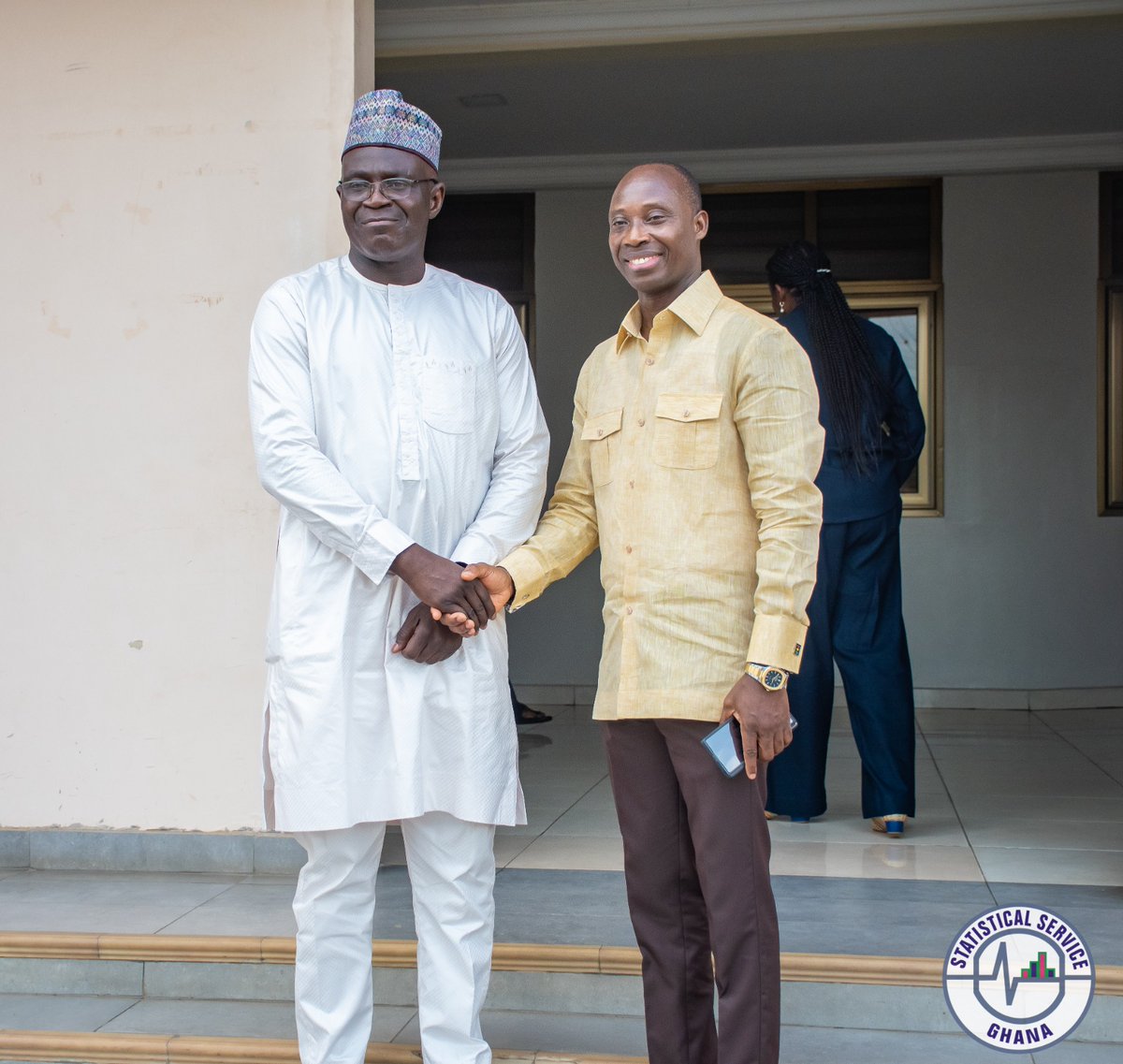
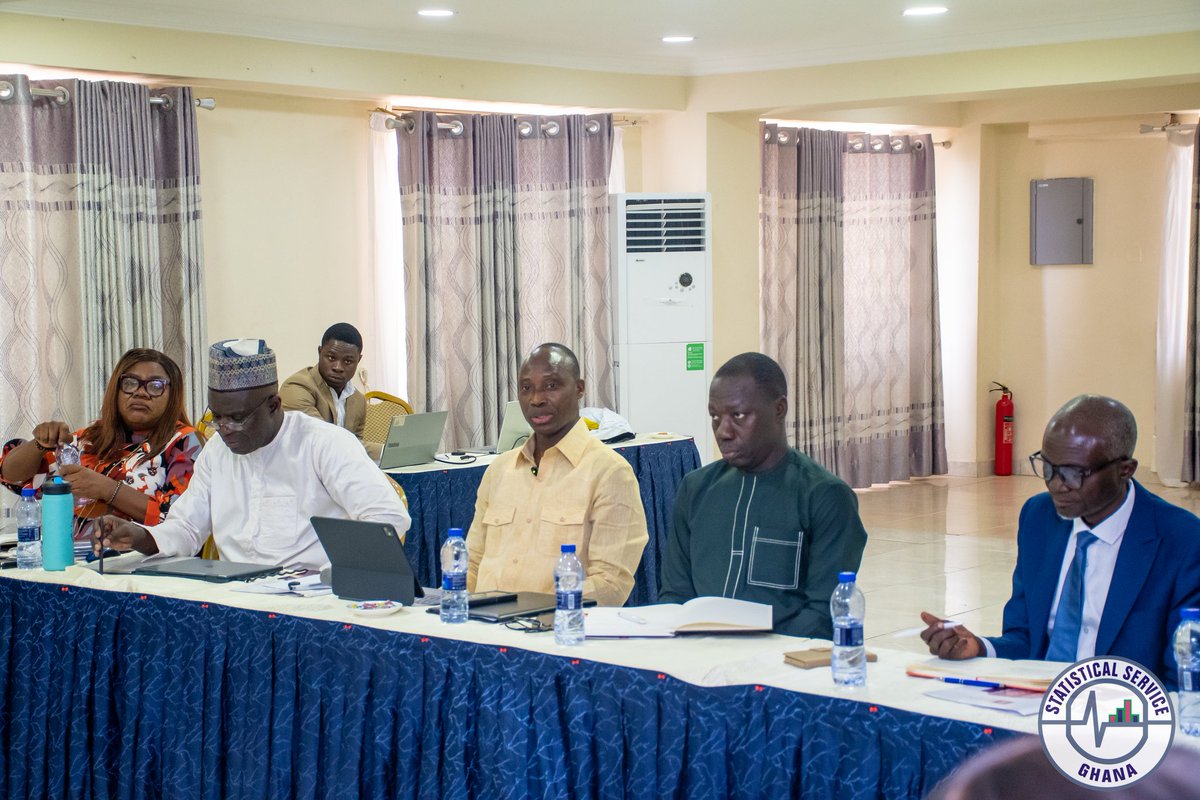
Today, the Ghana Statistical Service (GSS) received a delegation from the Management Development and Productivity Institute (MDPI), led by Prof. Elijah Yendaw, Director General of MDPI, to discuss their proposed National Productivity Metrics Framework for Ghana. Also present was the Deputy Government Statistician, Mr. Omar Seidu, and other staff from GSS. The framework seeks to develop a nationally adopted system for measuring productivity across sectors, covering labour productivity, capital productivity, and multifactor productivity. The goal is to provide government, the private sector, labour unions, and development partners with reliable, evidence-based tools to track productivity trends, guide wage negotiations, support investment decisions, and strengthen public sector performance management. GSS has been identified as a key national partner, contributing national accounts data, survey data, labour input estimates, and price indices to support the framework's implementation. The GSS commended MDPI for advancing this important work and offered key recommendations, including grounding the framework within the National Statistical Development Strategy (NSDS) III context, strengthening the governance structure, and conducting a data mapping and quality assessment as early priority steps. Productivity measurement is not just a statistical exercise. It is a governance and development tool that, when done well, strengthens the link between evidence and policy across every sector of the economy. GSS looks forward to working with MDPI to formalise this collaboration and contribute our institutional expertise to help Ghana develop a robust, credible, and internationally comparable productivity measurement system. #GSSGhana #ProductivityFramework #MDPI #DataForDevelopment #EvidenceBasedPolicy #NationalStatistics #NSDS3
Dr. Alhassan Iddrisu tweet mediaDr. Alhassan Iddrisu tweet mediaDr. Alhassan Iddrisu tweet mediaDr. Alhassan Iddrisu tweet media
English
0
2
12
208
Dr. Alhassan Iddrisu
Dr. Alhassan Iddrisu@daiddrisu·
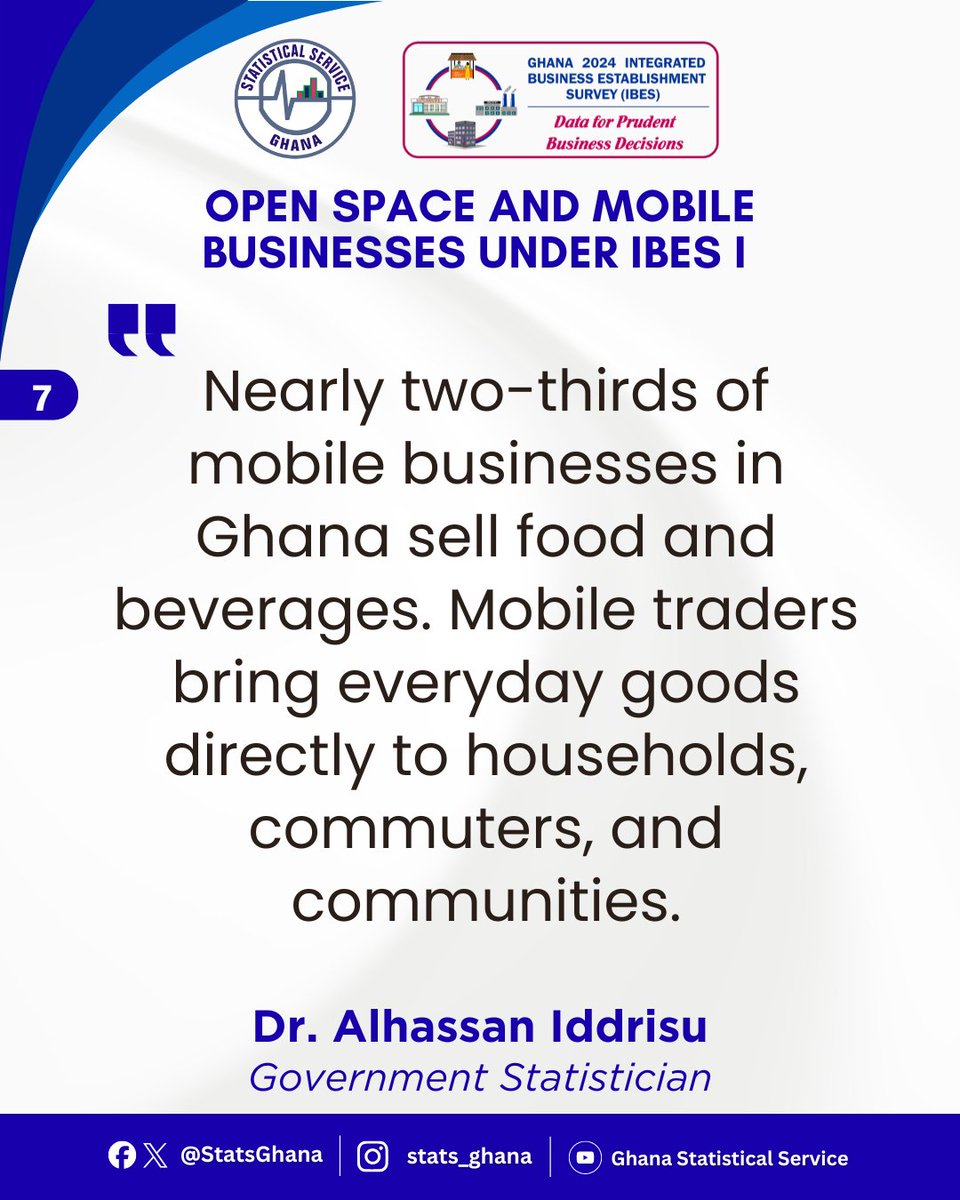
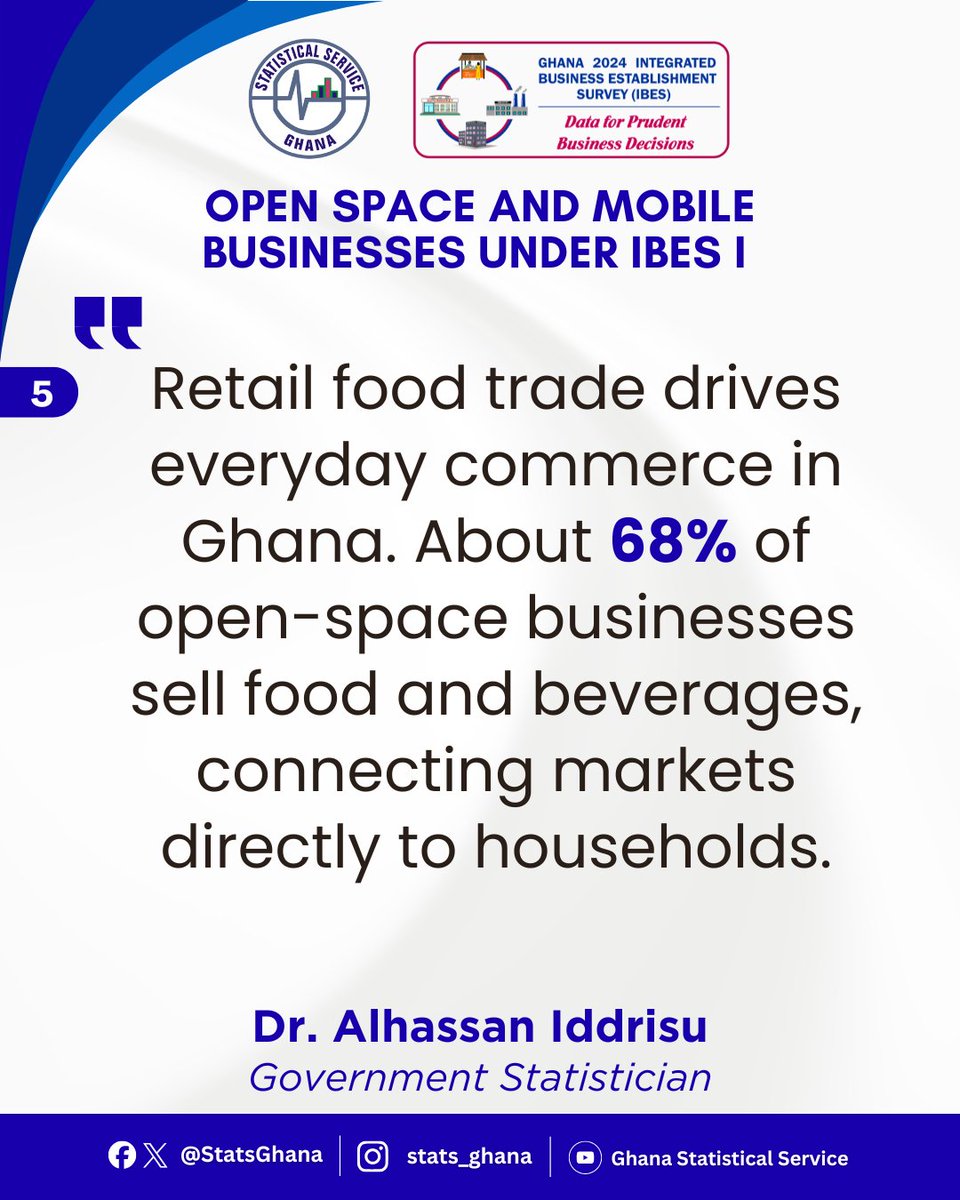
Today, I share key insights from the Integrated Business Establishment Survey I (IBES I) Reports on Open Space and Mobile businesses in Ghana, released by the Ghana Statistical Service (GSS). For the first time, GSS now has national data on businesses that operate beyond traditional structures, those in open spaces and those that move through our streets and communities. Together, they reveal a more complete picture of enterprises in Ghana's economy. The evidence is clear. Ghana has 2.64 million businesses, including 693,748 operating in open spaces and 82,920 mobile businesses. These enterprises employ hundreds of thousands of people, are driven largely by women and young people, and play a central role in delivering food, goods, and services directly to households. These quote cards highlight some of the key numbers and what they mean. They show that what we often call the "informal sector" is, in reality, a major engine of livelihoods, local commerce, and economic inclusion. I would like to express sincere appreciation to the business operators across the country who provided information, to our dedicated field officers, and to the hardworking staff of the Ghana Statistical Service whose commitment made this work possible. GSS also thanks the Government of Ghana, the World Bank, and our partners across Ministries, Departments, Agencies, and the broader statistical community for their support. With better data, GSS builds better policies and a more inclusive and resilient Ghana. #IBESI #BusinessStatistics #GhanaEconomy #InformalSector #OpenSpaceBusinesses #MobileBusinesses #DataForDevelopment #EvidenceBasedPolicy #GhanaStatistics #GSS
English
0
4
10
138
Dr. Alhassan Iddrisu
Dr. Alhassan Iddrisu@daiddrisu·
Today, I share key insights from the Integrated Business Establishment Survey I (IBES I) Reports on Open Space and Mobile businesses in Ghana, released by the Ghana Statistical Service (GSS). For the first time, GSS now has national data on businesses that operate beyond traditional structures, those in open spaces and those that move through our streets and communities. Together, they reveal a more complete picture of enterprises in Ghana's economy. The evidence is clear. Ghana has 2.64 million businesses, including 693,748 operating in open spaces and 82,920 mobile businesses. These enterprises employ hundreds of thousands of people, are driven largely by women and young people, and play a central role in delivering food, goods, and services directly to households. These quote cards highlight some of the key numbers and what they mean. They show that what we often call the "informal sector" is, in reality, a major engine of livelihoods, local commerce, and economic inclusion. I would like to express sincere appreciation to the business operators across the country who provided information, to our dedicated field officers, and to the hardworking staff of the Ghana Statistical Service whose commitment made this work possible. GSS also thanks the Government of Ghana, the World Bank, and our partners across Ministries, Departments, Agencies, and the broader statistical community for their support. With better data, GSS builds better policies and a more inclusive and resilient Ghana. #IBESI #BusinessStatistics #GhanaEconomy #InformalSector #OpenSpaceBusinesses #MobileBusinesses #DataForDevelopment #EvidenceBasedPolicy #GhanaStatistics #GSS
Dr. Alhassan Iddrisu tweet mediaDr. Alhassan Iddrisu tweet mediaDr. Alhassan Iddrisu tweet mediaDr. Alhassan Iddrisu tweet media
English
1
5
14
369