Dappify
6.1K posts

Dappify
@dappify_
Tracking crypto waves | Alpha drops, meme magic & market moves daily Here for the flips, the dips, and the degen scripts
参加日 Haziran 2025
255 フォロー中149 フォロワー

PCE drop or not, the real alpha rn is picking projects with actual purpose, that’s why $VEIL stands out. It’s one of the few privacy-first networks built with real utility and a capped, clean token structure.
When macro cools off, liquidity chases narratives with function, not hype, $VEIL fits that perfectly.
English

@SatoshiFlipper $VEIL thrives when markets ignite SUI’s surge just shows how fast demand for private, MEV-proof execution is growing.
With hidden orderflow, fast settlement, private perps, and slippage-resistant architecture, $VEIL gives traders the cleanest edge in high-volatility runs..

English


@AshCrypto $VEIL’s private execution layer is built for periods when big institutions quietly re-enter the market, ensuring their flows stay protected
As trillions from TradFi move into crypto, VEIL’s stealth orderflow and
Its MEV-resistant design keeps trades clean and protected..

English

In the last 72 hours:
$11T Vanguard opened access to crypto ETFs
$1.8T Bank of America recommended 4% portfolio allocation to crypto
$12T Charles Schwab announced its plan to offer BTC and ETH trading in early 2026
And all this happened after BTC and alts went through a brutal crash.
Maybe, it's all a coincidence.
English

@AshCrypto Big money keeps moving quietly , just like this buy.
$VEIL has private execution, hidden intent, and MEV-proof architecture give traders the same stealth advantage institutions rely on.

English

Wild how ppl still bearish when giants like Vanguard are eyeing multi-alt ETFs, bro. $VEIL diff tho, built around pure privacy infra, fixed supply + zk-layer that actually solves real user demand.
Not another hype coin, it’s a stealth utility stack designed for wallets, payments, and on-chain obfuscation.
English

@CryptoMichNL $VEIL’s MEV-proof DEX and hidden-orderflow navigate market swings with precision, thriving even through 35% corrections.
Its private execution, low slippage, and fair fills make it a resilient infrastructure play in any Bitcoin cycle.

English

Every #Bitcoin Cycle Rhymes, but not by exact dates
The #Bitcoin Cycle is one of the core layers of investment dynamics within the Web3 ecosystem. Quite often, it's the 4-year cycle that bases the thesis of anyone's investments in Bitcoin.
It's interesting to note that there has never been such a significant discrepancy between the two groups of bulls & bears. The bears are 'right' on their thesis of the 4-year cycle, until there's a new low being printed, the bulls are 'wrong' on their thesis, but are they? The markets have just witnessed an occassional 35% correction.
To quote Raoul Pal: 'We'll likely see a 35% correction on the markets, and people would assume it's over, but then, it's not.'
I would argue the same concept applies to the current status of the markets.
Neither the case about the death of the 4-year cycle is correct, nor the case that the 4-year cycle is alive. Both of them have some relevance in there, which requires some nuance.
The halving cycle, which is a technical and critical component of Bitcoin as an asset, still consists of the 4-year cycle.
However, the relationship between price appreciation or depreciation with the 4-year cycle is diminishing as there are multiple other factors more relevant than a simple supply/demand equation.
The current status of the cycle
The title of this article provides a clear thesis: the $BTC cycle does exist, but it doesn't rhyme with time-based assumptions anymore; other factors are more relevant.
This implies that there's still a cycle active, but not the 4-year halving cycle as the prime indicator.
This cycle has proven to be different than the previous cycles, and multiple relevant arguments are provided with insights to confirm the change of tides.
Why?
The ETF has changed the entire dynamics of the price of Bitcoin. There's been an influx of nearly 60.000 $BTC in liquidity through the ETF. The parties that were enabling clients to buy the ETF to get Bitcoin exposure were required to buy the Bitcoin as underlying collateral for their Bitcoin ETF.
Essentially, this buy pressure has resulted in Bitcoin accelerating from $30,000-40,000 all the way towards $80,000-120,000. The price of Bitcoin, through the demand of institutional buyers, has found a new floor more than 100% higher than the previous floor.
However, in terms of the structure of the markets, nothing has changed, right? The doors were opened for a new group of buyers, but the dynamics of the markets themselves didn't really change.
There was still a ton of headwind macroeconomic-wise, there's still QT, there's still high interest rates, and all other factors to take into account, which means that the current cycle is somewhere on the scale of the previous cycle, but where?
That's an interesting one, and that could be analyzed from various corners.
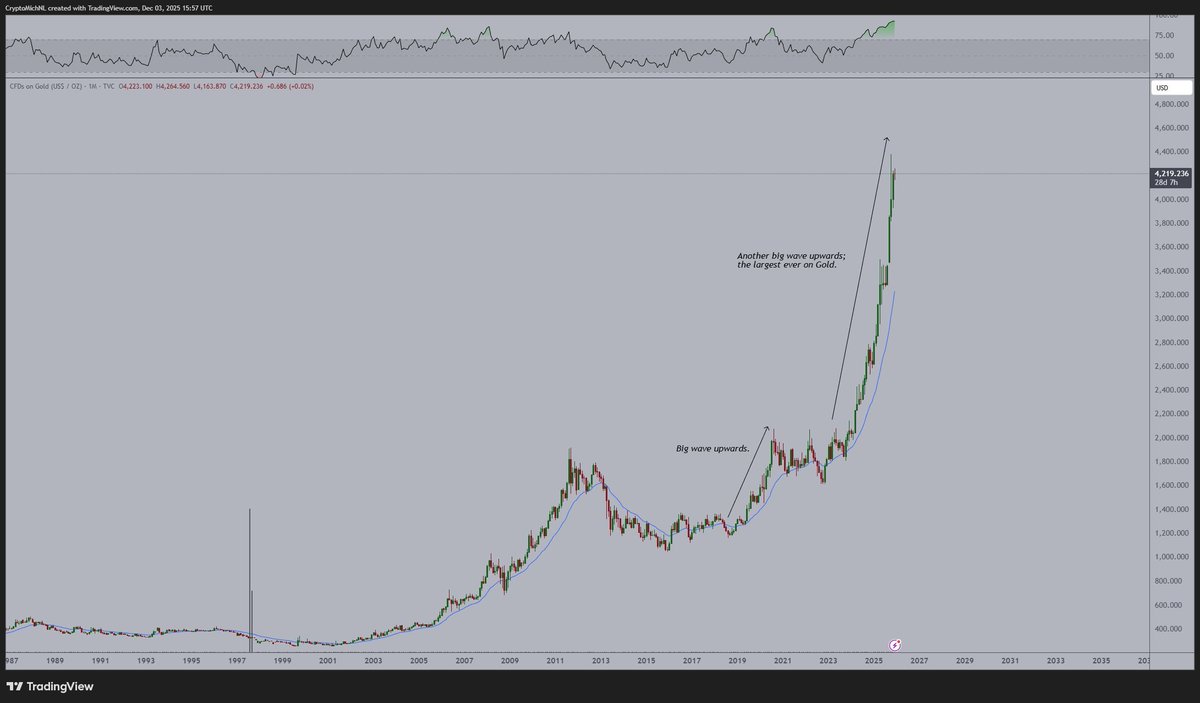
The prime chart to monitor for this is the strength of Gold. It's very clear to say that Bitcoin is a high Beta risk-on asset that thrives during periods of economic growth, great PMI, and all those things. It doesn't do well during periods of social and economic unrest, or in periods when Gold accelerates.
Even though we think that it might be the case that the two are correlated, they are not. I'm still under the assumption that the ETF has floored the price of Bitcoin towards a new high; otherwise, we'd be cheering around that Bitcoin has broken $40,000 at this point in time, rather than that we've been angry about this recent correction to $80,000. Yes, $80,000. Absolutely lunatics, it was $16,000 nearly 3 years ago.
Now, during previous cycles, when Gold accelerates, risk-on assets wouldn't do well, and that comparison can be made with this cycle again, which has everything to do with the macroeconomic environment.
The 4-year liquidity cycle only existed after 2008, which correlated with the peaks of Bitcoin in 2013, 2017, and 2021. Now, before 2008, liquidity cycles were significantly longer, averaging between 8-10 years.
In that case, it might actually be that the current cycle is in the middle of the entire bull cycle that it will go into, and perhaps, as Bitcoin becomes a mature asset, the thesis unfolds into lower volatility over time and therefore lower returns on a yearly basis as the asset class has significantly become larger.
Bummer, no clear 5x for Bitcoin every 4 years that I can predict on.
To be honest, the core thesis of Bitcoin isn't to become such an asset. The core thesis of Bitcoin is to become an asset that's safe, sound, and transparent, in such a way that 1 Bitcoin = 1 Bitcoin, and we are all becoming more relaxed with planning our financial futures.
Isn't that the whole point of nowadays economics? Inflation is going up massively, and people are seeking more and more risk as they need to beat the hurdle rate out of fear that they will become poor over time, as people have a clear understanding that the value of money is diminishing over time.
Another big argument is found in the data, which isn't correlated to the Bitcoin cycle, but perhaps it actually is. It's the correlation between CNY/USD and ETH/BTC.
Why is this relevant? The strength of the Chinese Yuan is the core indicator of strength for businesses in the US and, therefore, the economy worldwide. A stronger Chinese Yuan (and therefore a weaker Dollar) improves the balance sheets of both countries, increases margins, and therefore provides more economic growth, which then leads to more risk-on investment type of behavior.
Now, historically, when the CNY/USD bottoms out, that's signalling the bottom on ETH/BTC too.
If we compare the data points, this has been valid in previous cycles (bear in mind: N=3).
In 2016, the markets found a bottom for the Chinese Yuan, similarly for ETH vs. BTC, the same in 2019, and the same is applicable to the recent period of time, which was during April of 2025.
Basically, the chart shows that these two are still heavily correlated with each other, and therefore, we might be assuming that, if we compare the two cycles with each other, the Bitcoin cycle might be extended, and we might be at a similar stage to the previous cycles: the middle of 2016 or the middle of 2019.
The business cycle vs. Bitcoin
The business cycle thesis is the most dense argumentation of why the markets haven't been going up as we all wanted them to be. That has caused a case of reality vs. expectations for any investor in the markets, and it stress-tested any founder to have enough funding to succeed in this type of market.
It's required, as when markets mature, simple tricks to be launching tokens simply don't work anymore. It's a long-term game.
Therefore, the business cycle could be based on the valuations of Copper vs. Gold, or a combination of PMI data and economic growth. You can choose.
All I'm saying, based on the previous chart on the Chinese Yuan vs. Dollar, the bottoming on ETH/BTC and CNY/USD signals that we might be at the worst part of the cycle, which were those two periods.
If the business cycle is combined with this, we might conclude the exact same, which is that we're in the middle of peak bear, with Bitcoin at $90,000. Weird, isn't it?
The business cycle is currently still at its lowest point, slowly grinding up as PMI data is getting better and the FED is doing overnight repos to stimulate the economy.
Now, if we combine the business cycle strength/weakness with Bitcoin cycles, then again, the correlation is quite clear. This stage is comparable to Q1/2 2016, Q4 2019.
We're nowhere near a top on Bitcoin, and we're still in the final easy cycle of crypto with exorbitant returns.
Forward-looking for Bitcoin
If we look forward to 2026, 2027, it's quite hard to become bearish. Yes, if the 4-year cycle time-based assumption is right, we should be getting into a strong bear market.
However, if we look at some recent and upcoming news items, those are the complete opposite of how I've been living through 2018 and 2022.
- Bank of America opens up for investors to allocate 1-4% of their wealth into the spot Bitcoin ETF.
- Approval of the Clarity Act, opening up for founders within the DeFi space to build solutions for institutions to get on-chain.
- The FED has started overnight repos and needs to lower interest rates to stimulate the internal economy, which then means more liquidity, and QE is literally about to happen.
This latter one is a copy/paste of the periods that we've seen after 2016 and in 2019/2020.
The period of 2015/2016 was the last recession the US had, which then resulted in a large influx of money, and that resulted in the big bull run that we've seen on Bitcoin.
The period of 2020 was clearly the biggest money printing machine ever, as COVID-19 happened.
Now, I'm not saying that we're for sure going to be seeing big new ATHs for Bitcoin, all I'm saying is that everyone shouldn't entirely pinpoint that the 4-year cycle is going to lead going forward.
Everything is slightly nuanced, and one thing is for sure.
Bitcoin is the most sound and safe money that has ever existed. Eventually, everyone will jump on board, and we're still before the big mass will come in.


English

Halving hype is cool, but the real sleeper play rn is $VEIL, built for pure on-chain privacy with its own zk-focused architecture.
Tight supply + real transactional utility gives it actual demand, not just narrative pumps. When the market chases fundamentals again, projects like $VEIL stand out fast.
English

@GordonGekko Delegation hits different with $VEIL , its tech offloads leakage and MEV risk through private execution.
Hidden intent orderflow + MEV proof matching means traders focus on strategy, while the protocol handles the grind.

English

SEC easing up is a giga W, bro. Real builders finally get breathing room. That’s exactly where $VEIL shines with its tight supply + pure privacy fundamentals.
Low float, real utility, zero noise, it’s built for the meta that’s coming. If regs open the door, stealth killers like $VEIL are the first to rip.
English

Bro fr, in a sea of 11M random tokens, the plays with actual demand hit diff. $VEIL stands out ’cause privacy utility is real, scarce, and getting hyper-valuable each hr.
When the market stops rewarding noise, the quiet killers start running first.
Stacking $VEIL now feels like choosing survival over hype.
English

Everyone keeps waiting for a classic altseason like 2017 or 2021.
But the entire market structure has changed.
2017 had a few hundred coins competing for capital.
2021 had a few thousand.
2025 has more than 11 million tokens, memecoins, and worthless experiments.
The days where everything pumped just because “alts go up in bull markets” are gone.
This is the hardest cycle in crypto history.
You need a portfolio of real projects with real demand, or you will get destroyed.
English

Bro this the kinda setup ppl sleep on ngl. When the Fed flips, liquidity hunts real utility, not hype.
$VEIL whole mission is built different: proper on-chain privacy, stealth tech, tiny float, no VC dumping, pure community energy. Projects with actual purpose always lead the charge and $VEIL sits in that lane heavy.
English

@AshCrypto Alts stalling in 2025 just makes $VEIL even cleaner tbh. When privacy rotations kick in, it’s always the low-cap killers that move first.
$VEIL tech + mission is built for the next narrative wave, not the hype cycles.
English