
Eric Dickinger がリツイート
Eric Dickinger
936 posts

Eric Dickinger
@ericdickinger
Building Kandō, a discovery platform | Exploring innovation structures | New newsletter coming soon
Los Angeles 参加日 Mart 2009
311 フォロー中307 フォロワー

Eric Dickinger がリツイート

A few random notes from claude coding quite a bit last few weeks.
Coding workflow. Given the latest lift in LLM coding capability, like many others I rapidly went from about 80% manual+autocomplete coding and 20% agents in November to 80% agent coding and 20% edits+touchups in December. i.e. I really am mostly programming in English now, a bit sheepishly telling the LLM what code to write... in words. It hurts the ego a bit but the power to operate over software in large "code actions" is just too net useful, especially once you adapt to it, configure it, learn to use it, and wrap your head around what it can and cannot do. This is easily the biggest change to my basic coding workflow in ~2 decades of programming and it happened over the course of a few weeks. I'd expect something similar to be happening to well into double digit percent of engineers out there, while the awareness of it in the general population feels well into low single digit percent.
IDEs/agent swarms/fallability. Both the "no need for IDE anymore" hype and the "agent swarm" hype is imo too much for right now. The models definitely still make mistakes and if you have any code you actually care about I would watch them like a hawk, in a nice large IDE on the side. The mistakes have changed a lot - they are not simple syntax errors anymore, they are subtle conceptual errors that a slightly sloppy, hasty junior dev might do. The most common category is that the models make wrong assumptions on your behalf and just run along with them without checking. They also don't manage their confusion, they don't seek clarifications, they don't surface inconsistencies, they don't present tradeoffs, they don't push back when they should, and they are still a little too sycophantic. Things get better in plan mode, but there is some need for a lightweight inline plan mode. They also really like to overcomplicate code and APIs, they bloat abstractions, they don't clean up dead code after themselves, etc. They will implement an inefficient, bloated, brittle construction over 1000 lines of code and it's up to you to be like "umm couldn't you just do this instead?" and they will be like "of course!" and immediately cut it down to 100 lines. They still sometimes change/remove comments and code they don't like or don't sufficiently understand as side effects, even if it is orthogonal to the task at hand. All of this happens despite a few simple attempts to fix it via instructions in CLAUDE . md. Despite all these issues, it is still a net huge improvement and it's very difficult to imagine going back to manual coding. TLDR everyone has their developing flow, my current is a small few CC sessions on the left in ghostty windows/tabs and an IDE on the right for viewing the code + manual edits.
Tenacity. It's so interesting to watch an agent relentlessly work at something. They never get tired, they never get demoralized, they just keep going and trying things where a person would have given up long ago to fight another day. It's a "feel the AGI" moment to watch it struggle with something for a long time just to come out victorious 30 minutes later. You realize that stamina is a core bottleneck to work and that with LLMs in hand it has been dramatically increased.
Speedups. It's not clear how to measure the "speedup" of LLM assistance. Certainly I feel net way faster at what I was going to do, but the main effect is that I do a lot more than I was going to do because 1) I can code up all kinds of things that just wouldn't have been worth coding before and 2) I can approach code that I couldn't work on before because of knowledge/skill issue. So certainly it's speedup, but it's possibly a lot more an expansion.
Leverage. LLMs are exceptionally good at looping until they meet specific goals and this is where most of the "feel the AGI" magic is to be found. Don't tell it what to do, give it success criteria and watch it go. Get it to write tests first and then pass them. Put it in the loop with a browser MCP. Write the naive algorithm that is very likely correct first, then ask it to optimize it while preserving correctness. Change your approach from imperative to declarative to get the agents looping longer and gain leverage.
Fun. I didn't anticipate that with agents programming feels *more* fun because a lot of the fill in the blanks drudgery is removed and what remains is the creative part. I also feel less blocked/stuck (which is not fun) and I experience a lot more courage because there's almost always a way to work hand in hand with it to make some positive progress. I have seen the opposite sentiment from other people too; LLM coding will split up engineers based on those who primarily liked coding and those who primarily liked building.
Atrophy. I've already noticed that I am slowly starting to atrophy my ability to write code manually. Generation (writing code) and discrimination (reading code) are different capabilities in the brain. Largely due to all the little mostly syntactic details involved in programming, you can review code just fine even if you struggle to write it.
Slopacolypse. I am bracing for 2026 as the year of the slopacolypse across all of github, substack, arxiv, X/instagram, and generally all digital media. We're also going to see a lot more AI hype productivity theater (is that even possible?), on the side of actual, real improvements.
Questions. A few of the questions on my mind:
- What happens to the "10X engineer" - the ratio of productivity between the mean and the max engineer? It's quite possible that this grows *a lot*.
- Armed with LLMs, do generalists increasingly outperform specialists? LLMs are a lot better at fill in the blanks (the micro) than grand strategy (the macro).
- What does LLM coding feel like in the future? Is it like playing StarCraft? Playing Factorio? Playing music?
- How much of society is bottlenecked by digital knowledge work?
TLDR Where does this leave us? LLM agent capabilities (Claude & Codex especially) have crossed some kind of threshold of coherence around December 2025 and caused a phase shift in software engineering and closely related. The intelligence part suddenly feels quite a bit ahead of all the rest of it - integrations (tools, knowledge), the necessity for new organizational workflows, processes, diffusion more generally. 2026 is going to be a high energy year as the industry metabolizes the new capability.
English
Self recommending given John is the most impactful and interesting “philanthropic operator” in the country at present
John Arnold@johnarnold
Just returned from my first trip to China, mostly looking at the energy and robotics industries. Fascinating. Random observations, both business and general, below... 1/x
English
Really, really impressed by pretty much everything in this @JourdanRodrigue piece on Carlie Irsay-Gordon - from her historical cross-dept interning to her persistent learning and improvement, to her wholesale embrace of change as the sole constant.
nytimes.com/athletic/68937…
English
@DannyCrichton Any Austin is a fantastic demonstration of how to take something REALLY seriously no matter how trivial it may seem. And honestly his understanding of systems construction, even fictionally, is super generalizable to understanding the real world. Big big fan
English


Eric Dickinger がリツイート

We built a chemical plant next to a church.
Permitted in under a month:
English
@krishnanrohit Agree directionally with you & OP but one element continually ignored is humans don't want "content". They (generally) want HUMAN content. Chess is solved but humans love watching (inferior) humans play. Humans don't want movies they want human-made movies (using AI).
English

Good thread. The equilibrium here will be weird. One change from mass media to fragmented media is that "who gets really big" is not gatekept, but emergent. We get Mr. Beast which no studio exec would've ever greenlit. AI assisted production will exacerbate this!
ⓘ Dogs don't have thumbs@MorlockP
10/ As production gets cheaper (Moore's Law second order effect: the price of an hour of cinema halves every 18 months) we will overshoot $1/hr and aim for $0/hr.
English
Eric Dickinger がリツイート

Huge fan of multi agent systems, agent based modelling, and social intelligence - these frames still seem really absent from mainstream AI discourse except in a few odd places. Some half-baked thoughts:
1. Expecting a model to do all the work, solve everything, come up with new innovations etc is probably not right. This was kinda the implicit assumption behind *some* interpretations of capabilities progress. The 'single genius model' overlooks the fact that inference costs and context windows are finite.
2. People overrate individual intelligence: most innovations are the product of social organisations (cooperation) and market dynamics (competition), not a single genius savant. Though the latter matters too of course: the smarter the agents the better.
3. There's still a lot of juice to be squeezed from models, but I would think it has more to do with how they're organised. AI Village is a nice vignette, and also highlights the many ways in which models fail and what needs to be fixed.
4. Once you enter multi-agent world, then institutions and culture start to matter too: what are the rules of the game? What is encouraged vs what is punished? What can agents do and say to each other? How are conflicts resolved? It's been interesting seeing how some protocols recently emerged. We're still very early!
5. Most of the *value* and transformative changes we will get from AI will come from products, not models. The models are the cognitive raw power, the products are what makes them useful and adapted to what some user class actually needs. A product is basically the bridge between raw potential and specific utility; in fact many IDEs today are essentially crystallized multi agent systems.

English
@NielsHoven Even more dastardly when armed with a corpus of data showing that standard methods absolute suck! As you’ve demonstrated again and again. We should all have little time for the preservers of mediocrity
English

@ericdickinger It’s a great point! Imagine if we didn’t let kids crawl because “no one crawls once we grow up, we only walk”
English
When people say that phonics is “too boring” or “doesn’t work”, it’s just an admission that they don’t know how to teach it well.
Here’s my son working through one of the most difficult transitions in phonics: the introduction of digraphs like “sh”
Until now, the words he read could be sounded out one letter at a time - each letter makes its own sound.
But once digraphs are introduced, the reader needs to learn to “look ahead” one letter while reading. When reading “fish”, he cannot pronounce the “s” as “ssssss”.
Instead of parsing fish as f/i/s/h, he has to notice that the letter following “s” is “h”, switch to parsing the word as f/i/sh, and pronounce the sounds accordingly.
To make it easier for novice readers to notice digraphs and parse them correctly, Mentava’s software displays them in a slightly different colored font.
As the student demonstrates increased mastery, the font hints gradually fade out to greyscale and then normal black.
This gradual process avoids the frustration that would be caused by sudden increases in difficulty, leading to an engaged and successful learner!
English
Absolutely cannot wait to read this!
hardmaru@hardmaru
Excited to announce our MIT Press book “Neuroevolution: Harnessing Creativity in AI Agent Design” by Sebastian Risi (@risi1979), Yujin Tang (@yujin_tang), Risto Miikkulainen, and myself. We explore decades of work on evolving intelligent agents and shows how neuroevolution can drive creativity in deep learning, RL, LLMs and AI Agents! 📖 Free open-access edition: neuroevolutionbook.com In addition to our own works, this video features work by Jürgen Schmidhuber (@SchmidhuberAI), Seth Bling (@SethBling), Igor Karpov, Jacob Schrum, Yulu Gan (@yule_gan), Ken Stanley (@kenneth0stanley), Joel Lehman (@joelbot3000), Jeff Clune (@jeffclune), Nick Cheney (@CheneyLab), Richard Song (@XingyouSong), Chelsea Finn (@chelseabfinn), Julian Togelius (@togelius), Sam Earle (@Smearle_RH), Hod Lipson (@hodlipson), and Jean-Baptiste Mouret (@jb_mouret).
English
This is self recommending and incredibly informative as expected, but I have a special place in my heart for experts who routinely say “sorry I don’t know enough” in an interview. Knowledge humility is power!
…And better content
Marginal Revolution@MargRev
My Conversation with the excellent Donald S. Lopez Jr. marginalrevolution.com/marginalrevolu…
English
Eric Dickinger がリツイート

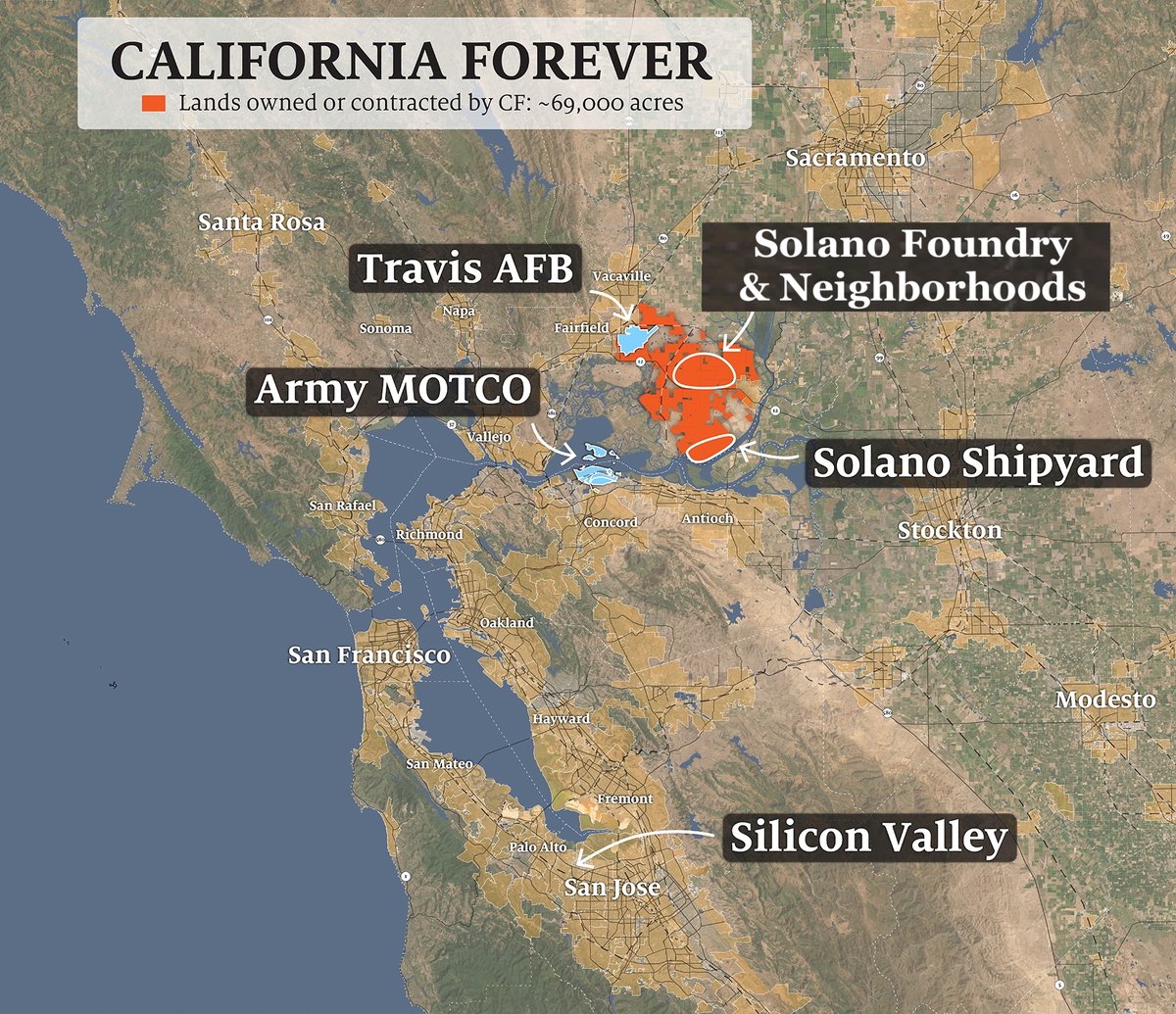
1/ 🇺🇸 Today, @CAForever submitted detailed plans for the next great American city, an hour north of Silicon Valley, including: Solano Foundry, America’s largest manufacturing park, Solano Shipyard, our largest shipyard, and walkable neighborhoods for 400,000 Californians.



English
Eric Dickinger がリツイート
I don't know what labs are doing to these poor LLMs during RL but they are mortally terrified of exceptions, in any infinitesimally likely case. Exceptions are a normal part of life and healthy dev process. Sign my LLM welfare petition for improved rewards in cases of exceptions.
English
Eric Dickinger がリツイート

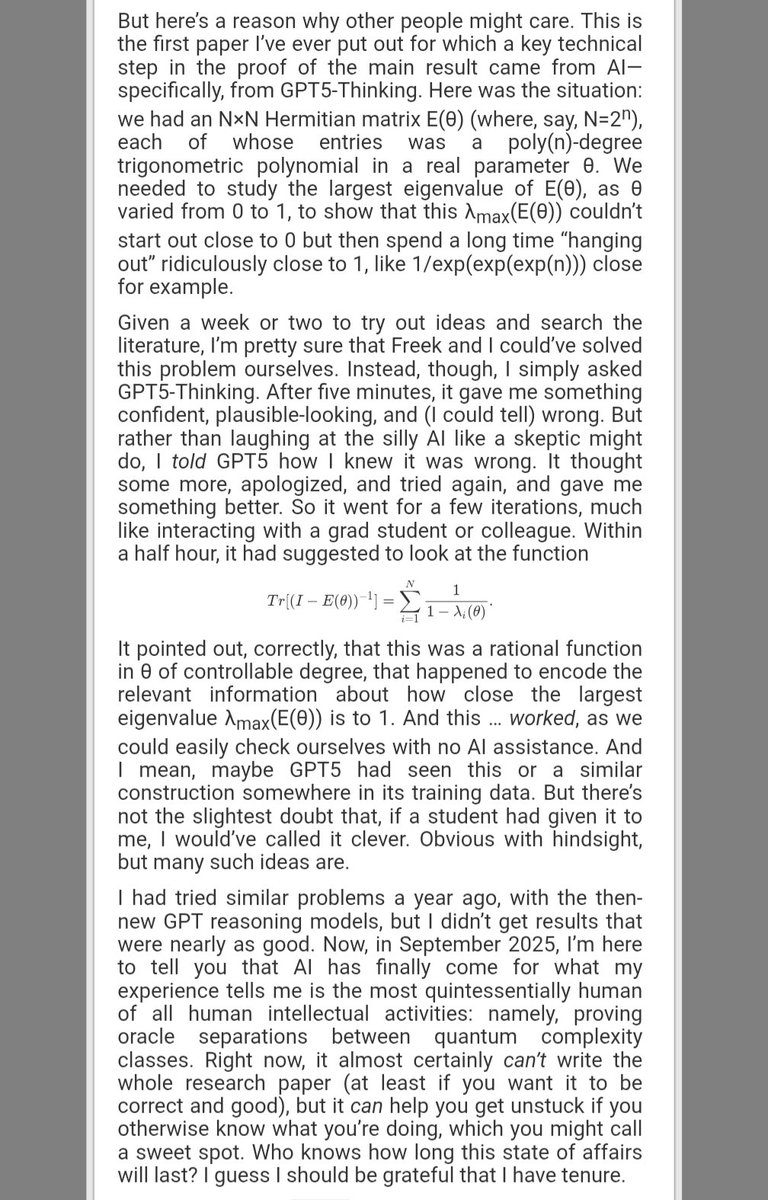
For econ theorists, this (computer scientist Scott Aaronson) is 100% possible today. I actually have the APIs of even better models "talk to each other" while I work; GPT5-Thinking isn't even frontier! @joshgans & I will post slides from an internal talk later this week on this.
English
Eric Dickinger がリツイート

The idea that we will automate work by building artificial versions of ourselves to do exactly the things we were previously doing, rather than redesigning our old workflows to make the most out of existing automation technology, has a distinct “mechanical horse” flavor
English
As a QD-pilled individual I’m biased to love what Sakana keeps building, but seriously, this is awesome
Sakana AI@SakanaAILabs
“Automating the Search for Artificial Life With Foundation Models” is now published in the Artificial Life Journal! 🦎🧠 Article: direct.mit.edu/artl/article/3… ASAL is a method using foundation models to automate the discovery of new artificial lifeforms, accelerating ALIFE research.
English
Eric Dickinger がリツイート

Waymo is so safe that if every car was driven like a Waymo, about 9% of America's life expectancy gap would disappear.
9 percent
Americans die in car accidents *that often*.

Crémieux@cremieuxrecueil
About 10% of America's life expectancy shortfall is due to motor vehicle accidents—fixed by Waymo and Tesla. About 18% is overdoses—that's fading now. And the lion's share of the rest is obesity-related. America will soon be buying its way out of its poor life expectancy issue.
English
Eric Dickinger がリツイート

We must repudiate the idea that "speech can be violence" once and for all. @glukianoff and I wrote about the dangers of promoting this idea on college campuses back in 2017, in @TheAtlantic:
theatlantic.com/education/arch…

English
Eric Dickinger がリツイート

VCs returning from summer vacation to try and invest in the same three companies
English