
Airborne Veteran がリツイート
Airborne Veteran
95.2K posts

Airborne Veteran
@rsteade
Conservative. Veteran. For those who know me, no bio is necessary. Si vis pacem, para bellum.
USA 参加日 Ekim 2011
7K フォロー中869 フォロワー

Airborne Veteran がリツイート


Airborne Veteran がリツイート

For the first time in decades, three aircraft carriers are operating in the Middle East at the same time. Accompanied by their carrier air wings, the USS Abraham Lincoln (CVN 72), USS Gerald R. Ford (CVN 78) and USS George H.W. Bush (CVN 77) include over 200 aircraft and 15,000 Sailors and Marines.

English
Airborne Veteran がリツイート

Airborne Veteran がリツイート

This is the epitome of the deep state. SPLC wasn’t just giving advice to these institutions.
They were demanding & dictating actions of these institutions based on their political beliefs.
Jack Posobiec@JackPosobiec
THIS IS BIGGER THAN YOU THINK 🚨 A coordinated system—linking the SPLC, Big Gov, Big Tech, and Big Finance —to label, censor, and shut down conservatives They didn’t just track extremism…they manufactured it
English
Airborne Veteran がリツイート

@ScottNover @liamjscott Of course a partisan hack would criticize the overhaul. Because now she can’t be a partisan hack anymore. At least not with an editor’s pen.
See how that works?
English
Airborne Veteran がリツイート

The blockade is, in fact, destroying Iran’s oil capabilities. Check this out:
Shanaka Anslem Perera ⚡@shanaka86
JUST IN: Iran just pulled a thirty-year-old empty supertanker out of retirement and began towing it toward Kharg Island. She is moving so slowly that a voyage that should take a day and a half is taking four days. Her name is NASHA. IMO 9079107. Built 1996. A two-million-barrel very large crude carrier that has been anchored empty off Kharg for years. TankerTrackers confirmed her reactivation yesterday. Gulf News, Iran International, and Fox News all picked it up within hours. The reason she is moving at all is that Iran is running out of places to put the oil. Kharg Island handles roughly ninety percent of Iran’s crude exports. Its onshore tanks had about thirteen million barrels of spare capacity when the US blockade began on April 13. Net inflow since has been running at one million to one point one million barrels per day because exports have collapsed to single digits of vessels while upstream production continues. The math is mechanical. Roughly twelve days of spare capacity. The calendar says that window closes this week. NASHA is not a strategy. NASHA is what you do when you have run out of strategy. A two-million-barrel floating storage vessel buys Iran approximately forty-eight hours of continued upstream production. After that, either the wells get shut in or the crude goes somewhere else. The parallel options being pursued, ship-to-ship transfers in the Riau Archipelago, AIS-dark transits, sanctioned VLCCs returning home through the blockade line, are not enough. Lloyd’s List Intelligence has tracked roughly twenty-six Iran-linked vessels evading since April 13. That cannot absorb a million barrels a day. The wells will shut in. The question is which wells, for how long, and whether they come back. The Asmari and Bangestan carbonate formations that sit under most of Iran’s giant southern fields are high-permeability, strong-water-drive systems. The Society of Petroleum Engineers literature on this specific reservoir class is unambiguous. Remove continuous pressure support for a prolonged shut-in and four damage mechanisms activate simultaneously: water coning upward through the fracture network, fines migration into pore throats, formation compaction under increased effective stress, and clay swelling under altered salinity and pH. The damage is not theoretical. It is documented. And it is measured in months to years of recoverable production capacity, not days. Maleki and Gordon estimate three hundred to five hundred thousand barrels per day of permanent capacity loss if the current shut-in trajectory completes. That is a directional estimate, not a lab measurement, but the direction is not in dispute. NASHA is the archaeological signature of the clock. When a country with the world’s third-largest oil reserves reactivates a thirty-year-old retired tanker to float on top of its main export terminal and buy forty-eight hours of time, the institutional systems designed to absorb shocks have already failed. The insurance market, the shadow fleet, the diplomatic channels, and the reservoir physics are all converging on the same conclusion at different speeds, and NASHA is the one that shows up on satellite. The market is pricing a ceasefire. The Pentagon is pricing six months of mine clearance. Iran just pulled a corpse out of the Persian Gulf and asked it to buy two days. That is not how a reversible crisis looks. That is how a regime tells you, operationally, that it has run out of options between the blockade and the shut-in. The reservoir does not negotiate. open.substack.com/pub/shanakaans…
English
Airborne Veteran がリツイート
This is how institutions get captured. Stars and Stripes was supposed to be non-partisan. Congress created specific safeguards in the 1990s to keep it journalistically independent from the Pentagon.
But what happens when that independence becomes a shield for ideological capture? When the “veil of virtue” is weaponized to push an agenda instead of serving the troops?
Let’s not soften it: In recent years, Stars and Stripes became a left-leaning ideological rag. Much of its coverage had little to do with the actual concerns of our service members.
Don’t take my word for it, read their reporting from 2023 to early 2026. The shift is obvious.
If we actually care about preserving real independent journalism, then removing the people who turned it into a partisan vehicle isn’t an attack on principle. It’s simple a defense of it.
Scott Nover@ScottNover
BREAKING: The Pentagon has fired the Stars and Stripes ombudsman — the role Congress created to protect the military paper's editorial independence — after she publicly criticized the DOD's overhaul of the publication. w/ @liamjscott washingtonpost.com/business/2026/…
English
Airborne Veteran がリツイート

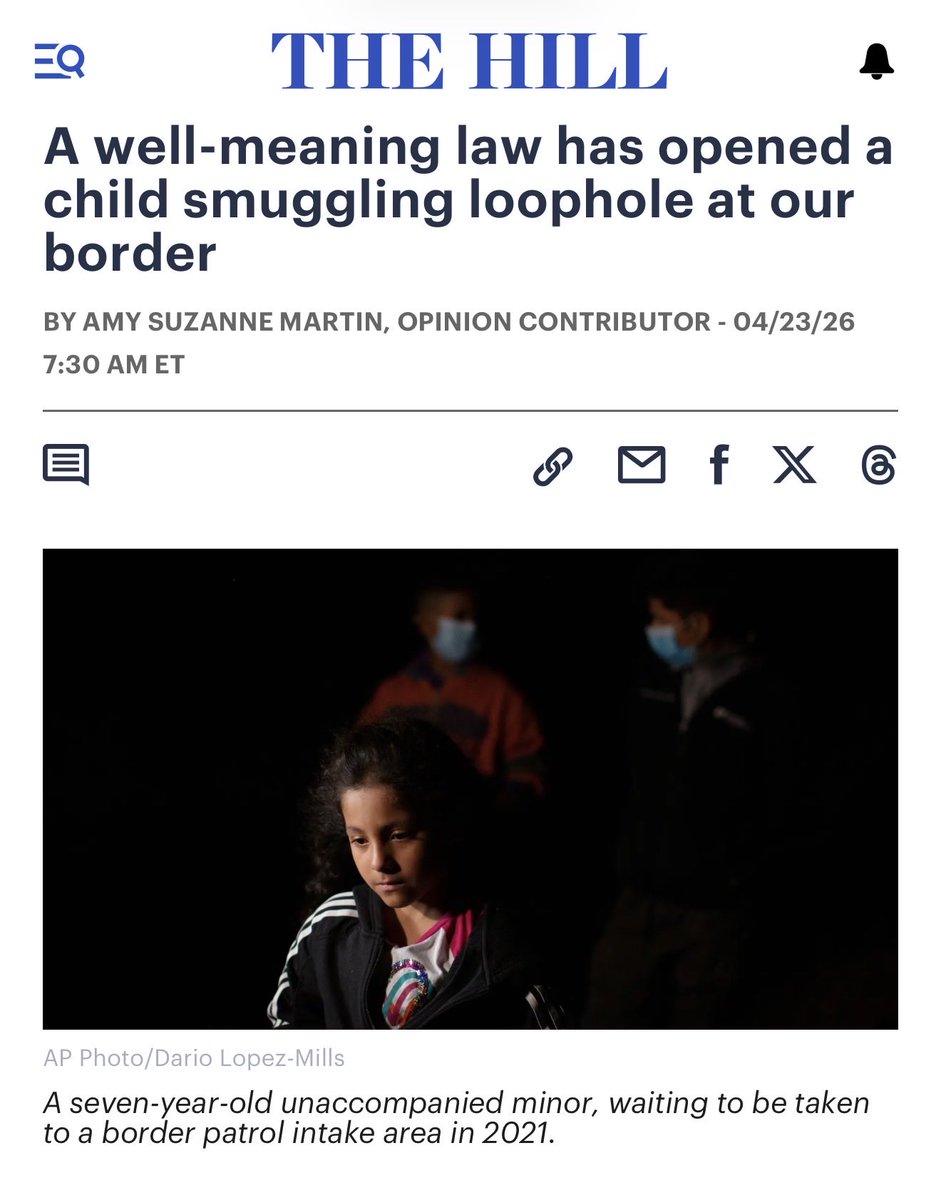
My op-ed in The Hill
“Ending the asylum-for-children loophole is not a partisan position — it is a test of whether America will stop playing pied piper to children.” thehill.com/opinion/immigr…
English

@axios Two failures weren't enough, now these midwit idiots want the trifecta.
English

NEW: A cohort of resistance-minded House Democrats is pushing their colleagues to begin building the case against Trump *now* in anticipation of a Day 1 impeachment vote if they retake the House.
“The push for impeachment is going to be overwhelming.” axios.com/2026/04/24/tru…
English
Airborne Veteran がリツイート

@washingtonpost Finally liberals on campus will have networking opportunities!
English
Airborne Veteran がリツイート

🔴 Listen to this monster's CONFESSION
For months, the regime apologists lied to the world, claiming that the massacre of Iranian civilians in January was the work of “Mossad/CIA agents”.
Now, hear the truth directly from the source:
Ahmad-Reza Radan, the regime's brutal police chief, just officially referred to the slaughter of thousands of Iranians as an “urban war” and a “second war.”
Worse? He openly stated he takes PRIDE in shedding their blood.
The regime in Iran is not a government. They are an occupying terrorist force waging a military war against unarmed civilians.
The world must see this confession!
HT @netvand
English
Airborne Veteran がリツイート

DEFUNDED! PBS has a "special correspondent" in the Middle East named Simona Foltyn. Watch how she plays publicist for a Hezbollah terrorist:
newsbusters.org/blogs/nb/clay-…
English
Airborne Veteran がリツイート

The bald eagle almost disappeared from the lower 48.
Now it’s one of the greatest wildlife comebacks in American history.
America's 250th birthday hits different when you remember that.

English
Airborne Veteran がリツイート

Michigan Sec of State Benson faces scrutiny over SPLC ties after group's indictment justthenews.com/nation/states/…
English
Airborne Veteran がリツイート

Airborne Veteran がリツイート
Airborne Veteran がリツイート

The IDF says Hezbollah used an ambulance in southern Lebanon to transport weapons and operatives, including explosives and mortar shells
English
@Khub94 @bourscheid The moment you uttered pedo, you revealed yourself to be nothing but a midwit delusional idiot.
English

@rsteade @bourscheid No he means quite literally the entire world & even people closest to him who are just using their proximity to benefit personally; genuinely nobody likes him. Unless you’re a pedo too??
English

Wow. If there are two facts you read today:
1) Everyone outside the US despises Donald Trump.
2) 67%+ of us inside the US despise Donald Trump.
He may go down as the most hated person in history. So I guess he can win one thing without cheating.
English