Samuel Nettey

153 posts

Samuel Nettey banner
Samuel Nettey

Samuel Nettey

@s_nettey

👨‍💻 .NET & C# Developer | 🏗️ Software Architect | ⚙️ Microservices | ☁️ Azure | 🌐 Blazor | Building scalable solutions #DotNet #CSharp #Azure #Blazor

Dortmund 🇩🇪 , Accra 🇬🇭 参加日 Eylül 2015
129 フォロー中44 フォロワー
Samuel Nettey
Samuel Nettey@s_nettey·
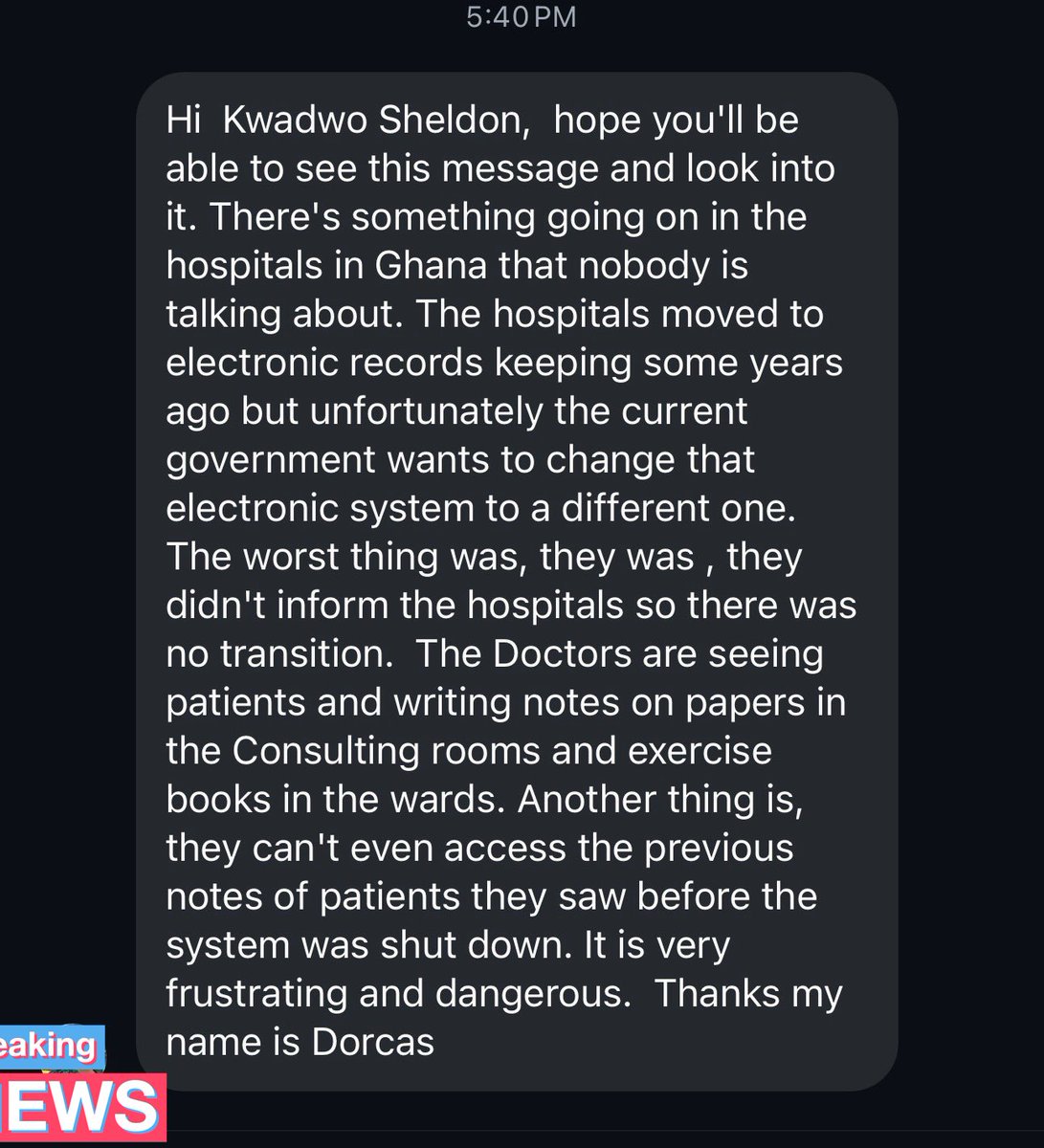
There will always be a transition period when a national digital system changes , that part is normal. The issue is how the transition is handled. Right now the challenges we’re seeing are due to: • No structured migration plan • No overlap between the old and new systems • Limited communication to facilities • No clear continuity of patient records These concerns have been circulating in the health sector for months. It’s not the change itself that’s the problem , it’s the lack of a smooth, coordinated handover. This is exactly why Ghana needs a unified digital health backbone so system changes don’t disrupt patient care.
English
0
0
5
1.1K
Kwadwo Sheldon
Kwadwo Sheldon@kwadwosheldon·
Doctors and Nurses in the TL, ebe true
Kwadwo Sheldon tweet media
English
235
175
1.4K
145.3K
Samuel Nettey
Samuel Nettey@s_nettey·
🧩 Syntactic interoperability → systems can talk (shared formats like HL7 / FHIR) 💡 Semantic interoperability → systems understand each other (shared meaning & codes) Without both, healthcare data stays in silos — disconnected and duplicated. #Interoperability #GDIW2025
English
0
0
0
11
Samuel Nettey
Samuel Nettey@s_nettey·
My latest LinkedIn article, “Ghana Doesn’t Need Another Health ERP — It Needs an Interoperability Layer” — just crossed 5,000+ impressions It’s clear people care deeply about Ghana’s digital health future. linkedin.com/feed/update/ur… @BBSimons @mohgovgh
English
0
0
0
20
Samuel Nettey
Samuel Nettey@s_nettey·
@BBSimons From a Health Informatics perspective, the real fix isn’t another ERP but an Interoperability Layer, a national “Health Exchange” that lets certified systems share data seamlessly. That’s how the EU’s EHDS evolved ,policy enabling ecosystem, not monopoly software.
English
0
0
0
139
Bright Simons
Bright Simons@BBSimons·
1. On Lightwave LHIMS & GHIMS. 2. Standard katanomics: "what is desirable" (digitalise healthcare) versus "how best to get there" (effective policy design). 3. Ghana doesn't only struggle with the "how," its elites simply can't keep track of why the "hows" always end up being a mess. 4.Even though IMANI flagged all the key issues in the LHIMS saga 4 years back, the current debate doesn't even feature the critical issues. (see: imaniafrica.org/2021/07/must-t…) 5. So, let me recap: Lightwave, a startup by a Ghanaian normally resident in the US, got a ~$100m contract to digitalise most of Ghana's major public hospitals & clinics, over 900 of them. 6. The company had no track record managing national-scale projects. But it partnered with Plus91, another startup, based in India, led by resourceful founders that began with ~$75,000 in funding and last year brought on board an angel (~$560,000). 7. Plus91 had deployed single-facility health-management systems in India under the MediXcel brand when it was tapped by Lightwave as its strategic partner. 8. Because there are over 236 major digital health app providers servicing over 150,000 clinical facilities, India created the ABDM program to deliver a "United Health Interface" (UHI). Digital Health apps approved by NABH (the regulator) can connect into the national ecosystem. MediXcel successfully underwent certification, connected to the UHI, and competes with many others for facility contracts. 9. But in Ghana, a Health Minister decided sometime in 2021 that such careful policymaking is too bothersome. Instead, he ruled that every single digital health app in public facilities be replaced by a white-labeled version of MediXcel called LHIMS, via the gigantic contract with Lightwave. 10. Innovators that had spent years building relationships with facilities and customising solutions to serve their unique challenges were thrown out into the streets. 11. Naturally, political fiat runs out in a democracy. The government changed in Dec 2024. The new government struggled to align with Lightwave, the favourite of its political rival. 12. The new government accuses Lightwave of delivering only 50% of the contract despite receiving 77% of the contract price. It accuses it of serious data breaches: citinewsroom.com/2025/10/data-p… myjoyonline.com/health-ministr… 13. To fix the issues, it has also contracted a company called Axon, with limited track record in digital health innovation, to build a new Super Health app to replace LHIMS at the reported cost of ~$50 million: graphic.com.gh/news/general-n… 14. I call this whole trend of policymaking, "katanomic." Political decision-makers exercise power without real policy guardrails. They often make catastrophic mistakes, and yet there is no "national learning", so the same mess seems to loop endlessly. 15. Obviously, the sensible thing to do here is to separate the "national interconnection system" from the facility-level service delivery system when rolling out digital health? 16. The state should only get involved in licensing providers to offer interconnection to certified service delivery apps that meet standards set by a national regulator. All certified apps should be able to exchange data so that patient data would be accessible regardless which specific facility a patient attends. 17. In a country where national learning is happening, policymakers would easily recognise parallels with how financial payments and electricity access is managed and draw lessons. Interconnection and service delivery are separate functions in multiple contexts familiar to them. 18. Next, it should be obvious that the ~450 facilities that have been digitalised already, with all the reported challenges, should have the option to weigh among Lightwave, Axon, and others and decide which ones to use. Those that decide to move away from Lightwave should have a transitional plan monitored by regional health directorates and the national regulator. 19. The cost of digitalising a facility and ongoing subscription fees to keep the platform running for each facility would then be set as a matter of competition. 20. Only in such a model can private health facilities be brought on board. In pharmacy and lab services, the vast majority of providers are private. In the current katanomic arrangement, they are not catered for. Each facility gets their own solution that cannot interchange effectively with others. 21. In a proper arrangement, specialisations among facilities can also be properly catered for. In the current katanomic situation, specialised features of facilities (think of oncology, maternity, vaccination etc.) are entirely subject to the feature roadmap of a centralised app provider selected by fiat by Ministers with virtually no input by any "critical audience." Ministers with no prior exposure to public or digital health. 22. Because health is such a vast and complex field, digitalisation is equally very complex, even in the richest countries like the United States. It requires a large number of innovators working on different segments and levels, but with common communication interfaces, to bring an ecosystem close to full digital coverage. 23. The last thing you need is a monopoly player hand-picked by a politician. 24. Ghana has had a national digital health innovation policy for a decade and half. There is clear political will to invest large amounts of money and power in its name. What is lacking is actual "policy momentum". The money and the power is not invested for policy traction but for "state enchantment" (the semblance of great progress). Buzzwords like "digitalisation" thus merely provide cover for more parochial interests. That is how come $77 million can be spent with no durable improvement. 25. The situation will only change when enough citizens can look beyond the often meaningless political disputes and see the hard neglected policy choices underneath. That is how a society transcends katanomics. Read another case study here: brightsimons.com/2025/02/pwalug…
Bright Simons tweet media
English
47
162
358
151.7K
Samuel Nettey がリツイート
Alfred
Alfred@CallmeAlfredo·
Lightwave was introduced by administrative fiat under the previous administration to displace all existing providers of electronic medical records solutions. Now, the new administration is also planning to displace Lightwave by administrative fiat and impose the Ghana Health Information Management System. Essentially, all that’s being done is replacing one vendor with another in typical Ghanaian policymaking fashion, while the underlying issues remain unresolved. The decision to impose Lightwave effectively created a monopoly over electronic medical records in Ghana. Having a monopoly in this space means creating a single point of failure. Local developers who had spent years building their own solutions were forced out. Replacing Lightwave with the Ghana Health Information Management System only reinforces that monopoly. We shouldn’t be confused by claims that it’s state-owned. The Ghana Card is supposedly state-owned too, yet the state cannot operate it without the private vendor. What lessons are we learning from this fiasco to ensure that the next change in government doesn’t trigger yet another change in vendor and further disruptions to e-health services? We’ve already heard reports of a return to manual record keeping. The Ministry said it had to reconstruct data because Lightwave refused to hand it over. We are also now learning that Lightwave was paid 77 percent of the contract amount for completing less than 50 percent of the work. Why must it always take a change in government for the Ghanaian taxpayer to learn about such issues? There are clearly deep governance and policy failures, ones that don’t automatically get fixed by changing vendors. But Ghanaian policymakers always seem to take the easy route, enriching cronies in the process.
Alfred tweet mediaAlfred tweet media
English
31
112
191
73.8K
Samuel Nettey
Samuel Nettey@s_nettey·
Join 100+ devs already signed up for my free Clean Architecture webinar. 🎯 Build software the right way → bit.ly/SNcabwl
English
0
0
0
23
Samuel Nettey
Samuel Nettey@s_nettey·
Engagement: Junior devs : what’s one concept you wish you learned earlier? Mid devs : what’s one habit that saved you from messy code?
English
0
0
0
25
Samuel Nettey
Samuel Nettey@s_nettey·
That 'quick fix' you shipped last week? It’s adding interest to your tech debt bank account. You will pay later.
English
0
0
0
25
Samuel Nettey
Samuel Nettey@s_nettey·
Rule of thumb: If changing one line requires editing 10+ files, your coupling is too high.
English
0
0
0
18