Sudarshan Pinglay

1.2K posts

Sudarshan Pinglay banner
Sudarshan Pinglay

Sudarshan Pinglay

@sudpinglay

bigDNA/synBio/soccer/food/heavymetal

Seattle 参加日 Nisan 2010
1.1K フォロー中755 フォロワー
固定されたツイート
Sudarshan Pinglay
Sudarshan Pinglay@sudpinglay·
Now out in @ScienceMagazine we present 'Genome-shuffle-seq': a method to shuffle mammalian genomes and characterize the impact of structural variants (SVs) with single-cell resolution in one experiment. science.org/doi/10.1126/sc…
English
6
50
207
50.6K
Sudarshan Pinglay
Sudarshan Pinglay@sudpinglay·
@BrianHie @pdhsu @Nature This would not have been possible without @AnsaBio providing the synthetic DNA. Their up to 50kb clonal DNA without any sequence restrictions is an absolute game changer!
English
0
1
4
351
Sudarshan Pinglay
Sudarshan Pinglay@sudpinglay·
Thrilled to see the Evo2 paper led by @BrianHie, @pdhsu & team out in @Nature! We helped bring long (20kb!) AI-designed DNA to life in cells. Seeing experiments match the designs was wild-biological abstraction is starting to feel real. Join us → pinglay-lab.com
Brian Hie@BrianHie

Evo 2, our genome language model that generalizes: - across biological prediction and design tasks, - across all modalities of the central dogma, - across molecular to genome scale, and - across all domains of life, is published today in @Nature.

English
3
7
36
10.6K
Sudarshan Pinglay
Sudarshan Pinglay@sudpinglay·
if you are excited about these areas, come join our lab @uwgenome and the Seattle Hub for Synthetic Biology! We are hiring at all levels. pinglay-lab.com
English
0
0
3
102
Sudarshan Pinglay
Sudarshan Pinglay@sudpinglay·
We also discuss current bottlenecks for mammalian genome writing (mainly throughput and size), mechanisms to address them, and future directions for the technology. We think it is particularly poised to revolutionize generating training data for genomic AI models.
Sudarshan Pinglay tweet media
English
1
0
2
187
Sudarshan Pinglay
Sudarshan Pinglay@sudpinglay·
A big thank you to all co-authors - looking forward to seeing where we can take this approach. If you are interested in joining us on this effort, check out our website: pinglay-lab.com
English
1
1
1
205
Sudarshan Pinglay
Sudarshan Pinglay@sudpinglay·
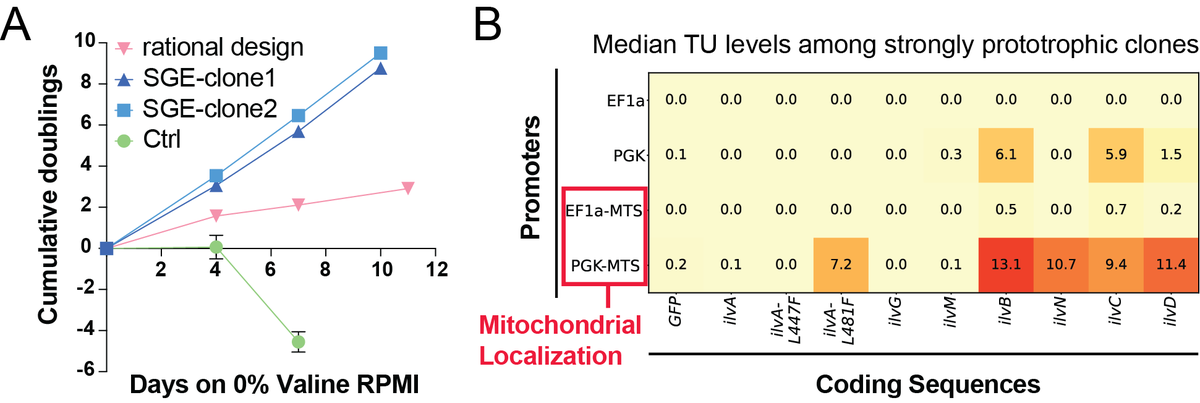
We then used SGE to engineer CHO cells to grow without isoleucine, a feat we could not achieve via rational design and delivery of entire synthetic pathways. Again, mitochondrial localization was favored, with individual clones reflecting ~40-50kb of integrated DNA!
Sudarshan Pinglay tweet media
English
1
1
4
642
Sudarshan Pinglay
Sudarshan Pinglay@sudpinglay·
Using SGE, we screened millions of pathway combinations in a single experiment to engineer CHO cells that grew at WT rate (~1.1 day/doubling) in valine-free medium. Intriguingly, the best clones all employed mitochondrial localization of pathway components.
Sudarshan Pinglay tweet media
English
1
0
0
161
Sudarshan Pinglay
Sudarshan Pinglay@sudpinglay·
In collaboration with Harris Wang’s lab, we previously engineered cells to grow without valine by importing 4 genes from E.coli. However, the cells grew 4x slower than normal - and we could not extend this strategy to enable any other amino acids. doi.org/10.7554/eLife.…
English
1
0
0
138
Sudarshan Pinglay
Sudarshan Pinglay@sudpinglay·
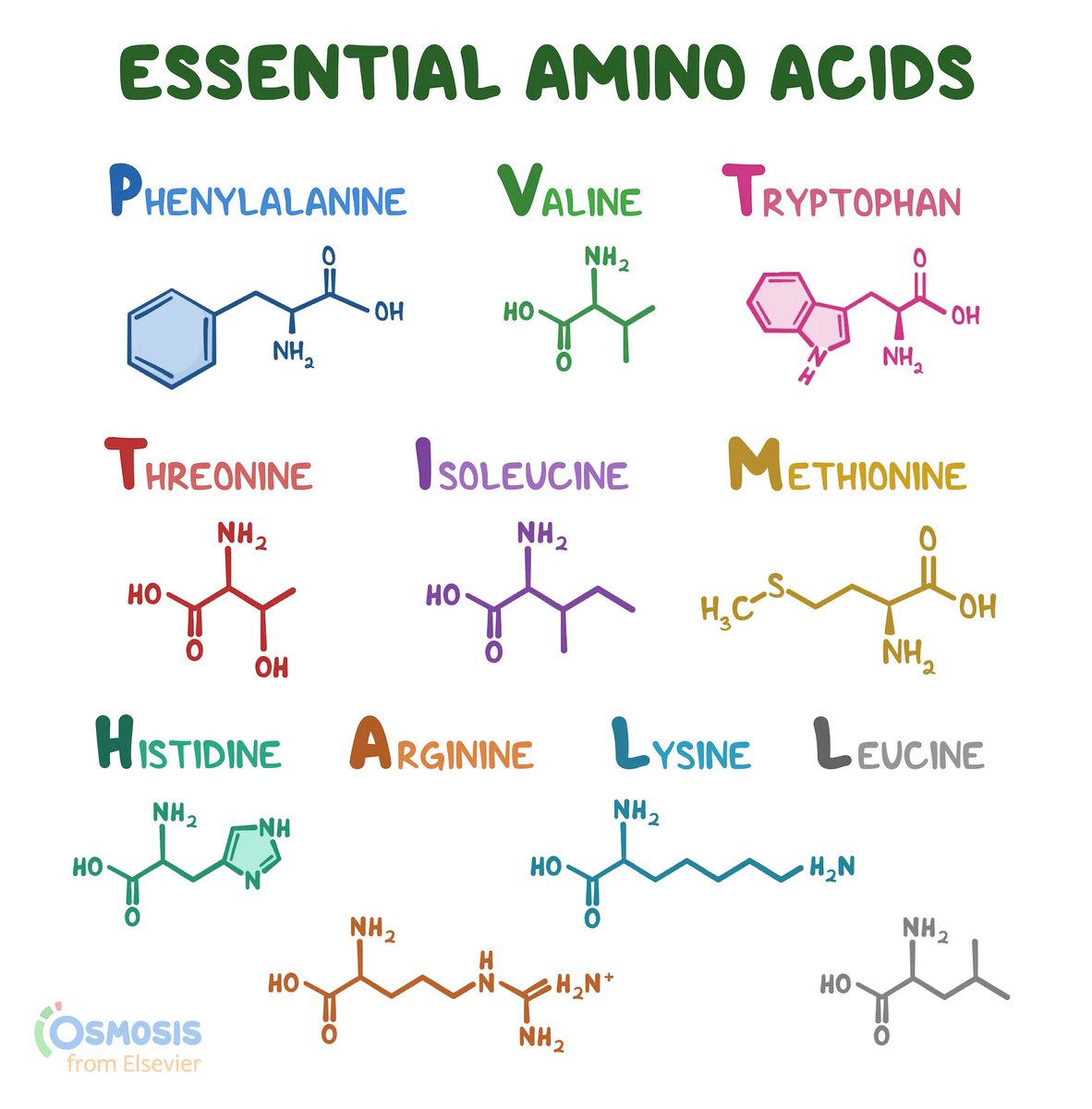
As a test case, we used SGE to engineer essential amino acid prototrophy in mammalian cells, a behavior last seen over 500 million years ago. Unlike E. coli, which can make all 20 amino acids, mammals lack the pathways for 9 “essential” ones that we obtain via our diet.
Sudarshan Pinglay tweet media
English
1
0
0
129
Sudarshan Pinglay
Sudarshan Pinglay@sudpinglay·
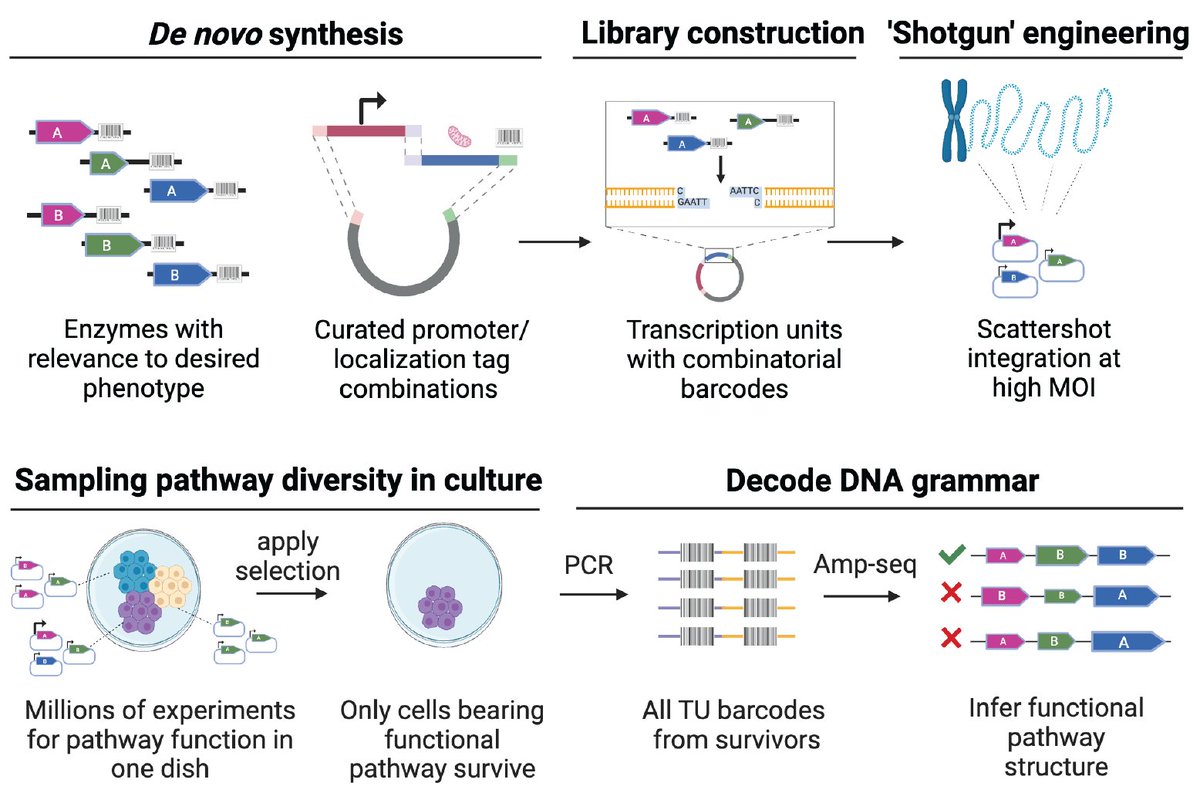
In SGE, we clone and randomly deliver a barcoded TU library at high MOI so that each cell represents a unique synthetic metabolic pathway experiment. Cells with the desired phenotype (e.g. viability) are selected, and TU barcodes are sequenced to identify functional combinations.
Sudarshan Pinglay tweet media
English
1
0
0
99
Sudarshan Pinglay
Sudarshan Pinglay@sudpinglay·
We developed Shotgun Genetic Engineering (SGE), which exploits the fact that building and delivering many small, transcription units - each with a gene, promoter and localization signal - is exponentially easier than delivering a single large construct to a mammalian cell.
English
1
0
0
93
Sudarshan Pinglay
Sudarshan Pinglay@sudpinglay·
Mammalian metabolic engineering is key to advancing bioproduction, cell therapy, and rejuvenation. But as pathway complexity grows, so does the combinatorial design space! But delivering large DNA constructs to mammalian cells is inefficient, making large screens intractable.
Sudarshan Pinglay tweet media
English
1
0
0
119