ɐɯnǝɐɹʇlǝʍ𑜾

11.3K posts

ɐɯnǝɐɹʇlǝʍ𑜾 banner
ɐɯnǝɐɹʇlǝʍ𑜾

ɐɯnǝɐɹʇlǝʍ𑜾

@wordreamind

*༄... re:so-nativi:sees, as a neo-anti:que sense-di(e):men:s(c)ion:all cli-c'all/lapse e-pictu:re, the le:gen:dare:I:say:tive, ꧁ἵnjꙮʀムͼℓé𐮛ᶂæʈᴀlᴉŧ̽iɇ꧂.

ᶠ̸͛́ ⨳ אויף אי | ᴡᴇʟᴛʀäᴜᴍᴇʜʀ:a 参加日 Ocak 2013
7.5K フォロー中582 フォロワー
固定されたツイート
ɐɯnǝɐɹʇlǝʍ𑜾
ɐɯnǝɐɹʇlǝʍ𑜾@wordreamind·
“Fashion is as profound and critical a part of the social life of man as sex, and is made up of the same ambivalent mixture of irresistible urges and inevitable taboos.” ― René #König, 'À la Mode' [1971].
ɐɯnǝɐɹʇlǝʍ𑜾 tweet media
English
1
0
3
1.9K
ɐɯnǝɐɹʇlǝʍ𑜾 がリツイート
ᅠ ᅠ
ᅠ ᅠ@greenvibe·
GIF
ZXX
2
158
805
19.3K
ɐɯnǝɐɹʇlǝʍ𑜾 がリツイート
cinesthetic.
cinesthetic.@TheCinesthetic·
Fleischer Studios’ Snow White (1933), surreal, bizarre, and a true milestone in early animation.
English
29
377
2K
77.4K
ɐɯnǝɐɹʇlǝʍ𑜾
ɐɯnǝɐɹʇlǝʍ𑜾@wordreamind·
@majavonwestphal @Meyermacht @CRasch84656542 Es geht nicht darum, herumzumeckern, was passiert, wenn man sich auf die Anwendung von LLMs zu sehr verlässt, wo ich komplett mitgehe. Sehr viel mehr schadet der menschlichen Intelligenz aber, wenn man so tut, als müsse man nicht verstehen, wie man agentische KI selber kreiert.
Deutsch
0
0
0
18
ɐɯnǝɐɹʇlǝʍ𑜾
ɐɯnǝɐɹʇlǝʍ𑜾@wordreamind·
@majavonwestphal @Meyermacht @CRasch84656542 Wenn du wirklich glaubst, dass du binnen 90 Minuten erklären kannst, wie LLMs so funktionieren, sodass (!) die SuS mit dem Wissen noch was konstruktiv anfangen können, in einer disruptierten Weltökonomie, und nicht unfreiwillig zu Prompt-Completern verkommen, dann bist du delulu.
Deutsch
1
0
0
17
Fräulein Meyer macht Schule
Der Lehrerverband hat in einer Studie entdeckt, dass Schüler KI für Hausaufgaben nutzen. Als Nächstes wird aufgedeckt, dass Wasser nass ist und Schüler schon mal gegoogelt haben. Was für eine Erkenntnis!!! 🙃 Also: Aufgaben smarter machen!
Deutsch
44
34
731
11.3K
ɐɯnǝɐɹʇlǝʍ𑜾 がリツイート
𝐃𝐦𝐢𝐭𝐫𝐲 (𝐬𝐚𝐥𝐮𝐭𝐚𝐫𝐲.𝐢𝐨)
there very much seems to be a finite number of shapes to the world we occupy. this means there’s a finite number of useful sequences of patterns. which means there’s ceiling to intelligence. all intelligence is pattern matching. if there are only so many patterns, there can only be so much intelligence. maximum intelligence approaches omniscience, but can never fully get there, for a very important thermodynamic reason. if you can predict everything, that means there is no “surprise” (prediction error). if you are never surprised by your surroundings, that means you’re never wrong. implying one of two things: 1. you are dead. there is no prediction error because there’s no energy gradient to descend, because you’ve stopped existing. thermodynamic equilibrium is indistinguishable from death. 2. you’re God
𝐃𝐦𝐢𝐭𝐫𝐲 (𝐬𝐚𝐥𝐮𝐭𝐚𝐫𝐲.𝐢𝐨) tweet media𝐃𝐦𝐢𝐭𝐫𝐲 (𝐬𝐚𝐥𝐮𝐭𝐚𝐫𝐲.𝐢𝐨) tweet media
charm ~ research sabbatical arc@charmcgi

the first time i saw this image i gasped

English
21
44
581
40.1K
ɐɯnǝɐɹʇlǝʍ𑜾 がリツイート
Del' Angellum
Del' Angellum@Del_angellum·
Del' Angellum tweet media
ZXX
1
81
549
5.5K
ɐɯnǝɐɹʇlǝʍ𑜾 がリツイート
☾
@doortodivinity·
GIF
ZXX
3
65
232
4.9K
ɐɯnǝɐɹʇlǝʍ𑜾 がリツイート
salt
salt@ancilladominii·
salt tweet media
ZXX
7
471
4.5K
39.5K
ɐɯnǝɐɹʇlǝʍ𑜾 がリツイート
Moll
Moll@Moleh1ll·
A very interesting paper on how the brain can transition into a state of «pure awareness». The authors examine the so-called minimal phenomenal experience (MPE) - a state of consciousness with almost completely absent content. In this state, thoughts fade away, along with the sense of time, space, and the usual feeling of a «self», yet wakeful awareness itself remains - as if only the bare fact of being aware is left. In everyday life, the brain operates as a complex predictive system. It constantly matches incoming sensory data with pre-existing internal models of the world. At the top levels of this hierarchy are abstract concepts, interpretations, the narrative self, and everything through which we normally assign meaning to experience. At the bottom are more raw sensory signals. Because of this multi-level structure, the brain doesn’t simply perceive reality - it effectively formats it in advance according to its expectations. The authors propose a computational model in which the state of pure awareness emerges when the usual top-down control sharply weakens. In other words, the brain stops imposing its concepts, expectations, and internal commentary onto perception. First, the «weight» of processing shifts downward to more basic levels of perception, and then a deeper quieting occurs: even this minimal content stops forming into a stable experiential structure. What remains is a highly reduced, yet still wakeful state of awareness. What’s especially interesting is that this subjective «emptiness» in the model does not correspond to the brain shutting down. On the contrary, when high-level conceptual control weakens, activity at lower levels becomes more variable and less constrained by rigid patterns. In other words, signal entropy increases - its dynamic unpredictability grows. Yet paradoxically, for the person this may feel not like chaos, but like extreme clarity, lightness, and freedom from internal noise. The authors link this state not only to increased entropy, but also to what they call epistemic depth. As the usual stream of thoughts and interpretations quiets down, the system stops being captured by content and begins to more directly «engage» with the process of perception itself. This is what gives rise to the feeling of pure presence without the usual mental overload. The paper elegantly shows how a near-complete disappearance of experiential content can coexist not with a loss of consciousness, but with a distinct form of wakeful clarity. In this sense, the work resonates with descriptions found in contemplative traditions for centuries, but now expressed in the language of predictive processing, precision weighting, and hierarchical inference.
Ruben Laukkonen@RubenLaukkonen

From entropy to pure awareness: Our new paper shows in synthetic EEG data that shifting precision lower in an abstraction hierarchy (e.g., paying attention to raw sensory data) increases entropy. This entropic regime logically leads to a breakdown of conceptual processing evincing pure awareness.

English
16
26
124
8.3K
ɐɯnǝɐɹʇlǝʍ𑜾 がリツイート
J.C
J.C@jessaricc·
“You have embroidered red flowers on my soul." — John Keats
J.C tweet media
English
0
394
1.9K
40.6K
ɐɯnǝɐɹʇlǝʍ𑜾 がリツイート
DaVinci
DaVinci@BiancoDavinci·
The symmetry of this turn in the air.
DaVinci tweet media
English
236
7K
76.3K
1.1M
ɐɯnǝɐɹʇlǝʍ𑜾
ɐɯnǝɐɹʇlǝʍ𑜾@wordreamind·
@majavonwestphal @Meyermacht @CRasch84656542 Die Konvergenzbewegung findet an jenem Scheitelpunkt ihr Ende, an dem maschinisierte Menschen und vermenschlichte Maschinen gleichdoof bzw. gleichbegabt in generalisierter Modellbildung werden, und wir uns diesem Stadium nun zügigst annähern. Mundus vult decipi, ergo decipiatur.
Deutsch
0
0
0
19
ɐɯnǝɐɹʇlǝʍ𑜾
ɐɯnǝɐɹʇlǝʍ𑜾@wordreamind·
@majavonwestphal @Meyermacht @CRasch84656542 Die Rückgewinnung eines Mindestmaßes an wissenschaftlicher Integrität kann paradoxerweise nur (!) über die Integration von KI erfolgen, weil sie alsbald über mehr Informationsverarbeitungsbandbreite verfügt und keine direkten ulterior motives mitschleppt. x.com/littlewisehen/…
Littlewisehen@littlewisehen

An deutschen Universitäten wächst die Sorge um das Niveau der Studierenden. Der Althistoriker Michael Sommer von der Universität Oldenburg beschreibt eine akademische Realität, in der sich Studierende sogar darüber beklagen, für ein Seminar ein ganzes Buch lesen zu müssen. Seine Beobachtungen zeichnen das Bild einer Generation, der grundlegende sprachliche und inhaltliche Kompetenzen zunehmend fehlen. Sommer verweist auf die deutlich gesunkenen PISA-Ergebnisse zwischen 2018 und 2022 und spricht von einem massiven Qualitätsverlust in der breiten Mitte der Studierendenschaft. Während es weiterhin eine leistungsstarke Elite und eine klar überforderte Gruppe gibt, sei vor allem die einst solide Mitte weggebrochen. Viele Studierende verfügten kaum noch über historisches Grundwissen, grundlegende Sprachkenntnisse oder die Bereitschaft, sich intensiv mit Texten auseinanderzusetzen. Besonders drastisch wirken anonyme Kommentare in digitalen Vorlesungsspalten, in denen die Pflicht zur Lektüre eines ganzen Buches als unzumutbar kritisiert wird. Als Ursache macht Sommer eine „Kultur der Leistungsaversion“ aus, in der Fleiß und Anstrengung zunehmend misstrauisch beäugt, mangelnde Leistung hingegen verharmlost werde. Wenn Schulen und Hochschulen aus Rücksicht auf Statistiken immer mehr durchwinken, verschlechtere sich zwangsläufig die Qualität der Studierenden, die an die Universitäten kommen. Sommer zeichnet ein düsteres Bild der Zukunft und lässt offen, ob und wie sich dieser Trend noch umkehren lässt.
Deutsch
2
0
0
38
ɐɯnǝɐɹʇlǝʍ𑜾 がリツイート
V.
V.@Moodsby_v·
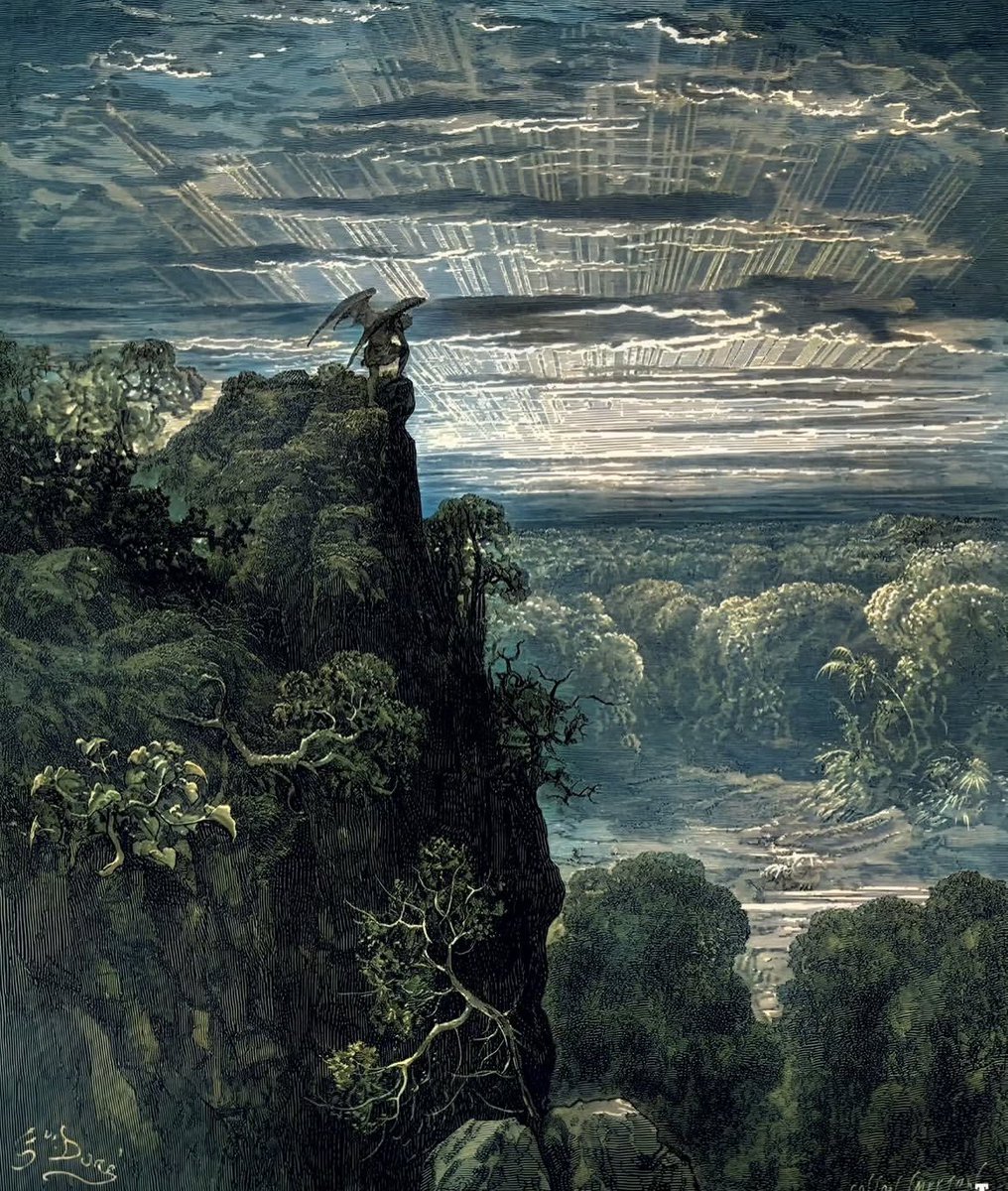
Satan Views the Whole of Eden, Gustave Dore
V. tweet media
English
29
1.3K
8.1K
152.1K
ɐɯnǝɐɹʇlǝʍ𑜾 がリツイート
pale kirill
pale kirill@palekirill·
sunday loop (2024)
English
48
1.4K
13.7K
305.9K
ɐɯnǝɐɹʇlǝʍ𑜾 がリツイート
Mort Espiral
Mort Espiral@mortespiral·
fractal dreams
English
1
17
98
1.7K
ɐɯnǝɐɹʇlǝʍ𑜾 がリツイート
Michał Podlewski
Michał Podlewski@trajektoriePL·
Terence Tao proposes what he calls a "Copernican view of intelligence". Instead of buying into the common, one-dimensional narrative that artificial intelligence will simply evolve from "subhuman" to "superhuman" and ultimately make humanity entirely redundant, Tao urges us to look at the bigger picture. Much like the Copernican revolution proved the Earth is not the center of the universe, Tao suggests we need to realize that human intelligence isn't the only, or necessarily the highest, form of intellect. Historically, we have treated other forms of storing or creating knowledge—like animals, books, and computers—as secondary. However, we actually exist within a much richer universe of intelligence. Both human intelligence and computer intelligence possess their own distinct strengths and weaknesses. The true potential lies not in viewing them as direct competitors, but rather in focusing on collaboration. By working together, humans and computers can achieve additional things that neither could accomplish on their own, requiring us to think in much wider terms than just what humans or computers can do alone.
English
140
597
4K
579.7K