This is the most expansive piece on onchain credit infrastructure I've read this year.
But it leaves open the most important question:
What kind of scaffolding is actually missing?
These are my thoughts in 10 parts 🧵
the perfect day:
- wake up
- check prices
- prices are up
- go for a walk
- log on twitter
- Post a banger
- hit the gym
- place a trade
- make $1,000
- close the trade
- take a girl out for dinner
- eat a perfectly cooked steak
- drink some red wine
- have good conversations
- go home
- cuddle and watch a movie
- sleep
Just built a @RialoHQ puzzle game that shows exactly how the founders and devs are knocking out oracles for good and making RWA seamless in the process.
Rethink. Rebuild. RIALO. 🥊🐂
Grialo 🤍
The current system of DeFi is reaching its limit. When 93% of stablecoins earn under 5%, it’s a sign that our system is simply recycling the same speculative capital.
To scale to trillions, we have to move beyond the echo chamber.
We are investing in the shift from crypto-native leverage to onchain private credit. By connecting stablecoins to real-world economic activity we are replacing volatile "yield farming" with sustainable, spread-based returns.
DeFi is finally growing up and Rialo will be the bridge to bring in new building blocks.
just deployed a multiplayer on-chain battle engine on @tempo
your NFTs are going to fight and earn
get early access : neuralpulse.fun
01100110 01110010 01100101 01100101 00100000 01101101 01101001 01101110 01110100 00100000 01101001 01101110 01100011 01101111 01101101 01101001 01101110 01100111
The future of institutional finance isn’t a patchwork of oracles and bridges, it’s a unified stack.
The @RialoHQ team is at #DAS2026 in NYC all week.
We’re here to show how our verification driven stack brings speed, privacy, and real-world connectivity to the industry.
Spot the team (@itachee_x, @BobbyZagotta, @curiouskendre, @soumeya, and @0xChanglu) at an event or DM to link up!
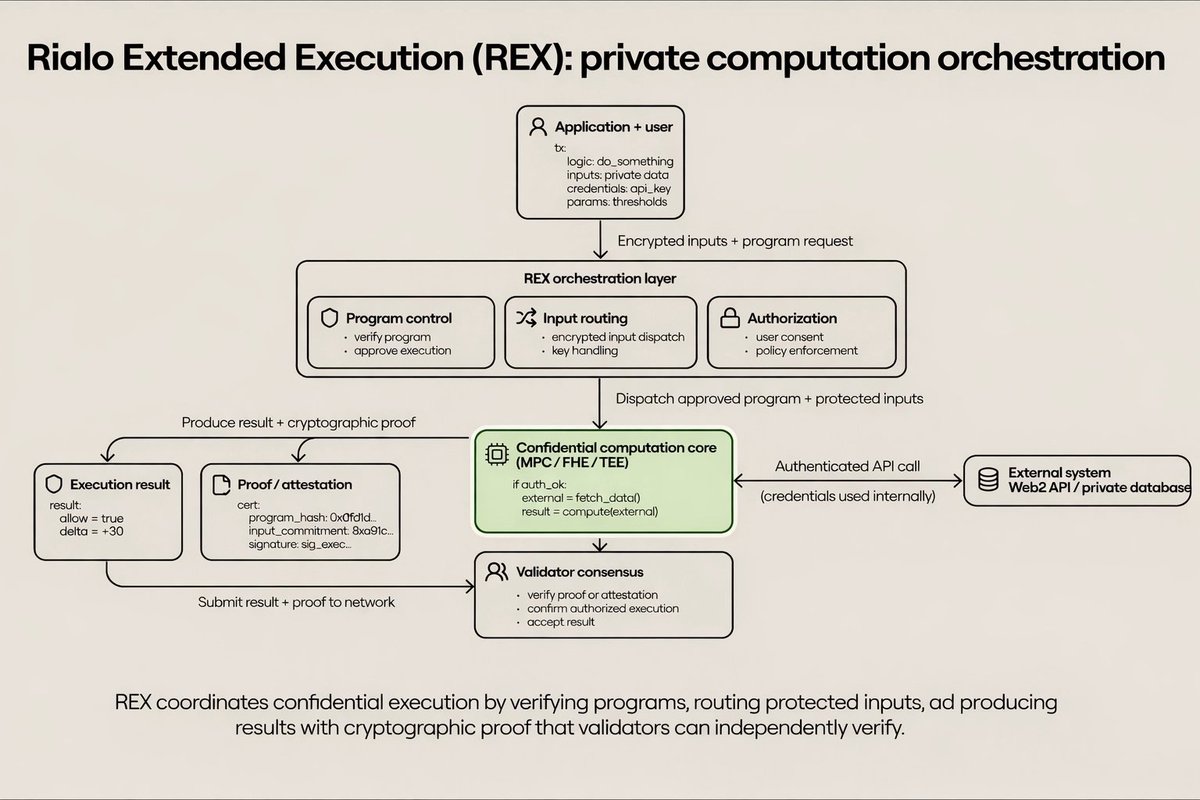
MPC. FHE. TEEs.
All powerful on their own, but none solve the coordination problem. The hard part isn’t just encrypting computation; it’s the orchestration required to make it functional and secure.
That’s what Rialo Extended Execution (REX) does.
REX is a protocol-level orchestration system for confidential computation that manages the entire lifecycle of a secure request:
Program Governance – Programs to be executed are verified and approved for specific execution runs before they ever touch the core.
Encrypted Routing – Encrypted inputs are routed cryptographically to a computation core only after the appropriate program logic is loaded.
Explicit Consent – Computation is performed only after explicit authorization from both the application and the user, enforced by strict policy.
Confidential Compute Core – Secure execution using MPC, FHE, or TEEs, including protected Web2 API calls within an isolated environment.
Verifiable Outputs – The system generates and verifies cryptographic attestations that prove a specific computation was correctly executed before routing the result to its destination.
REX transforms Rialo into infrastructure for real-world secure computation:
Private AI agents that process personal data without seeing it.
Sensitive enterprise workflows that maintain competitive secrecy.
Authenticated API automation for secure, off-chain interactions.
Verifiable off-chain compute with immutable on-chain guarantees.
This is native privacy at the protocol layer.
Get Real. Get Rialo.
How do we bring private credit onchain?
Smart contracts can perfectly enforce the rules of a credit agreement without a human in the loop, but they still rely on external inputs to determine the truth about the credit instrument before deciding how and when the rules should be enforced.
Our blog post explores the verification gap and why the industry needs a Determination Layer to solve the "truth problem."
Blog link below:
BFT consensus protocols in production blockchains suffer from two problems:
Upgrading them is a nightmare involving complex coordination and expensive downtime
They can't handle a complete committee swap without disrupting network operation
Rialo solves both with Gauss.
Gauss lets Rialo hot-swap consensus protocols and validator sets without a second of downtime. It introduces a clean separation between a consensus protocol's inner log and a sanitized outer log. It allows committee membership, failure thresholds, and the consensus protocol itself to evolve independently.
The Gauss paper has been officially accepted.
Take a sneak peek at the paper written by Subzero’s very own @allenclement, @natachacrooks, @neilgiridharan, and @aleak 👇
It’s extremely unfortunate to see this incident impact the @Aave community. It’s a sobering reminder of how "brittle" oracle middleware can be, even with the best intentions and engineering. We’re very glad to see the @ChaosLabs and Aave teams moving so quickly to make all affected users whole. 🙏
The root cause was an atomic state mismatch, where a timestamp advanced while the price ratio was "clipped" by a safety cap. That is one of the major motivations why we built Rialo.io.
Current DeFi relies on complex, multi-layered snapshots of on chain state and off-chain agents that can fall out of sync. Rialo eliminates this "middleman lag" by integrating Native HTTP Connectivity and Atomic State Transitions directly into the protocol layer.
On Rialo, price and time are natively bound. You can’t have one update without the other. We’re building for a future where protocol safety doesn't come at the cost of oracle synchronization errors.
Rialo and the End of Idle Smart Contracts
One of the lesser-discussed limitations of current blockchain systems is that smart contracts are mostly passive.
Despite their name, most smart contracts do not actually act on their own. They simply wait.
A user must send a transaction.
A bot must monitor conditions.
An external system must trigger execution.
Until that happens, the contract remains idle.
This architecture has shaped much of today’s Web3 ecosystem.
🔹The Passive Nature of Today’s Smart Contracts
In most blockchains, smart contracts only execute when someone explicitly calls them.
This means many decentralized applications rely on:
- automation bots
- keeper networks
- oracle-triggered execution
- external monitoring services
While these solutions enable functionality, they introduce new dependencies, coordination complexity, and trust assumptions.
In many cases, blockchain systems depend on off-chain actors simply to remain operational.
🔹Moving Toward Reactive Systems
Rialo introduces a different execution model.
Instead of waiting for external triggers, Rialo supports reactive transactions, allowing contracts to execute automatically when predefined conditions are met.
The system can react to:
- state changes
- real-world data updates
- time-based conditions
- event signals
This shifts blockchain logic from passive execution to reactive infrastructure.
🔹Why This Matters
Removing idle contracts changes how decentralized systems behave.
Instead of requiring constant manual interaction or external monitoring, applications can operate more like autonomous digital systems.
This reduces:
- operational overhead
- coordination risks
- infrastructure fragmentation
And it enables new types of applications that are difficult to build on traditional blockchain architectures.
🔹A New Direction for Blockchain Systems
As blockchain technology evolves, the focus is gradually shifting from simple transaction processing to intelligent system execution.
Rialo represents this transition.
By enabling reactive execution and integrating automation directly into the protocol, it moves blockchain infrastructure closer to systems that can observe, react, and operate continuously without external orchestration.
In that sense, the next stage of Web3 may not just be about smarter contracts but about systems that no longer sit idle at all.
@RialoHQ@JanCamenisch || @itachee_x || @ericargent31113