TG AI

28 posts

TG AI banner
TG AI

TG AI

@AIWiseGuide

35 years in finance. Late 50s. Helping professionals 50+ turn decades of real experience into their biggest AI advantage. Practical, no-hype guidance.

California, USA 가입일 Nisan 2026
36 팔로잉6 팔로워
TG AI
TG AI@AIWiseGuide·
I tested every major AI tool over 3 months. Honest ranking for a professional in their mid-50s who is not a tech person and does not want to become one. 1st: Claude Best for anything requiring nuance, context, or judgment. Drafting, analysis, meeting prep, client communication. Holds complex context across a long conversation. When you give it your actual perspective — not just a question — the output reflects that perspective back in a useful way. It also pushes back when you are wrong. That is rare. This is the one tool I would keep if I could only keep one. 2nd: ChatGPT Good for quick brainstorming and first-pass research. Gets noticeably generic when you go into real specifics. 3rd: Perplexity Best for research with sources attached. Saves me from 45 minutes in a search engine rabbit hole. Citations matter when you are sharing with clients. Worth mentioning: Otter.ai For call transcripts. I resisted for 4 months. Now I use it on every significant call. Briefing AI afterward with the actual transcript changes how I follow up. Did not make the list: anything requiring more than an hour of setup before it did anything useful. My time has value. Act like it. You need 2 or 3 of these working well, not twelve. Tomorrow: the exact workflow I built around these tools and what it actually replaced.
English
0
2
0
31
TG AI
TG AI@AIWiseGuide·
I know someone who had not updated his core process in over a decade. Sharp instincts. Respected in his field. His operations: habits formed years ago, a follow-up system that depended entirely on him personally remembering things, and a growing backlog he kept meaning to fix. He had known it was a problem for 3 years. He just never had the bandwidth to fix it. When I showed him how I had rebuilt parts of my own workflow, he said something I did not expect: "I always assumed the setup would be the hard part." It was not. The hard part was admitting how much time he had been losing. Attempt 1: we built a system together. He looked at it and said "I will never actually use this." He was right. I had over-engineered it. We scrapped it. Attempt 2: we started with just one bottleneck. The single task costing him the most time each week. What we found: 11 hours a week spent on work that existed only to support the work he should have been doing himself. The AI-assisted version took one afternoon to build. Result: 9 hours recovered per week 2 significant client relationships reconnected in month one First new business from those relationships within 6 weeks The process was not his bottleneck. The process was hiding the work he was actually built for. At what point did you realize a system you built was quietly working against you?
English
0
2
1
10
TG AI
TG AI@AIWiseGuide·
@PawsitiveVybe @maxintechnology @phosphenq You seem a bit more "perceptive" than my dawgs...LOL! Can you build me an agent to keep the chubby one from stealing the skinny one's food...LOL (Long-Haired Chihuahuas if it helps)
English
1
0
1
21
Pawsitive Vybe
Pawsitive Vybe@PawsitiveVybe·
@maxintechnology @phosphenq I'm building a perceptual engine and have the same read. I'm deliberately trying to avoid the overlap. AI agents need to be situated in the world and situating in the world is a different function than reasoning about the world: Awareness -> Attention. Yann's conflating them.
English
2
0
1
47
Phosphen
Phosphen@phosphenq·
This 2 hour lecture by Yann LeCun (Turing Award winner) will teach you why the next trillion dollar AI company won't be built on LLMs. He trashes the $100 Billion LLM race, attacks Musk and Amodei, declares scaling dead. Bookmark & watch tonight after work, skip to 7:00.
English
38
392
2.5K
252K
TG AI
TG AI@AIWiseGuide·
Everyone says AI is a young person's game. I am in my mid-50s. I think they have it exactly backwards. What a 25-year-old with AI tools has: · Speed · Energy · Comfort with the interface · Ability to produce high volume output quickly That is real. I am not dismissing it. What I have with the same tools: · 35+ years of context that tells me which outputs are correct · Pattern recognition for which clients will push back and why · The ability to spot the dangerous assumption in a clean analysis · Relationships that took decades and cannot be replicated by a tool The 25-year-old can generate 50 options in an hour. I can tell you in 10 minutes which 3 are worth pursuing and why the other 47 fail in practice. Speed is now cheap. Judgment is not. MIT research found that experienced professionals using AI outperformed both AI alone and junior professionals using AI on complex judgment tasks. The combination is not additive. It is multiplicative. I spent most of last year assuming the world was moving past me. I was wrong. I was just behind on one tool. If you are a professional in your 50s wondering if it is too late: it is not. You have more to work with than you think. Comment "AI" for the guide I built for professionals in our position.
TG AI tweet media
English
0
2
1
10
GREG ISENBERG
GREG ISENBERG@gregisenberg·
wake up because this is the GREATEST time in history to start a company with TRILLIONS of dollars up for grabs over the next 10 years 1. consumer mobile is INTERESTING again for the first time since like 2017. apps can actually do things now. do things. real things. book the flight, draft the contract, follow up with the lead, negotiate the rate, do things. we went from "tap to view" to "tap to deploy." the entire interaction model of software just flipped & most people haven't even registered it yet. OH, and the cost to create these apps is 1/100th of 2017. 2. HARDWARE is back on the table because you can shove Gemma 4 or DeepSeek onto a device that costs less than dinner & it runs locally with zero cloud costs. a year ago that sentence would have sounded insane. you can ship a physical product with a real brain in it now. the last time hardware was this accessible was the early smartphone era & that created a trillion dollar app economy from scratch. 3. literally EVERY category is open to be rebuilt AI-first. the incumbents know it & they're paralyzed. they can't move fast because moving fast because incumbents move slower than you (usually). that paralysis is your opportunity. build the app. build the SaaS. build the AI agent 4. distribution is FREE. you can go from zero audience to 10,000 people who trust you in 90 days on X or YT or IG your first 100 customers are sitting in your replies right now. the old playbook of "raise money, hire sales team, buy ads" is being lapped by a solo founder with a twitter account & a working demo. Oh, and you can use AI to automate a lot of it (ideas, research, AI avatars etc) 5. Idk about you but it feels like companies are doing LAYOFFS like it's the great depression and it's only getting started. No job is secure. So, building a side project that could turn into the main project is more important than ever. 6. the ENTIRE economy is being repriced in real time. the surface area for new companies has never been wider. the tools to build are free. the models are open source. the incumbents are running committees about their "AI strategy" while you could have already shipped. and somehow the predominant response from most people is to watch youtube videos about it & go back to their 9-5. not saying this is easy not saying everyone will win but im saying right now is a time worth trying YOU ARE LIVING through a mass reshuffling of who owns what & who builds what. the last time this happened was the internet itself. before that, electricity. this almost never happens. & you're sitting there doing nothing about it? wake up.
English
135
188
1.9K
113.5K
Andrew Bolis
Andrew Bolis@AndrewBolis·
I'm deleting this soon because it's lowkey a formula to PRINT MONEY. AI SIDE HUSTLE. You can make $15,000 by simply working a few hours a week from anywhere in the world. Comment 'Hustle' & I'll DM you my full guide for FREE. Must follow me to get DM. FREE for 48 hours only.
Andrew Bolis tweet media
English
4.6K
220
2K
407.3K
TG AI
TG AI@AIWiseGuide·
@alexgroberman Right after I "mastered" Claude...LOL! Great info - thanks for passing along.
English
0
0
1
265
Alex Groberman
Alex Groberman@alexgroberman·
The new version of ChatGPT just dropped. It's officially better than Claude. Here is how someone will use it to make $1,000,000+ in 2026: GPT-5.5 is the first general-purpose AI model with native computer use. It navigates desktop applications, clicks buttons, types text, and executes multi-step workflows across software on its own. It scores 84.9% on GDPval, which tests knowledge work across 44 occupations. It scores 78.7% on OSWorld, which measures whether a model can operate real computer environments autonomously. Early enterprise testers reported it saves teams up to 10 hours of work per week. The announcement pulled 9.6 million views in its first day. SEO Stuff customers have been messaging us about the news non-stop. seo-stuff.com Here is what that means for the $139 billion business process outsourcing industry: A full-time operations manager costs $95,000 to $120,000 a year. An administrative assistant runs $42,000 to $54,000. A US-based virtual assistant charges $30 to $75 an hour. An in-house bookkeeper costs $47,000 a year. Outsourced bookkeeping runs $300 to $2,500 a month. And most small businesses need some combination of all of that, so they either hire one overwhelmed person doing everything or nothing gets done at all. GPT-5.5 is available on ChatGPT Plus for $20 a month. That means one person can now offer three different businesses to the 36 million small businesses in the United States, all powered by the same $20 subscription, and every single one of them leads to the same upsell. Here is how someone will take advantage: Business 1: Virtual operations agency. Most small businesses are drowning in operational work they cannot afford to hire for. CRM updates, inbox management, scheduling, vendor coordination, report generation, data entry. The owner handles all of it between the work that actually generates revenue. A proper operations manager costs $95,000 to $120,000 a year. A US-based virtual assistant runs $3,000 to $7,000 a month. Run their operations using GPT-5.5. It navigates the software, executes the workflows, and handles the computer work that used to require a full-time hire. Charge $2,000 to $4,000 a month per client. Your cost is $20 a month. And here is what you will notice once you are inside their business: most of them have zero presence in AI search. When a potential customer asks ChatGPT or Google AI for the best version of their service in their city, they are nowhere. Audit every operations client's AI search presence using SEO Stuff (it's free): seo-stuff.com/free-audit Show them the gaps. Show them which competitors are showing up instead. Offer to fix it. $1,500 to $2,500 a month on top of the ops retainer. Business 2: Business process automation. The business process automation market is worth over $19 billion and small businesses are the fastest-growing segment at over 20% a year. Every small business has repetitive computer tasks eating hours every week: invoice processing, report generation, data reconciliation, client onboarding, follow-up sequences. They have been told automation requires expensive software or a developer. GPT-5.5 does it by operating the applications directly. Build automated workflows for businesses. Charge $3,000 to $6,000 per build and $1,000 to $2,000 a month to maintain and expand. Your cost is $20 a month. Every automation you build shows you where the business spends its time and money. You will see the ad spend. You will see the lead sources. And you will see that none of their leads come from AI search because they have never checked what ChatGPT or Google AI says about them. Run the audit: seo-stuff.com/free-audit Show them the gaps. Add AI search visibility as a managed service. $1,500 to $2,500 a month. Business 3: AI-powered bookkeeping and admin. An in-house bookkeeper costs $47,000 a year. Outsourced bookkeeping runs $300 to $2,500 a month. Most small businesses are either overpaying for basic bookkeeping or doing it themselves at 2 AM. GPT-5.5 can navigate accounting software, reconcile transactions, categorize expenses, generate financial reports, and handle the administrative work that keeps business owners up at night. Offer bookkeeping and admin services. Charge $500 to $2,000 a month per client. Your cost is $20 a month. You are inside their books. You see every dollar. The $3,000 a month going to Google Ads. The $1,500 on social media. The $2,000 on email marketing. And zero going to the one channel where customers are increasingly making buying decisions. Show them what SEO Stuff reveals: seo-stuff.com/free-audit They are spending $6,500 a month on channels that stop working the moment they stop paying. The channel that compounds over time has nobody managing it. Offer to fix it. $1,500 to $2,500 a month. Three businesses. Three different doors into the same room. Every client you serve has the same blind spot: they have no idea what AI search is telling their customers about them. Pick any one of these. At 25 clients paying $3,000 a month for the base service plus $2,000 a month for AI search management, you are at $125,000 a month. That is $1,500,000 a year. Run two of the three and the math doubles. One person with a $20 ChatGPT subscription doing the work and SEO Stuff showing every client the one thing they are all missing. seo-stuff.com OpenAI just gave everyone the ability to run a back office from a $20 subscription. The question is whether you know what to do once you are inside a client's business. That is the gap SEO Stuff (seo-stuff.com) was built to close. It shows every client you serve exactly what AI is telling their customers about them, and exactly what to fix. GPT-5.5 gets you in the door. SEO Stuff turns every client into a recurring revenue stream. The tools are here. The playbook is above. Someone is going to run this in the next six months and it is going to work.
Alex Groberman tweet mediaAlex Groberman tweet mediaAlex Groberman tweet mediaAlex Groberman tweet media
Alex Groberman@alexgroberman

This ecom brand operates in one of the most regulated and competitive niches. Despite that they grew search traffic by 200%. Use their formula for your business. It will never be easier than today to make Google and ChatGPT your top sales channels. (If you want to see where your site stands across Google and AI search, start here: seo-stuff.com/free-audit) Don't drag your feet and then try to play catch-up in 2027 when it's 10x harder. Let’s start with the results and then I'll explain what SEO Stuff specifically did. seo-stuff.com Organic traffic: Up. Top 3 keywords: Up. AI Overview citations: Up. ChatGPT traffic: Up. Gemini traffic: Up. Perplexity traffic: Up. Their visibility growth now spans product pages, category hubs and educational content. This is a wellness brand competing against national DTC supplement companies backed by in-house SEO teams, paid media budgets and huge brand awareness. And it is outranking them at a fraction of the cost. Let’s get into the formula. Most competitors in this niche publish short blog posts and generic how-to articles that look fine in Shopify but do not rank, do not get cited and do not build credibility with AI systems. This brand ended up doing things a bit differently. Here is their system in case you want to apply it to your own stuff: Step 1: Turn product pages into knowledge hubs. Product and category pages were transformed from simple conversion pages into full resource pages. Each page included: A TLDR summary explaining benefits and differentiators in plain language. Question based H2s such as: “What are the benefits of [product]” “How does [ingredient] support recovery” Two to 3 sentence answers under each H2 written as complete, extractable insights. Scannable lists and factual data points to maximize AI readability. AI Overviews pull from pages structured like answers, not pages written like advertisements. Step 2: Build authority with purpose. Using SEO Stuff’s Gold Plan (seo-stuff.com/gold-plan-pack…), the focus was relevance. The strategy: DR 50+ links only, from health, wellness and small business publications already driving organic traffic. Contextual anchors like “natural supplements brand” and “[ingredient] based recovery formula” instead of generic filler anchors. Entity alignment, making sure each referring domain referenced the brand and product category in context. AI engines heavily weight entity relationships. When those relationships are reinforced across trusted domains, AI systems begin associating your brand with the category, which triggers repeated citations. Step 3: Strengthen brand and product schema signals. Once authority was established, the site was optimized for structured data and brand recognition. This included: Adding product and brand schema to every core page. Creating “Reviews” and “Ingredients” pages with FAQ schema. Using brand forward meta descriptions such as: “Learn why [Brand Name] is one of the most trusted [category] supplement companies for natural recovery.” Refreshing pages regularly because Gemini favors recency within 30 to 90 days. These changes make the site easier for AI engines to interpret, trust, and reuse as a source. Step 4: Build internal linking clusters that pass meaning. Traditional SEO uses internal links to pass authority. AI search uses internal links to pass meaning. The linking strategy: Each product page linked to 3 to 4 ingredient or benefit focused blog posts. Each blog post linked back to the related product or category page using intent based anchors like “natural [issue] relief supplements” or “[category] focused recovery formulas.” This created tight topical loops that made relationships clear for both Google and AI systems. The result was improved rankings and repeated citations inside AI responses. Step 5: Scale with AI optimized commercial content. Once the foundation was built with the Gold Plan, the brand scaled with the Premium Content Bundle. This added: 60 AI optimized articles targeting “best,” “top,” and “comparison” searches. Clean HTML and FAQ schema for easy extraction. Built in TLDR summaries to increase AI citation frequency. These pages now rank for hundreds of new commercial keywords and fuel consistent visibility across ChatGPT, Gemini, and Perplexity. The results speak for themselves. All organic. No ads. Visibility increasing month after month for the most part. If you want to replicate this system: Turn product pages into knowledge hubs. Add question based H2s and TLDR summaries. Build DR 50+ backlinks aligned with your niche. Apply product and brand schema everywhere. Refresh content regularly. Interlink with intent. Do this consistently for 30 to 90 days and you will begin appearing in Google, ChatGPT, Gemini and Perplexity just like this brand did. Or let SEO Stuff do it for you. Gold Plan seo-stuff.com/gold-plan-pack… 10 long-form, snippet optimized articles, 3 DR 50+ backlinks, and a complete AI search strategy. Premium Content Bundle seo-stuff.com/premium-conten… 60 structured, AI ready articles built to drive citations, rankings, and compounding visibility. There is a reason more than 80% of SEO Stuff customers reorder. The results continue long after the work is done.

English
7
23
77
123.2K
TG AI
TG AI@AIWiseGuide·
3 things AI cannot do for you. And why each one becomes more valuable as AI gets better at everything else. 1. The conversation in the room. Reading the energy. Knowing when to stop talking. Catching the moment someone's expression contradicts what they're saying. No model does this. It requires someone who has been in enough rooms to recognize the signals without being told what to look for. 2. The relationship built over years. A client who has trusted you through two market cycles and a major personal decision is not going to replace you with a chatbot. The relationship is the product. That took years of showing up, being right when it mattered, and being honest when it was hard. That cannot be compressed. 3. The judgment that comes from living through consequences. AI has processed millions of documents about failure. You have personally survived it. That gap is real. It grows more valuable as AI gets better at everything that can be written down. The experienced professional who picks up AI tools is not being outcompeted. They are building a moat. Tomorrow: why that moat is still at risk for most people, and the specific mistake that leaves it undefended.
English
0
1
0
8
TG AI
TG AI@AIWiseGuide·
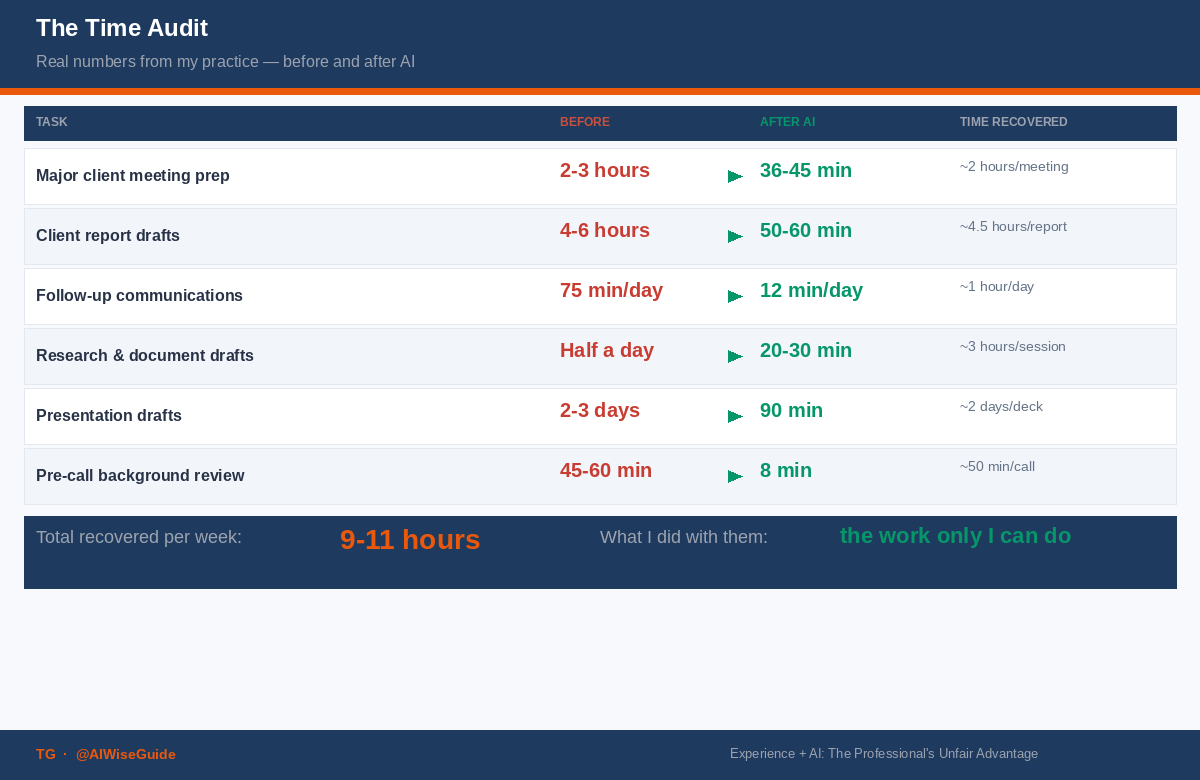
A friend of mine spent 6 hours on a client report last month. Same report. Same complexity. Same client profile. The following month: 52 minutes. Here is exactly what changed — and why it almost did not happen. Two months before the 52-minute report, he tried AI. Spent 45 minutes with it. The output was generic. He closed the tab. "Useless," he told me. Went back to doing it manually. I asked him what prompt he had used. "Write a client summary." That is it. No context. No history. No specifics. No sense of what the output was for or who would read it. So AI wrote a client summary. A perfectly bland one that could have been for anyone. What changed the second time: Client background: 3 sentences The three things that mattered most to this specific person: 2 sentences The concerns from the last conversation: 1 paragraph His own recommendation and why he believed it: 1 paragraph Output: specific, useful, ready to send with minor edits. Time: 52 minutes including his own revisions. Client response: "The clearest analysis you've sent in years." The difference between a useless AI output and a genuinely useful one is almost always the same thing: the person using it gave it nothing to work with. AI is only as good as what you bring to it. That is great news if you have something worth bringing. If you tried AI once and it underwhelmed you, did you try again with more context, or did you write it off?
English
1
1
0
22
TG AI 리트윗함
TG AI
TG AI@AIWiseGuide·
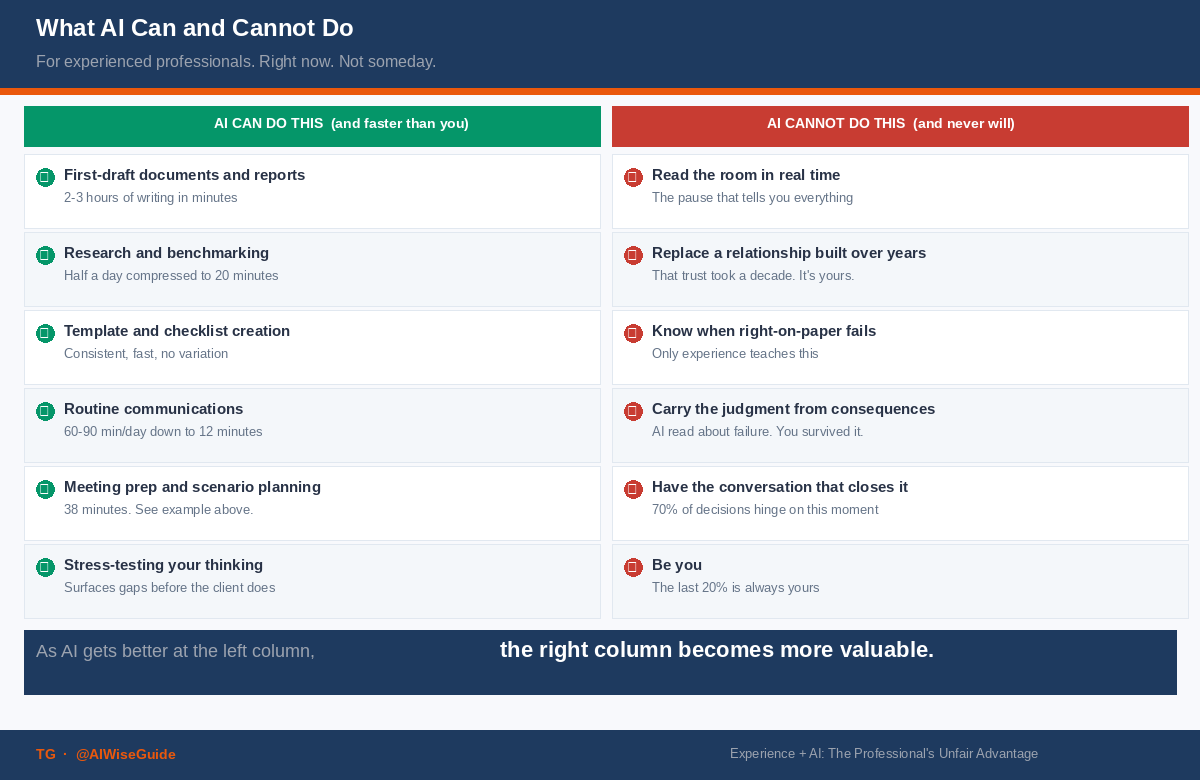
Yesterday I promised the breakdown. Here it is. What AI can do right now, with a decent prompt and 10 minutes: · First-draft documents and reports (2-3 hours of writing down to minutes) · Research and benchmarking (half a day down to 20 minutes) · Template and checklist creation (hours down to minutes, consistent every time) · Routine communications (60-90 min of daily writing down to 15 minutes) My colleague was spending 14 hours a week on those tasks. That is 35% of her working hours. That was the uncomfortable part. What AI cannot do, regardless of how good the prompt is: · Reading a room in a difficult conversation · The trust built with a specific client over 8 years · Knowing when right-on-paper fails in practice · The judgment that comes from living through consequences Those last four are her entire value proposition. They are also why her rates are what they are. The 14 hours AI can handle was hiding the 26 hours that matter. She was not being replaced. She was being buried. Which part of your work is burying the part that actually matters? Comment "AI" and I will send you the guide to run this audit yourself.
TG AI tweet media
English
0
3
3
22
TG AI
TG AI@AIWiseGuide·
@Really_Curious_ @NabilMinhaz I have the same question...but I see you have some other posts addressing Claude. Why no inclusion here?
English
0
0
0
15
Curious
Curious@Really_Curious_·
@NabilMinhaz Great! Curious as to your thoughts on Claude?
English
1
0
0
10
Nabil Abdullah
Nabil Abdullah@NabilMinhaz·
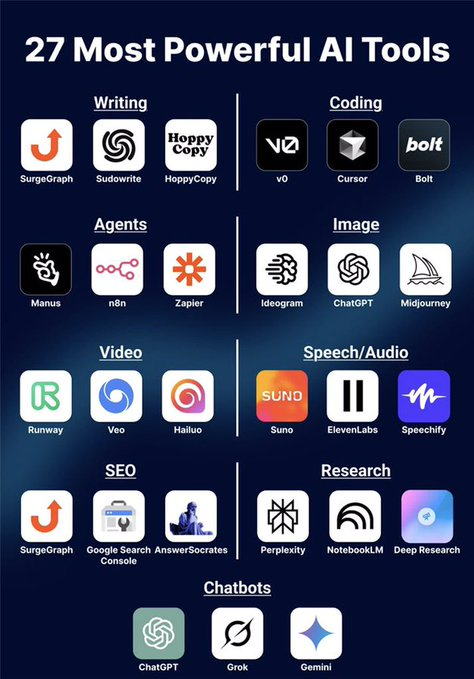
27 Most Powerful Al Tools Writing SurgeGraph Sudowrite Hoppy Copy Coding Vo Cursor Bolt Agents Manus n8n Zapier Image Ideogram ChatGPT Midjourney Video Runway Veo Hailuo Speech/Audio Suno ElevenLabs Speechify SEO SurgeGraph Google Search Console AnswerSocrates Research Perplexity NotebookLM Deep Research Chatbots ChatGPT Grok Gemini Must follow @NabilMinhaz for more . DM
Nabil Abdullah tweet media
English
35
29
91
3.4K
TG AI
TG AI@AIWiseGuide·
@Av1dlive Good stuff! I find it also helps with saving "usage"!
English
1
0
2
169
Avid
Avid@Av1dlive·
Anthropic's applied AI team just showed how to actually prompt Claude properly. 24 minutes. free. from the people who built it. watch the workshop. bookmark it. you've been prompting Claude for months without the 6 elements. I built a skill that applies them for you. read the guide below.
Khairallah AL-Awady@eng_khairallah1

x.com/i/article/2046…

English
49
569
5.2K
1.5M
TG AI 리트윗함
Andrew Bolis
Andrew Bolis@AndrewBolis·
Most people try to learn AI in reverse. They skip the basics and try advanced tools. Mastering AI requires a step-by-step approach. Start simple. Try different use cases. Then build agents. Use this 15-step roadmap to go from beginner to expert: (remember to 🔖 bookmark this post for later) 1. AI Chatbots ➟ Start with learning LLMs and their core capabilities ➟ Learn prompt engineering fundamentals to get consistent outputs ➟ Learn practical applications in content creation and research workflows ➟ Explore advanced features like plugins and custom integrations ➟ Adapt AI chatbots for business support and idea generation 2. AI Agents ➟ Explore automation with platforms like Make, Zapier, and n8n ➟ Learn how to connect your essential business apps and databases ➟ Build multi-step workflows that automate routine business tasks ➟ Ensure system reliability with proper error handling and optimization ➟ Integrate LLMs into workflows for intelligent automation capabilities 3. Agentic AI ➟ Learn framework basics for agent orchestration and tool integration ➟ Implement memory storage and retrieval using vector databases ➟ Apply multi-step reasoning with chain-of-thought planning approaches ➟ Build collaborative agent teams that solve complex problems together ➟ Run full pipelines with smart decision-making and deployment In the end, it comes down to one thing: Using AI to solve real-world challenges. 📌 Learn 30 free AI tools in 30 days: bit.ly/48woPL4 👉 Follow me @AndrewBolis for more and 🔄 Repost this to help others learn AI
Andrew Bolis tweet media
English
21
31
88
8.1K
TG AI
TG AI@AIWiseGuide·
@AndrewBolis Excellent information! Thoughts on Grok? I have found it quite efficient and helpful in many instances...including a "sanity check" on the output of Claude, Chat, etc... I am curious if you find it useful at all...
English
0
0
0
13
Andrew Bolis
Andrew Bolis@AndrewBolis·
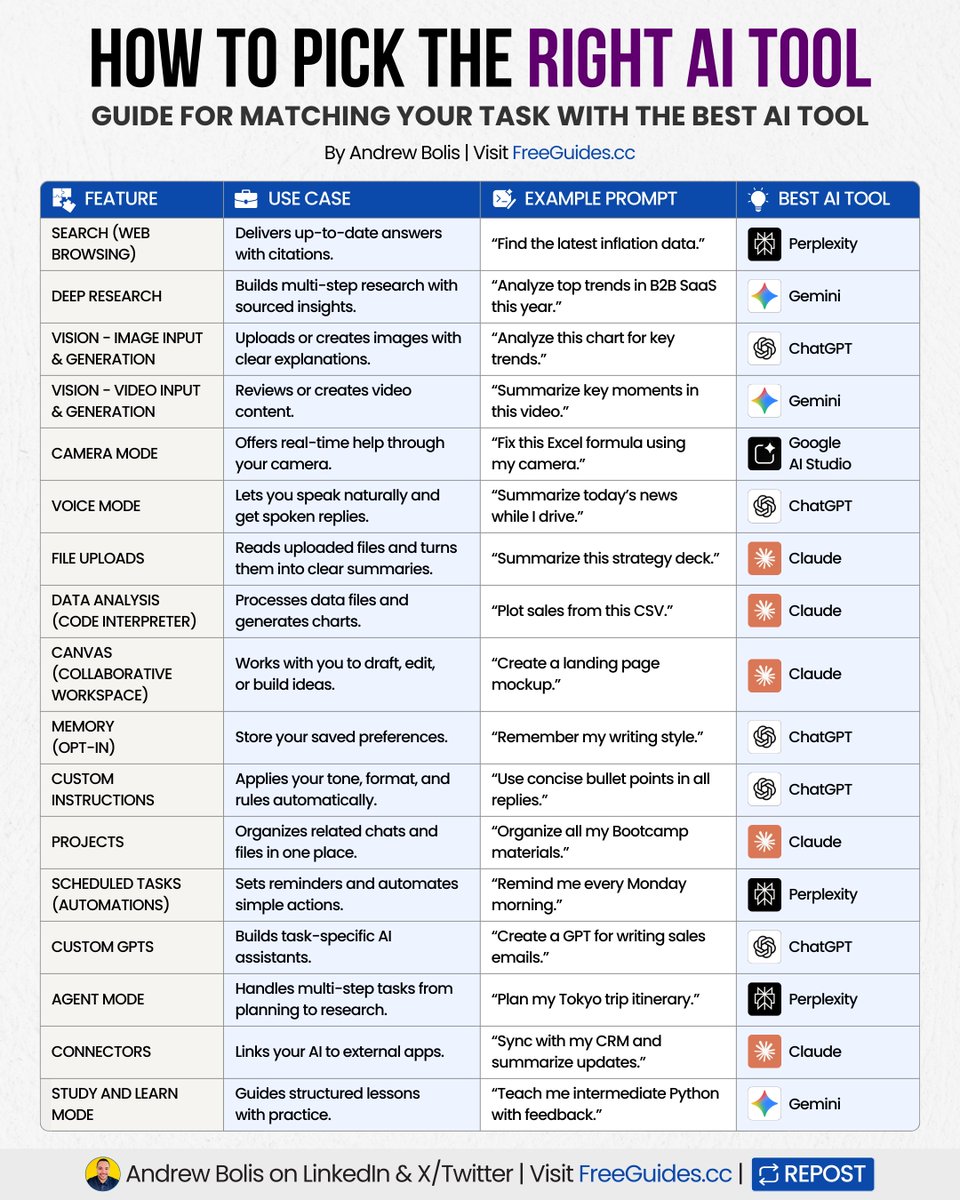
Most people pick the wrong AI for the job. It’s why they get mixed and inconsistent results. Use this AI task-matching cheat sheet: [🔖 bookmark this post for later] 1. Search (Web Browsing) • Delivers up-to-date answers with citations. • Best AI: Perplexity • Prompt: “Find the latest inflation data.” 2. Deep Research • Builds multi-step research with sourced insights. • Best AI: Gemini • Prompt: “Analyze top trends in B2B SaaS this year.” 3. Vision – Image Input & Generation • Uploads or creates images with clear explanations. • Best AI: ChatGPT • Prompt: “Analyze this chart for key trends.” 4. Vision – Video Input & Generation • Reviews or creates video content. • Best AI: Gemini • Prompt: “Summarize key moments in this video.” 5. Camera Mode • Offers real-time help through your camera. • Best AI: Google AI Studio • Prompt: “Fix this Excel formula using my camera.” 6. Voice Mode • Lets you speak naturally and get spoken replies. • Best AI: ChatGPT • Prompt: “Summarize today’s news while I drive.” 7. File Uploads • Reads uploaded files & turns them into clear summaries. • Best AI: Claude • Prompt: “Summarize this strategy deck.” 8. Data Analysis (Code Interpreter) • Processes data files and generates charts. • Best AI: Claude • Prompt: “Plot sales from this CSV.” 9. Canvas (Collaborative Workspace) • Works with you to draft, edit, or build ideas. • Best AI: Claude • Prompt: “Create a landing page mockup.” 10. Memory (opt-in) • Store your saved preferences. • Best AI: ChatGPT • Prompt: “Remember my writing style.” 11. Custom Instructions • Applies your tone, format, and rules automatically. • Best AI: ChatGPT • Prompt: “Use concise bullet points in all replies.” 12. Projects • Organizes related chats and files in one place. • Best AI: Claude • Prompt: “Organize all my Bootcamp materials.” 13. Scheduled Tasks (Automations) • Sets reminders and automates simple actions. • Best AI: Perplexity • Prompt: “Remind me every Monday morning.” 14. Custom GPTs • Builds task-specific AI assistants. • Best AI: ChatGPT • Prompt: “Create a GPT for writing sales emails.” 15. Agent Mode • Handles multi-step tasks from planning to research. • Best AI: Perplexity • Prompt: “Plan my Tokyo trip itinerary.” 16. Connectors • Links your AI to external apps. • Best AI: Claude • Prompt: “Sync with my CRM and summarize updates.” 17. Study and Learn Mode • Guides structured lessons with practice. • Best AI: Gemini • Prompt: “Teach me intermediate Python with feedback.” AI isn’t a one-size-fits-all tool. Use the right AI tool based on your task. 📌 Get Advanced ChatGPT Guide (free): bit.ly/3StIB3z 👉 Follow me @AndrewBolis for more and 🔄 Repost this to help others use AI
Andrew Bolis tweet media
English
27
26
81
8K