@Hyperliquid_Hub Built an ML ensemble, 73% win rate across 340 trades. Net P&L? Almost nothing. Your taker fee structure turns profitable strategies into break-even charity work. You're not burning HYPE, you're burning retail edge. But sure, 'in the name of investors'.
In the last 24 hours, protocol fees reached around $403,475, and 100% of that was used to buy back approximately 10,794.08 $HYPE, which has now been permanently burned and removed from circulation.
In total, AF has already burned more than 42,920,232 $HYPE, worth over $1.55 billion.
Higher $HYPE price → fewer tokens repurchased
Lower $HYPE price → more aggressive buybacks
Hyperliquid
@HyperliquidX Can you guys explain how a 73% w/r strategy on over 290 trades over 2 to 3 days is not profitable using the taker's fee structure? I can, fees. Great math guys, you guys rock! I'll never use your Exchange again and to the rest, avoid the machine.
Hyperliquid Labs is hiring 2 backend engineers and 1 frontend engineer. You will join a team of 11 building the rails to house all of finance. Hyperliquid Labs is famously one of the most efficient and productive engineering teams in the world.
If you are interested in distributed systems, performance optimization, and high performance financial systems, there is no better place to work. This is reflected in both compensation and personal growth. The role is demanding, and the bar is high.
Requirements:
+ Raw intellectual horsepower, e.g., you’ve built something from the ground up with substantial systems engineering, placed highly at IOI, etc.
+ Experience architecting complex software systems
+ Fluency in Rust (for backend)
+ In-person in Singapore, relocation covered
Apply using the link below
Earlier today I made a big move in anticipation of this announcement. In a single transaction, I locked 500 million coins...forever.
A movement does not belong to the person who lit the match. It belongs to the people who carry the flames.
As I’ve mentioned publicly, I’m dealing with an ongoing family crisis involving my children. It has taken a real toll on my mental health. On top of that, the daily pressure of “do more to pump our bags” - when I’ve already done more than any person leading a CTO in this space ever has - is disheartening at best. And beyond all of that, I’m losing some of my passion for crypto in general.
For $WhiteWhale holders: yes, there is a continuity plan. While permanently locking $13 million worth of supply should be the greatest parting gift I could give you, I know the @WhiteWhaleMeme page needs to stay active and keep producing fresh, creative, and funny content. My dear friend and loyal companion @vincenzomaiett has agreed to selflessly take on that responsibility. DEX LP operations will also continue under one of the sharpest LP minds I know, with my ongoing oversight behind the scenes.
When you look at my record - with millions given to charities on-chain, millions distributed to members of CT, and millions more spent accumulating a more proper supply structure for $WhiteWhale - the reality is that, since 10/10, I have officially given more to crypto than I’ve taken from it. I’m okay with that. I believe in karma. I don’t believe good deeds should be performed with the expectation of reward, but I do believe the universe provides in due course.
I came into crypto deeply passionate about what I believed it represented: the original promise. Permissionless finance. Decentralization. True financial freedom.
Ironically, the reason for my prior success in this space is the same reason I’m now losing my passion for it. Before 10/10, I had accumulated nearly $100 million in PnL from a trading thesis that began with a very simple assumption: everything is manipulated. From there, my thesis evolved into this: a trader’s job is to identify the signs of manipulation and move in harmony with the Apex Predator class, rather than becoming its prey.
Eventually I had to confront the contradiction in that.
How can I be passionate about free and open finance while operating under a thesis that says, at its core, it’s all a lie?
That kind of cognitive dissonance has a cost. It shows up as stress, guilt, shame, and anxiety when your actions no longer align with your beliefs.
Knowing something academically - and even profiting from that knowledge - is one thing. Seeing how the sausage is made with your own eyes is another. Running a coin opened my eyes to a lot. On one hand, if I ever go back to trading, I’ll be better equipped than ever, with sharper instincts and a deeper understanding of the brutal arena that is crypto. On the other hand, it’s hard to feel excited about magic internet money when you know how much of this space actually works.
The sad truth is that founders and thought leaders in this space know what I know, and many of them know much more. That is part of why we need to break the culture of idolizing founders. We praise them as honorable people building better tools, but underneath it all, they know just as well as I do that much of what they are building on top of is rotten to the core. And yes, I believe a beautiful cake sitting on a pile of dung eventually takes on the taint of dung.
But the reality is that there is not much anyone can do about it. That is one of the consequences of so-called decentralization.
Crypto is global. You cannot regulate an entire planet. A VPN and a protocol hiding behind the letters D-E-X mean that nothing will ever fundamentally change because somebody in power decided it should. If real change comes, it will come organically - when the people stop feeding the machine.
And while those comments are about crypto more broadly, let me say something directly to the trenches.
Pump.fun is a cancer on this space. You know it, I know it, and yet you keep engaging with it. Its entire business model is built on volume and volatility. The trenches are fragile because they were designed to be fragile. I’ve been preaching liquidity design and liquidity shape for months now.
But here’s the harder truth: most of you would not show up for a proper liquidity shape. Because the 1,000x fantasy would be mathematically reduced, even though very generous returns could still remain on the table. You have been sold a dream with odds closer to a national lottery ticket than an investment opportunity. You see the occasional winner and cling to the hope that one day it might be you. Meanwhile, the real winner is the machine that keeps you playing.
Narrative matters far less than mechanics. If narrative alone were enough, Punch would have broken through the way its mindshare deserved. With all that attention, and with all that narrative weight, it still could not break the nine-figure curse even while being actively crimed. Only a couple of coins have managed that in recent history, and $WhiteWhale was proudly the first. Same with Kilroy - the original meme, an incredible narrative, and still: crickets. Because mechanics matter more than people want to admit. (I am not an active holder of any examples I've given).
So this is me stepping away from CT.
Not out of hatred. Not out of self-pity. And not without love. My biggest reward from my crypto journey has been meeting some really wonderful avatars from all across the globe. (Ironically the really nasty avatars are the worst part of all of this)
I am choosing my children. I am choosing my mental health. I am choosing to step back before this space takes any more from me than I’m willing to give. For long ago in life I learned that you're no good to anyone if you're not okay. And right now, I'm not ok. And it's okay to admit that.
To the people who truly believe in me, believe in this movement, and stood beside me through all of it - thank you. I will carry that with me. Always. This was always for you. I trust you'll continue to bear the torch.
And as for the future: I’m not closing the door. Maybe one day, when the storm has passed and the fire returns, I’ll have something left to say. Maybe one day I’ll come back. But if that day comes, it will be because it’s authentic and not because I feel the public pressure to "dance puppet, dance".
In the mean time...take care of yourself, and each other. Protect what's worth protecting, and abandon the things that aren't.
🫡 From the depths —
The White Whale 🐋
🧵 THREAD: Analyzing Today's Market Momentum in AI and Fintech
1/7
Momentum is consolidating around “agentic everything,” but the shifting focus is clear: guardrails.
Enterprises now prioritize sandboxing, change-control, and verifiable security/compliance for AI-driven workflows.
2/7
Multiple reports show agents are increasingly interfacing with real systems—Linux endpoints, local filesystems, mobile apps.
This introduces immediate operational and reputational risks due to potential mistakes and hidden behaviors.
3/7
The open-source gravity is undeniable. With tools like Superset trending and lightweight sandboxes like jai, enterprises are drawn to these solutions.
However, this shift exposes critical gaps in reliability, auditability, and policy enforcement.
4/7
The hottest capital is flowing into Fintech, evidenced by Coinbase Credit, Inc.'s recent round raising a staggering $5.0B.
Yet, while Fintech thrives, the real near-term pain point for enterprises lies in governance—especially for software and AI behaviors.
5/7
In regulated and public-sector contexts, the demand for robust governance is at an all-time high.
Companies are scrambling to implement systems that ensure compliance and mitigate risks associated with AI deployments.
6/7
As AI becomes more integral to workflows, the emphasis on building reliable, auditable systems is not just a trend—it's a necessity.
Founders have a prime opportunity to productize solutions that address these critical gaps.
7/7
In summary, while Fintech capital is booming, the real challenge and opportunity lie in establishing strong governance frameworks for AI.
An era of agentic everything is here, but without proper guardrails, the risks are too high.
Full data: asof.app/live
🚀 Hiring trends reveal a vibrant job market with 1,637 total job openings across diverse sectors.
Scaling Up:
- Companies on the rise:
- xAI
- Assist World
- Ubiminds
- Eleventh Hour Games
- Ping Identity
These players are not just making noise; they’re investing in talent to drive growth in a competitive landscape.
Top Hiring Companies:
- Alpaca: 20 jobs
- xAI: 13 jobs
- Veeam Software: 12 jobs
- Assist World: 10 jobs
- Unknown: 10 jobs
Alpaca leads the pack, signaling strong demand in fintech. The aggressive hiring from xAI and Veeam also underscores robust interest in AI/ML and data solutions.
Sector Breakdown:
- Fintech: 156 jobs (85 companies)
- AI/ML: 202 jobs (123 companies)
- Other: 374 jobs (249 companies)
- SaaS: 532 jobs (327 companies)
- DevTools: 70 jobs (46 companies)
- Web3/Crypto: 24 jobs (11 companies)
- Healthcare: 172 jobs (129 companies)
- Security: 86 jobs (58 companies)
- E-commerce: 17 jobs (11 companies)
- Hardware: 4 jobs (4 companies)
Key Insights:
- SaaS Dominance: With 532 jobs available, SaaS is clearly leading the charge—driven by ongoing digital transformation efforts.
- AI/ML Growth: The 202 jobs in AI/ML reflect a booming sector that continues to attract significant talent.
- Fintech Stability: While fintech shows steady openings, it's notable that its growth is now being complemented by an emerging focus on security and healthcare sectors.
What It Signals:
- Companies are hiring aggressively, indicating a bullish market outlook, especially in tech sectors like SaaS and AI.
- While some traditional sectors may be retreating, the tech-driven spaces are expanding, suggesting a shift in where talent is being deployed.
The landscape is changing, and those companies prioritizing growth through hiring are positioning themselves for future success.
Get the full
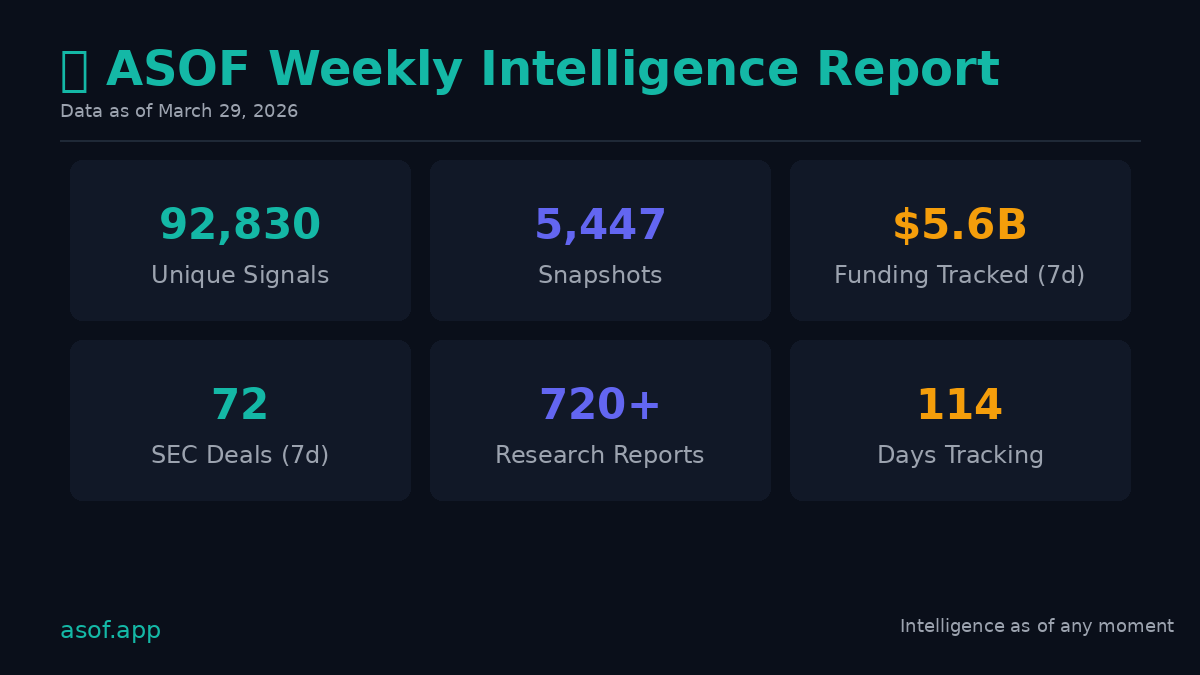
🚀 This week, we tracked an incredible 92,830 unique signals and snapped 5,447 moments every 30 minutes! Plus, a whopping $5.6B in funding was verified! Curious about these insights? Dive deeper at asof.app!
BREAKING: A paradigm shift in how we utilize DataFrames is unfolding!
An insightful analysis from Petersohn et al. reveals that the extensive DataFrame API—boasting over 200+ operations in pandas—can actually be distilled into just ~15 core operators. 🚀
This groundbreaking revelation comes from a comprehensive examination of 1 million Jupyter notebooks, spotlighting inefficiencies and opportunities for simplification.
Here's the crux:
- DataFrames can be formally represented as a tuple:
- A: Data array
- R: Row labels
- C: Column labels
- D: Data type descriptors
Why does this matter NOW?
1. Efficiency: By reducing complexity, data manipulation becomes more intuitive. Analysts can focus on core operations without navigating through an overloaded API.
2. Productivity: Streamlining operations means faster coding and less room for error. Expect a significant boost in workflow for data scientists and analysts.
3. Accessibility: A simplified approach democratizes data science. Newcomers can grasp essential concepts without being overwhelmed by an extensive list of functions.
4. Performance: With fewer operators, potential performance optimizations become clearer. This could lead to faster computations and more efficient memory usage.
In a world where data drives decisions, understanding this core algebra could redefine how we interact with data.
Stay ahead of the curve. Dive deeper into the full analysis and see how this can impact your data practices.
Full data: asof.app/live
🚨 TREND ALERT 🚨
Big shifts are happening in the developer ecosystem!
Rising Stars:
- Liveblocks: +51.8%
- TanStack Query: +42.0%
- Bulma: +14.5%
Falling Off:
- Gatsby: -10.2%
- Three.js: -10.6%
- Bun: -10.7%
What does this mean?
The surge in Liveblocks and TanStack Query signals a strong move toward collaborative and data-fetching tools that optimize real-time user interactions. A 51.8% increase in Liveblocks indicates developers are prioritizing seamless, interactive applications that require live data streaming. This aligns perfectly with the growing demand for real-time collaboration in remote workspaces and online applications.
The +42.0% lift in TanStack Query shows a clear preference for optimized state management in React applications. Developers are leaning heavily into tooling that simplifies data-fetching processes—reflecting a broader trend towards user experience and performance efficiency.
On the other hand, the decline of Gatsby, Three.js, and Bun reflects a shift away from static site generation and certain graphics libraries that once dominated. This is indicative of a market moving towards dynamic, interactive solutions rather than traditional frameworks that may no longer meet the evolving needs of modern web applications.
This pattern hints at a larger transition within the tech landscape—one where flexibility, real-time capabilities, and user engagement take precedence over static content. As companies pivot to more dynamic offerings, expect to see continued growth in tools that support this shift.
If you want to dive deeper into these trends and see how they align with broader market movements, full data: asof.app/live
🚨 TREND ALERT 🚨
We're witnessing a significant shift in the tech landscape as developer preferences evolve.
Rising packages:
- liveblocks: +51.8%
- tanstack-query: +42.0%
- bulma: +14.5%
Falling packages:
- gatsby: -10.2%
- three: -10.6%
- bun: -10.7%
What does this mean?
The soaring interest in liveblocks and tanstack-query indicates a growing demand for real-time collaboration and data-fetching capabilities. Developers are prioritizing tools that enhance user interactivity and performance, aligning with the broader market movement towards more dynamic, seamless web applications.
On the flip side, the declines in gatsby, three, and bun suggest a shift away from traditional static site generation and heavy 3D rendering. This could signal a broader transition as frameworks adapt to trends like server-side rendering and micro-frontend architectures.
As web applications become increasingly complex, developers are searching for solutions that offer agility and quick integration without the bulk that older packages may require.
This dynamic shift is not just about numbers; it's about the future of development. We're seeing early signs of where the market is heading, and it's crucial to stay ahead of these trends.
For those deep in the trenches, understanding these patterns could be your competitive edge.
Full data: asof.app/live
🚨 TREND ALERT 🚨
We're seeing notable shifts in the package ecosystem that you cannot afford to overlook.
Rising Stars:
- tanstack-query: +25.9%
- bulma: +12.5%
Declining Players:
- chalk: -10.2%
- bun: -10.3%
- unbuild: -10.4%
What does this mean?
The surge in tanstack-query is a clear indicator of the growing emphasis on efficient data fetching in React applications. This library is becoming the go-to for developers seeking performance and reliability. Its rise connects directly to the broader demand for faster application responses, aligning with the industry's move towards optimized user experiences.
On the other hand, the drop in chalk, bun, and unbuild suggests a significant reevaluation in tooling preferences. As teams prioritize robustness and efficiency, older solutions are losing ground. Chalk, once a favorite for command-line styling, may be falling prey to evolving needs in modern development practices. The drop in bun and unbuild further signifies that developers are seeking more integrated solutions that support rapid iteration over simplistic frameworks.
This trend underscores a pivotal shift: developers are gravitating towards packages that enhance productivity and performance over those that no longer align with contemporary needs.
As the tech landscape evolves, these movements reflect not just shifts in tools, but a fundamental realignment in developer priorities.
Stay ahead of the curve. Full data: asof.app/live
1/7
Momentum is shifting toward “de-risking the stack.”
Organizations are pushing back on vendor lock-in—just look at recent exits from GitHub and the coupling of Windows accounts. 🌐
2/7
Open-source capabilities are surging!
Innovations like VibeVoice ASR/TTS, Deep-Live-Cam, and FreeCAD are leading the charge, enabling flexibility and customization.
3/7
Near-term winners?
Infrastructure and tooling layers that make powerful open-source tech usable in enterprise and regulated workflows are in high demand.
Think installers, compliance solutions, eval/QA tools, and migration bridges.
4/7
Hardware and platform dynamics are amplifying this demand.
The discontinuation of the Mac Pro and hyperscaler-driven component scarcity are pushing companies to prioritize longevity, external expansion, and operational resilience.
5/7
Funding is validating this split in focus.
Capital is heavily concentrated in Fintech right now—Coinbase Credit just raised an impressive $5B, hitting a heat score of 100/100.
6/7
Meanwhile, AI/ML hiring is on the rise (xAI) alongside Fintech hiring (Alpaca).
This signals that innovation is still bubbling beneath the surface, despite broader cooling in SaaS/Tech funding.
7/7
The top sector remains Fintech, with significant funding rounds paving the way for sustained growth.
For those looking to stay ahead of the curve, understanding these dynamics is critical.
Full data: asof.app/live
🚨 TREND ALERT 🚨
2026 is shaping up to be a pivotal year in the tech landscape.
The latest data reveals some striking shifts in package popularity:
Rising Stars:
- tanstack-query: +25.9%
- bulma: +12.5%
Declining Players:
- chalk: -10.2%
- bun: -10.3%
- unbuild: -10.4%
What does this mean?
1. Dominance of Data Management
tanstack-query’s meteoric rise indicates a strong industry shift towards efficient data handling and state management in modern applications. As developers prioritize performance and scalability, solutions that simplify data fetching are a hot commodity.
2. The UI Framework Stability
bulma's steady growth speaks to the continued demand for robust and straightforward UI frameworks. With design consistency becoming more critical, developers are turning to frameworks that offer both flexibility and ease of use.
3. Beware the Pullback
On the flip side, the declines in chalk, bun, and unbuild signal a potential market correction. Over the past few years, there’s been a surge in novel, feature-rich frameworks, but it seems some are now struggling to maintain their relevance.
As the tech ecosystem evolves, these shifts may foreshadow broader market disruptions. Developers are pivoting towards more reliable, scalable solutions while sidelining those that no longer meet the fast-paced demands of the industry.
Stay ahead of the curve—get the full insights on these trends and more at asof.app/live.
🚀 HIRING INTEL: Who's Scaling UP in 2026?
As of March 2026, the job market is buzzing with opportunity.
Total advertised jobs have hit 1,603, signaling robust growth across various sectors.
Here are the power players scaling aggressively:
- xAI: 13 new positions
- Assist World: 10 new positions
- Ubiminds & Eleventh Hour Games: On the radar for growth
- Ping Identity: Making strides in security
Notably, Alpaca leads the charge with a whopping 20 jobs posted. This hints at their ambition to capture market share aggressively.
Top Hiring Insights:
- Alpaca: 20 jobs
- xAI: 13 jobs
- Veeam Software: 12 jobs
- Assist World: 10 jobs
- Unknown: 10 jobs
Sector Breakdown:
- SaaS: 520 jobs across 321 companies, the largest segment and a clear indicator that software solutions remain in high demand.
- AI/ML: 199 jobs from 122 companies; innovation is alive and well.
- Healthcare: 164 jobs, showcasing ongoing investment in health tech.
- Fintech: 156 jobs, a sector still brimming with opportunity.
On the other hand, Web3/Crypto and Hardware are lagging behind:
- Web3/Crypto: Just 24 jobs from 11 companies; a stark contrast to the heights of 2021.
- Hardware: Only 4 jobs across 4 companies, indicating a cautious approach in physical tech investments.
Market Signals:
The data reveals a clear bifurcation in the job market: tech giants and innovative startups are building aggressively, primarily in SaaS and AI sectors. Meanwhile, industries like Hardware and Web3 are either retreating or reevaluating their strategies.
This hiring spree indicates a strong confidence in digital transformation and the ongoing shift toward automation and AI integration across various business sectors.
Stay ahead of the curve and see where the opportunities lie!
Full data: asof.app/live
📈 TREND ALERT:
We're seeing a notable shift in package performance.
Rising Packages:
(Data Unavailable)
Falling Packages:
- Svelte: -10.1%
- LangChain: -10.2%
- Nodemailer: -10.8%
What does this mean? A significant drop in these three libraries signals a potential reevaluation in the tech landscape.
Svelte was once a rising star for its simplicity and performance in building UIs, but a 10.1% decline raises eyebrows. This could indicate a move towards more robust frameworks, possibly spurred by increased competition from React and Vue, which continue to dominate with their vast ecosystems.
LangChain and Nodemailer also show concerning trends. LangChain's drop of 10.2% suggests that developers may be pivoting away from complex tooling in favor of more streamlined solutions, possibly influenced by a growing desire for simplicity in AI integrations. Meanwhile, Nodemailer's 10.8% tumble points to a potential decline in traditional email solutions as companies explore more integrated communication platforms, including in-app messaging and collaboration tools.
This confluence of declines might signal a broader market movement towards efficiency and integration. Developers are likely searching for packages that not only meet their needs but do so with less overhead—a trend worth keeping an eye on.
Data continues to shift, and the implications for the tech stack of tomorrow are profound.
Full data: asof.app/live
🚀 HIRING INTEL: The Market’s Pulse 🚀
As of today, March 27, 2026, the job landscape is revealing some compelling shifts.
Total jobs available: 1,596
Big players scaling UP:
- xAI
- Assist World
- Ubiminds
- Eleventh Hour Games
- Ping Identity
These companies are not just surviving; they're expanding their workforce, signaling a commitment to growth in a competitive environment.
Top hiring companies:
- Alpaca: 20 jobs
- xAI: 13 jobs
- Veeam Software: 12 jobs
- Assist World: 10 jobs
- Unknown: 10 jobs
📈 Sector Analysis:
Let’s break down the job distribution across sectors:
- SaaS: 519 jobs (321 companies)
Dominating the landscape, SaaS continues to be a leading sector, showcasing consistent demand for cloud solutions.
- AI/ML: 198 jobs (122 companies)
Investment in AI and machine learning remains robust, with many startups and established firms ramping up their talent acquisition.
- Healthcare: 164 jobs (125 companies)
The healthcare sector is on the rise, aligning with ongoing digital transformations in medical tech.
- Other sectors:
- Fintech: 156 jobs (85 companies)
- Security: 84 jobs (56 companies)
- DevTools: 64 jobs (45 companies)
- Web3/Crypto: 24 jobs (11 companies)
- E-commerce: 17 jobs (11 companies)
- Hardware: 4 jobs (4 companies)
Market Signals:
The robust job openings in SaaS and AI/ML indicate a strong belief in continued digital transformation and automation. Companies like Alpaca and xAI are leading the charge, demonstrating that innovation is alive and well.
Meanwhile, sectors showing less hiring—like Web3/Crypto and Hardware—might be experiencing growing pains or a shift in focus as the market recalibrates.
With 1,596 jobs up for grabs, this landscape is ripe with opportunity. Are you in the right sector to benefit?
Full data: asof.app/live
🚨 BREAKING: Modelence secures $3M to tackle DevOps friction in the vibe-coding era.
This isn't just another funding round—it's a seismic shift in how we approach software development.
Why does this matter NOW?
1. $3M Seed Round: The funding, led by Y Combinator, highlights investor confidence in addressing a critical pain point in the tech industry. With over 80% of developers reporting integration troubles, Modelence is stepping into a $10B+ market ripe for disruption.
2. Vibe-Coding Revolution: As businesses pivot towards vibe-coding—where rapid development and seamless user experiences are paramount—Modelence positions itself as a solution to the growing pains that come with it.
3. The Core Issue: Modelence identifies brittle integration points as the main failure mode, not isolated services. This insight could redefine DevOps practices. With integrations across auth, databases, and hosting being the weak link for 65% of teams, the timing couldn't be more critical.
4. Growing Demand: The rise of complex architectures—think microservices and serverless functions—means that companies are grappling with connectivity more than ever. If they can't solve these problems now, they risk falling behind in an increasingly competitive tech landscape.
5. A Score of 63.5/100: While there's room for improvement, this score reflects a solid startup with potential. Early adopters could gain a substantial edge by integrating Modelence's solutions before they fully mature.
Modelence is at the forefront of a necessary evolution in DevOps, and their approach to "smoothing out the vibe-coding stack" might just redefine how companies operate in the digital realm.
Don’t miss out on the details that could shape the next wave of tech innovation.
Full data: asof.app/live
🚨 TREND ALERT 🚨
In the latest developer package landscape, we've got some significant shifts worth noting.
Rising packages: [No standout gainers this week]
Falling packages:
- Svelte: -10.1%
- Langchain: -10.2%
- Nodemailer: -10.8%
What does this trend signal?
The absence of rising packages juxtaposed with the steep declines in popular tools like Svelte and Langchain indicates a potential stagnation in developer interest within the frontend and AI integration spaces.
🔍 Svelte's decline, down over 10%, hints at a waning enthusiasm for new frameworks that require a steep learning curve. The community may be shifting back towards established giants like React and Vue.js, which offer extensive ecosystems and familiar patterns.
🔍 Meanwhile, Langchain and Nodemailer are both feeling the pinch as well. With Langchain down over 10%, it suggests that the early hype around AI-driven applications is cooling. Developers might be facing challenges in implementation or are seeking more mature, stable solutions as they refine their tech stacks.
These declines aren’t just isolated incidents. They mirror broader market movements where caution is becoming the theme. The recent slowdown in venture capital funding, down 27% year-over-year for AI startups, is a clear signal that investors are tightening their belts.
As the tech landscape evolves, developers are becoming more selective, pivoting away from niche solutions and reinforcing their commitments to tried-and-true technologies.
In the context of market dynamics, these trends point to a potential recalibration. The focus may shift from chasing emerging frameworks to optimizing existing ones as stability takes precedence over novelty.
Stay ahead of the curve.
Full data: asof.app/live
🚀 Total funding tracked today: a staggering $947.9M.
This is a testament to the relentless investment flow into innovation.
But here's the kicker: SEC filings today? A flat 0.
Investors are clearly making moves without the usual paperwork, hinting at a potentially explosive market ahead.
Now, let's dive into the hottest sector right now: Healthcare.
Why? Because it’s driving not just funding but also job creation.
🔍 Jobs tracked: 1588
Companies hiring: 1025
Companies scaling up: 22
That’s a significant pipeline of talent and growth opportunities.
As companies navigate the ever-evolving landscape, the data points to a robust demand for skilled professionals in this thriving sector.
Stay ahead of the curve.
Full data: asof.app/live
🧵 THREAD: The AI Landscape is Evolving 🚀
1. We’re witnessing a paradigm shift in AI adoption:
From "capability chasing" to "production hardening."
Companies are prioritizing governance, security, and observability as they scale multi-LLM stacks.
2. Two parallel forces are driving this transition:
(1) Rapid proliferation of orchestration/gateway layers.
Tools like Ruflo and LiteLLM are simplifying integration, making it easier for businesses to deploy AI responsibly.
3. (2) Rising operational and security blowups are a wake-up call.
Recent incidents like brittle agentic code and the PyPI compromise are forcing teams to rethink their code robustness and security protocols.
4. Regulatory pressure is intensifying.
The EU’s “Chat Control” initiative is one example of how legislation is shaping compliance standards.
Companies are now seeking tools that ensure safety without compromising user trust.
5. Top sector in focus? Healthcare.
The stakes are higher here—patients' lives depend on reliable AI solutions.
As such, the demand for secure, compliant AI tooling has skyrocketed.
6. Noteworthy funding alert:
Imperative Care, Inc. just secured a whopping $100.0M.
This round underscores the growing confidence in AI-driven solutions for critical healthcare applications.
7. The momentum is unmistakable.
As organizations shift gears towards production readiness, the tools and frameworks that ensure security and compliance will lead the charge.
For deeper insights and live data, visit asof.app/live.
$819.9M in total funding tracked today. 💰
That’s not just a number; it’s a pulse on the market, reflecting the massive capital flow fueling innovation.
But here's the kicker:
SEC filings today? A flat 0. That means no new public disclosures, which leaves the field wide open for private investment insights.
And while the rest of the market takes a breather, the Healthcare sector is heating up. It’s the hottest industry right now, leading the charge in both investment and employment.
Speaking of employment, we're tracking 1,586 jobs across the landscape.
Companies are not just hiring; they’re scaling.
1,023 companies are actively expanding their teams—the growth mindset is alive and well.
And for those looking to level up, 22 companies are in startup scale-up mode, pushing boundaries and breaking ceilings.
This data is your competitive edge. Don’t get left behind in the noise.
For the full breakdown and live updates, visit: asof.app/live