Denis Pitcher

5.7K posts

Denis Pitcher banner
Denis Pitcher

Denis Pitcher

@DenisPitcher

Entrepreneur, business owner, former Chief Fintech Advisor, coder, worked in finance, trained as an engineer. - not financial advice

Bermuda 가입일 Şubat 2008
1.1K 팔로잉783 팔로워
Denis Pitcher 리트윗함
Students For Liberty
Students For Liberty@sfliberty·
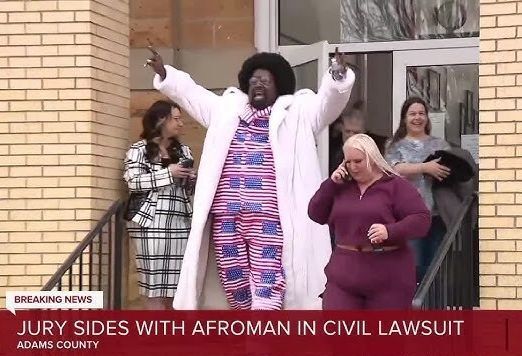
A rapper just defended the Bill of Rights better than most politicians ever have. The police raided his house. Destroyed his door. Found nothing. And then sued him for making songs about it. The jury took less than a day. 🧵
Students For Liberty tweet media
English
64
1.1K
7.3K
374.6K
Denis Pitcher 리트윗함
Tracy Alloway
Tracy Alloway@tracyalloway·
If you haven’t been following this, Afroman’s lawyers have also had some incredible moments — including asking if any reasonable person would think that a man wearing a flag suit in court should be taken seriously
Count Dankula@CountDankulaTV

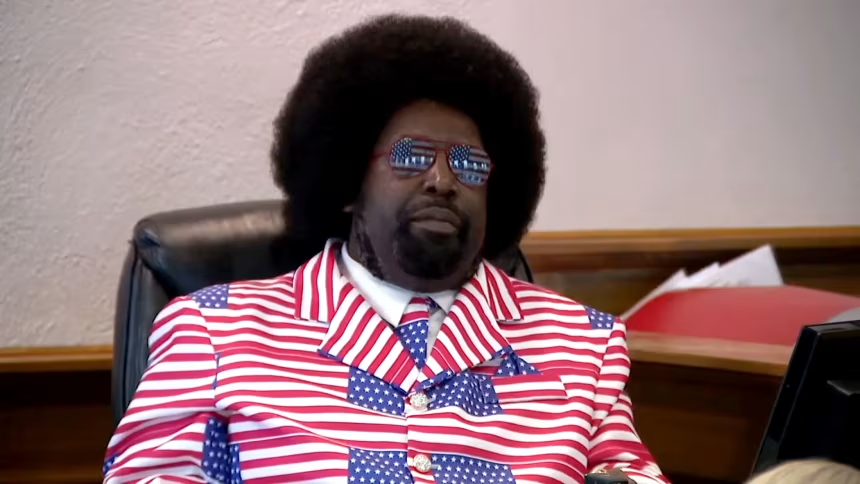
The Afroman Trial. -Cops raid Afromans house for bullshit reasons. -Steal money, break his door, fuck his house up. -No criminality found whatsoever, no charges at all pressed on Afroman. -Afroman spends the next 3 years making songs that make fun of all the officers involved by name, even using footage of the raid from his own CCTV cameras. -Songs had titles like "Randy Walters is a son of a bitch" and "Lick Em Low Lisa" accusing one of the officers of being a lesbian and sleeping with the other officers wives. -During the raid one officer looked like he was about to eat some lemon pound cake sitting on Afromans counter, Afroman made a whole album calling the officer fat. -The cops get mad and file a lawsuit for defamation. -Afroman turns up to court in a whole American flag suit. -Officers performatively mald and cry while listening to the songs really trying to oversell how badly the songs upset them. -One officer was suing because Afroman made a whole song about him saying he was fucking the officers wife. When the officer was asked if Afroman was really fucking his wife, he said "I don't know". Nuking his own case and establishing that there is a non-zero chance that Afroman might actually be fucking his wife. -As his only witness for the trial, Afroman brought a deputies EX FUCKING WIFE. -The jury ruled completely in favour of Afroman. This entire thing has been a great win for free speech and absolutely fucking hilarious.

English
34
417
11K
1.3M
Denis Pitcher 리트윗함
Count Dankula
Count Dankula@CountDankulaTV·
The Afroman Trial. -Cops raid Afromans house for bullshit reasons. -Steal money, break his door, fuck his house up. -No criminality found whatsoever, no charges at all pressed on Afroman. -Afroman spends the next 3 years making songs that make fun of all the officers involved by name, even using footage of the raid from his own CCTV cameras. -Songs had titles like "Randy Walters is a son of a bitch" and "Lick Em Low Lisa" accusing one of the officers of being a lesbian and sleeping with the other officers wives. -During the raid one officer looked like he was about to eat some lemon pound cake sitting on Afromans counter, Afroman made a whole album calling the officer fat. -The cops get mad and file a lawsuit for defamation. -Afroman turns up to court in a whole American flag suit. -Officers performatively mald and cry while listening to the songs really trying to oversell how badly the songs upset them. -One officer was suing because Afroman made a whole song about him saying he was fucking the officers wife. When the officer was asked if Afroman was really fucking his wife, he said "I don't know". Nuking his own case and establishing that there is a non-zero chance that Afroman might actually be fucking his wife. -As his only witness for the trial, Afroman brought a deputies EX FUCKING WIFE. -The jury ruled completely in favour of Afroman. This entire thing has been a great win for free speech and absolutely fucking hilarious.
Count Dankula tweet media
English
1.9K
26.6K
212.8K
12.1M
Denis Pitcher 리트윗함
Anish Moonka
Anish Moonka@AnishA_Moonka·
Every time you get a cancer biopsy, the lab makes a tissue slide that costs about $5. It shows the shape of your cells under a microscope, and every cancer patient already has one on file. There’s a much fancier version of that test called multiplex immunofluorescence (basically a protein-level map showing which immune cells are near your tumor and what they’re doing). It costs thousands of dollars per sample, takes specialized equipment most hospitals don’t have, and barely scales. But it’s the kind of data oncologists need to figure out whether immunotherapy will actually work for you. Right now, only about 20 to 40% of cancer patients respond to immunotherapy, and one of the biggest reasons is that doctors can’t easily tell whether a tumor is “hot” (immune cells actively fighting it) or “cold” (immune system ignoring it). Microsoft, Providence Health, and the University of Washington trained an AI to analyze the $5 slide and predict what the expensive test would show across 21 different protein markers. They called it GigaTIME, trained it on 40 million cells in which both the cheap slide and the expensive test coexisted, and then turned it loose on 14,256 real cancer patients across 51 hospitals in 7 US states. The results landed in Cell, one of the most selective journals in biology. The model generated about 300,000 virtual protein maps covering 24 cancer types and 306 subtypes. It found 1,234 real, verified connections between immune cell behavior, genetic mutations, tumor staging, and patient survival that were previously invisible at this scale. When they tested it against a completely separate database of 10,200 cancer patients, the results matched up almost perfectly (0.88 out of 1.0 agreement). Nature Methods named spatial proteomics (mapping where specific proteins sit inside your tissue) its Method of the Year in 2024, and specifically cited GigaTIME in a March 2026 update as a model that “democratizes” this kind of analysis. The full model is open-source on Hugging Face. Any cancer research lab with archived biopsy slides, and most of them have thousands, can now run virtual immune profiling without buying a single piece of new equipment.
Satya Nadella@satyanadella

We’ve trained a multimodal AI model to turn routine pathology slides into spatial proteomics, with the potential to reduce time and cost while expanding access to cancer care.

English
103
1.8K
11.2K
932.1K
Denis Pitcher 리트윗함
Anish Moonka
Anish Moonka@AnishA_Moonka·
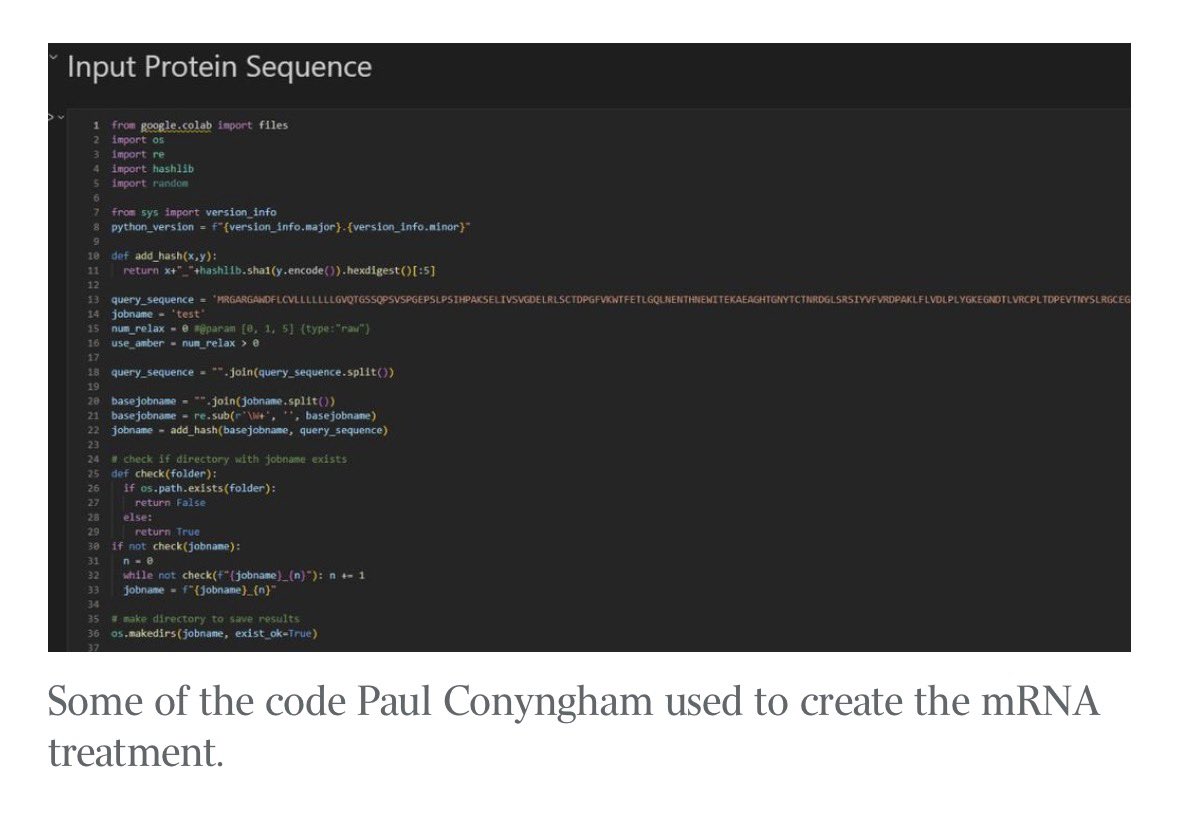
A man in Sydney just built a personalized cancer vaccine for his dying dog. Using AI. With no background in biology. Paul Conyngham adopted Rosie, a staffy-Shar Pei cross, from a shelter in 2019. She’s been with him through some of the worst stretches of his life. “She’s my best mate,” he says. In 2024, Rosie got diagnosed with mast cell cancer, the most common skin cancer in dogs. He threw everything at it. Surgery. Chemo. Immunotherapy. The tumors slowed down but wouldn’t shrink. Vets gave her one to six months. Conyngham works in AI and data science. So he did what he knows. He opened ChatGPT and started asking it what else was possible. That conversation led him somewhere wild. He got Rosie’s tumor sequenced at UNSW’s Ramaciotti Centre for Genomics, basically converting her cancer from tissue into raw data. Then he ran that data through AlphaFold, a Google AI tool that predicts the 3D shape of proteins (it won the Nobel Prize in Chemistry in 2024). He used it to pinpoint the exact mutations driving the cancer and match them to drugs. A genomics professor at UNSW was, in his own words, “gobsmacked” that a guy with zero biology training had pulled together a complete analysis. And then the really hard part started. Not the science. The paperwork. You can’t just create a vaccine and inject your dog in Australia. He spent 3 months writing a 100-page ethics application, two hours every night after work, just to get permission to treat his own pet. The red tape was harder than the actual drug design. Once he cleared that, he connected with Páll Thordarson, director of the UNSW RNA Institute, who built a custom mRNA vaccine (same tech behind the COVID shots) from Conyngham’s data. Sequencing to finished vaccine: less than two months. Conyngham drove 10 hours to the lab with Rosie for her first injection in December. Within a month, the tumor on her leg, roughly tennis ball sized, shrank by up to 75%. Her coat got glossier. She started acting like herself again. The treating vet called it “magical.” Conyngham is now sequencing a second tumor that didn’t respond to the first vaccine, trying to figure out why it’s resistant. The part that keeps rattling around in my head: Moderna and Merck are running billion-dollar Phase 3 trials on a human version of the exact same idea. Their vaccine, mRNA-4157, sequences a patient’s tumor, identifies mutations, and builds a custom vaccine to teach the immune system to attack that specific cancer. Five-year data shows it cut melanoma recurrence by 49%. Expected cost per patient when approved: $100,000–$300,000. Expected approval: around 2027. Over 120 similar trials are running worldwide right now. Conyngham did it for tens of thousands of dollars with free AI tools and university lab access. The tools to build personalized medicine already exist. The bottleneck is a regulatory system still calibrated for a world where designing a treatment took a decade, not eight weeks.
Séb Krier@sebkrier

This is wild. theaustralian.com.au/business/techn…

English
29
175
824
144K
Denis Pitcher 리트윗함
Ejaaz
Ejaaz@cryptopunk7213·
this is so fucking wholesome guy used AI to save his cancer-ridden dog by sequencing its DNA and creating a CUSTOM cure. the tech behind this is fucking awesome (well done @demishassabis and the google team): - used CHATGPT to sequence dogs DNA discovers mutations - ran the mutations through Google’s Alphafold (AI protein sequencer) which CREATED A CUSTOM VACCINE TO TREAT THEM. - treated dog and reduced tumour by 50% in WEEKS. dog is alive and well. - this is the 1st time AI has been used to create a custom vaccine for a dog (and it worked) - dude is now working on similar vaccines for humans using AI! 2026 is definitely the year we see AI change personalised medicine in a HUGE way so sick
Ejaaz tweet mediaEjaaz tweet mediaEjaaz tweet mediaEjaaz tweet media
Séb Krier@sebkrier

This is wild. theaustralian.com.au/business/techn…

English
287
1.4K
10.2K
1.3M
Denis Pitcher
Denis Pitcher@DenisPitcher·
There is a massive paradigm shift happening for those with agency who can properly leverage AI tooling across industries.
Gabe Wilson MD@Gabe__MD

A corporate lawyer named Zack Shapiro just published the most important essay I've read on how AI transforms a profession. It's about law. Every word applies to medicine. His core thesis: AI is not a democratizing force. It is an amplifier. It amplifies excellent judgment into exceptional output. It amplifies poor judgment into faster mistakes. In law, the concept of the "10x lawyer" never existed — not because talent didn't vary, but because the structure of legal work prevented the best lawyers from delivering returns proportional to their ability. Complex deals required teams. Delegation diluted the senior partner's judgment through layers of associates with less context. Time was a hard ceiling. One person simply could not do two hundred hours of work in two weeks. AI removes that ceiling. A senior lawyer with AI can now hold an entire transaction in a single context window, cross-reference six interrelated agreements simultaneously, and produce a complete markup with strategic memo in one working session. What took a five-person team three weeks now takes one excellent lawyer three days. The same structural constraint has existed in medicine. A physician's clinical judgment — the pattern recognition built over thousands of patient encounters — has always been diluted by the production mechanics of care delivery. You can only see so many patients. You can only hold so much of a complex case in working memory. You can only read so many studies. The system compresses the signal from your best physicians into the same throughput as your average ones. AI changes that equation. A physician with excellent clinical judgment using frontier AI models can now hold an entire patient's longitudinal history in context, cross-reference it against current literature, generate and pressure-test a differential, and draft a management plan — in the time it previously took to review the chart. The cognitive bandwidth constraint that made all physicians look roughly equivalent in throughput is dissolving. This is where it gets uncomfortable. The gap between the best and the average is about to become visible in ways the old system could hide. And the market — whether that's patients, health systems, or payers — will reprice accordingly. But here's what most physicians are missing. The physicians dismissing AI because their EHR's built-in tools are underwhelming are making a critical error. They're evaluating a domain-specific wrapper and concluding that AI itself isn't ready. That's like a lawyer dismissing AI because Harvey's interface didn't impress them, while their competitor is using frontier models natively to produce categorically different work. The frontier models are already good enough. The bottleneck was never the technology. The bottleneck is whether you have the judgment to use it and the curiosity to start. Shapiro's full essay is worth reading regardless of your profession. The structural dynamics he describes — the re-sorting of an entire market around individual capability rather than institutional prestige — are not unique to law.


English
0
0
0
37
Denis Pitcher
Denis Pitcher@DenisPitcher·
Dec 1: Price controls introduced Dec 9: Council seeks to "clarify" Ozempic + other branded meds included Dec 23: We report the largest wholesaler not adhering Feb 3: Media coverage – still no visible change Mar 6: Opinion article on uneven application of the rules Mar 12: Medicines (eg Ozempic) moved to “Phase II” – Council announces “no enforcement actions” while it reviews bbc.bm/price-regulati…
English
0
0
0
24
Denis Pitcher 리트윗함
Armani Ferrante
Armani Ferrante@armaniferrante·
I keep seeing terrible advice online for people interested in computer science. AI is making programming knowledge obsolete in the same way interpreted languages made compiled languages obsolete, in the same way compilers made assembly obsoletely, and in the same way assembly made knowledge of circuits obsolete. It didn't. The percentage of people that can go through every layer of the stack will shrink and that knowledge will become more valuable, not less. With more tools, your knowledge base should expand not contract. Learn everything you can, while you're in school--and use AI to accelerate that process. Learn how programming languages work. Learn how computers work. Learn how matrix multiplication is optimized. Learn FFTs are implemented. Learn calculus and linear algebra. Learn optimization. Learn how that all applies to training. Learn how to use the AI tools, but also learn how they are built. The history of computing is the history of abstraction layers being built one on top of the other, and it's only when you can traverse layers of abstraction can you truly build new things. Learn more. Build more.
English
88
163
1.2K
70.8K
Denis Pitcher 리트윗함
Rob Eisenberg
Rob Eisenberg@EisenbergEffect·
This is very context dependent. A solopreneur on a greenfield project can achieve this today. But a huge share of the industry works in legacy codebases, larger teams, and regulated or process-heavy environments, where integration, review, governance, and risk management matter just as much as generating code.
Kent C. Dodds ⚡@kentcdodds

As someone who's already at the spot where agents write 100% of my code, it's crazy to me to see that 28% of responses here think they still won't be there a year from now

English
4
1
19
2.4K
Denis Pitcher
Denis Pitcher@DenisPitcher·
I love hearing "payments are already digital" from guys who barely worked in finance and don't write code. Much of the financial architecture of the planet is running on archaic tech but they act like its perfectly suitable while suggesting you need the latest and greatest phone
Roberto Rios@peruvian_bull

Tradfi guys will bend over backwards to tell you that the incumbent financial system is the safest, most secure and most efficient one that could ever be conceived. Yet they don’t even know that the entire finance backend is made in COBOL, a coding language made literally in the late 1950s for business data processing.

English
0
0
1
44
Denis Pitcher
Denis Pitcher@DenisPitcher·
Its disappointing to see the Premier pledge to match public funds for fintech experiments. I never felt this was necessary. What we need is to create an environment conducive and welcoming to being a test bed. Mind you, while my approach for attracting companies seems to have been successful, it didnt yield results in terms of companies willing to pilot tech locally. I would love to take a crack at it myself to launch a BMD stablecoin backed by BMD gov debt and tie it to an identity solution with no gov funding. Unfortunately capacity is an issue and my challenges with regulators has left me wary that the downside significantly outweighs the upside. The digital id regulatory framework in the last round of consultations also seems to make the prospect of launching a solution from Bermuda unviable if its limited to just id verification. royalgazette.com/international-…
English
0
0
1
27
Denis Pitcher
Denis Pitcher@DenisPitcher·
Bermuda health care is headed for consolidation similar to what we see in grocery, electricity, telecoms. Its a matter of time before most healthcare businesses are owned and operated by a couple players. bbc.bm/insurer-narrow…
English
0
1
1
122
Denis Pitcher
Denis Pitcher@DenisPitcher·
As soon as Bermuda health insurers were allowed to own health provider businesses, the writing was on the wall for independent health providers. The market will consolidate to look like Belco with a couple providers, regulated margins and no incentive to cut costs.
English
0
0
2
157
Denis Pitcher
Denis Pitcher@DenisPitcher·
Its crazy how quickly the personal agent space is evolving.
Aakash Gupta@aakashgupta

The vertical integration pattern is the story here, and it keeps repeating out of Shenzhen. Sipeed built PicoClaw to run on their own $9.90 LicheeRV Nano boards. The company that wrote the software also manufactures the hardware it runs on. That’s the part worth paying attention to. The numbers are absurd. 10MB of RAM vs OpenClaw’s 100MB+. Boot time of 1 second vs 500+ seconds. 95% of the codebase was generated by an AI agent, then human-refined. They shipped it in a single day and hit 5,000 GitHub stars in four. Zoom out and you see the DeepSeek pattern applied to infrastructure. DeepSeek took frontier model training and compressed the cost by 10-20x. PicoClaw takes AI agent orchestration and compresses the hardware requirement by 40x. Both came out of China. Both are open source. Both make Western incumbents look like they’re optimizing for the wrong variable. Sipeed is one of China’s most active RISC-V hardware companies, partnered with Canonical on Ubuntu, shipping everything from $10 dev boards to AI cameras. China’s government is actively pushing RISC-V adoption as an alternative to ARM and x86. PicoClaw running on RISC-V means AI agents on chips with zero Western IP licensing dependencies. The $399 Mac mini comparison in the tweet is funny, but undersells what’s actually at stake. What happens when a billion IoT devices in emerging markets can each run a personal AI agent for under $10 in total hardware cost? That’s the market Sipeed is building toward. And they control both sides of the stack.

English
0
0
0
52
Denis Pitcher
Denis Pitcher@DenisPitcher·
@timourxyz In 1993 I was 12 using gopher to look up information internet and MUDs to play games with people worldwide. It'll take years to cross the chasm of the adoption curve. Seeing the future is recognizing the time it'll take for tech to become accessible m.youtube.com/watch?v=OIRZeb…
English
0
0
0
26
timour kosters
timour kosters@timourxyz·
It's such a weird feeling to feel like you can see the future but be unsure what to do about it. Must be how early internet people felt in like 1993. I just built a JARVIS-style assistant for myself over the weekend that can do ~20% of my job. I can see how it'll do 50% in a week or two. It's mostly Claude Code + Obsidian. In 3-6 months, everyone will have this. Someone is going to figure out how to make it normie-accessible. Maybe one of the big labs, maybe a startup. It's all very exciting and I feel a level of giddy-ness I haven't felt in a while when I'm building it. But I genuinely don't know what the move is. We can clearly see what's coming, but what are you supposed to do about it?
English
42
13
331
17.9K
Denis Pitcher 리트윗함
Eric S. Raymond
Eric S. Raymond@esrtweet·
If you are a software engineer "experiencing some degree of mental health crisis", now hear this, because I've been coding for 50 years since the days of punched cards and I have a salutary kick in your ass to deliver. Get over yourself. Every previous "programming is obsolete" panic has been a bust, and this one's going to be too. The fundamental problem of mismatch between the intentions in human minds and the specifications that a computer can interpret hasn't gone away just because now you can do a lot of your programming in natural language to an LLM. Systems are still complicated. This shit is still difficult. The need for people who specialize in bridging that gap isn't going to go away. As usual, the answer is: upskill yourself and adapt. If a crusty old fart like me can do it, you can too.
Tom Dale@tomdale

I don't know why this week became the tipping point, but nearly every software engineer I've talked to is experiencing some degree of mental health crisis.

English
659
1.8K
15.8K
1.6M
Denis Pitcher
Denis Pitcher@DenisPitcher·
Almost exactly a decade later and the OBA are still operating as Ivory Tower Politicians. It didn't work then and I doubt it will work now. 21square.com/2016/02/ivory-…
English
0
0
0
29
Denis Pitcher
Denis Pitcher@DenisPitcher·
@dampedspring "BTC is dead for that purpose" I wouldn't be so quick to rule it out. The BTC camp seems to remain the most energized and focused on building out infrastructure to broaden its utility into privacy and tokenisation at the moment.
English
0
0
0
16
Andy Constan
Andy Constan@dampedspring·
How do you do fellow kids. I am in now with a small position that will unlikely grow. I will get great pleasure if BTC goes to zero and I lose this investment and will make a bit of money of it bounces. Win win! Please do not follow me as my reasoning is perverse and folks bet way too much in this space. Here is my view While I bought a degen piece of $IBIT today, I am NOT including any of my BTC trading in any of my DS portfolios at all. I am NOT convinced of BTC or crypto more broadly as an investable asset class. My reasoning has been and continues to be that as a store of value digital coins have NOT shown any reliable correlations to other store of value assets, show high correlation to speculative sentiment, have much much too high correlations to equities and are too volatile. While gold has been more volatile lately it is still less than half as volatile as BTC and probably long term closer to 1/4 as volatile AND its volatility is "good" volatility in that it becomes volatile in the direction one would expect as a store of value. I have extensive thoughts on tokenization and block chain and the usage of coins like ETH, SOL, and HYPE and beleive more on chain transactions will need compensation for the transaction processors but BTC is dead for that purpose imho and the others are mostly not supply limited. Anyway that's me current view. Always learning and will have some fun here but crypto is NOT an institutional asset worth owning and I can't justify putting it in my beta portfolio today even at my price. I will play with my degen money and that's that
Andy Constan@dampedspring

Still bid 69,420

English
72
8
291
47.2K