DNA Data Storage Alliance

229 posts

DNA Data Storage Alliance banner
DNA Data Storage Alliance

DNA Data Storage Alliance

@DnaDataStorage

An alliance of leading storage and biotech companies to drive the market of DNA Data Storage. A @SNIA Technology Affiliate.

가입일 Nisan 2021
41 팔로잉807 팔로워
DNA Data Storage Alliance
DNA Data Storage Alliance@DnaDataStorage·
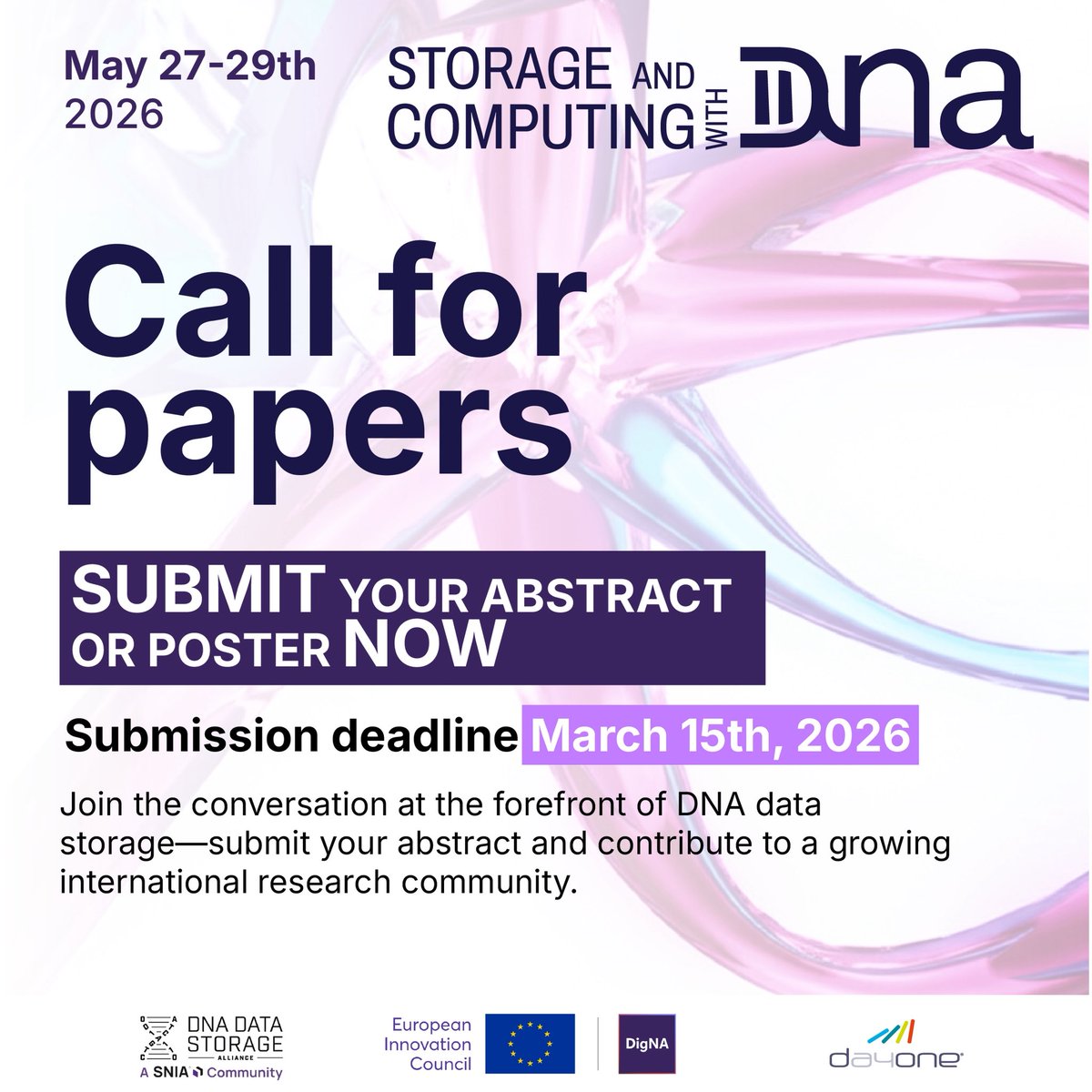
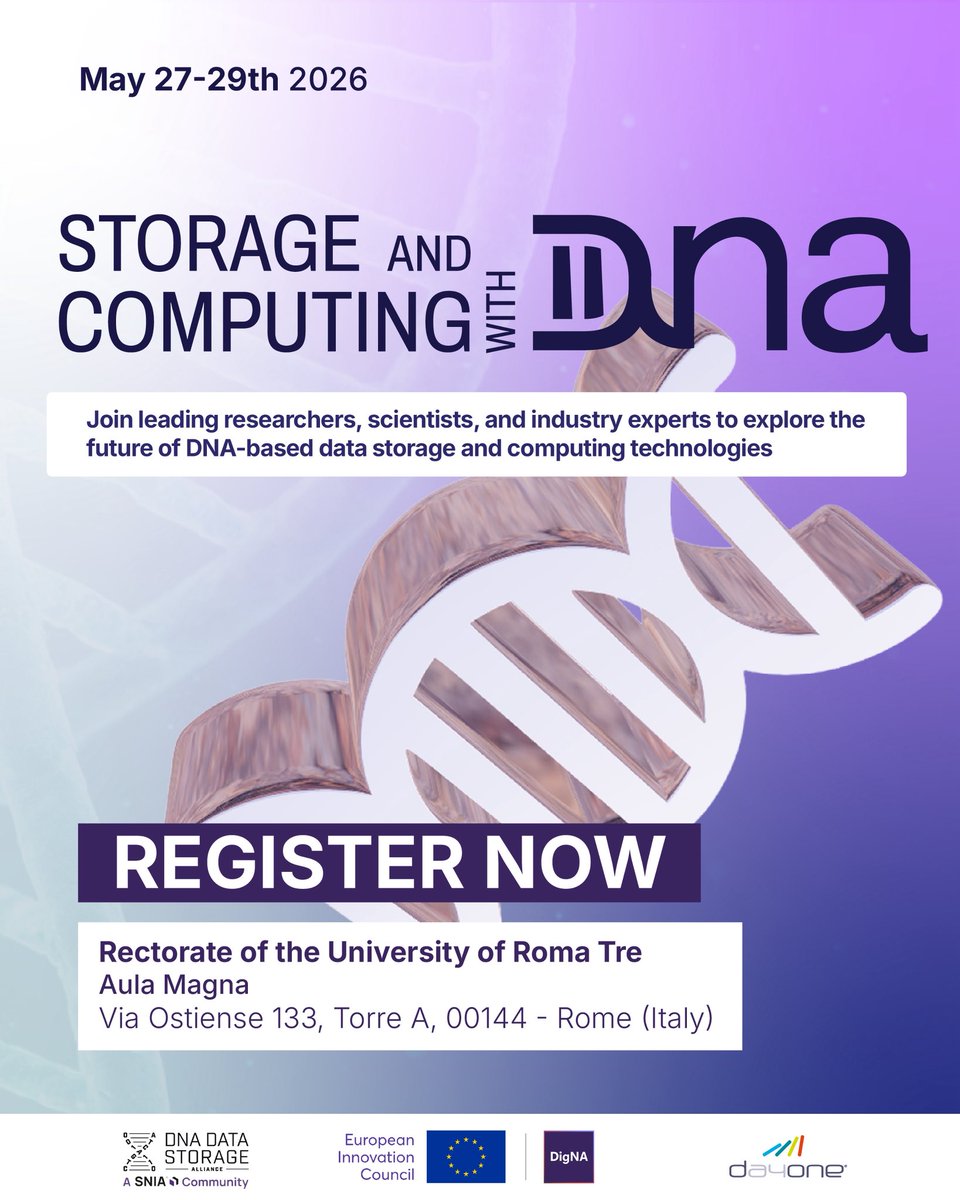
Registration is now open! Join us in Rome from the 27th-29th of May. The conference aims to promote collaboration and innovation by uniting top researchers, industry experts and startups working in the areas of DNA data storage and computing. Register: scdna26.day-one.biz
DNA Data Storage Alliance tweet media
English
0
0
2
75
DNA Data Storage Alliance
DNA Data Storage Alliance@DnaDataStorage·
🧬 Welcome to the DNA Data Storage Alliance Winter 2026 newsletter! DNA Data Storage continues to make progress on multiple fronts. Here’s what’s happening within the Alliance and in the industry right now. linkedin.com/posts/dna-data…
English
0
0
5
78
DNA Data Storage Alliance
DNA Data Storage Alliance@DnaDataStorage·
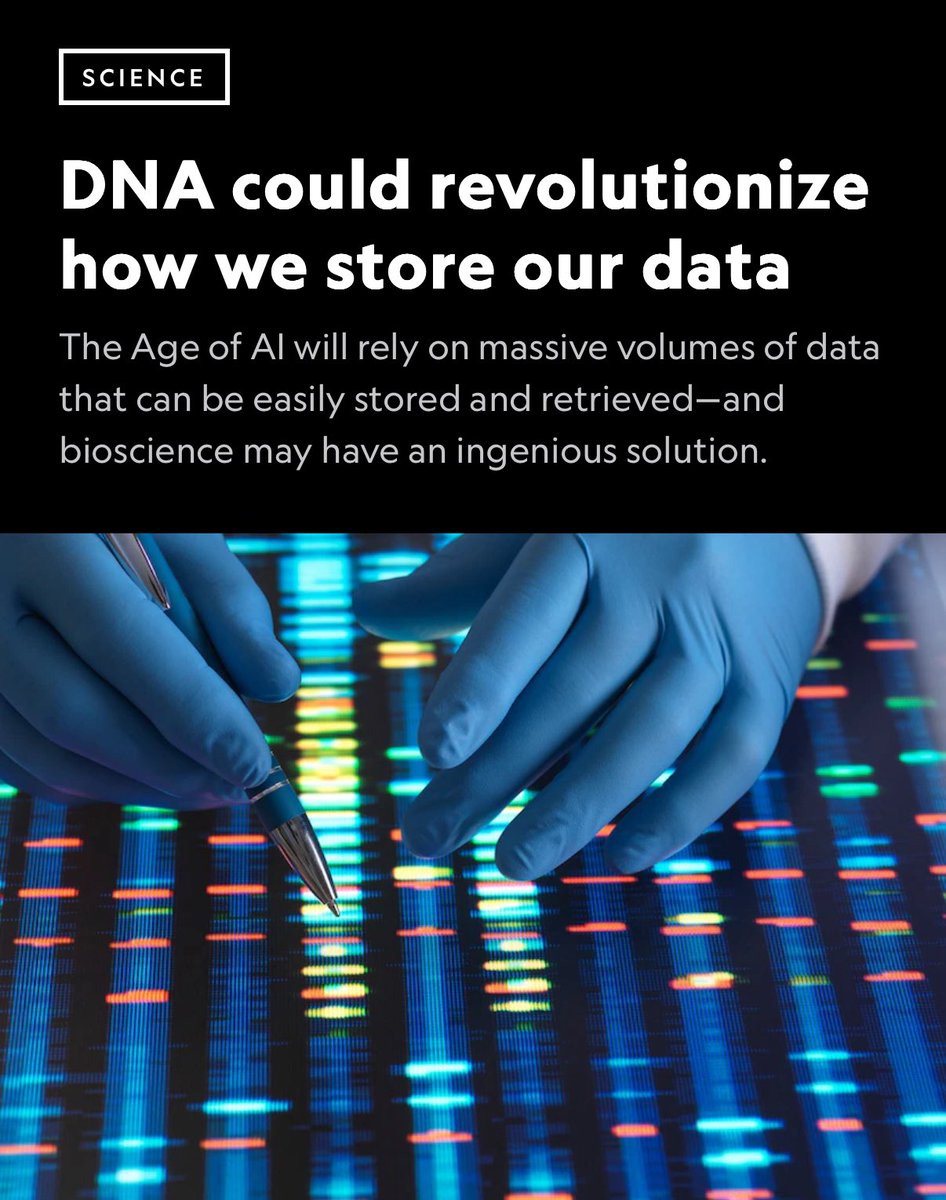
Big data is becoming a big problem. In the face of rising emissions from data centres, researchers are turning to novel solutions for storage. Memory crystals and DNA are two frontrunners. bbc.com/future/article…
English
0
0
3
88
DNA Data Storage Alliance
DNA Data Storage Alliance@DnaDataStorage·
As we look ahead, we are pleased to announce that Vincent Franceschini of Biomemory (SNIA Chairman Emeritus) and Robertas Skliaustas of Genomika Lietuva (DDSA Board Member) will assume leadership of the Alliance as Co-Chairs.
English
0
0
0
64
DNA Data Storage Alliance
DNA Data Storage Alliance@DnaDataStorage·
The DNA Data Storage Alliance is entering a new chapter in its leadership! We extend thanks to our Chair, David Landsman of Western Digital, who is retiring. His leadership & vision have been instrumental in strengthening collaboration across the ecosystem & advancing our mission
English
1
0
1
81
DNA Data Storage Alliance
DNA Data Storage Alliance@DnaDataStorage·
13TB of data in a single water drop! 🧬💧 Alliance member Atlas Data Storage plans to commercialize DNA-based storage by 2026, encoding 13TB of data in a single water drop for ultra-dense, durable archiving. techradar.com/pro/after-near…
English
0
0
0
81
DNA Data Storage Alliance
DNA Data Storage Alliance@DnaDataStorage·
Welcome to the DNA Data Storage Alliance 2025 Fall newsletter! We are sharing our latest white paper, information on how to watch all of the sessions from the Storage and Computing with DNA Conference 2025, news from members and the community, and more! linkedin.com/pulse/top-news…
English
0
0
1
93
DNA Data Storage Alliance 리트윗함
Twist Bioscience
Twist Bioscience@TwistBioscience·
Our head of biosecurity James Diggans is thinking about the necessary safety measures surrounding synthetic DNA so you don’t have to. Full talk from the Storage and Computing with DNA Conference: buff.ly/Ik7PMjM @SNIA @DnaDataStorage @TwistBioscience
English
0
8
7
1.1K
DNA Data Storage Alliance 리트윗함
Niko McCarty.
Niko McCarty.@NikoMcCarty·
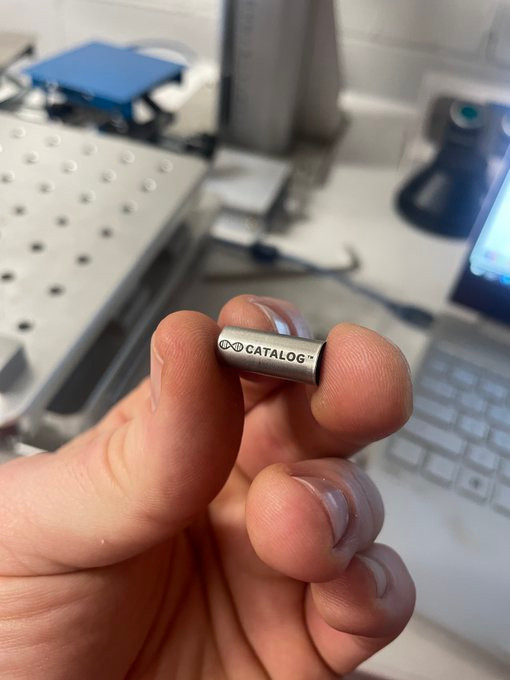
While making the second @AsimovPress book, we asked CATALOG (a DNA computing company in Boston) if they could write it in DNA. And they said yes! But the encoding steps, or how the book was converted to nucleotides, wasn't obvious. Now a new paper explains it all in detail. The open-access paper explains how CATALOG wrote "The Complete Works of William Shakespeare—about 1 million words of text—into DNA with raw error rates rivaling conventional media." Now, a direct encoding scheme would be to simply convert each letter of text into its binary form. So you could say that A = 00, T = 01, C = 10, and G = 11, and then you could go through all the words, convert them into binary, and synthesize the DNA accordingly. But that would not be super efficient and would be super expensive to synthesize! So instead, CATALOG started with a plain text file of Shakespeare, where all the punctuation had been removed and all the words were made lowercase. Then, they split this text into individual words, resulting in 982,890 total words or 29,869 unique words. The final file was only 5 MB. Each unique word was next turned into DNA. The trick here is that CATALOG didn't use a direct encoding scheme, but rather started with 81 short pieces of DNA that they had already made ahead of time. You can think of these 81 sequences a bit like Lego bricks. Then, these "bricks" were partitioned into 14 sets; some sets had 4 bricks, others had 5, and and so on. CATALOG took just the first six sets of DNA bricks (containing 6, 5, 5, 5, 5, 5 bricks, respectively) and used that to write the words in Shakespeare. The other sets were used for retrieval, identifying where in the text the words show up, and so on. They picked exactly one brick from each of these six sets and stuck them together in order, thus making a longer DNA molecule called an identifier. There are 18,750 possible identifiers one can make by connecting a single brick from each of the first six sets. I'm simplfying a bit, but each word was basically assigned a set of 3 different identifiers. (So for the word love, maybe identifiers #984, #12,442, and #17,301 would be selected, and they would synthesize and combine those 3 DNA molecules.) Every unique word in Shakespeare got its own unique pattern of three identifiers, and that pattern is the code for the word. So finally, they went through the Shakespeare text word-by-word, looked up the three identifiers for each word, and told their custom-built DNA printer — a machine called “Shannon” — to make them. Shannon works fast because it just mixes the bricks together into a spot and lets chemistry glue them together automatically. The DNA printing took minutes, and processing the DNA afterwards took a few hours. They checked their work by sequencing the DNA and comparing it to the original text. Only about 2% of the identifiers were wrong before error correction. Read the paper: dl.acm.org/doi/pdf/10.114… Get the book ($30): press.asimov.com/books
Niko McCarty. tweet mediaNiko McCarty. tweet media
English
6
40
215
21.4K
DNA Data Storage Alliance
DNA Data Storage Alliance@DnaDataStorage·
New work from our @DnaDataStorage Alliance members at Technion - Israel Institute of Technology! Dubbed the DNA-Storalator, offers a computational simulation platform for researchers to explore & refine solutions without the prohibitive costs of physical experiments. Read more:
English
1
2
7
199