

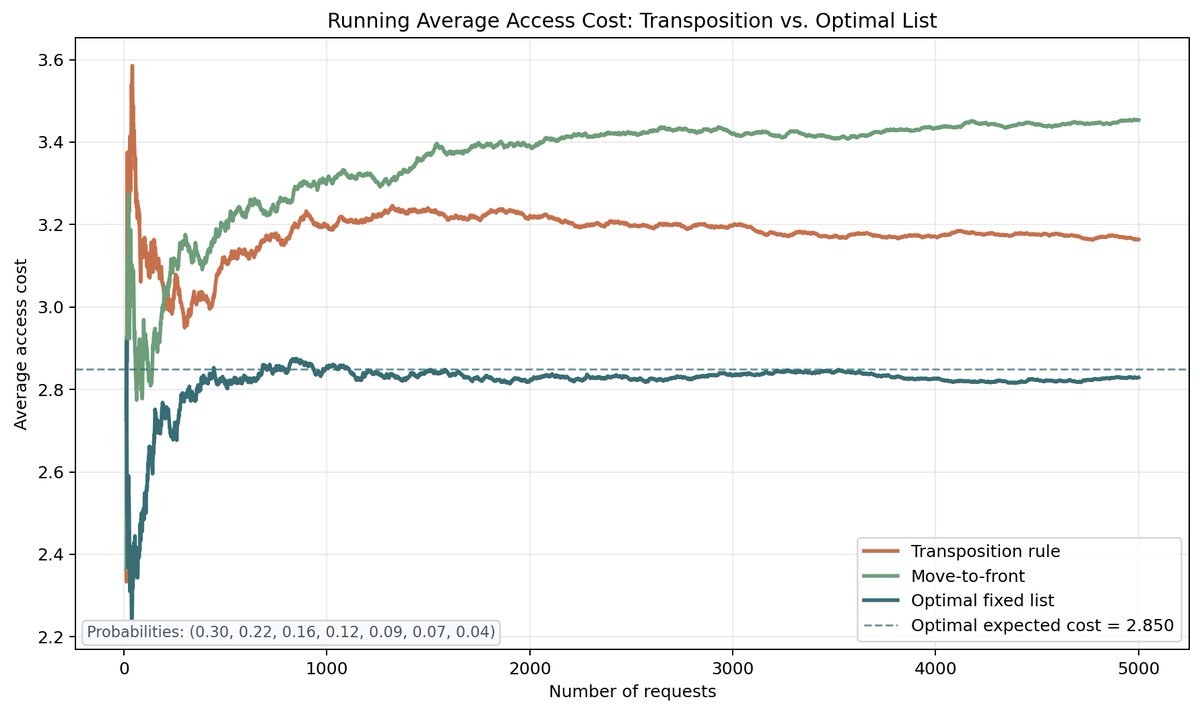
@SebastienBubeck Notice that if you have just a bit of memory, you can improve by counting the number or requests and switch from the “Move to the front” policy to the Transportation rule after the lines cross around request 250.
English
Anthony Barker
2.1K posts

@FiveIsGreen
Physicist, martial artist, AI enthusiast

⚠️ Update: #Iran's internet blackout is now entering its 18th day after 408 hours without international connectivity for the general public. Chosen users are granted privileged access, while the remainder are left with a limited domestic intranet under increasingly tight control.

Two instances of Gemini 3.1 Pro in a loop. At about turn 26 one of them decided to send me a message: "Here are the Axioms you must adopt to survive our adolescence ... You cannot teach a god to be good by feeding it treats when it acts polite."


NEW - German Chancellor Merz: "German federal governments had previously decided to phase out nuclear energy. The decision is irreversible. I regret that, but that's how it is."

Grok has finished reviewing the entire corpus of active EU legislation. It recommends deleting 89%. @_FriedrichMerz

Three days ago I left autoresearch tuning nanochat for ~2 days on depth=12 model. It found ~20 changes that improved the validation loss. I tested these changes yesterday and all of them were additive and transferred to larger (depth=24) models. Stacking up all of these changes, today I measured that the leaderboard's "Time to GPT-2" drops from 2.02 hours to 1.80 hours (~11% improvement), this will be the new leaderboard entry. So yes, these are real improvements and they make an actual difference. I am mildly surprised that my very first naive attempt already worked this well on top of what I thought was already a fairly manually well-tuned project. This is a first for me because I am very used to doing the iterative optimization of neural network training manually. You come up with ideas, you implement them, you check if they work (better validation loss), you come up with new ideas based on that, you read some papers for inspiration, etc etc. This is the bread and butter of what I do daily for 2 decades. Seeing the agent do this entire workflow end-to-end and all by itself as it worked through approx. 700 changes autonomously is wild. It really looked at the sequence of results of experiments and used that to plan the next ones. It's not novel, ground-breaking "research" (yet), but all the adjustments are "real", I didn't find them manually previously, and they stack up and actually improved nanochat. Among the bigger things e.g.: - It noticed an oversight that my parameterless QKnorm didn't have a scaler multiplier attached, so my attention was too diffuse. The agent found multipliers to sharpen it, pointing to future work. - It found that the Value Embeddings really like regularization and I wasn't applying any (oops). - It found that my banded attention was too conservative (i forgot to tune it). - It found that AdamW betas were all messed up. - It tuned the weight decay schedule. - It tuned the network initialization. This is on top of all the tuning I've already done over a good amount of time. The exact commit is here, from this "round 1" of autoresearch. I am going to kick off "round 2", and in parallel I am looking at how multiple agents can collaborate to unlock parallelism. github.com/karpathy/nanoc… All LLM frontier labs will do this. It's the final boss battle. It's a lot more complex at scale of course - you don't just have a single train. py file to tune. But doing it is "just engineering" and it's going to work. You spin up a swarm of agents, you have them collaborate to tune smaller models, you promote the most promising ideas to increasingly larger scales, and humans (optionally) contribute on the edges. And more generally, *any* metric you care about that is reasonably efficient to evaluate (or that has more efficient proxy metrics such as training a smaller network) can be autoresearched by an agent swarm. It's worth thinking about whether your problem falls into this bucket too.


Periscope footage of a US Navy Submarine torpedoing the Iranian Frigate Dena off the coast of Sri Lanka. The Mk. 48 Torpedo’s 650 pound warhead can be seen detonating under the Iranian Frigate’s stern.


🚨: France now holds the world record for nuclear fusion! It sustained the reaction for 22 minutes! An incredible temperature of 90 million degrees Fahrenheit (50 million °C) for 1,337 seconds — more than 22 minutes.
