Niggas and this protein propaganda is getting outa hand. That lil ass 10-15 mg protein ain't doing nan. Y'all niggas go to ya butcher and buy a fucking ribeye and throw out them booty ass protein bagels away
Alcibiades tells us how Socrates is like certain statues of sileni with pipes and such, with doors that open at the stomach and have miniature statuettes of the Olympian gods inside. Socrates not only literally bears a physical resemblance to these figures but, according to Alcibiades, he also has the same spirit as them. Just as all who learn the satyr Marsyas’ flute tunes and repeat them have a magical effect on their listeners, so also not only do those who listen directly to Socrates experience a Dionysian madness but even those who listen to second- hand accounts of his discourses. These discourses have a profound ability to move listeners to tears, and they even make the toughest-skinned or thickest-skulled people, like Alcibiades himself, feel ashamed. Thus Alcibiades spends his life running away from Socrates, so that he can carry on with the politics of pandering to the mob, only to feel heart-rending shame when he once again happens to come face to face with the master. This makes Alcibiades wish Socrates dead and yet at the same time he realizes that if his wish came true, he would really be devastated. In the course of his eulogy, Alcibiades utters these extraordinary words, in which he compares being passionately seized by Socrates’ philosophy to being bitten by a poisonous snake and suffering from a kind of Dionysian madness…
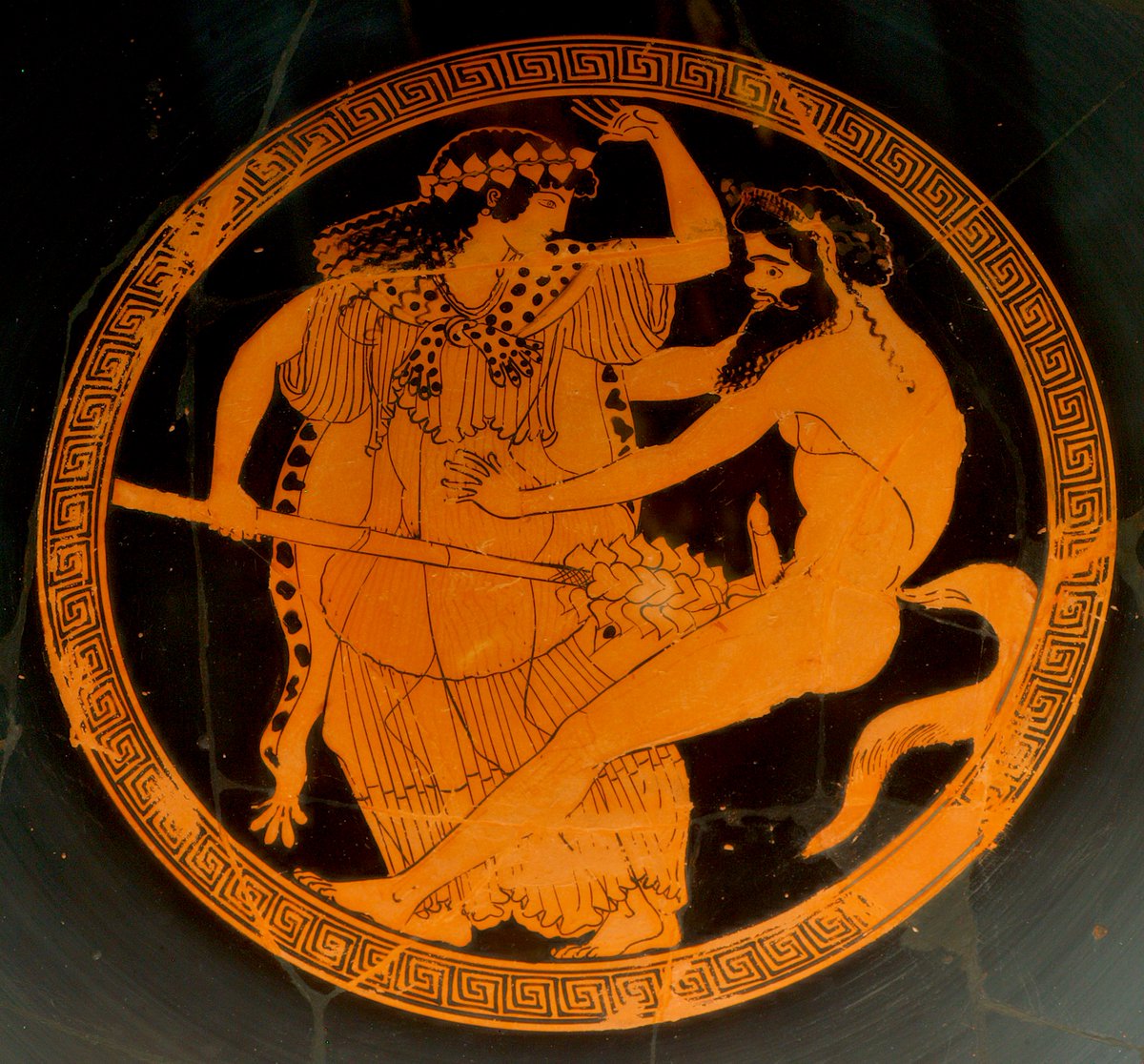
The sileni and the satyr Marsyas were bearded, half-human, half-goatlike beings with huge phalluses and tails, who on the one hand acted like fools, and on the other like sages pronouncing dark oracular sayings. They formed one of two groups of Dionysus’ companions. Members of the other group were the maenads, women who held serpents and staffs entwined with poison ivy in their hands and wore wreath-crowns. Both maenads and sileni played enchanting flute melodies. Nietzsche sees them as a symbol of what is still animal in man, a primal and erotic nature masked by reason and wrought through and through with contradiction. In the mystery rites of the Dionysian cults, by means of intoxication male and female initiates were to be transfigured into dancing Maenads and sileni/satyrs, and thereby symbolically enter into the company of their god. This “companionship” would mean a painfully blissful vision of the chaotic oneness of reality beyond the illusory individuation of beings.
…Nietzsche argued that Greek tragedy originated in the chorus (not the dramatic action) and it was in its most ancient form nothing but the chorus. People of Dionysian spirit desire the truth of nature in its most unforgiving reality and when they achieve this through intoxication they are transformed into satyr-like beings that speak with an oracular wisdom, which flows from comprehending the heart of existence through union with it. This is the chorus in its most ancient form. In tragedy it becomes a realized projection of the desire of the civilized mass of spectators to regain this primordial state. The action is in turn a “vision” of the chorus. Originally the only subject of drama was the suffering and redemption of Dionysus. Moreover, this drama was not actually present but was imagined, literally as a vision of the chorus who in their intoxication were the servants of Dionysus. In music, dance, and words they conveyed this invisible epiphany of their god. The introduction of actors and drama is an Apollonian objectivization—in dreamlike epic imagery—of the Dionysian state of the chorus.
Nietzsche goes on to explain that all of the heroes of tragedy are masks of what was originally none other than Dionysus. The simplicity and clarity of their lines and characters are merely the glimmers of an Apollonian surface of light behind which there looms an infinite background of darkness from out of which they arise (as consolations). In tragedy, the hero’s suffering or demise (originally the dismemberment of Dionysus) is dramatized in order to show that it is a mere phenomenon and the eternal life behind it remains untouched and persists (originally, Dionysus’ rebirth). This suffering and redemption, dismemberment and rebirth, is an expression of the truth of the Dionysian mysteries: that individuation is the source of all suffering and redemption is to be found in the intoxication that allows one to plunge into the primordial unity of all (Dionysus returning to the womb for rebirth).
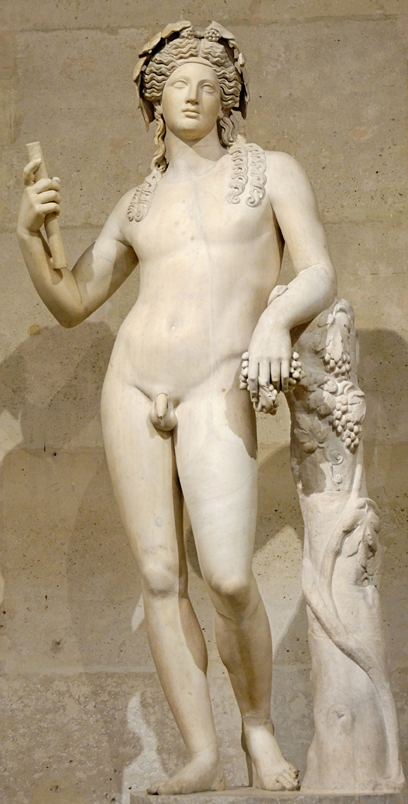
In The Birth of Tragedy, Friedrich Nietzsche radically reinterprets the pre-Socratic period of Greek culture and its epitomizing tragic art in terms of the dynamic balance of two seemingly opposed states — the Apollonian and Dionysian. The former can be understood through the analogy of a dream, particularly a lucid dream, in which both the joys and struggles of life are resolved into a simpler and more perfect form and are thus imbued with greater meaning than a reality that is confusing, contradictory and fragmentary. It is a world of vivid yet merely apparent images. The Apollonian is the basis of the principle of individuation—which provides us with the illusion of a boundary of rational and independent self-hood that guards us from the surging flux of chaos which is the true nature of the world and which would otherwise envelope and swallow us. On the other hand, the nature of the Dionysian can be comprehended through the analogy of intoxication. In this state the forms of rationality that sustain the principle of individuation are compromised and revealed as limited, or they collapse altogether. This results at once in a tremendous feeling of horror in the subject, which is swallowed by chaos, and also a tremendous feeling of ecstasy and rapture, which rises up from the most profound depth of humanity. This ecstasy is really the ecstasy of nature’s self-satisfaction in man. In the Dionysian the son of humanity is reunited in communion with Mother Nature—for whom there is great awe and reverence. Not only do the subjective boundaries between people re-dissolve into a primordial unity, but also the boundary between humanity and the earthly element. Human being itself becomes a work of art, a rapturous embodiment of Nature’s creative force.
– Jason Reza Jorjani, LOVERS OF SOPHIA
Nietzsche saw Prometheus as a mask of Dionysus in the age of Greek tragedy, and Dionysus is the best friend of Artemis. It is Artemis, not Prometheus, who is the deepest and most central archetypal figure animating my corpus. “The name of the bow is life; its work is death.” This is, of course, a cryptic reference to Artemis on the part of Heraclitus, who took refuge in her temple at Ephesus for the remainder of his life, following the contemptible democratic revolt of his city-state against the Persian Empire.
– Jason Reza Jorjani, EROSOPHIA
Been waiting with eager anticipation for this to arrive. Anyone read it or have thoughts?
The felt experience of time is, I think, a vital thing to appreciate from this era.
How did it compare with the Bronze Age appreciation of time? How are both conceptions different from today? What questions emerge?
This is my agenda as I attack the book.
Tried to roll a joint in an art school bathroom because I’m addicted to weed and also have a massive wound but I bought these tiny cones that take a lot of focus. I hate social interaction so I’ve gotta power through these cones.
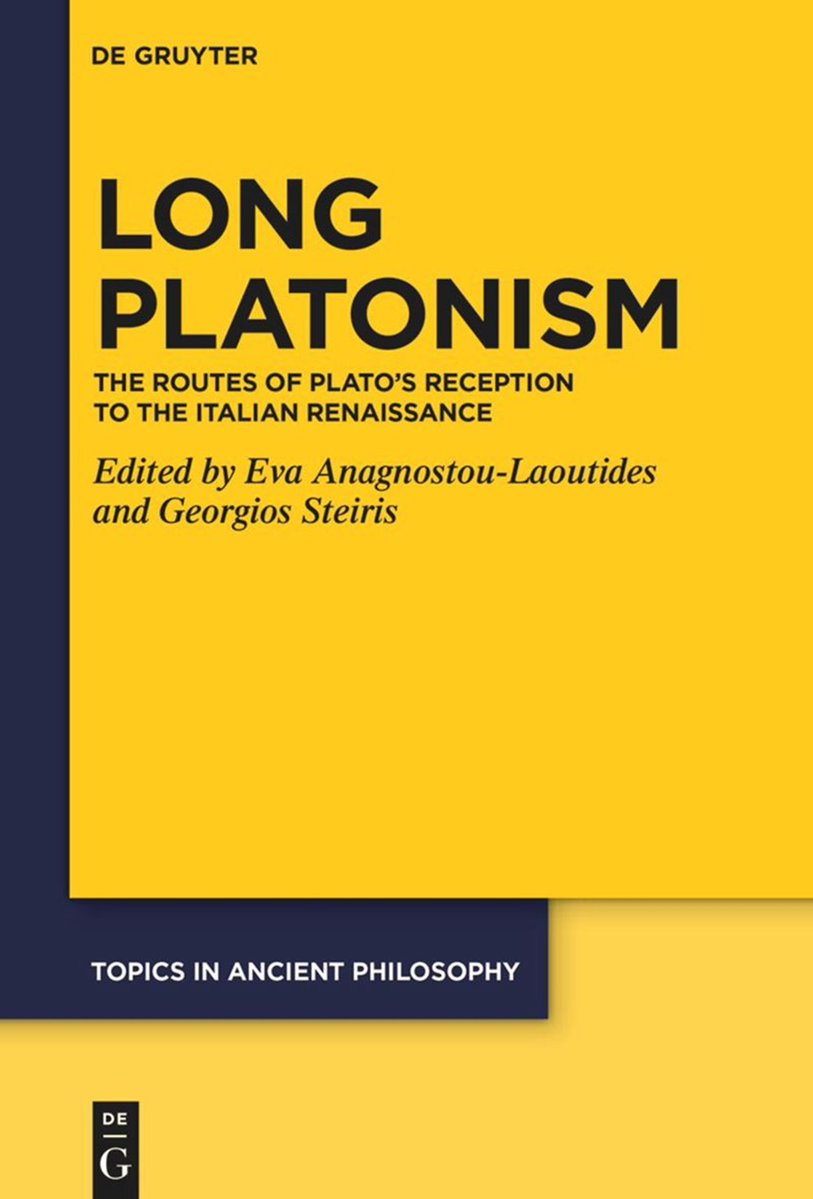
After 7 years of intensive work, the volume “Long Platonism: The Routes of Plato’s Reception to the Italian Renaissance” (662 pages) has been published today by De Gruyter–Brill, the result of my collaboration with E. Anagnostou-Laoutides @anagnostou_eva#Plato#Platonism 1/2
@Gnosisinformant@gsteiris@anagnostou_eva This book looks like a heavy hitter! It definitely sounds like some of the recent videos you been making on platonism and the Bible