
고정된 트윗
ICC Watch
5.8K posts

ICC Watch
@ICCwatch
Monitoring the activities of the International Criminal Court and examining claims of institutional racism and corruption. Following and RTs ≠ endorsement
가입일 Ocak 2013
4.8K 팔로잉1.4K 팔로워
When justice becomes a weapon: Tanzania and the politics of the ICC
dailynews.co.tz/?p=120728
English
Stakeholders questions ICC governance in the pursuit of global justice
dailynews.co.tz/?p=136369
English
India and the International Criminal Court
toaep.org/pbs-pdf/54-bais
English
"We ask whether . . . the premise and promise of international criminal justice can — for self-determination struggles or anti-imperial movements in the global South — be anything more than illusory.
‘The Dark Corners of the World’ academic.oup.com/jicj/article-a…
English
"[T]the International Criminal Court (ICC) has been met with resistance by various African states and their leaders, who see the court as a new iteration of colonial violence and control."
read.dukeupress.edu/books/book/267…
English
"The critique of International Criminal Law as a Western project rests on historically and empirically solid ground."
verfassungsblog.de/international-…
English
Force, Vetoes, and Sanctions: Why the ICC Can’t Touch a US President jurist.org/commentary/?p=…
English
The ICC has only had three Chief Prsoecutors to date. Two of them have been mired in sordid sexual scandals, despite pledges to address gender violence...
ICC moves ahead with disciplinary proceedings against chief prosecutor: WSJ news.cgtn.com/news/2026-04-0… via @cgtnofficial
English
Why the International Criminal Court Isn’t Taking On Iran by @EVKontorovich wsj.com/opinion/why-th… via @WSJopinion
English
The sexist and racist ICC is up to it's old tricks again trying to ignore yet another sexual scandal.
International Criminal Court: Exposing the misogyny in the handling of the sexual misconduct allegations against the Prosecutor fidh.org/en/issues/inte… via @fidh_en
English
An Insight into the Reality of the International Criminal Court
thenigerianvoice.com/amp/news/36509…
English
How sanctions can weaponize US tech against the ICC justiceinfo.net/en/156691-how-…
English
Support for Duterte’s ICC trial has halved in a year. Here’s why
sc.mp/b3t0w?utm_sour… via @scmpnews
English
The real story behind the ICC's indictment of Benjamin Netanyahu and Yoav Gallant
“Hiding Behind Atrocities” open.substack.com/pub/dropsitene…
English
ICC Watch 리트윗함

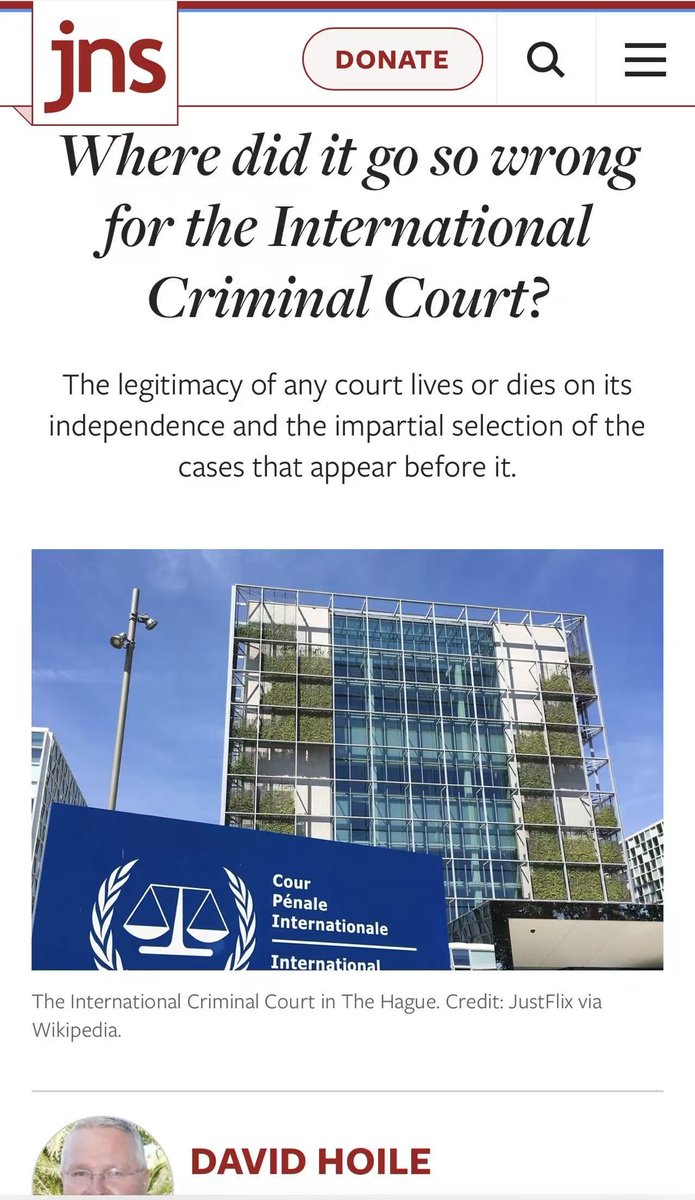
Where did it go so wrong for the International Criminal Court?
By: David Hoile, the author of Justice Denied: The Reality of the International Criminal Court.
February 21, 2026
The legitimacy of any court lives or dies on its independence and the impartial selection of the cases that appear before it.
The doyen of international jurists, Georg Schwarzenberger, writing in the wake of the Nuremberg and Tokyo military tribunals, observed that international lawyers suffered from a “professional disease against which other members of the legal profession are remarkably immune”: an overzealous legal evangelism that failed to distinguish between commendable values and existing realities.
The most mistaken lawyers, he observed, were those who believe in the existence of an “international criminal law.”
H. L. A. Hart, whose contribution to analytical jurisprudence shaped the landscape of legal philosophy in the Anglo-American sphere and beyond, also believed international law to be problematic inasmuch as its ill-defined nature means that it does not have all the elements of a fully developed judicial system, especially with regard to procedural safeguards that ensure the due process of law.
The International Criminal Court in The Hague, established by the 1998 Rome Statute and which opened its doors in 2002, was nevertheless the product of a tide of legal evangelism that marked the 1990s.
Public international law scholar Professor Christine Schwöbel observed: “The branding of [international criminal law] is one of a discipline fighting impunity, a beacon of global justice, and the heroic few internationalists who dare to fight big power-players.”
Many saw the court, charged with prosecuting individuals for genocide, crimes against humanity, war crimes and the supreme crime of aggression if and when its member states were unwilling or unable to do so, as the shining apex of international justice and adjunct of global liberal governance. The ICC has been projected as “speaking in the name of” the international community and taking action on behalf of victims of injustice and impunity, victims of the most serious of crimes “for the sake of humanity.”
Amnesty International, for example, has referred to the court as “prosecuting crimes in the name of international justice,” a glittering legal citadel.
The legitimacy of any court lives or dies on its independence and the impartial selection of the cases that appear before it. Accusations of “victor’s justice” and the retroactive criminalization of aggression had dogged the post-war Nuremberg tribunal.
Subsequent international criminal courts have been in the spotlight over certain cases they select. This concern was said to have been addressed in the Rome Statute through the creation of an independent prosecutor. Article 15 (1) of the Statute provides that “the prosecutor may initiate investigations proprio motu [at his or her own discretion] on the basis of information on crimes within the jurisdiction of the court,” as opposed to opening an investigation following a formal referral by an ICC member state (Article 14 of the Statute) or by the U.N. Security Council (Article 13 (b) of the Statute).
The reality is that regardless of how robust the statute’s procedural safeguards may or may not be on paper, they are all for naught if the structure in place is in the hands of questionable prosecutors with a political agenda and/or, to be generous, a questionable grasp of judicial procedures. This is further exacerbated if the checks and balances one would normally expect to be in play on the bench are absent because of questionable judges with little or no real judicial expertise or courtroom experience, themselves the result of vetting by unaccountable non-governmental organizations and approved by corrupt vote-trading.
Far from a shining example of judicial brilliance, the court has had prosecutors who appear to be unaware of the inconvenient concept of the presumption of innocence and willing to hide exculpatory evidence from both judges and the defense in trials described by the pro-ICC Economist as “bumbling,” “chaotic” and “near-farcical,” and by legal bloggers as “slapstick comedy.”
Prominent legal blogger and ICC enthusiast Professor Mark Kersten has observed that far from being independent, “The court demonstrated a bias towards both major Western powers as well as despots.” He has further noted that “a string of controversies and unnecessary failures always seemed to follow the ICC … Staff were wrongfully dismissed. Cases collapsed under weak evidence.” One of the ICC’s godfathers, legal scholar Professor William Schabas, even placed on record that the ICC has convicted people of crimes they never committed.
The ICC has well and truly fallen short of the claims made on its behalf. The result has been a fatally flawed court that has paid ineffectual lip service to the crime of aggression; prolonged conflict rather than deterred it; entrenched impunity for despots and its own European funders; afforded immunity to powerful states and funders; and, in serving as an instrument of European foreign policy, has engaged in racial profiling of black Africans on a continental scale.
It is a court that has flouted cornerstones of customary international law, such as the 1961 Vienna Convention on Diplomatic Relations regarding immunity for Heads-of-State and the 1969 Vienna Convention on the Law of Treaties. Politicized ICC rulings have been dismissed by leading international law scholars, including Britain’s International Court of Justice candidate Professor Dapo Akande, as “extremely controversial,” “inconsistent,” “stunning,” “deeply misguided,” “very dangerous and unwise,” and “very poorly reasoned.”
When did it start to go wrong? The answer is from the very beginning.
Schabas, a key participant observer in the creation of the ICC, also candidly admitted that “[t]he final version of the Rome Statute [establishing the ICC] is not without serious flaws.”
These are the last words one would wish to hear about a body presented as a shining legal Camelot. Here we have the irreparable hole in the heart of the ICC since its establishment in 2002. The combination of legal evangelism, a seriously flawed statute, and lackluster jurists has been fatal to this vision of international justice.
Link: jns.org/where-did-it-g…
English
This is nothing more than a political showtrial by a dysfunction and discredited wannabe court. It also violates its own Statute in ignoring Filipino courts.
@PhilippineStar @indaysara
Duterte’s drug war faces judgement at the ICC aje.news/s3vnsm via @AJEnglish
English
The Russian perspective on the International Criminal Court
International Criminal Court: a Puppet Institution orinocotribune.com/international-…
English
The ICC is an international NGO masquerading as a court. President Duterte should not recognise its competence.
globalnation.inquirer.net/310480/pulong-…
English
Why the ICC Should Respect Immunities of Heads of Third States
justsecurity.org/108885/icc-imm…
English