Jorge Alberto

243 posts

Jorge Alberto banner
Jorge Alberto

Jorge Alberto

@JorgeA77832

AWS SDE - opinions my own. Prev ML @ AFRL. AI infra and RL enthusiast, stonks sometimes too

Washington, DC 가입일 Şubat 2025
248 팔로잉35 팔로워
Jorge Alberto 리트윗함
Benjamin De Kraker
Benjamin De Kraker@BenjaminDEKR·
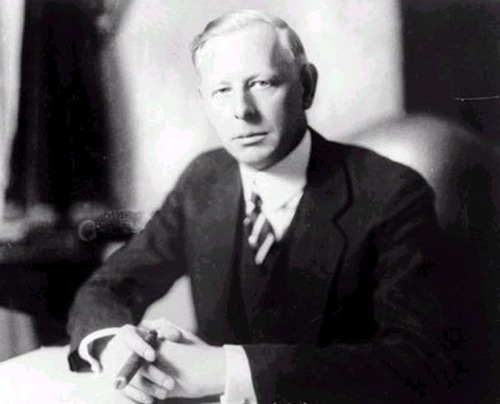
Elon Musk and SpaceX President Gwyneth Paltrow (left), 2010

Benjamin De Kraker tweet media
English
17
17
1.2K
61.2K
Jorge Alberto
Jorge Alberto@JorgeA77832·
Uber has a problem with underestimating wait times and drivers randomly refusing pickup. Short $UBER
English
0
0
0
32
Jorge Alberto 리트윗함
MTS
MTS@MTSlive·
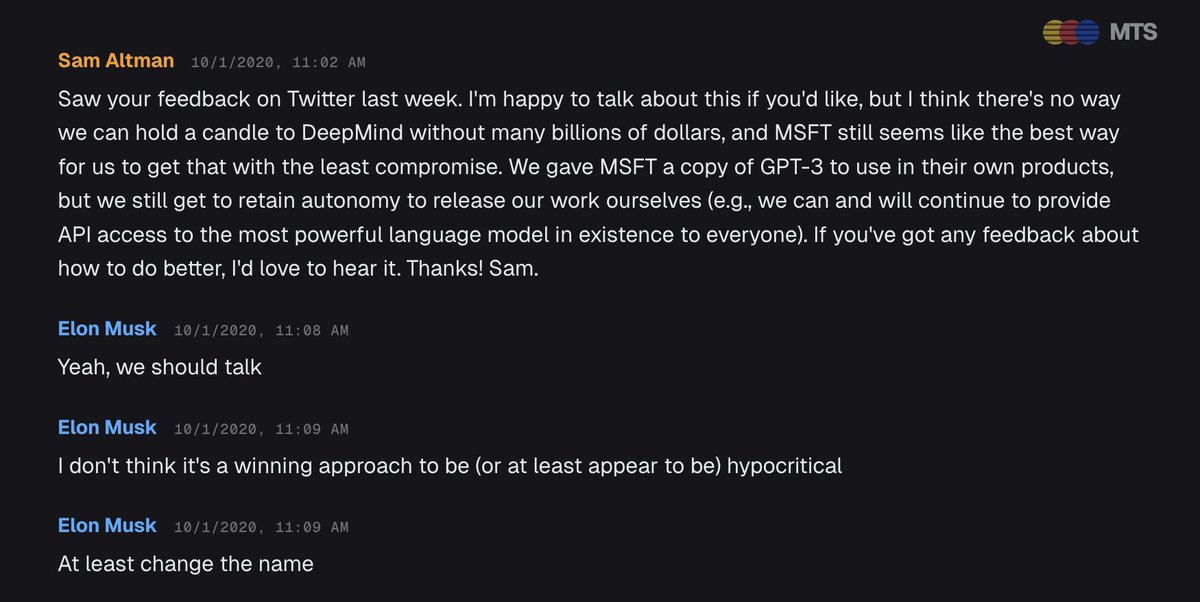
We built a way to explore everything that's been entered into evidence for the Musk v. Altman trial. Greg's journal. Texts between Elon and Sam. OpenAI's LP agreement and more. All at our latest drop: evidence.mts.now
MTS tweet media
English
42
57
687
690.6K
Chubby♨️
Chubby♨️@kimmonismus·
Okay Anthropic, show us what you could do with 220,000 NVIDIA GPUs and 310MW.
English
66
55
2.2K
76.7K
Jorge Alberto 리트윗함
Armin Ronacher ⇌
Armin Ronacher ⇌@mitsuhiko·
Also pretty much everybody I talked to, who has been exposed to this yet: having non engineers ship code sucks for every engineer on the org. I would not (at least at present) advertise that.
English
22
15
647
40.8K
Jorge Alberto
Jorge Alberto@JorgeA77832·
@tengyanAI now imagine if ASML raises prices to capture the margins i'm surprises they haven't done so yet, given how they're the bottleneck for the entire AI supply chain
English
0
0
1
54
Teng Yan
Teng Yan@tengyanAI·
now imagine if TSMC raises prices to capture the margins i'm surprised they haven't done so yet, given how they're the bottleneck for the entire AI + consumer electronics supply chain
Macro_Lin | 市场观察员@LinQingV

AI Didn't Just Create a Chip Shortage. It Created a Customer Hierarchy. Last week, Tim Cook told analysts that Mac mini and Mac Studio shortages could last "several months." The cause was not what most expected. Demand for these machines as local AI platforms, running agentic tools like OpenClaw, surged far beyond Apple's forecast. Cook said the company simply "under-called the demand." Some configurations are listed as "Currently Unavailable" on Apple's store. The Mac Studio with 512GB RAM has been delisted entirely. This is a squeeze from both sides. On the demand side, AI is driving Apple's own customers to buy more hardware than predicted. On the supply side, the same AI boom is draining the manufacturing resources Apple needs to build that hardware. TSMC's 3nm capacity and global DRAM supply are both being consumed by AI infrastructure at a rate that leaves less room for consumer electronics. In January, Cook made a separate and equally rare admission. TSMC's 3nm node is "gating" iPhone production, and Apple has only secured DRAM allocation through the first half of 2026. The company could not project supply conditions beyond that. This was the first time in years Apple publicly acknowledged a foundry constraint on its flagship product. Reading Chinese and Taiwanese supply chain sources fills in the mechanics behind these admissions. Morgan Stanley's AI supply chain report, widely cited in Chinese financial media, shows TSMC is emergency-expanding 3nm capacity by converting part of Fab 18's 4nm line in Tainan, adding roughly 25,000 wafers per month. Jensen Huang personally visited TSMC's Tainan 3nm fab to negotiate allocation for Nvidia's next-generation products. Some customers are reportedly willing to pay 50% to 100% premiums for rush orders. Total 3nm monthly capacity is being pushed from roughly 100K-110K toward 140K-160K wafers, with most of the increment going to AI accelerators. According to TrendForce data cited in Chinese financial media, 3nm capacity is dominated by Nvidia, AMD, and major cloud ASICs. TrendForce data shows only about 3,000 wafers per month of new 3nm capacity being added in 2026, compared to 55,000 wafers of new 2nm capacity. TSMC's expansion priority has already shifted to the next node, which means the 3nm squeeze is not going to be solved by building more 3nm lines. It will only ease when customers migrate to 2nm. Apple's position within this hierarchy is layered. On 2nm, Apple has reportedly secured over half of TSMC's initial 2026 capacity, alongside Qualcomm. But 2nm revenue does not begin meaningfully until Q3 2026. The A19 and A19 Pro chips powering the current iPhone 17 lineup are on N3P, the exact node being squeezed. Apple remains TSMC's leading customer on the newest node. On 3nm, which is the node that matters right now, Apple is competing for capacity against customers willing to pay double. The DRAM constraint compounds the problem from a different direction. Cook said memory cost impact was "minimal" in fiscal Q1 but would be "more pronounced" in Q2. Samsung and SK Hynix are preparing price hikes for mobile DRAM as HBM conversion continues to drain conventional memory capacity. Apple has only confirmed DRAM supply through H1 2026. The second half is open. Both constraints trace to the same root cause. AI infrastructure buildout is consuming manufacturing resources that used to serve consumer electronics. TSMC's 3nm lines are being pulled toward GPUs and ASICs. Samsung and SK Hynix's DRAM fabs are converting to HBM. This is not a shortage in the traditional sense. It is a repricing. AI customers pay more per wafer, consume more wafers per product, and lock capacity further in advance. Consumer electronics is moving down the priority stack. The downstream impact on Android chipmakers is less visible but structurally similar. Qualcomm and MediaTek are both on TSMC 3nm for their current flagships: Snapdragon 8 Elite at a reported procurement cost of roughly $190, Dimensity 9400 at roughly $155, both approximately 20% above the prior generation. Xiaomi's VP of marketing publicly confirmed that the shift to 3nm is a key driver of flagship phone price increases. These cost pressures intensify as long as AI demand gates 3nm supply. On 2nm, the allocation math is tighter. Initial monthly capacity is projected at roughly 55,000 wafers. Apple reportedly takes the majority. Qualcomm is confirmed as a 2026 customer but queues behind Apple. MediaTek's Dimensity 9600 taped out in September 2025, targeting H2 2026 mass production. What remains for Qualcomm, MediaTek, AMD, and everyone else is thin. This flows directly to Chinese OEMs. Xiaomi, OPPO, and vivo depend entirely on Qualcomm and MediaTek for flagship SoCs. If those chipmakers cannot secure enough 3nm or 2nm allocation because AI customers outbid them, the constraint transmits straight to handset production. Xiaomi's self-developed Xuanjie O1, which taped out on TSMC 3nm, adds yet another competitor for the same constrained lines. The response is telling. Digitimes reported in January that Apple, Qualcomm, and MediaTek are all shifting next-generation chip strategy from pure node shrinks toward architecture optimization and cache expansion. This is partly technical evolution. It is also a capacity hedge. If 2nm is oversubscribed, extracting more performance from 3nm through architectural improvements becomes a necessity. One divergence worth watching. Samsung Foundry's 4nm is now fully booked through next year, partly driven by Chinese customers using it as a TSMC alternative. If TSMC's leading nodes remain gated by AI, Samsung could absorb overflow demand from mobile chipmakers willing to trade peak performance for guaranteed supply. For Qualcomm, which has historically split orders between TSMC and Samsung, this hedge becomes more active. JPMorgan projects TSMC will capture over 95% of the global AI accelerator market on 2nm. If that happens, the tension between AI and consumer electronics only deepens on the next node. The question is no longer whether Apple can afford TSMC's capacity. It is whether TSMC's allocation model, optimized for the highest-margin AI customers, will structurally disadvantage consumer electronics going forward. AI did not just create a chip shortage. It created a customer hierarchy. Apple just learned where it ranks. Qualcomm, MediaTek, and every Chinese OEM behind them are next.

English
4
1
19
5K
Jorge Alberto 리트윗함
Jorge Alberto
Jorge Alberto@JorgeA77832·
Funny if you think $ASML will peak at 5% of CapEx
English
0
0
0
28
Midnight Capital LLC
Midnight Capital LLC@Midnight_Captl·
I expect the burden of proof of the existence of ROI on CapEx this afternoon to shift from the bulls to the bears (at least start to) Bears will have to justify their stance that ROIC is lackluster against mounting evidence to the contrary Bulls start to become innocent till proven guilty. Inverse for the bears
English
3
1
61
6.9K
Jorge Alberto
Jorge Alberto@JorgeA77832·
@insane_analyst LMAOO when I saw $CRWV down today was like... wow just when even the haters were bought in
English
0
0
1
321
Jorge Alberto
Jorge Alberto@JorgeA77832·
RL enough and you will get continual learning
English
0
0
0
36
Irrational Analysis
Irrational Analysis@insane_analyst·
Maybe Cerebras inference is not completely stupid.
English
14
3
179
57.8K
Shanu Mathew
Shanu Mathew@ShanuMathew93·
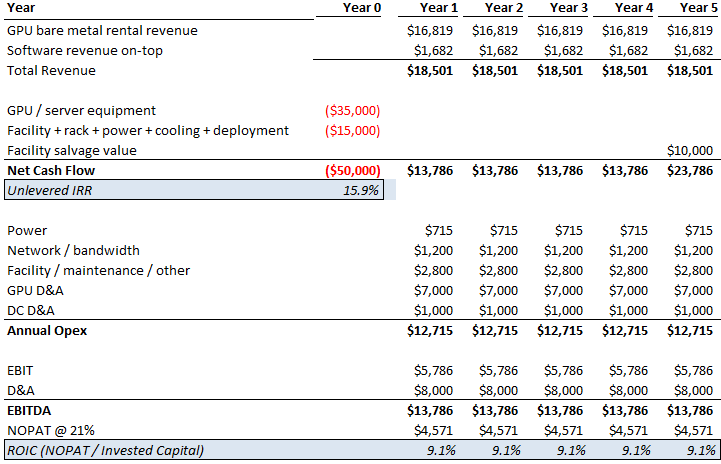
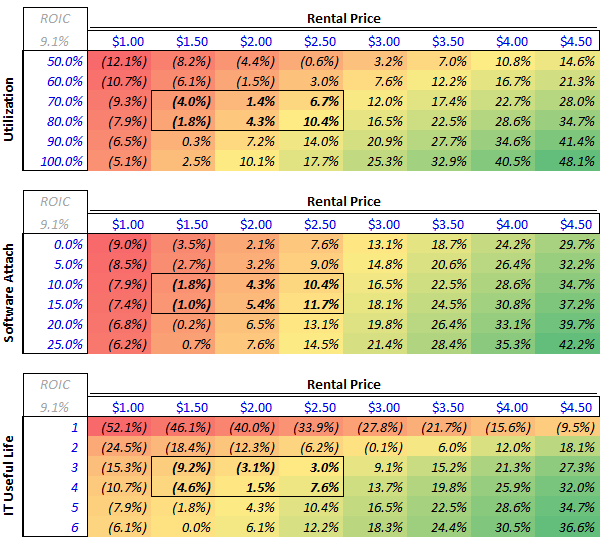
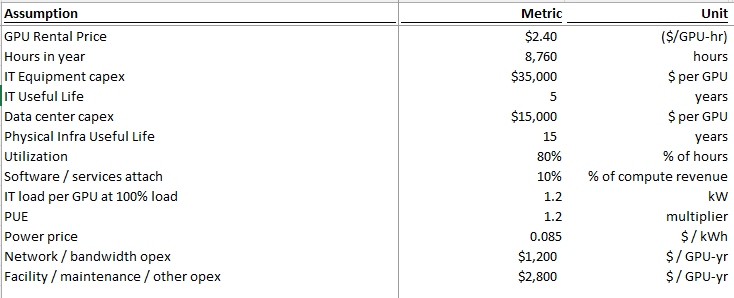
Against my better judgment, wanted to sense check the GPU math at a unit economics level. Am I missing something here? 3 main assumptions to flex are: i) rental $ per GPU hour ii) software attach rate iii) depreciation on IT equipment If the argument is rental prices hold up or that useful life isn't as bearish as some assume, can get into +LDD ROIC pretty easily. Whether LDD ROIC is attractive for companies that earned really high rates of return the past decade is worth it or not is another debate. I assume no GPU fractionalization given that premium buyers will want dedicated workloads.
Shanu Mathew tweet mediaShanu Mathew tweet mediaShanu Mathew tweet media
Shanu Mathew@ShanuMathew93

Podcast is long and info-dense (thanks both!) but worth a listen or transcript skim. Parts that stood out to me - especially on capacity, unit economics, residual value, and bottlenecks. Separate power post (after) to follow. -Lab capacity today and forward: Both OpenAI and Anthropic are at roughly 2 to 2.5 GW today. Dylan estimates both reach 5 to 6 GW by year-end, with OpenAI slightly higher. Both targeting around 10 GW by end of next year. -Anthropic revenue and implied compute need: Anthropic has been adding $4 to 6B in monthly revenue per Dylan's estimates. Straight-line that over 10 months and you get roughly $60B of incremental revenue. At sub-50% gross margins (per The Information), that implies around $40B of compute spend. At roughly $10B per GW in rental cost, that is 4 GW of new inference capacity needed just for revenue growth before any training fleet expansion. -Procurement strategy divergence: Anthropic was deliberately conservative on compute contracting. OpenAI signed aggressively and has better access to capacity into year-end. Anthropic now has to acquire capacity through Bedrock / Vertex / Foundry revenue-share arrangements or spot deals at steep premiums (Dwarkesh suggested 50% margins to the hyperscaler CSPs). Dylan has seen labs sign H100 deals at $2.40/hr for 2 to 3 year terms vs. a $1.40/hr fully loaded 5-year TCO. Standard 5-year contracts at $1.90 to $2.00 yield roughly 35% gross margins. Late-cycle short-duration contracts yield dramatically more for the provider. -Supply chain conviction decay: Labs know they need X compute. Nvidia builds X minus 1. Each layer down the supply chain builds X minus 1 again, sometimes X divided by 2. Conviction about demand attenuates at every step. Anthropic's compute team (ex-Google) spotted a dislocation and negotiated roughly 1M TPU v7s before Google leadership realized the demand. Google then went to TSMC asking for emergency capacity and was told they were sold out. -GPU depreciation thesis: Bears argue H100 spot falls to $1.00 when Blackwell scales and $0.70 when Rubin scales. Dylan argues the opposite. GPT-5.4 is cheaper to run than GPT-4, has fewer active parameters, and is far more capable. An H100 produces more tokens of a better model than it ever could before. TAM for GPT-4 tokens was maybe low billions to tens of billions. GPT-5.4 TAM is "probably north of $100B." His direct quote: "An H100 is worth more today than it was three years ago." In a supply-constrained world, GPU value is set by marginal output value, not replacement cost. -Memory crunch: Roughly 30% of Big Tech 2026 AI CapEx goes to memory. Vendors were unprofitable in 2023 and did not build fabs. Even after the demand surge became foreseeable, it took a year for pricing to move, another 3 to 6 months for vendors to react, and fabs take 2 years to build. Meaningful relief likely does not arrive until late 2027 or 2028. DRAM has roughly tripled in price. He argues this spills into consumer electronics with significant BOM pressure on smartphones, though his volume decline projections (from 1.1B to 500 to 600M units) are on the more aggressive end. -Long-run bottleneck: By 2028 to 2029, Dylan believes the binding constraint shifts to ASML EUV tools. Currently producing around 70 per year, growing to roughly 100 by end of decade. Each gigawatt of AI capacity requires about 3.5 EUV tools. That is $1.2B of tooling supporting $50B of downstream data center CapEx. The supply chain simply cannot scale fast enough.

English
9
8
124
29.9K
Jorge Alberto
Jorge Alberto@JorgeA77832·
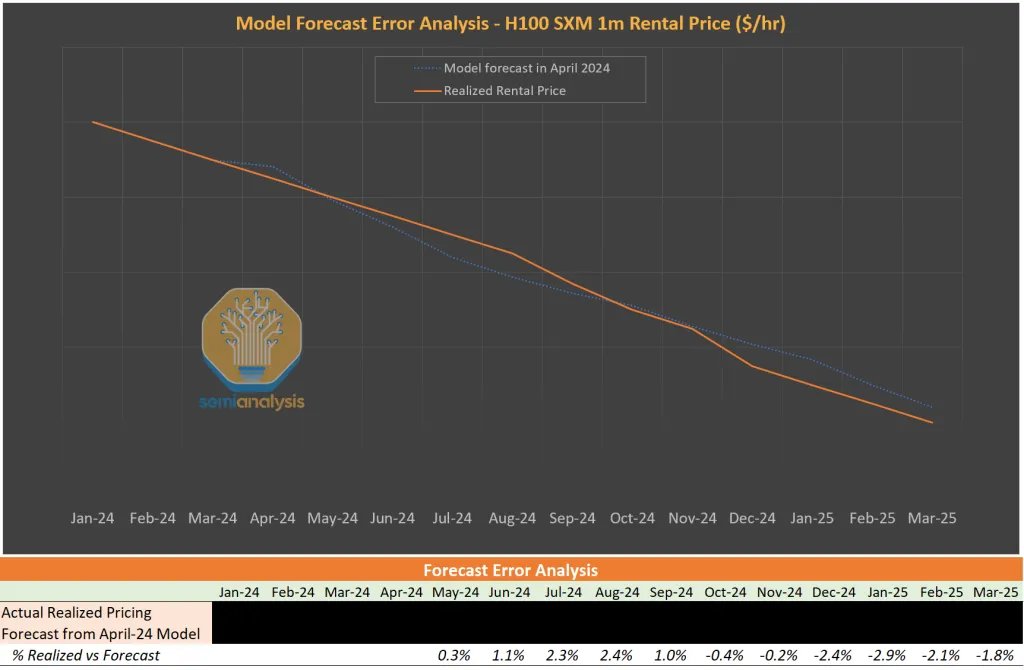
Insane how neocloud prices were higher when this was a thing
Jorge Alberto tweet media
English
0
0
0
43
Jorge Alberto
Jorge Alberto@JorgeA77832·
Reminder that 8 months ago xAI had a higher valuation than Anthropic...
English
0
0
0
40
Serenity
Serenity@aleabitoreddit·
I have high conviction that majority/full port $IREN investors are the dumbest people you’ll meet in this world.
English
243
50
1.5K
345K