

Lars Tovander 🇸🇪🇺🇸🇮🇪
8.9K posts

Lars Tovander 🇸🇪🇺🇸🇮🇪
@LTovander
Happily retired. Unapologetically conservative.
Galway, Ireland 가입일 Temmuz 2014
2K 팔로잉1K 팔로워


Good question.
Sure, I can break my stance on climate change down for you to the best of my ability.
Grab some popcorn! 🍿
First, the Earth has warmed up by ~1.2°C since 1850, though nobody knows precisely how much because of data quality issues (e.g., uneven station distribution; fragmented records, especially outside of the United States; station siting changes; and urban heat island contamination) that have not been, based on some of the evidence I have seen.
But, I have no doubt that the Earth is slightly warmer than it was 175 years ago or that 𝑠𝑜𝑚𝑒 warming is due to carbon dioxide (CO₂) emissions.
Second, contrary to what the online army of alarmist foot soldiers have 𝑚𝑖𝑠𝑙𝑒𝑑 people to believe, there are not really any so-called “fingerprints” that distinguish human-caused global warming from warming caused by other factors.
Numerous peer-reviewed papers claim to have found a human “fingerprint,” but the only evidence that they have presented is that the anomaly of interest is 𝑐𝑜𝑛𝑠𝑖𝑠𝑡𝑒𝑛𝑡 𝑤𝑖𝑡ℎ anthropogenic warming, but they fail to note that said anomaly would also be consistent with natural warming.
A reduction in cloud cover, for example, would allow more sunlight into the climate system, which would warm the oceans. A warmer ocean—all else being equal—increases the rate of evaporation, which raises the vapor pressure (humidity) contributing to polar amplification and faster land warming than the ocean (e.g., Compo & Sardeshmukh, 2008).
🔗link.springer.com/article/10.100… / open-access: psl.noaa.gov/people/gilbert…
All warming, natural or man-made, results in:
1⃣ The higher latitudes warming faster than the mid-latitudes and tropics.
2⃣ Land heating up faster than the oceans.
An increase in solar forcing would have essentially the same material effect, although we can probably rule that out as the cause since sunspot activity has been declining in recent decades. But the sun does affect our climate system in ways that have not really been thoroughly researched.
In any case, the 𝒃𝒆𝒔𝒕 empirical evidence that I have seen to suggest that there is probably at least some anthropogenic “fingerprint” on recent temperature increases is stratospheric cooling.
First, understand that in atmospheric physics, heat flux is measured as the power—measured in Watts (that is, Joules per second)—standardized per square meter of surface area.
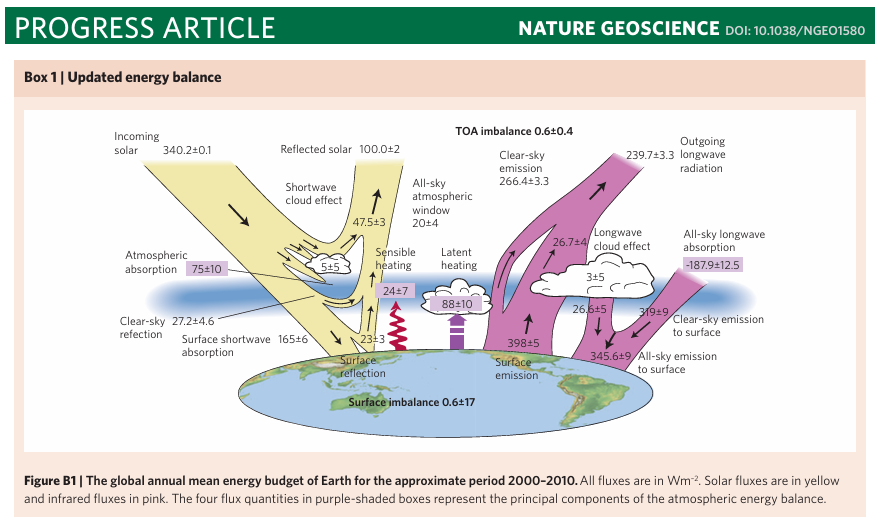
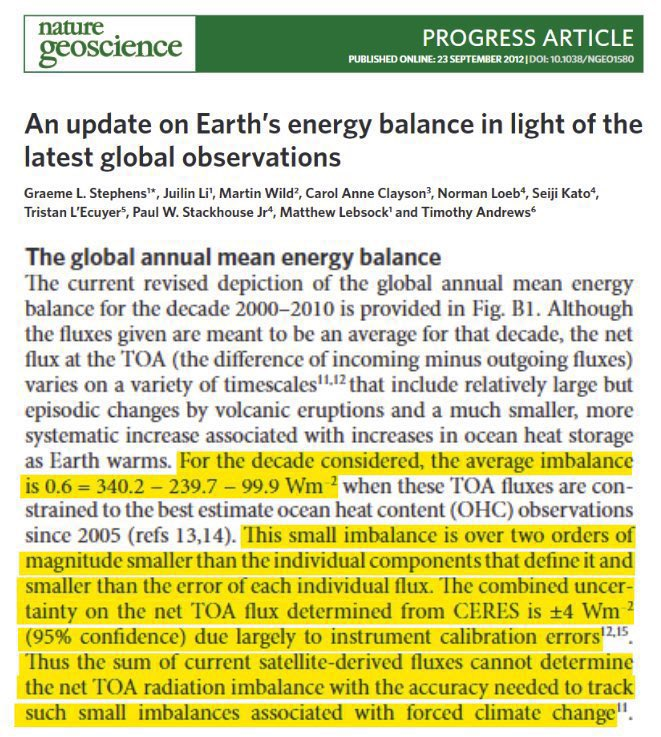
Next, the average radiation flux into the atmosphere is on the order of 239 ± 3.3 W/m² of absorbed solar radiation (ASR) averaged over a year (Stephens et al., 2012). This means that in order to maintain a constant surface air temperature the Earth's surface must emit 239.7 ± 3.3 W/m² back to outer space.
🔗nature.com/articles/ngeo1… / open-access: researchgate.net/publication/26…
Global warming theory maintains the direct radiative forcing of doubling atmospheric CO₂ concentrations (RF 2×CO₂) is 3.7 ± 0.4 W/m² (IPCC TAR, 2007). That means the net outgoing longwave radiation to space is reduced by 3.7 W/m², which creates an Earth energy imbalance (EEI) leading to a slight warming tendency in the troposphere (surface to ~13 km altitude).
🔗ipcc.ch/site/assets/up… (p. 357)
In the stratosphere (~13-50 km altitude), this causes a cooling tendency because less infrared radiation (IR) flux is moving up from below. These relationships were first demonstrated in Manabe & Strickler (1964).
🔗journals.ametsoc.org/view/journals/…
NASA satellite measurements indicate that cooling in the stratosphere has been observed since the late 1970s, although there has been very little cooling over the last 25 years, all the while the troposphere has continued to warm.
🔗nsstc.uah.edu/data/msu/v6.1/…
That means that most of the warming observed since 2000 is likely natural OR perhaps caused by a reduction in stratospheric sulfate aerosol concentrations, in part an artifact of stricter pollution regulations in recent years.
But, yes, I would agree with most scientists that the cooling observed in the stratosphere, at least that from the 1970s to 2000, is most likely a result of CO₂ forcing.
So what?
What happens in the troposphere in response to CO₂ forcing is a lot more nuanced.
Why?
Because in the lower atmosphere, we have feedbacks (largely cloud-related) and precipitation processes that affect the atmospheric radiation budget far more than CO₂. And, how exactly clouds will respond to tropospheric warming, if at all, is not well understood (and by extension, not well-modeled).
What we do know, theoretically speaking, is that the direct warming effect of doubling atmospheric CO₂ (RF 2×CO₂) is actually very small; it is on the order of ~1°C (Wijngaarden & Happer, 2020).
🔗arxiv.org/abs/2006.03098
However, amplifying (or dampening) feedbacks that kick in as a response to forcing mean that the real-world value—the equilibrium climate sensitivity (ECS)—will be higher (lower) than the ~1°C figure that you derive from radiative transfer calculations.
Three pieces of critical information remain unknown:
1⃣ Exactly how much warming has been man-made (since, let's say, 1950). We still don't know the answer to this because the coefficients that are used to ascribe anthropogenic versus natural forcings are all computed from computer modeling, not physical measurements.
2⃣ What the exact value of ECS is.
3⃣ Even if global warming is entirely man-made, is it really a net drawback to civilization?
To break it down:
• If ECS is <3°C, the climate system is largely insensitive to GHGs, and impacts are exaggerated.
• If ECS is ≥3°C, the climate system is very sensitive to GHGs, and the warming could be a concern.
The IPCC’s “best estimate” of Earth's ECS is 3.0°C with a range of 2-5°C.
🔗ipcc.ch/report/ar6/wg1… (pp. 44-45)
In 1994, using NASA's real-world bulk atmospheric temperature data, Drs. John Christy and Richard McNider from the University of Alabama in Huntsville (UAH) calculated the climate sensitivity by removing the effects of El Niño / La Niña and volcanic aerosol injection (e.g., El Chichón, 1982; Mt. Pinatubo, 1991).
They found that the human-induced warming rate is about 0.09°C / decade (lower than observations of actual temperature increase). This, by the way, came with the stipulation that unknown mechanisms of internal variability or external forcing are assumed to remain zero.
🔗nature.com/articles/36732…
The authors validated their 1994 findings in McNider & Christy (2017). Specifically, they found a near-identical anthropogenic warming rate of only 0.096°C / decade and a transient climate response (TCR) of 1.10 ± 0.26°K.
🔗 link.springer.com/article/10.100… / open-access: sealevel.info/christymcnider…
Many other recent studies (e.g., Lewis & Curry, 2018; Scafetta, 2021; Spencer & Christy, 2023; Lewis, 2025) have all estimated ECS to be far lower than the IPCC AR6's “best estimate.”
🔗journals.ametsoc.org/view/journals/…
🔗mdpi.com/2225-1154/9/11…
🔗link.springer.com/article/10.100…
🔗acp.copernicus.org/articles/25/88…
The jury is still out. 🤷♂️
What's more, in order to reliably detect anthropogenic influence on the climate system, the EEI must be known to the nearest 0.1 W/m² (e.g., Von Schuckmann et al., 2016; Gebbie, 2021).
🔗nature.com/articles/nclim… / open-access: nora.nerc.ac.uk/id/eprint/5127…
🔗annualreviews.org/content/journa…
However, the aforementioned Stephens et al. (2012) estimates the EEI to be 0.6 ± 0.4 W/m², which is eight times larger than the anthropogenic detection limits. And, the natural top-of-atmosphere (TOA) flux has a 6.6 W/m² margin of error, which is 66 times larger than the detection limits.
This range of uncertainty remains in newer estimates, such as Loeb et al. (2021), which estimates EEI to be 1.12 ± 0.48 W/m².
🔗agupubs.onlinelibrary.wiley.com/doi/10.1029/20…
This means that 𝑚𝑜𝑠𝑡 (not all!) of the observed global warming since 1950 could be natural and scientists would never know for certain. Alternatively, warming could be mostly man-made, but, even if that happens to be the case, SO WHAT? That doesn't mean it is an existential crisis.
The big unknown here are CLOUDS. ☁️
This is because (a) cloud albedo has far more impact on the atmospheric radiation budget than CO₂, and (b) how clouds change in response, if at all, to the CO₂ forcing is unknown. What's more, cloud cover can (and does) change naturally without our assistance for any number of chaotic reasons (e.g., El Niño / La Niña activity; ocean circulation changes; cosmic ray flux; etc.).
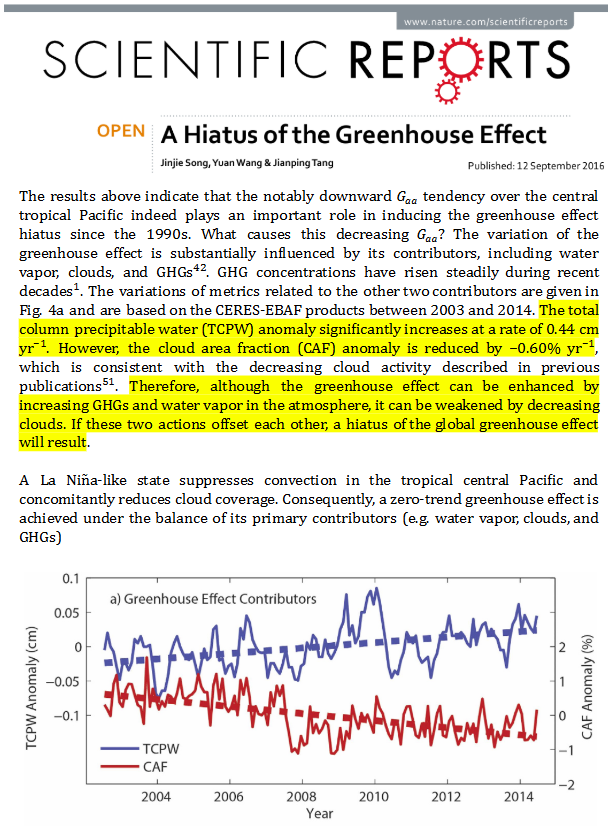
Case in point, even a small decrease in global cloud area fraction (CAF) can more than offset any temperature rise caused by CO₂. Song et al. (2016), for instance, found that,
🗨️ “[𝐴]𝑙𝑡ℎ𝑜𝑢𝑔ℎ 𝑡ℎ𝑒 𝑔𝑟𝑒𝑒𝑛ℎ𝑜𝑢𝑠𝑒 𝑒𝑓𝑓𝑒𝑐𝑡 𝑐𝑎𝑛 𝑏𝑒 𝑒𝑛ℎ𝑎𝑛𝑐𝑒𝑑 𝑏𝑦 𝑖𝑛𝑐𝑟𝑒𝑎𝑠𝑖𝑛𝑔 𝐺𝐻𝐺𝑠 𝑎𝑛𝑑 𝑤𝑎𝑡𝑒𝑟 𝑣𝑎𝑝𝑜𝑟 𝑖𝑛 𝑡ℎ𝑒 𝑎𝑡𝑚𝑜𝑠𝑝ℎ𝑒𝑟𝑒, 𝑖𝑡 𝑐𝑎𝑛 𝑏𝑒 𝑤𝑒𝑎𝑘𝑒𝑛𝑒𝑑 𝑏𝑦 𝑑𝑒𝑐𝑟𝑒𝑎𝑠𝑖𝑛𝑔 𝑐𝑙𝑜𝑢𝑑𝑠. 𝐼𝑓 𝑡ℎ𝑒𝑠𝑒 𝑡𝑤𝑜 𝑎𝑐𝑡𝑖𝑜𝑛𝑠 𝑜𝑓𝑓𝑠𝑒𝑡 𝑒𝑎𝑐ℎ 𝑜𝑡ℎ𝑒𝑟, 𝑎 ℎ𝑖𝑎𝑡𝑢𝑠 𝑜𝑓 𝑡ℎ𝑒 𝑔𝑙𝑜𝑏𝑎𝑙 𝑔𝑟𝑒𝑒𝑛ℎ𝑜𝑢𝑠𝑒 𝑒𝑓𝑓𝑒𝑐𝑡 𝑤𝑖𝑙𝑙 𝑟𝑒𝑠𝑢𝑙𝑡.”
🔗nature.com/articles/srep3…
While it is politically popular for people to splinter into one of the two tribalistic camps that either (a) increasing CO₂ has zero effect on the climate, or (b) that it will lead to Al Gore's Armageddon, the truth is probably somewhere in the middle of those extremes.

🐅@DPSOTS3
@ChrisMartzWX Do you have somewhere that you breakdown your view on climate change discussion with statistics? Would be really cool to be able to see all that in one place
English
#more-32640" target="_blank" rel="nofollow noopener">judithcurry.com/2025/12/29/the…
ZXX
@BradCozart The one person that could decorate his house the fastest was @LTovander.
Plug them in and toss the lights on top of the bushes - no need to untangle them all the way.
Lars @LTovander , now that you've retired in Ireland - do you still decorate your bushes for Christmas?
English

We haven’t had outside Christmas lights up in 15 years. We do now. I always used the excuse of there was no way to clip them to the outer metal edge of the carport. That is until my brother in law to the boss to use magnets. I’m going to hurt him
English