
MutualFunds.com

6.7K posts

MutualFunds.com banner
MutualFunds.com

MutualFunds.com

@MutualFundscom

Official X Account of https://t.co/frsueJ0EHr – Helping investors navigate mutual funds with data-driven insights, screening tools, and expert research.

New York, NY 가입일 Haziran 2014
610 팔로잉4.5K 팔로워
고정된 트윗
MutualFunds.com
MutualFunds.com@MutualFundscom·
Weekly Financial Advisor Peer Poll & Results Stay ahead of how your peers are positioning right now. Each week, we capture real-time allocation shifts from financial advisors responding to the current economic backdrop—rate moves, inflation prints, earnings, geopolitics, and more. No noise. Just clear, decision-grade insight into how advisors are adjusting equity, fixed income, cash, and alternatives—plus what’s driving the changes. It’s built to keep disciplined advisors aligned with opportunity and prepared for what’s next. One weekly pulse. Transparent positioning. Actionable context. Subscribe below to view live results and weekly summaries. rb.gy/3gkzhj
MutualFunds.com tweet media
English
1
2
5
1.7K
MutualFunds.com
MutualFunds.com@MutualFundscom·
CEF yields don’t come from nowhere — they come from leverage. Funds borrow at short-term rates and invest at higher yields. When the spread works, income gets boosted. But the rate environment changes everything: • Rising rates → borrowing costs jump → income gets squeezed • Stable/falling rates → costs ease → income improves That’s why CEFs struggled during hikes — and why the setup looks better now. Leverage isn’t free yield. It’s amplification — in both directions. Know the cost of leverage, not just the headline yield.
English
0
0
0
6
Michael (Hedge Fund Manager)
The day before the Stock Market crashed in 1929, starting the Great Depression - the temperate was 56 degrees in NYC The temperature today in NYC? Yep, 56 degrees. There are no coincidences Buckle up
English
60
27
341
20.3K
MutualFunds.com
MutualFunds.com@MutualFundscom·
If inflation starts ticking higher, positioning matters. ETFs to consider: • SPDR Gold Shares (GLD) — gold as an inflation hedge • Invesco DB Commodity Index Tracking Fund (DBC) — broad commodity exposure • Schwab U.S. TIPS ETF (SCHP) — inflation-protected Treasuries • Energy Select Sector SPDR Fund (XLE) — energy tends to benefit from rising prices Real assets + inflation-linked income > nominal exposure. Position before inflation shows up — not after.
Lukas Ekwueme@ekwufinance

No one is positioned for an inflation surge. The S&P is printing new ATHs like the Iran war got wrapped up in a neat peace treaty and a Netflix documentary. It’s dominated by tech... the sector whose entire multiple assumes permanently low inflation and cheap capital. Meanwhile, materials and energy, the sectors that actually benefit when inflation runs hot, sit at roughly 6% of the index, as if governments can just hit CTRL+P on copper, diesel, and jet fuel the same way they print IOUs.

English
0
0
0
14
MutualFunds.com
MutualFunds.com@MutualFundscom·
If inflation starts ticking higher, positioning matters. ETFs to consider: • SPDR Gold Shares (GLD) — gold as an inflation hedge • Invesco DB Commodity Index Tracking Fund (DBC) — broad commodity exposure • Schwab U.S. TIPS ETF (SCHP) — inflation-protected Treasuries • Energy Select Sector SPDR Fund (XLE) — energy tends to benefit from rising prices Real assets + inflation-linked income > nominal exposure. Position before inflation shows up — not after.
English
0
0
0
37
Lukas Ekwueme
Lukas Ekwueme@ekwufinance·
No one is positioned for an inflation surge. The S&P is printing new ATHs like the Iran war got wrapped up in a neat peace treaty and a Netflix documentary. It’s dominated by tech... the sector whose entire multiple assumes permanently low inflation and cheap capital. Meanwhile, materials and energy, the sectors that actually benefit when inflation runs hot, sit at roughly 6% of the index, as if governments can just hit CTRL+P on copper, diesel, and jet fuel the same way they print IOUs.
English
9
30
164
8.2K
unusual_whales
unusual_whales@unusual_whales·
BREAKING: Investors are dumping US stocks for international markets, per Bank of America.
English
368
670
4.9K
367.4K
MutualFunds.com
MutualFunds.com@MutualFundscom·
If you buy one ETF this week, consider Tortoise North American Pipeline Fund. Last week was about a quick move in oil. This week is different. The disruption hasn’t resolved — shipping is still constrained and energy flows remain tight. That shifts the opportunity from trading oil prices to owning the parts of the system that keep energy moving. TPYP focuses on midstream infrastructure — pipelines, storage, and transport — where revenues are tied more to volume and long-term contracts than daily price swings. If this environment persists, that setup tends to be more stable and easier to hold over multiple weeks. More about positioning for sustained energy strength than chasing short-term spikes.
English
0
0
0
8
MutualFunds.com
MutualFunds.com@MutualFundscom·
Last week: trade the oil spike. This week: own the earnings. The move now is energy equities that benefit from sustained oil — not just price jumps. ETFs to express it: • Energy Select Sector SPDR Fund (XLE) — large-cap oil majors with direct earnings leverage • SPDR S&P Oil & Gas Exploration & Production ETF (XOP) — higher beta upstream exposure • Global X MLP & Energy Infrastructure ETF (MLPX) — midstream cash flows + contracts Oil holding higher → earnings revisions come next. Own the cash flows, not the spike. More equity energy funds: mutualfunds.com/equity-categor…
English
0
0
0
49
MutualFunds.com
MutualFunds.com@MutualFundscom·
Most popular ETFs this week: MINT (short-term bond ETF focused on capital preservation + income) VTI (total U.S. stock market exposure) VGK (European equities) VCIT (intermediate-term investment-grade corporate bonds) IVV (S&P 500 exposure) EIS (Israel equities) QQQI (Nasdaq-100 covered call income strategy) UCO (leveraged oil exposure) VOO (S&P 500 exposure) IGV (software and tech stocks)
MutualFunds.com tweet media
English
0
0
2
140
MutualFunds.com
MutualFunds.com@MutualFundscom·
Active ETF Scorecard: commodities and international funds are leading. While the S&P 500 is down ~6–7% YTD, active ETFs tied to commodities and global markets are outperforming: • Active Alts: +10.55% • Active EM Equity: +10.30% • Active Intl Equity: +6.38% The takeaway: leadership has clearly shifted outside the U.S. We track and rank the largest active ETFs each week — so you can quickly see where active managers are actually winning. mutualfunds.com/p/4nlgiuly2wvo…
MutualFunds.com tweet media
English
0
0
0
34
unusual_whales
unusual_whales@unusual_whales·
"Americans feel worse about the economy than ever before," per BI
English
213
324
3.7K
121.5K
MutualFunds.com 리트윗함
MutualFunds.com
MutualFunds.com@MutualFundscom·
Most popular ETFs on our site this week: $MINT — ultra-short duration bonds (capital preservation) $TQQQ — leveraged Nasdaq (high-risk growth) $VTI — total U.S. stock market (broad exposure) $BOND — active core bond fund (income + stability) $XQQI — covered call Nasdaq strategy (income + tech exposure) $JEPQ — covered call equity income (yield + reduced volatility) $XLE — energy equities (oil exposure) $EIS — Israel equities (geopolitical trade) $QQQ — Nasdaq 100 (large-cap tech) $DRN — leveraged REITs (real estate + high beta)
MutualFunds.com tweet media
English
1
1
2
288
MutualFunds.com 리트윗함
MutualFunds.com
MutualFunds.com@MutualFundscom·
That’s not a stat — it’s a multi-year demand signal for builders. If policy shifts + capital flow toward construction, builder-heavy ETFs are one of the cleanest ways to play it: • iShares U.S. Home Construction ETF — pure-play exposure to homebuilders • SPDR S&P Homebuilders ETF — broader mix (builders + suppliers) • Invesco Dynamic Building & Construction ETF — adds industrial/construction leverage Housing shortage = supply response. Supply response = builders.
unusual_whales@unusual_whales

"America is short 10 million single family homes," per the White House

English
0
1
1
139
MutualFunds.com
MutualFunds.com@MutualFundscom·
There have been multiple peaks where nothing immediate happened: • 1999–early 2000: margin debt surged for months before the dot-com peak • 2006–2007: elevated levels persisted well ahead of the financial crisis • 2014–2015: hit new highs, market kept grinding higher • 2021: record margin debt, equities continued higher into late-cycle strength
English
0
0
0
9
StockMarket.News
StockMarket.News@_Investinq·
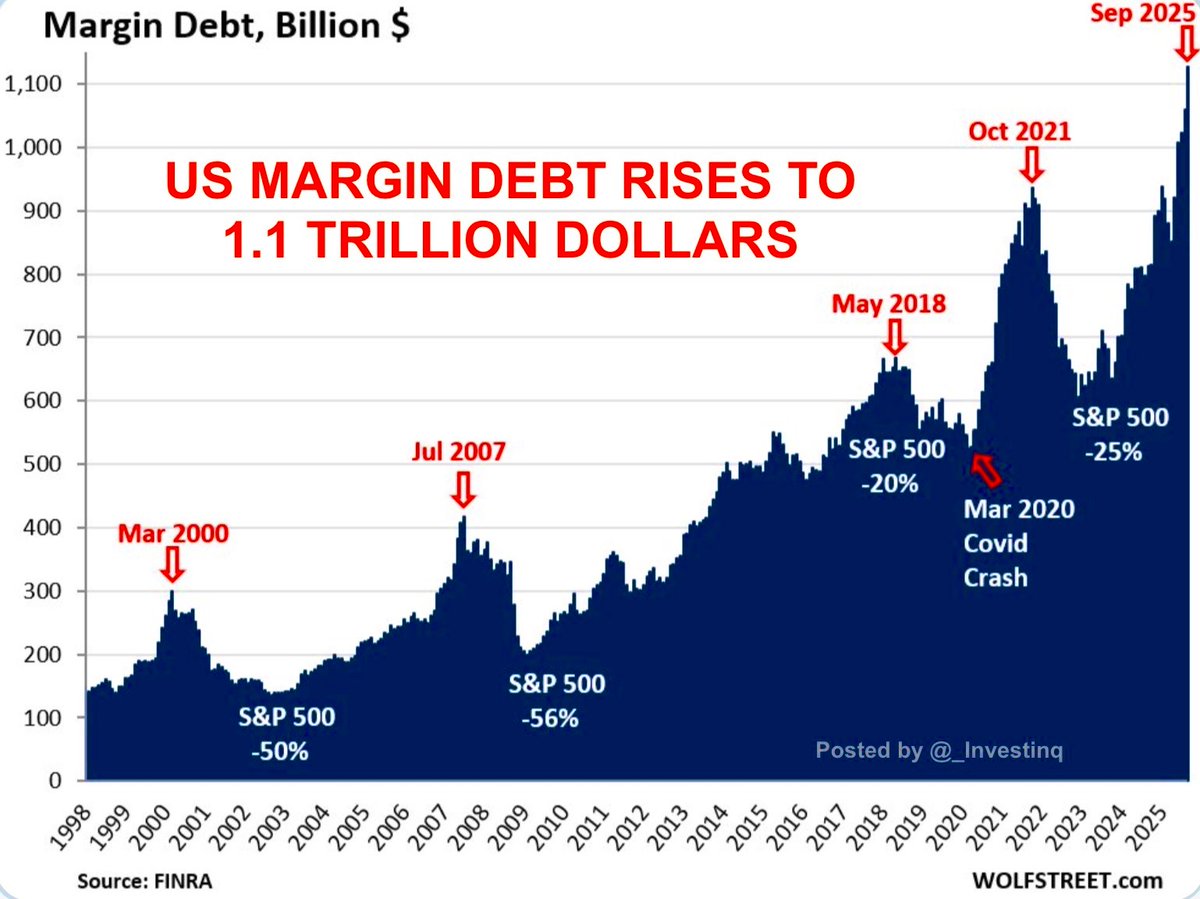
U.S. margin debt just hit $1.1 trillion, the highest ever. That means investors have borrowed over a trillion dollars to buy more stocks. In September alone, they borrowed another $67 billion. And now, the SEC is being asked to approve something called 5x leveraged ETFs, which would let people borrow five times the amount they invest. In simple terms: investors are already loaded with debt, and now some firms want to hand them an even bigger credit card. Margin debt is basically money borrowed from a broker to buy more investments. If your portfolio goes up, you make extra money. But if it goes down you lose faster and if it falls too much, you’re forced to sell to pay back what you owe. That’s called a margin call. So, when margin debt hits record highs like this, it means a lot of people are investing with borrowed money. It works great in a bull market, but it makes the system fragile when prices start falling. Right now, margin debt equals about 2% of the total value of the S&P 500, higher than during the dot-com bubble in 2000. That doesn’t automatically mean a crash is coming, but it does mean everyone’s taking on more risk. When markets are full of borrowed money, small dips can snowball into bigger ones, because people have to sell to cover their loans. That selling creates even more pressure on prices And here’s where it gets risky, some firms want to launch 5x leveraged ETFs, funds that would let traders magnify stock or crypto moves by five times each day. So if Tesla moves 2%, that ETF could move 10%. It sounds exciting, but it also means a small market drop could wipe out an investor in a day. The U.S. currently limits leverage to 2x for safety reasons, but these proposals would go far beyond that. If approved, they could make the market even more sensitive to fast, sharp swings. We already saw what can happen when everyone is leveraged at once. On October 10th, crypto markets lost $19 billion in just 24 hours. Over 1.6 million traders were wiped out because prices dropped, triggering automatic liquidations. Once that started, everything snowballed prices fell faster, trading systems froze and there was almost no liquidity left to stop the fall. Now imagine that kind of event in traditional markets where stocks and crypto are more connected than ever. If one side breaks, it could easily spill over to the other. That’s why regulators are watching closely approving 5x ETFs in an already leveraged environment could turn normal market pullbacks into chaos. This all just means we’re in a phase where confidence is high and risk taking is everywhere. Leverage isn’t necessarily evil but it just magnifies everything. When things are good, it makes them great. But when things turn, it makes them worse.
StockMarket.News tweet media
English
40
256
771
58K
MutualFunds.com
MutualFunds.com@MutualFundscom·
There have been multiple peaks where nothing immediate happened: • 1999–early 2000: margin debt surged for months before the dot-com peak • 2006–2007: elevated levels persisted well ahead of the financial crisis • 2014–2015: hit new highs, market kept grinding higher • 2021: record margin debt, equities continued higher into late-cycle strength
English
0
0
0
5
Guilherme Tavares
Guilherme Tavares@i3_invest·
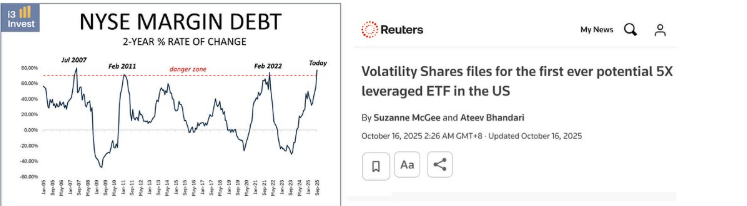
Don't forget that there is always more room to fuel this already overvalued market. NYSE margin debt growth remains far from extreme levels. The next major top will probably occur after reaching 50%, followed by deleveraging. We will likely get there in one year.
Guilherme Tavares tweet media
English
7
39
116
11.7K
MutualFunds.com
MutualFunds.com@MutualFundscom·
There have been multiple peaks where nothing immediate happened: • 1999–early 2000: margin debt surged for months before the dot-com peak • 2006–2007: elevated levels persisted well ahead of the financial crisis • 2014–2015: hit new highs, market kept grinding higher • 2021: record margin debt, equities continued higher into late-cycle strength
English
0
0
0
6
Guilherme Tavares
Guilherme Tavares@i3_invest·
I truly believe we are already in a bubble (it doesn't mean the party is over), but if we adjust margin debt for U.S. corporate profits, we are still far from the insane levels seen prior to the dot-com bubble burst. This suggests that (according to this indicator), whether measured by NYSE margin debt adjusted for profits or even as a percentage of market cap, the insanity is not over.
Guilherme Tavares tweet media
The Kobeissi Letter@KobeissiLetter

Margin investing is skyrocketing: Margin debt jumped +9.4% in June to a record $1.01 trillion. This also marks the largest monthly increase in history, at +$87 billion. Over the last 2 years, margin debt has surged by ~$400 billion. To put this into perspective, total margin debt relative to the US M2 money supply hit ~0.046, the highest since 2018. Risk appetite is through the roof.

English
4
6
45
5.3K
MutualFunds.com
MutualFunds.com@MutualFundscom·
There have been multiple peaks where nothing immediate happened: • 1999–early 2000: margin debt surged for months before the dot-com peak • 2006–2007: elevated levels persisted well ahead of the financial crisis • 2014–2015: hit new highs, market kept grinding higher • 2021: record margin debt, equities continued higher into late-cycle strength
English
0
0
0
8
Ben Carlson
Ben Carlson@awealthofcs·
30 year old has $50k saved for retirement Plans to save $200/month but mostly let compounding do the heavy lifting for the next 35 years (assumes 7% ROI) No debt Is that enough to be comfortable in retirement by age 65? I have some thoughts: awealthofcommonsense.com/2024/01/coasti…
Ben Carlson tweet media
English
26
6
127
55.1K
MutualFunds.com
MutualFunds.com@MutualFundscom·
There have been multiple peaks where nothing immediate happened: • 1999–early 2000: margin debt surged for months before the dot-com peak • 2006–2007: elevated levels persisted well ahead of the financial crisis • 2014–2015: hit new highs, market kept grinding higher • 2021: record margin debt, equities continued higher into late-cycle strength
English
0
0
0
6
Guilherme Tavares
Guilherme Tavares@i3_invest·
Has the financial system failed or advanced? This chart shows the absolute amount of money that investors/traders borrow from brokerage accounts since 1970. The point is that from 1931 to 1970, margin debt rose 222%, while the S&P 500 gained 869%. On the other hand, since the gold standard was fully abandoned, margin debt has jumped 26,000%, while the S&P 500 is up 7,530% (3.4× higher). Totally debt-driven, a de-leverage situation is basically unavoidable at some point, and the economy will really need to be reinvented, imho.
Guilherme Tavares tweet media
English
17
44
149
17.3K
MutualFunds.com
MutualFunds.com@MutualFundscom·
Margin debt always gets flagged as a warning sign — but it’s not a timing tool. There have been multiple peaks where nothing immediate happened: • 1999–early 2000: margin debt surged for months before the dot-com peak • 2006–2007: elevated levels persisted well ahead of the financial crisis • 2014–2015: hit new highs, market kept grinding higher • 2021: record margin debt, equities continued higher into late-cycle strength What it signals is a market with higher leverage and sensitivity — not an instant top.
English
0
0
0
2
Lukas Ekwueme
Lukas Ekwueme@ekwufinance·
We’re entering end-stage bubble territory. As the AI bubble keeps inflating, investors are piling on record margin debt. At the same time, Volatility Shares just launched the first-ever 5× leveraged ETF. What could possibly go wrong, using leverage at this stage of the cycle?
Lukas Ekwueme tweet media
English
1
1
13
1.1K
MutualFunds.com
MutualFunds.com@MutualFundscom·
Margin debt always gets flagged as a warning sign — but it’s not a timing tool. There have been multiple peaks where nothing immediate happened: • 1999–early 2000: margin debt surged for months before the dot-com peak • 2006–2007: elevated levels persisted well ahead of the financial crisis • 2014–2015: hit new highs, market kept grinding higher • 2021: record margin debt, equities continued higher into late-cycle strength What it signals is a market with higher leverage and sensitivity — not an instant top. Positioning can stay stretched longer than expected, but when things shift, the unwind can be fast.
English
0
0
0
29
Thierry from arvy 🇨🇭
Thierry from arvy 🇨🇭@ThierryBorgeat·
Every major market top in history had one thing in common. Margin debt peaked first. 2000: margin debt topped → Dotcom crash 2008: margin debt topped → Financial crisis 2022: margin debt topped → −25% bear market Today? Margin debt has just topped again. When borrowed money starts leaving the market — it doesn’t trickle out. It floods out. This is the risk factor nobody is discussing.
Thierry from arvy 🇨🇭 tweet media
English
49
128
609
49.7K