Paperity

2.3K posts

Paperity banner
Paperity

Paperity

@Paperity

The first global multidisciplinary aggregator of #OpenAccess journals. 30K periodicals. Founded 2014. 👉 Support us: https://t.co/YZFz3mYgTe #OA

가입일 Mayıs 2012
2.3K 팔로잉2.2K 팔로워
Paperity 리트윗함
BURKOV
BURKOV@burkov·
A math professor noticed his kitchen sink at home was leaking. He called a plumber. The plumber came the next day, tightened a couple of nuts, and the sink worked perfectly again. The professor was delighted. But when, a minute later, the plumber handed him the bill, he was shocked. “This is a third of my monthly salary!” “Yeah, I get it…” said the plumber. “Why don’t you come work for our company as a plumber? You’ll make three times more than you do as a professor. Just remember: when you apply, say you only finished seventh grade. They don’t like hiring educated people.” So the professor got a job as a plumber, and his life really did improve. All he had to do was tighten a nut here and there every so often, and his salary was much higher. One day, the management of the plumbing company decided that every plumber had to attend evening classes to finish eighth grade. So our professor had to go too. By chance, the very first class was math. The evening school teacher, wanting to check what the students knew, asked for the formula for the area of a circle. They called the professor up to the board, and he suddenly realized he’d forgotten it. He started frantically reasoning it out, covering the board with integrals, differentials, and all sorts of fancy formulas to re-derive the result. In the end, he got: S = –π r² He didn’t like the minus sign, so he started again. Again he got a minus. No matter what he did, it kept coming out negative. He cast a panicked look at the class, and all the plumbers were whispering: “Swap the limits of integration!”
English
424
2.9K
36.4K
4.4M
Paperity 리트윗함
Nicholas Fabiano, MD
Nicholas Fabiano, MD@NTFabiano·
Chocolate intake is associated with the number of Nobel Prize recipients.
Nicholas Fabiano, MD tweet media
English
412
820
11.8K
867.5K
Paperity 리트윗함
Publishing with Integrity
Publishing with Integrity@fake_journals·
Scientists’ suit against top academic publishers lays bare deep frustration over unpaid peer review buff.ly/06TVgRk
English
1
10
30
7.1K
Paperity 리트윗함
NIH
NIH@NIH·
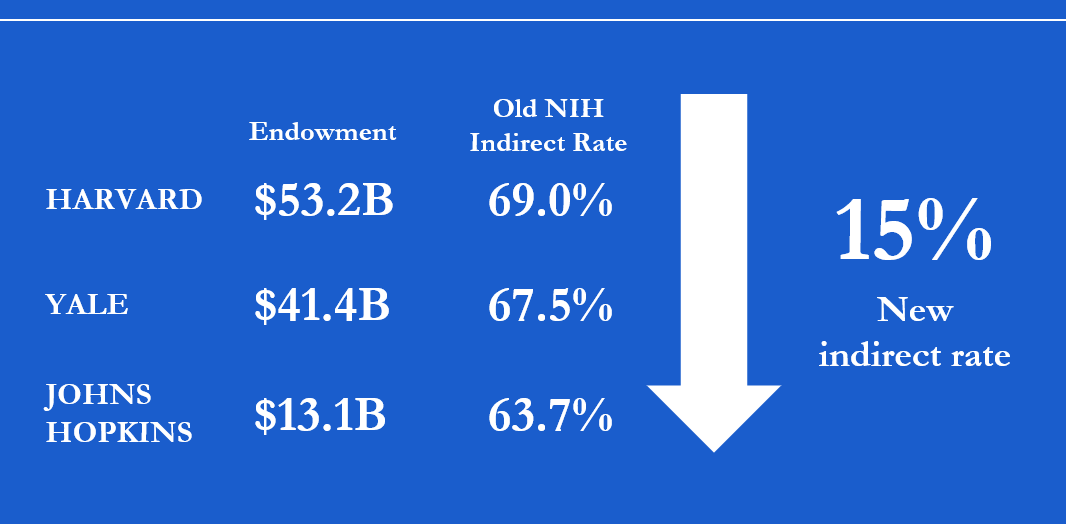
Last year, $9B of the $35B that the National Institutes of Health (NIH) granted for research was used for administrative overhead, what is known as “indirect costs.” Today, NIH lowered the maximum indirect cost rate research institutions can charge the government to 15%, above what many major foundations allow and much lower than the 60%+ that some institutions charge the government today. This change will save more than $4B a year effective immediately.
NIH tweet media
English
2.7K
6.3K
32.3K
29.2M
Paperity 리트윗함
Nicholas Fabiano, MD
Nicholas Fabiano, MD@NTFabiano·
Academics are paid nothing for peer review. Yet journals made a total of over $8.3 billion on article processing charges alone between 2019-2023. Make it make sense.
Nicholas Fabiano, MD tweet media
English
124
610
2.4K
243.5K
Paperity 리트윗함
Will Kinney
Will Kinney@WKCosmo·
We shall measure stellar brightness logarithmically, and it will be called the "magnitude." - Sir, will that logarithm be base 10, or based on Napier's constant? Neither. It shall be of the base of the fifth root of one hundred.
Will Kinney tweet media
English
129
1.1K
14.2K
782.5K
Paperity 리트윗함
Brian Roemmele
Brian Roemmele@BrianRoemmele·
🚨Amnesia Generation. The Internet will lose over 500,000 books. The Internet Archive has been ordered to delete them. The Internet Archive is appealing and essential for libraries to lend, preserve ensure access to out-of-print books. Sign a protest: change.org/p/let-readers-…
English
171
733
2.1K
373K
Paperity 리트윗함
Peyman Milanfar
Peyman Milanfar@docmilanfar·
Reviewer 2
Peyman Milanfar tweet media
English
13
157
1.5K
127.7K
Paperity 리트윗함
Massimo
Massimo@Rainmaker1973·
The importance of punctuation (Commas save lives)
Massimo tweet media
English
162
600
5.4K
536.5K
Paperity
Paperity@Paperity·
🎉Exciting news! We've surpassed 20,000 journals indexed at Paperity, making more #openaccess content available than ever before!📚✨ ➡️ paperity.org #Research & #academic community: your work is changing the world. Thank you for letting us be part of it!
English
0
0
0
96
Paperity 리트윗함
@mikko
@mikko@mikko·
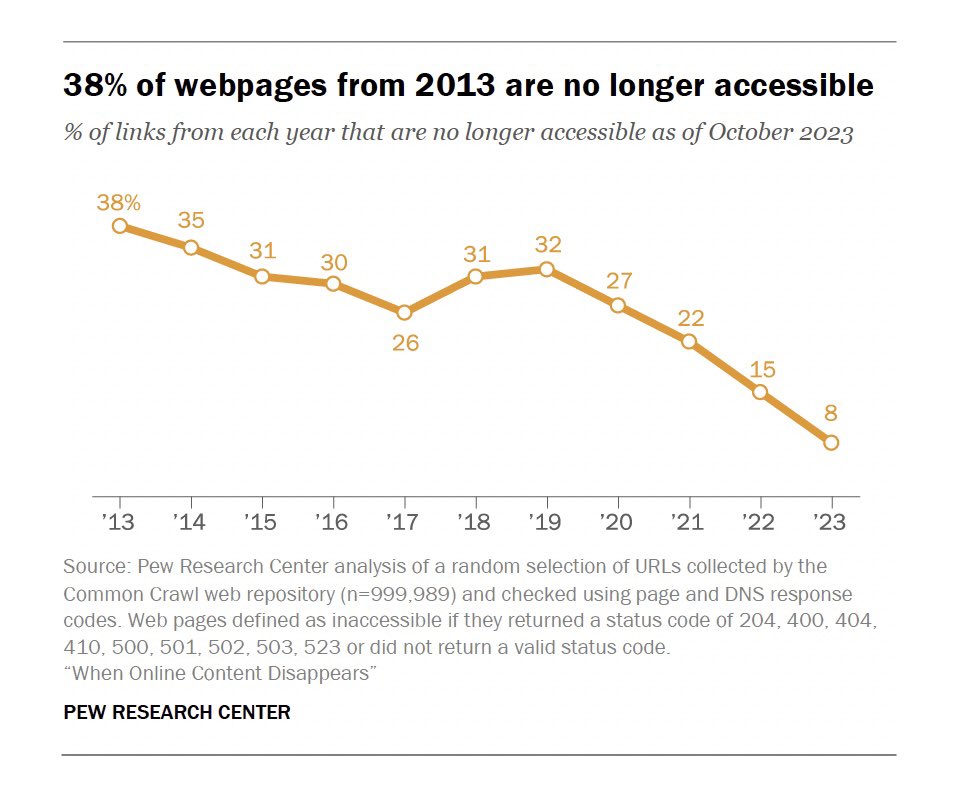
The mankind’s knowledge lasted better when it was printed on paper. 38% of webpages that existed in 2013 are no longer accessible. pewresearch.org/data-labs/2024…
@mikko tweet media
English
280
1.4K
5.3K
1.8M
Paperity 리트윗함
Sabine Hossenfelder
Sabine Hossenfelder@skdh·
I find it interesting that the word "science" in English has acquired a rather narrow meaning, usually referring only to the natural sciences. I have been wondering for some while now if not the shift of the meaning and use of the word "science" has had an impact on how the English-speaking world thinks about knowledge discovery, often dismissing knowledge in any discipline that is not part of what they call "science". If you look up the German translation of “science”, you will get "Wissenschaft", which means loosely speaking 'dealing with knowledge' (“Wissen” = knowledge). But it’s a poor translation, because “Wissenschaft” is about knowledge discovery in general, not about the natural world in particular. The origin of the word "science" is the Latin word "scientia" from scire ‘know’. That is, the original meaning also referred to knowledge in general, not to some disciplines in particular. Consequently, in German, mathematics is -- of course -- a science. We also have "music science" (Musikwissenschaft) and "religion science" (Religionswissenschaft) and "literature science" (Literaturwissenschaft), etc, as they all deal with knowledge in some sense. These latter examples are part of what in English is called "humanistics". In German they are called "Geisteswissenschaft", which means kind of "science of the mind" (that makes it sound like consciousness research, but I can't think of a better translation). Philosophy is also a "science of the mind", in the German sense, as it concerns itself with knowledge. I have talked to some Spanish people who have told me that they use the word 'ciencia' more in the German meaning of the word, not in the English one (not sure this is correct, my Spanish isn’t great). You may notice this sometimes online, if you have non-native English speakers, some tend to assume eg that mathematics is science, whereas English native speakers find this odd. One of the consequences of this linguistic shift seems to have been that as the English speaking world became dominant in science, the new “scientists” stopped paying attention to philosophy, as that was no longer part of their “science”. This is especially obvious in physics, where you can see this happening in the early 20th century. While physicists previously had valued philosophical discourse, they later discarded it as supposedly useless. Personally I think it’s a big problem and the major reason why the foundations of physics have stagnated. The new ‘scientists’ in this discipline seem to think that ‘theories’ are ‘scientific’ just because you can write them in maths. As a consequence, they keep on producing mathematical theories about nothing in particular. If they stopped to think about what they are doing and why it’s not working and maybe read some philosophers, we’d make more progress. The blame is partly on philosophers though because they seem to take pride in not being useful to scientists, usually not concerning themselves with any questions that physicists could actually use. Like why aren’t there thousands of philosophers discussing cosmological priors or naturalness or how to find out whether two models are “the same”. Somewhat disturbingly, I have had several exchanges with so-called philosophers of science who clearly seem to take pride in being useless, and get offended if you ask them to be useful, as they see ‘being useful’ as being the task of scientists, which they are not. And that returns me to my misgiving about the English use of the word ‘science’. This was a “short” reply I wrote to Philip’s quote from Dirac… x.com/philipcball/st…
English
346
185
1.2K
139.2K
Paperity 리트윗함
Yann LeCun
Yann LeCun@ylecun·
Let me tell a story about free books. In the mid 1990s, I started a project called DjVu at AT&T Labs. The purpose was to devise a new image compression format so that printed documents could be scanned at high resolution and distributed efficiently over the newly expanding Internet. The format was released in the late 90s/early 00s and adopted by websites li,e the Internet Archive. As a useful demonstration of the technology, I decided to scan and distribute the complete collection of proceedings of the Neural Information Processing conference (NIPS). I asked the publishers, Morgan Kaufman and MIT Press, for permission to do that. They agreed because they weren't making any revenue from past proceedings. We scanned the 13 volumes, OCRed and indexed all of the material, and put it up on a free website in 2000: nips.djvu.org This open-access repository turned out to be *extremely* useful to the machine learning research community. Around the same time, the ML community rebelled against commercial journal publishers and created JMLR, which was one of the first open-access and totally free journal. This also turned out to be enormously beneficial. Eventually, the NIPS conference stopped making printed proceedings and started hosting all the books on their website ( nips.cc ), including our scans. If you ever wondered why the ML/AI community embraced a culture of fast posting of preprint and open-access publications, that's it.
English
96
352
2.8K
538.6K
Paperity 리트윗함
Massimo
Massimo@Rainmaker1973·
The Rhind Mathematical Papyrus is the oldest manuscript written in algebra and trigonometry, dating back to 3,550 years ago. It shows that the Egyptians used first-order equations, geometric series and a second-order algebraic equation, related to the Pythagorean theorem a² + b² = c² It also describes how to obtain an approximation of π accurate to within less than 1% and one of the earliest attempts at squaring the circle.
Massimo tweet media
English
125
1.8K
10.1K
2.3M