고정된 트윗

Is the JCI back, or is this rally just "rented"?
Here is what the data says:
_____________________________________________________
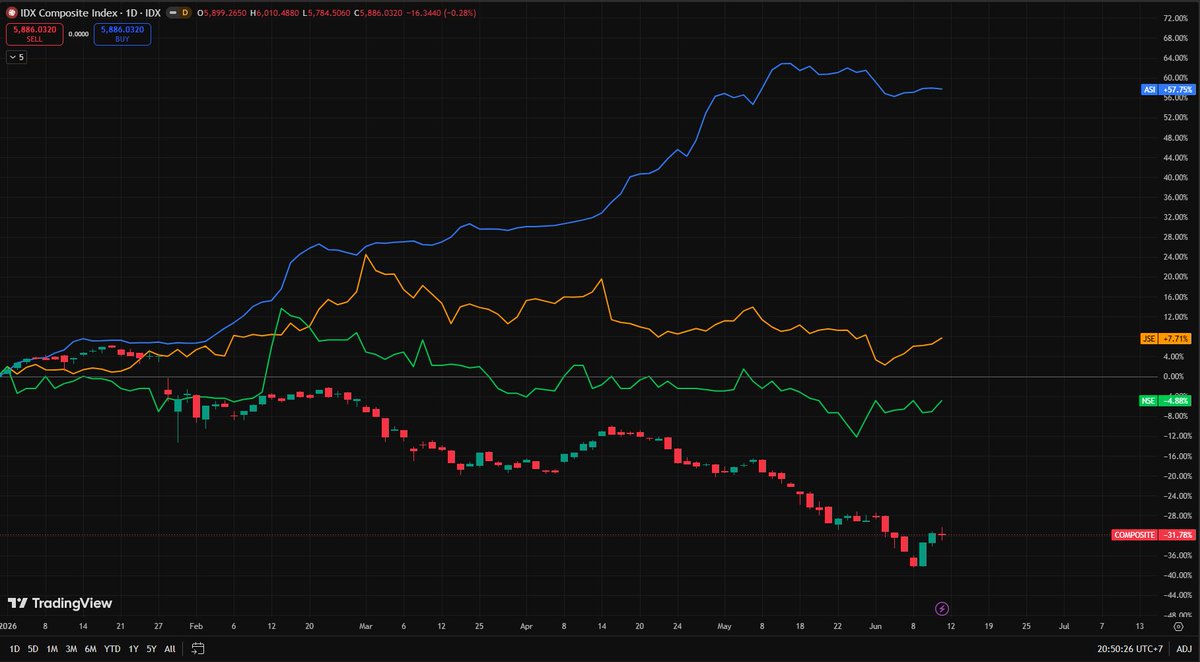
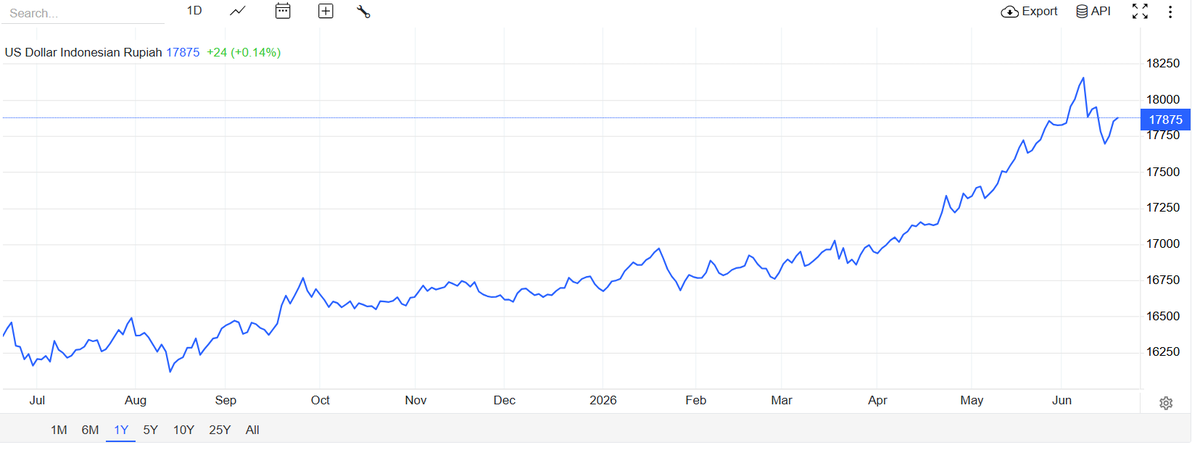
On Monday, 8 June 2026, USDIDR printed a record low: 18,190. The rupiah had never been weaker. The week before, Indonesian stocks had fallen at the fastest pace in the world.
By the Friday that followed, the dollar was changing hands near 17,700 — a roughly 2.6% rupiah recovery in days. The JCI, meanwhile, ripped +7.57% in a single session on the 9th, the steepest one-day gain since the fall of Suharto.
So the question every JCI investor should be asking isn't did the rupiah strengthen?
It's who strengthened it, and will they stick around?
____________________________________________________
First, what USDIDR actually is
USDIDR is the number of rupiah it takes to buy one US dollar. When the number goes up, the rupiah is weaker. When it goes down, the rupiah is stronger. Simple — but the direction of that number is arguably the single most important variable on your screen, because foreign investors think in dollars, not rupiah.
A foreigner holding BBCA earns a return in two layers: the stock's move and the currency's move. If BBCA rises 5% but the rupiah falls 6%, they lost money. That's why a weak rupiah triggers foreign selling of Indonesian equities — and why USDIDR is effectively the control panel for the JCI. Watch the currency and you're watching the foreigner's appetite to be here at all.
The 8–9 June episode is a textbook demonstration: rupiah at its weakest = stocks at their worst. Rupiah snaps back = stocks explode higher.
They are two readings of the same instrument — foreign conviction.
_____________________________________________________
So who bought the bottom? Three actors, in sequence.
It's tempting to credit one hero. The truth is a relay race.
We're trying to dissect the data on BI FX Auction during 3 June - 18 June, and here is what we found:
1) BI lit the match — with the policy rate, not the FX desk.
With the rupiah at a record low, Bank Indonesia called a surprise, off-cycle meeting on 9 June and hiked 25bp to 5.50%. Markets expected a hold. The hike produced instant strengthening on the day — the rupiah firmed around 0.7%. This is the catalyst. But notice which lever it was: the benchmark rate, raising the carry on Indonesian assets — not a quiet spot intervention.
2) The world poured the fuel — and this part wasn't about Indonesia at all. The same week, Iran and Israel agreed to halt attacks. Oil collapsed, the US dollar index slid off a nine-week high, and every Asian market caught a massive risk-on bid. A +7.57% JCI day is not a story about a 25bp hike in Jakarta — it's a regional wave breaking on every emerging market at once. Much of the move was generic, external, and would have happened to Indonesia whether BI hiked or not.
3) Foreign portfolio flows did the actual buying, and the bond market gives them away. Here's the part most people miss. As USDIDR fell, the Indonesia 10Y yield also fell — from a ~7.5% early-June spike back toward ~6.97%. That co-movement is the signature of foreign buying of government bonds (SBN): to buy a rupiah bond, an offshore investor sells dollars and buys rupiah.
That simultaneously
(a) pushes USDIDR down, (b) pushes bond prices up / yields down.
Currency rally + bond rally together = real inflow, not just a central bank defending a line. BI's own data flagged Q2 net portfolio inflows of around USD5.5bn, concentrated in SRBI and SBN — the aggressive hikes were explicitly engineered to pull that foreign money back.
BI struck the match, the global truce poured the fuel, and foreign flows lit. Remove anyone, and the move is smaller.
____________________________________________________
What about BI's FX auctions? They're the plumbing, not the pump.
Anyone watching BI's daily monetary operations saw something dramatic in the FX securities auctions (SVBI/SUVBI) across 3–18 June:
The 11 Jun settlement (auctioned 9 June) absorbed 462m — by far the biggest in the window, right at the FX turning point. It's tempting to read this as BI defending the rupiah. It isn't, directly.
SVBI/SUVBI are USD-in, USD-out instruments. Banks park dollars with BI and get dollars back. They don't convert USD into rupiah — so they don't move spot the way intervention does. What that 462m spike actually tells you is that onshore USD liquidity was abundant (banks had dollars to park) and BI was happy to mop it up while nudging the 1-month rate up step by step (3.592% → 3.602% → 3.612%) to keep those dollars onshore rather than fleeing abroad.
Translation: the auctions are the defensive plumbing — they manage where dollars sit and how much yield they earn for staying. The spot reversal on 8–9 June was driven by the rate hike and the global tape. Don't confuse the supporting cast for the lead.
The uncomfortable part: this strength is rented, not owned
____________________________________________________
Three things made the rupiah strong this week:
a surprise hike, a Middle East truce, and a soft dollar.
All three are reversible. And the cost of holding the line is mounting: forex reserves fell in May to their lowest level in nearly two years, a telltale sign of sustained intervention.
The near-term calendar is loaded:
18 June — A triple header: the Fed's first decision under new chair Kevin Warsh, BI's scheduled meeting (which hiked again, to 5.75% — a cumulative 100bp since May), and MSCI's Global Market Accessibility Review.
23 June — MSCI's Annual Market Classification Review. This is the binary one for EM weight and potential constituent removals. Earlier estimates flagged up to ~USD1.7bn of possible outflow risk.
24 July — A US 18% tariff on Indonesian goods begins phasing in, pressuring an export surplus that has already narrowed.
Street positioning clusters support around 17,500–17,800, with a real path back toward 18,200 if the Middle East reignites or MSCI disappoints.
Key Takeaways for you:
USDIDR is not a side metric — it's the leading read on whether foreigners want to own the JCI. The 8–9 June bottom wasn't one hero; it was a hike, a truce, and a wave of foreign bond buying, in that order.
Watch three things from here:
The 10Y yield and USDIDR together.
When both fall, foreigners are buying — that's the bullish-for-JCI signal.
When the rupiah weakens and yields rise, money leaves.
The MSCI verdicts (18th and 23rd). A benign outcome plus a holding truce can grind USDIDR toward 17,500. A weight cut flips the flow.
The July tariff. The one structural headwind no rate hike can fully offset.
The rupiah didn't get strong because Indonesia suddenly got safer. It got strong because the carry got juicy and the world got brave on the same day.
Know the difference — because the market will remind you of it the moment either changes.



English