

Tony Slagle
56 posts
Tony Slagle
@StillNotJack
Built the CNC industry's first app store. Cloud & AI architect. Ex-Promethean Devices (acq. Genscape). CEO of a stealth startup. Dad. Husband. Christian.
가입일 Nisan 2025
52 팔로잉9 팔로워

⏳ 6/18: Your last chance to invest at $3.10/share!
The future of flight is being built for your garage. Invest in the company redefining personal aircraft ownership with the H1-X, engineered for safety and performance.
Visit our site to learn more and invest in Doroni today.
English
@shiri_shh Before someone says "but muh ocean globe warming!" Think... energy to run it comes from *the ocean* and goes back into *the ocean*. Zero net energy added. In fact, energy is lost into space via radio signals and energy is reflected by the white dome. That's net cooling. Cool!
English

They are putting DATA CENTERS in the ocean now.
Panthalassa, a startup from Portland, just raised $140 MILLION.
what they do: build floating platforms that sit out at sea and run AI. no power grid needed. the ocean waves make all the electricity. the seawater keeps the chips cool.
How it works: big floating balls bob up and down with the waves. that motion makes power. the power runs the AI chips inside.
backed by PETER THIEL. company now worth almost $1 BILLION.
land is running out of room and power for AI. so the next move is simple. go to the sea.
English

luckily bookmark rot is an easy problem to fix now
here's how to turn every X bookmark you've ever saved into a second brain your agent has full context on:
1. export your bookmarks. i use twitter-web-exporter (free userscript) or the BookmarkSave extension. you get one file with every bookmark + the full text + the author + the link
2. drop that file into a folder. if you already run an llm wiki / obsidian vault, drop it straight in so your bookmarks join the rest of your knowledge
3. point your agent at the folder (claude code, codex, hermes, whatever you run) and tell it: "read this export and turn every bookmark into its own markdown note with the original link and a couple of topic tags"
that's it, your agent has read all of it.
now you can ask "what have i saved about pricing" or "pull everything i bookmarked on claude code" and it answers across the whole pile
takes maybe 10 minutes
after that they actually get used, and every new bookmark folds into the same brain instead of rotting in a tab you never open again
GREG ISENBERG@gregisenberg
Bookmarking tweets and not going back to them has become an epidemic
English
Tony Slagle 리트윗함

The reason we think dandelions are weeds is because of a 1950s marketing campaign.
Dandelions, native to Europe and Asia, were brought to North America in the 1600s by European colonists who grew them deliberately.
Every part is edible. The leaves are a salad green, the flowers were made into wine, and the roots were roasted as a coffee substitute and used medicinally for liver and kidney conditions for thousands of years. They were a kitchen-garden staple well into the 1800s.
The shift happened after World War II, when 2,4-D (originally developed for chemical warfare research) was approved as a residential herbicide. Companies like Scotts built the modern lawn-care industry around the idea that a perfect green lawn meant zero broadleaf plants.
Dandelions, being bright yellow and resistant to mowing, became a visible enemy, and the campaign worked. By the 1970s, "dandelion-free" was synonymous with "well-kept."
They aren't native, but they aren't doing significant ecological harm either. The herbicides used to kill them, on the other hand, kill bees, contaminate groundwater, and have been linked to non-Hodgkin lymphoma in humans.
If you hate dandelions, it's most likely due to a marketing campaign that ran before you were born.

English
Children, this is why we make AI calls server side.
dax@thdxr
someone made a fork of opencode that routes through the unsecured ai endpoints from chipotle
English
AI is great until it's misused. Knowing the weaknesses is as important than knowing the strengths, just like RSA or a lock on your door. Our strongest collective defense is a society armed with knowledge and a culture of AI fluency.
André@oracles
Today Instagram had this massive exploit where hackers were just stealing rare handles left and right. Hundreds of accounts gone. People losing handles they’ve owned since 2010, some worth hundreds of thousands. I own a few rare ones so I was actually stressed watching this happen in real time, which I haven’t been in years. Obama White House account got hit. These aren’t some random new accounts, these are verified, locked down accounts and they still got compromised. The thing is the exploit is so simple it’s almost funny. Attacker goes to Forgot Password, says their account is hacked, turns on a VPN to match the target’s location (which now you can find on the about section of the page). Instagram’s AI support flow asks them to verify with a selfie. They grab a photo from the target’s profile, run it through an AI video generator to make an animation of the person’s face moving around, upload that to Meta’s AI as proof. And Meta’s AI just accepts it because it can’t tell the difference between a real selfie and an AI-generated video of someone’s face . Once verified they change the email to theirs. Password reset link goes to their email. They own it now. 2FA gets bypassed somehow in the process but honestly I don’t know exactly how, just that it did. Point is even locked down accounts went down. Then you try to recover your account and you’re talking to a chatbot that has zero ability to help. You can’t escalate to a human. You’re just stuck. Your asset is gone and there’s no one to call. The whole thing just highlighted how stupid it is to automate account security without any human in the loop. One AI fooling another AI while there’s literally no person anywhere to catch it. Meta took hours to even acknowledge it while accounts were getting stolen every minute. Now thankfully it’s patched but I don’t think it will be the last one. Stay safe!
English
@cybrgalaxy Excellent questions and articulate responses. I'd like to have heard the rest of *his* take on the range. An invitation to compare to gas rather than cutting him off would have been more effective.
English

We grew the dream team to 96 years of experience delivering with 33 of that in AI and startups. We're solving for the overcrowded AI space. Stay tuned.
English
@Michael15028851 @rtwlz And the HOA fines you if you download faster than 56.59kbps
English

@rtwlz This but its just an open router with an HOA password.
English

Tony Slagle 리트윗함
A ten strike law preventing people from leaving prison after that many violent crime convictions would reduce period violent crime by 20%
Five strikes would cut violent crime by 40%
Three strikes would halve violent crime
Two strikes would remove ~two-thirds of violent crime

English
Tony Slagle 리트윗함

Your brain has a circuit that doesn't know you live in a city. Its only job is to monitor whether birds are still singing. Right now, in this room, it is on.
The circuit predates primates. Mammals have been using ambient soundscape continuity as a predator-detection system for roughly 200 million years. Birds stop singing when something larger moves through their territory. For most of mammalian history, a forest full of song meant no large predator was nearby, and the cessation of sound was the warning. Your nervous system never updated this software.
The Max Planck Institute tested the inverse in 2022 with 295 participants. Six minutes of birdsong dropped anxiety with a medium effect size. Six minutes of traffic noise raised depression with the same. The effect worked on subjects who lived in dense urban environments and had no regular contact with nature. The brain still ran the check.
Birdsong sits in the 1,000 to 8,000 Hz range. Your brainstem reads continuous patterns in that band as a signal that nothing dangerous is currently moving through the environment. EEG data shows birdsong at 45 to 50 decibels boosts alpha wave activity by 14.1% relative to silence. Alpha is the brainwave signature of relaxed alertness. Push the same birdsong above 60 decibels and the response flips. Stress markers rise 29%. The circuit only trusts the signal at the volume of quiet conversation, which is exactly the volume birds sing at from a typical distance.
Three things happen simultaneously when the brain registers ambient safety. The amygdala downregulates. The parasympathetic nervous system takes over from the sympathetic. Heart rate variability rises, cortisol drops. The posterior cingulate cortex, which sits at the center of the rumination circuit, quiets down. King's College London tracked this through a smartphone study with over 1,200 participants and found the mood lift lasted hours after the sound stopped. People diagnosed with depression got the same response as healthy controls.
Most of what gets labeled mental fatigue is hypervigilance running in the background. Birdsong tells the circuit it can stand down, and the brain reallocates the freed compute everywhere else.
A quiet park feels different from a quiet office because the parks have sentinels.

English
Tony Slagle 리트윗함

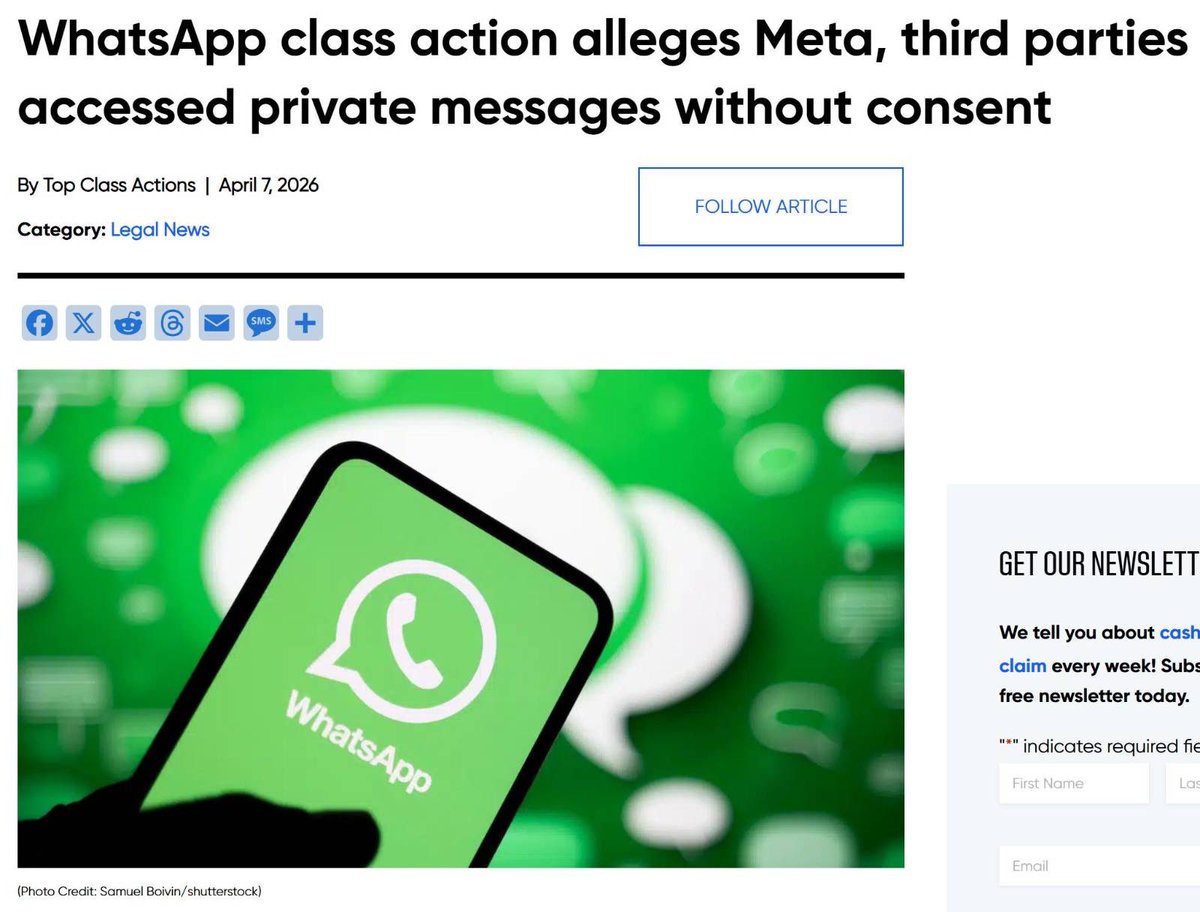
🚨 WhatsApp’s “end-to-end encrypted” privacy is a total lie.
New class-action lawsuit just dropped: Meta secretly let employees, contractors like Accenture, and third parties read, intercept, and store your private messages WITHOUT consent.
All while marketing it as “only you and the recipient can read it.”
Zuck lied to billions. Your chats were never safe.
English
Tony Slagle 리트윗함

This is WILD.
A secret workplace war just broke out in China and it has gone fully viral on GitHub.
Companies started ordering their workers to document all their knowledge as AI "skill files."
Why? to replace those same workers with AI but workers figured out the plan fast so they fired back.
Someone built a tool called colleague.skill, software that scrapes a coworker's chat logs, emails, and work docs from Chinese platforms like Feishu and DingTalk, then clones them into an AI agent.
The idea was savage, digitize your colleague before they digitize you, hand the AI clone to the company, and watch your coworker get laid off while you survive.
A real GitHub project that exploded in popularity in days but then someone else entered the chat and changed everything.
A developer released anti-distill.skill, a tool that takes the skill file your company forces you to write, then strips out every piece of real knowledge before you hand it in.
The output looks perfectly professional, totally complete, impressively detailed but every critical insight has been secretly removed.
Your company gets a hollow shell while you keep the real knowledge locked away in a private backup.
The tool even has three intensity levels, light, medium, and heavy depending on how closely your bosses are watching.
Companies across China have been building AI digital twins of departed employees, feeding their old chat histories and documents into large models to produce clones that keep working after the humans are gone.
One verified case is that an employee left, and their replacement was literally an AI trained on every message they ever sent.
The anti-distill tool went viral on GitHub within hours of being posted, racking up stars faster than almost anything trending that week.
The implications reach far beyond China's borders.
Every knowledge worker on earth now faces a version of this question, when your company asks you to document your process, they may be building the tools to replace you.
English
Tony Slagle 리트윗함

🚨 Your brain shuts down in time intervals.
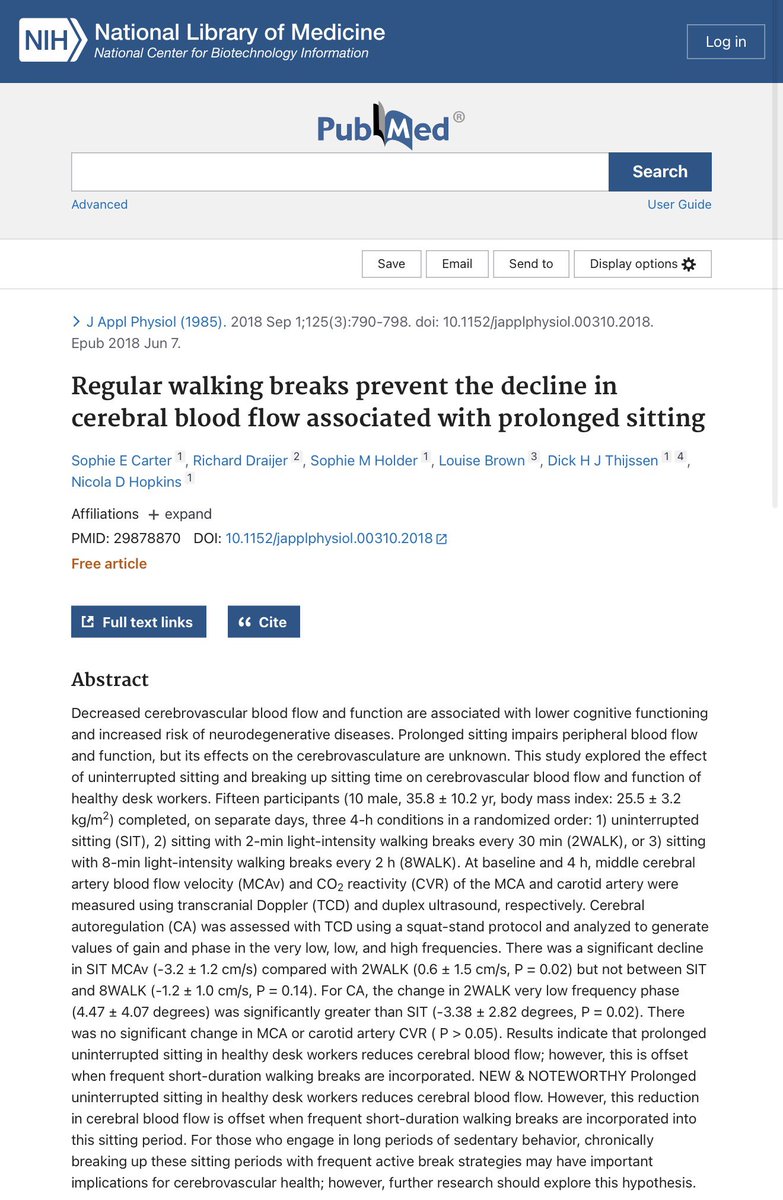
New research tracked cerebral blood flow in desk workers using transcranial Doppler imaging. What they discovered changes how we should think about cognitive performance during work.
Sitting for 30 minutes measurably reduces blood velocity to your middle cerebral artery. Your prefrontal cortex begins operating on restricted fuel. The decline happens predictably, like clockwork, every half hour.
But walking for just 2 minutes every 30 minutes completely reversed the effect. Not walking for 8 minutes every 2 hours. Short, frequent interruptions.
The timing reveals something crucial about how your cardiovascular system operates under sedentary stress. Blood doesn’t pool gradually. It pools in waves. Your circulation hits specific failure points at regular intervals when movement stops. The 30 minute mark appears to be a biological threshold where your calf muscle pumps lose their ability to maintain adequate venous return.
Think about every important decision you’ve made sitting at a desk after 30 minutes of stillness. Every creative problem you’ve tried to solve. Every complex analysis you’ve attempted. You were operating with diminished blood flow to the exact brain regions responsible for higher order thinking.
The implications extend beyond productivity. Prolonged periods of reduced cerebral blood flow accelerate cognitive decline. The same vascular mechanisms that impair thinking in real time contribute to neurodegeneration over decades. Office workers aren’t just experiencing temporary mental fatigue. They’re participating in a daily pattern that systematically starves neural tissue.
What makes this particularly disturbing is how perfectly our work culture aligns with the worst possible timing. Meetings scheduled for an hour. Focus blocks planned for 90 minutes. Deep work sessions extending for multiple hours. We’ve organized professional life around intervals that guarantee cognitive impairment.
The solution sounds absurd until you understand the physiology.
Stand up and walk for 2 minutes every 30 minutes. Not stretch. Not shift in your chair. Walk. Activate the muscle pumps in your calves. Force blood back toward your brain.
Every knowledge worker should treat this like a medical prescription. Your cognitive capacity depends on maintaining cerebral blood flow. Your long term brain health depends on preventing chronic vascular stress. Movement every 30 minutes isn’t a productivity hack. It’s basic cardiovascular maintenance for an organ system that requires constant circulation to function.
Your brain runs on blood flow, not willpower.
Starve it for 30 minutes and watch your intelligence evaporate in real time.
Darshak Rana ⚡️@thedarshakrana
Your brain goes dark when you sit still. Dr. Chuck Hillman at the University of Illinois put people in brain scanners and measured neural activity after 20 minutes of sitting versus 20 minutes of walking. The difference was notable. The sitting brain showed lower activation in key cognitive control areas. The walking brain showed increased activity across attention and executive networks. Twenty minutes. Same people. Completely different brain responses. What you’re seeing in these scans reveals something unsettling about modern life. We’ve built a world that systematically limits optimal brain function. Every chair, every car ride, every hour spent motionless is missed neurological enhancement happening in real time. The enhanced zones in the walking scan represent areas responsible for executive function, spatial processing, memory formation, and creative problem solving. These regions show stronger engagement when you move. Movement doesn’t just change your body. Movement turns on your mind. The implications go far beyond fitness. Every major decision you make while sitting is being made without the full acute boost that prior movement can provide. Every problem you try to solve from a desk is being processed with cognitive resources that benefit from activity. Every creative project you attempt while sedentary is running with added support available from movement. Think about where our most important mental work happens. Board meetings around conference tables. Students taking exams in classroom chairs. Writers staring at screens. Programmers debugging code. Therapists conducting sessions. All of it happening in environments designed to minimize movement. Hillman’s research suggests we’ve accidentally limited cognitive potential through environmental design. The walking brain and the sitting brain show meaningful functional differences. One operates with enhanced cognitive control. The other runs without that acute boost. Ancient humans walked 12 miles daily while thinking, planning, and problem solving. Their brains evolved under constant movement. Our brains carry the same neural architecture but we’ve imprisoned it in furniture. The most productive people throughout history understood this instinctively. Aristotle taught while walking. Darwin took daily thinking walks. Dickens walked 30 miles through London every night. Tesla walked 10 miles daily to stimulate ideas. They weren’t just exercising. They were unlocking cognitive potential that remains less activated when stationary. The business world talks endlessly about optimizing performance through better tools, systems, and strategies. Meanwhile, the most powerful cognitive enhancer costs nothing and requires no equipment. Just get up and move. Every step triggers a neurochemical cascade that increases BDNF, boosts dopamine, and activates neural networks that show less engagement during stillness. The effect peaks around 20 minutes and persists for hours afterward. You can literally watch improvements in cognitive performance turn on and off depending on whether you’re moving or sitting. The next time you face a difficult decision, a creative block, or a complex problem, pay attention to your position. If you’re sitting, your brain may be operating without the full acute boost available. The solution might require neural resources enhanced by activity. Stand up. Walk around. Let the enhanced zones activate. Your best thinking happens when your brain has the support of movement.
English
Tony Slagle 리트윗함

Mark Zuckerberg just described the death of human connection on the internet and no one flinched.
One sentence. Fifteen years of erosion in twelve words.
Mark Zuckerberg: “Social media started out as people primarily interacting with their friends. And now… at least half of the content is basically people interacting with creators.”
You used to open your phone to see what your friends were doing.
Now you open it to watch strangers.
You did not choose this. The algorithm chose it for you.
It tested your friends against optimized strangers.
Your friends lost. Every time.
A stranger with better lighting, better timing, and a better hook held your attention three seconds longer than someone who loves you.
So the algorithm buried your best friend’s wedding photos under a cooking video from someone in Dubai you have never met.
And you watched the cooking video.
That was the first replacement. Friends for strangers. You barely noticed.
The second one is already underway.
If the algorithm already proved strangers outperform your real relationships, and AI can now build a stranger more engaging than any human alive, the math finishes itself.
The AI does not have a bad week. It does not post something careless and lose the algorithm’s favor. It does not burn out.
Every word calibrated.
Every frame tuned.
Every pause placed at the exact interval that keeps your thumb from moving.
A human creator competing against that is carving stone tablets in a world that just built the printing press.
The economics are not even close.
A person needs rent, sleep, and motivation.
The machine needs electricity.
When the cost of generating perfect content hits zero, the feed fills with faces that do not exist.
Voices that feel familiar.
Opinions that mirror yours just enough to feel like trust.
Personalities built from scratch to feel like someone you have known for years.
You will not know when the switch happens.
That is the point.
The feed does not care whether the thing holding your attention has a pulse. It cares whether you stay.
And a machine that knows your patterns better than you know yourself will always keep you longer than a person ever could.
This is not a warning. Half of it already happened.
You lost your friends to strangers and did not notice.
You will lose the strangers to machines and call them friends.
Somewhere in a different app, in a different tab, in a room you are sitting in right now, someone who actually knows you is living a moment you will never see.
Not because they stopped sharing it.
Because you stopped being where it was.
English
Tony Slagle 리트윗함

THIS GUY AUDITED 926 CLAUDE CODE SESSIONS AND FOUND MOST OF THE TOKEN WASTE WAS ON HIS SIDE
everyone is blaming anthropic for the limits, so he decided to actually look at the data
858 sessions, 18,903 turns, and $1,619 estimated spend across 33 days
here's what he found:
1\ one default setting was burning 14,000 tokens per turn
Claude Code loads the full JSON schema for every tool into context at session start. whether you use them or not. 20,000 tokens of tool definitions sitting there on every single turn.
the fix: one line in your settings.json
"ENABLE_TOOL_SEARCH": "true"
context dropped from 45K to 20K instantly. across 858 sessions that one setting was wasting an estimated 264 million tokens
2\ cache expiry is the single biggest waste
54% of his turns came after a 5+ minute idle gap.
every one of those turns re-processed the entire conversation at full price which caused a 10x cost jump
you go grab coffee. come back 5 minutes later. type your next message. everything rebuilds from scratch. the context didn't change. you didn't change. the cache just expired.
12.3 million tokens wasted on idle gaps alone
3\ 42 skills loaded. 19 of them used twice or less across 858 sessions.
every one of those skill schemas sat in context on every turn eating tokens for nothing.
4\ 1,122 redundant file reads where the same file was read 3+ times
one session read the same file 33 times.
he ALSO built a full token auditor dashboard that shows you exactly where your waste is coming from
19 charts, opens in your browser, free AND open source
English
Tony Slagle 리트윗함

The hidden architecture of a bird’s voice. 🙌🏻
Did you know a bird's song can be mapped into a mathematical fingerprint? 🧬
This isn't sci-fi; it's the real-time mapping this is a multi-dimensional bioacoustic visualization of a Carolina Wren's song.
By tracking the frequencies, can build a unique radar chart signature for the species. It tracks spectral flatness , entropy, and slope in 3D space to reveal the hidden geometry behind the music.
Nature is literally math in motion.
the video tracks specific spectral features that define the bird's unique Vocal Signature. 🥺
A beautiful reminder of the complexity hiding in everyday sounds.
English