Gavin Baker@GavinSBaker
Much of Dwarkesh's argument hinges on this statment which *was* accurate but will be increasingly inaccurate on a go forward basis imo:
“American labs port across accelerators constantly. Anthropic's models are run on GPUs, they're run on Trainium, they're run on TPUs. There are so many things you can do, from distilling to a model that's well fit for your chips.”
As system level architectures diverge (torus vs. switched scale-up topologies, memory hierarchies, networking primitives), true portability is eroding. The Mi300 and Mi325 had roughly the same scale-up domain size as Hopper while Blackwell’s scale-up domain is 9x larger than the Mi355 scale-up domain, etc.
Many frontier models are now being explicitly co-designed for inference on specific hardware like GB300 racks. Codex on Cerebras is another example. Those models run less efficiently on other systems and the performance differentials will only widen. A model that runs well on Google’s torus topology will run less efficiently on Nvidia’s switched scale-up topology and vice versa - the data traffic is fundamentally different as a byproduct of the models being parallelized across the different topologies.
Google’s internal teams - and increasingly the Anthropic teams as they become the most important customer of almost every cloud - have the luxury of operating across the stack (models, chips, networking) - but that is not the case for the rest of the market and other prospective users. Anthropic is the exception, not the rule. To wit, Anthropic and Google allegedly have a mutual understanding where Anthropic can hire the TPU engineers they need every year to ensure that they can continue to get the most out of the TPU.
Given the overwhelming importance of cost per token to the economics of the labs, models will be run where they run best. Most extremely large MoE models will run best on GB300s given the importance of having a switched scale-up network like NVLink for MoE inference. When training was the dominant cost for labs and power was broadly available, labs were optimizing to minimize capex dollars. Model portability was a way to create leverage over suppliers. I think that drove a lot of the focus on portability.
Today, inference costs as measured by tokens per watt per dollar are everything. Inference is way more important than training costs (inference is effectively now part of training via RL). Labs are therefore now optimizing for inference. This means increasing co-design and higher go-forward switching costs for individual models between systems. I do think this explains why Anthropic and Nvidia came together: Anthropic needed Blackwells and Rubins to inference at least *some* of their models economically. And Mythos might just end up being released coincident with the availability of Rubins for inference.
TLDR: as labs shift their focus from training to inference, the costs of portability and the upside of co-design to maximize tokens per watt per dollar both rise. Portability is likely to begin decreasing as a result.
I think what I might have respectfully added to Jensen’s answer is that systems evolve under local selective pressures.
The evolutionary pressure in America is a shortage of watts so it makes sense for Nvidia to optimize, as an American company, for power efficiency and tokens per watt and stay on copper as long as possible. China has a surfeit of watts. Chinese AI systems are already taking advantage of this with the Huawei Cloudmatrix 384 and Atlas SuperPoD having an optical scale-up domain that is much larger than anything offered by Nvidia today at the cost of *much* higher power consumption and much lower tokens per watt. The networking primitives for this Huawei system are very different than those for Nvidia’s systems and a model that runs well on Nvidia will not run well on that system and vice versa. This means that if a Chinese ecosystem gets momentum, Chinese models might stop running well on American hardware. And when Chinese models run best on American hardware, America is in a better position as this gives America a degree of leverage and control over Chinese AI that it risks losing to an all-Chinese alternative ecosystem.
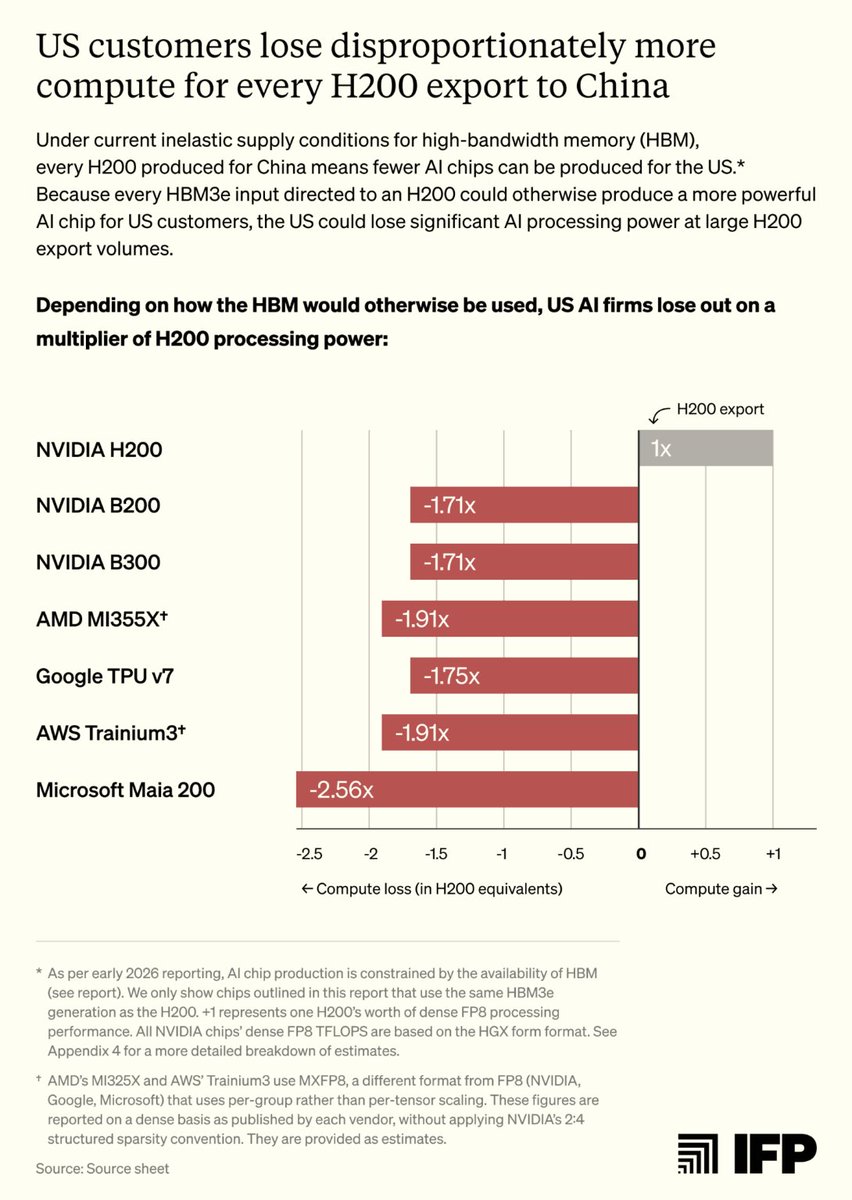
This architectural fork makes porting and distillation less effective and strengthens the pro-American national security case for selling China deprecated GPUs imo.
Also I will attest that I did not wake up a loser this morning.