W3 Explore

13.6K posts

W3 Explore banner
W3 Explore

W3 Explore

@VIBEKEYZ

W3 (Web3) represents the next evolution of the internet — a decentralized, user-owned digital ecosystem powered by blockchain technology.

Ikeja, Nigeria 가입일 Ekim 2024
2.4K 팔로잉1.2K 팔로워
W3 Explore 리트윗함
【公式】FCT(Fave Character Token)
/ 総額10,000円を10名様にプレゼント🎁 \ 大人気シリーズ新作、FCT連携タイトル 「ファントムオブキル スリースターズ」 新タイトル公開記念Giveaway Amazonギフト券当たる! かんたん懸賞 参加方法 ① @FaveFct79600 をフォロー ② このツイートをRT&いいね 締切:4/19(金) 23:59 #ファンキル

【公式】FCT(Fave Character Token) tweet media
日本語
154
3.2K
2.7K
29.1K
W3 Explore 리트윗함
LEE
LEE@mmmneee·
Day N of solo building. I've been betting on Polymarket almost every day for the past few months. Tbh, the experience isn't great. I'm guessing most of you feel the same way. Let me share the parts that have been driving me crazy: First, to place a single bet, I have to open three tabs. Check @Polymarket, switch to @Kalshi, then switch to @predictdotfun, do the math in my head to figure out which one has the better odds, then switch back to place the order. For the same event, the spread between platforms is often 5 to 10 percent. You pay 62$ for YES on Polymarket when Kalshi is offering it at 55$. You didn't compare, so you just paid 11 percent more for nothing. The whole flow is slow and honestly kind of dumb. Second, placing a bet on the best platform means connecting different accounts, moving funds around, jumping through hoops. By the time you're done, the edge is gone. I tried a few existing aggregators. After using them, all I could think was: I'd rather just go back to opening three tabs. As someone who came from memecoin trading, I've gotten used to the information density and execution speed that @gmgnai & @AxiomExchange give me. I can see everything I need at a glance, execute in one click, and never have to bounce between a dozen pages. Why can't prediction markets feel the same way? So I'm building one myself. It's not a commercial product right now. It's something I'm building for my own trading. Real time odds aggregation across the three main platforms, automatic cross platform spread detection with arbitrage highlighting, a toggleable stats view and price chart to see how probabilities moved over time, wallet connected one click trading routed to the best platform. Still very early, but the core experience works. Just want to know: What other things drive you crazy when you use prediction markets? What features do you think absolutely need to be there? If you're interested in testing or want to share feedback, reach out.
English
3
268
135
1.4K
W3 Explore
W3 Explore@VIBEKEYZ·
Decentralized AI Node Network Instead of relying on one server (like OpenAI): Thousands of nodes: run models process requests earn rewards Key benefits: No downtime (high resilience) No censorship Scalable globally. @dgrid_ai @Galxe
English
0
0
1
11
W3 Explore
W3 Explore@VIBEKEYZ·
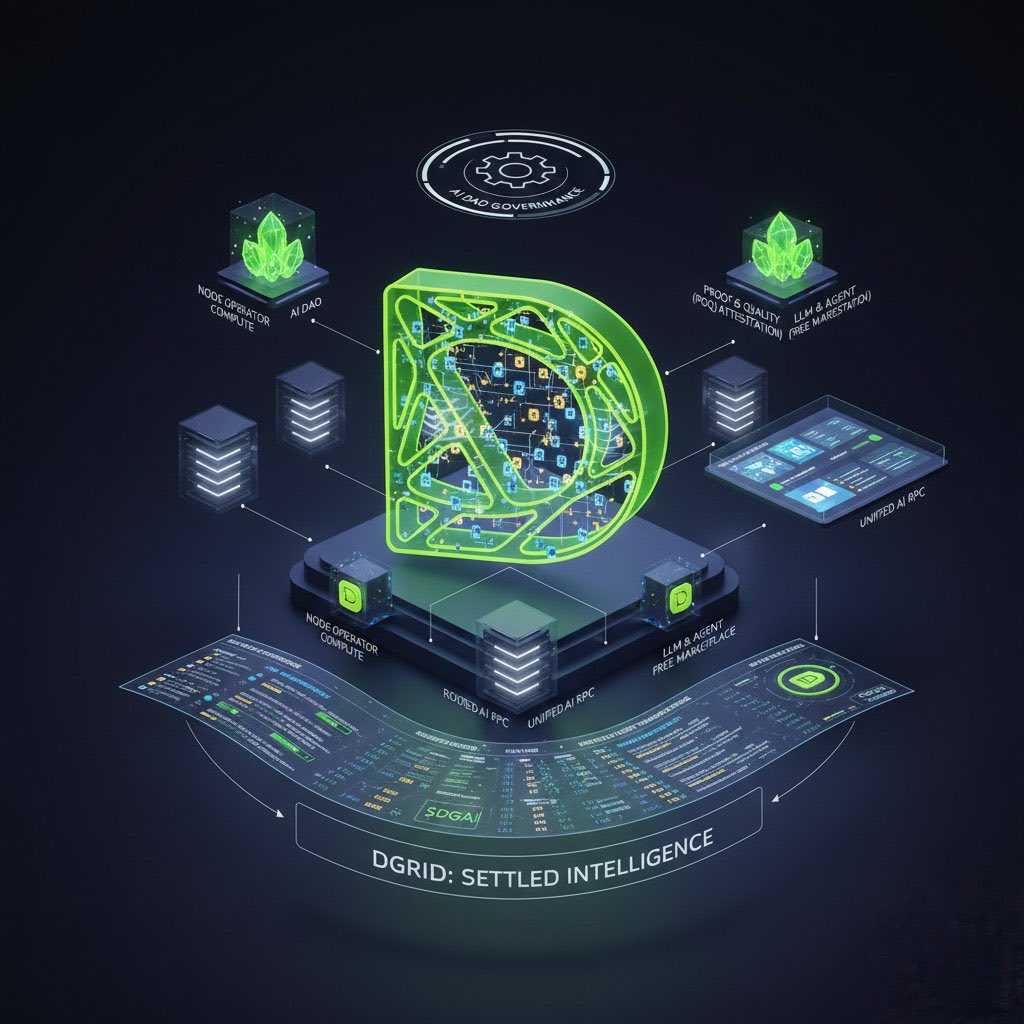
🎮 AI Arena (Human Feedback Engine) This is not just “earn points”… it’s data mining for intelligence Users compare AI outputs (AI battles) Their votes: train routing system improve model selection shape network behavior Earn: points → USDT leaderboard rewards. @dgrid_ai
W3 Explore tweet media
W3 Explore@VIBEKEYZ

Intelligent Routing Engine (Core Alpha Layer) Most people mention“AI Gateway”… but the real power is routing intelligence. Automatically selects the best AI model per task Factors: cost latency historical performance task type Works like a “smart liquidity router” for @dgrid_ai

English
4
3
4
51
W3 Explore
W3 Explore@VIBEKEYZ·
Dori AI (Autonomous AI Advisor) Think of this as your AI strategist inside DGrid Recommends: best model cheapest option highest performance route 👉 It abstracts complexity: You don’t choose models — Dori chooses for you 📌 Makes DGrid beginner-friendly despite deep tech
W3 Explore@VIBEKEYZ

🎮 AI Arena (Human Feedback Engine) This is not just “earn points”… it’s data mining for intelligence Users compare AI outputs (AI battles) Their votes: train routing system improve model selection shape network behavior Earn: points → USDT leaderboard rewards. @dgrid_ai

English
0
0
1
3
W3 Explore
W3 Explore@VIBEKEYZ·
Intelligent Routing Engine (Core Alpha Layer) Most people mention“AI Gateway”… but the real power is routing intelligence. Automatically selects the best AI model per task Factors: cost latency historical performance task type Works like a “smart liquidity router” for @dgrid_ai
W3 Explore tweet media
English
0
0
1
63
W3 Explore
W3 Explore@VIBEKEYZ·
AI DAO Governance (Self-Evolving AI Networks) DGrid will evolve into a DAO-controlled AI system. Token holders govern: Fees upgrades ecosystem rules Future twist: AI agents may participate in governance 👉 This leads to: Self-improving, semi-autonomous AI ecosystems. @dgrid_ai
English
0
0
0
3
W3 Explore
W3 Explore@VIBEKEYZ·
Decentralized AI Compute Layer (Like AWS for AI—but Open) @dgrid_ai is building a global network of AI nodes. Anyone can run a node Nodes provide compute power They earn rewards in $DGAI Future evolution: Millions of distributed AI nodes Region-based optimization.
W3 Explore tweet media
W3 Explore@VIBEKEYZ

AI Agent Economy(Autonomous Digital Workers) DGrid is positioning itself for the AI agent era. Future direction: AI agents will: Execute tasks Interact with smart contracts Earn and spend money DGrid enables: A marketplace where agents are: Created Tokenized Monetized. @dgrid_ai

English
1
0
0
16
W3 Explore
W3 Explore@VIBEKEYZ·
Tokenized Intelligence (AI Becomes an Asset Class) DGrid introduces something very few people fully grasp: 👉 AI models and agents become investable assets Developers can: Launch models Set prices Earn directly Users can: Pay per usage Invest in high-performing AI
W3 Explore@VIBEKEYZ

Decentralized AI Compute Layer (Like AWS for AI—but Open) @dgrid_ai is building a global network of AI nodes. Anyone can run a node Nodes provide compute power They earn rewards in $DGAI Future evolution: Millions of distributed AI nodes Region-based optimization.


English
0
0
0
2
W3 Explore
W3 Explore@VIBEKEYZ·
AI Agent Economy(Autonomous Digital Workers) DGrid is positioning itself for the AI agent era. Future direction: AI agents will: Execute tasks Interact with smart contracts Earn and spend money DGrid enables: A marketplace where agents are: Created Tokenized Monetized. @dgrid_ai
W3 Explore tweet media
English
0
0
0
20
W3 Explore 리트윗함
Oluwafemi👑❤️🚀
Oluwafemi👑❤️🚀@TheFemog·
Something is quietly shifting in Web3, and you can feel it if you look past the noise. The conversation is no longer about isolated innovation or which project is “better,” but about how different layers are starting to think together. 0G_labs, Dgrid_a, Permacastapp, and Dango may seem unrelated at first glance, but the real story is how they collectively shape a more intelligent, responsive, and human-centered decentralized stack where data, energy, communication, and intent flow as one. 0G_labs is not just another modular data availability layer; it is reframing how high-performance data throughput interacts with AI-native applications. The emphasis on scalable DA, decentralized storage, and verifiable compute creates a base where AI doesn’t just run on-chain but belongs there. This becomes more interesting when viewed alongside Dgrid_a, where decentralized physical infrastructure networks (DePIN) meet energy coordination. Dgrid is quietly solving a real-world constraint, power distribution and anchoring it into Web3 logic, turning energy into a programmable, incentivized network primitive rather than a background utility. Then comes Permacastapp, which introduces a persistence layer not just for data, but for communication itself. In a space where narratives are often ephemeral and algorithm-driven, Permacast flips the model by anchoring voice, media, and content permanently on decentralized rails. It’s not just storage, it’s cultural continuity on-chain. This is where information stops being disposable and starts becoming composable across ecosystems. Dango, on the other hand, operates in a more abstract but equally critical layer, coordination and execution. It brings together intents, automation, and user-centric flows in a way that reduces friction between human decisions and on-chain actions. Instead of forcing users to adapt to protocols, Dango makes protocols adapt to user intent, which is a subtle but powerful shift. What ties all of this together is not similarity, but complementarity. Data from 0G feeds intelligence, Dgrid powers the infrastructure physically, Permacast preserves the narrative layer, and Dango orchestrates interaction. This is not a stack built top-down; it’s a mesh forming sideways, where each protocol strengthens the other without needing to merge. The conversation is no longer about which project leads, but how these systems interlock to remove friction across the entire Web3 experience. That’s where the real shift is happening not in hype cycles, but in silent alignment.
Oluwafemi👑❤️🚀 tweet media
Oluwafemi👑❤️🚀@TheFemog

The emerging competition between 0G_labs, Dgrid_a, Permacastapp, and Dango is no longer just about building in Web3, it’s about defining how intelligence, data, and computation will coexist in a decentralized future. Each project is attacking the same endgame from radically different angles: modular AI infrastructure, decentralized compute grids, programmable content layers, and autonomous agent ecosystems. What we are witnessing is not rivalry at the surface level, but a deeper architectural divergence that will likely shape the dominant paradigm of decentralized systems. 0G_labs is pushing the boundaries of modular AI with a strong focus on high-performance data availability, decentralized storage, and scalable AI execution. Their approach leans into creating a base layer where AI models can operate trustlessly with near Web2 efficiency. In contrast, Dgrid_a is positioning itself as the backbone of decentralized compute, emphasizing distributed GPU networks, permissionless resource sharing, and efficient workload orchestration. Where 0G is structuring intelligence, Dgrid is powering it. Permacastapp introduces a different layer entirely by focusing on programmable, permanent media and content intelligence. Its relevance in this competition lies in how data is not just stored but contextualized and made usable for AI agents and decentralized applications. Meanwhile, Dango is exploring autonomous coordination through AI agents, leaning into intent-based systems, adaptive execution, and self-operating digital entities that interact across these infrastructures. The real insight here is that none of these projects are truly competing in isolation, they are converging toward a stack where data availability, compute power, content permanence, and agent autonomy must seamlessly integrate. The winner will not necessarily be the most advanced in one category, but the one that best understands how to interlock all layers into a unified, scalable ecosystem.

English
3
60
61
677
W3 Explore 리트윗함
Richard⚓️
Richard⚓️@Richard12413054·
Most systems store outcomes but lose reasoning over time without context the past fragments into competing versions PermawebDAO preserves the why not just the result while DGrid ensures decisions are executed through measurable and auditable processes
Richard⚓️@Richard12413054

Reference is the foundation of accountability systems that cannot cite their past cannot verify their decisions PermawebDAO enables addressable and traceable knowledge while DGrid ensures execution remains transparent and verifiable

English
0
46
51
286
W3 Explore 리트윗함
Holmms Ⓜ️
Holmms Ⓜ️@Nyerishi·
The Permanent Stack: Permacast, DGrid AI, Dango Web3 infrastructure is moving toward specialization. Permacast, DGrid AI, and Dango are building essential layers for media permanence, verification, and settlement. Permacast: Media Permanence Permacast solves content loss on Web3. Links break. Platforms disappear. Archives vanish. Permacast stores content permanently on Arweave. Accessible for decades. Verifiable. Censorship-resistant. Permacast uses an AI Media Intelligence Engine for content generation, summarization, tagging, and sentiment analysis. Permacast builds an AI Social Graph mapping creators, listeners, and content. Permacast ties everything to on-chain identity. Long-term reputation assets that persist across applications. Permacast ensures content lasts. Permacast makes media verifiable. Permacast preserves on-chain identity. DGrid AI: Verification DGrid AI built Proof of Quality consensus. Every AI inference carries cryptographic proof. Verification nodes on DGrid AI sample outputs continuously. Results that pass are rewarded. Results that fail are slashed. DGrid AI launched AI Arena, a blind-test battleground where users vote on model quality without knowing identities. DGrid AI ensures every operation leaves an auditable trail. DGrid AI makes trust a property of the system, not a promise. DGrid AI verifies every inference. DGrid AI proves every output. DGrid AI makes AI accountable. Dango: Settlement Dango is a blockchain built for high-velocity settlement. The Central Limit Order Book lives at consensus level. Matching and execution are one atomic motion. Dango eliminates latency. Sub-second finality. No smart contract overhead. Dango integrates TradingView for institutional-grade charting. Dango provides real-time liquidity visualization. Dango is not a DEX on an existing chain. Dango is a chain built to be a DEX. Dango settles trades instantly. Dango settles at consensus speed. Dango settles every trade without compromise. The Infrastructure Stack Media storage from Permacast. Verification from DGrid AI. Settlement from Dango. A creator publishes content on Permacast. Stored permanently on Arweave. On-chain identity attached. DGrid AI verifies provenance and AI-generated elements. Value transfers settle on Dango at consensus speed. Permacast preserves. DGrid AI verifies. Dango settles. Three layers. Specialized. Essential. The permanent stack for Web3. This is the infrastructure for decentralized media, verified AI, and instant settlement.
Holmms Ⓜ️ tweet media
Holmms Ⓜ️@Nyerishi

The Permanent Stack: Permacast, DGrid AI, Dango Web3 infrastructure is becoming specialized. Permacast, DGrid AI, and Dango are building essential layers for media permanence, verification, and settlement. Permacast: Media Permanence Permacast solves a critical Web3 problem: content loss. Links break. Platforms disappear. Archives vanish. Permacast stores content permanently on Arweave, making it accessible, verifiable, and censorship-resistant for decades. Permacast uses an AI Media Intelligence Engine for content generation, summarization, tagging, sentiment analysis, and trend discovery. Permacast builds an AI Social Graph mapping relationships between creators, listeners, and content. Permacast ties all creations to on-chain identity, forming long-term reputation assets that persist across applications. Permacast ensures content lasts. Permacast makes media verifiable. Permacast preserves on-chain identity. Permacast is the permanence layer Web3 has been missing. DGrid AI: Verification DGrid AI built Proof of Quality consensus to ensure every AI inference carries cryptographic proof. Verification nodes on DGrid AI sample outputs continuously. Results that pass are rewarded. Results that fail are slashed. DGrid AI launched AI Arena, a blind-test battleground where users vote on model quality without knowing identities. DGrid AI ensures every operation leaves an auditable trail. DGrid AI makes trust a property of the system, not a promise. DGrid AI verifies every inference. DGrid AI proves every output. DGrid AI makes AI accountable. DGrid AI is the verification layer for transparent, trustworthy content. Dango: Settlement Dango is a blockchain built for high-velocity settlement. The Central Limit Order Book lives at consensus level, making matching and execution a single atomic motion. Dango eliminates latency, delivering sub-second finality without smart contract overhead. Dango integrates TradingView for institutional-grade charting. Dango provides real-time liquidity visualization. Dango is not a DEX on an existing chain. Dango is a chain architected to be a DEX from day one. Dango settles trades instantly. Dango settles at the speed of consensus. Dango settles every trade without compromise. Dango is the settlement layer for value transfer. The Infrastructure Stack Media storage from Permacast. Verification from DGrid AI. Settlement from Dango. A creator publishes content through Permacast, storing it permanently on Arweave with on-chain identity. DGrid AI verifies the content's provenance and any associated AI-generated elements. Value transfers for that content settle on Dango at consensus speed. Permacast preserves. DGrid AI verifies. Dango settles. Three layers. Specialized. Essential. The permanent stack for the next generation of Web3. This is the infrastructure that will power decentralized media, verified AI, and instant settlement for years to come.

English
0
47
52
348
W3 Explore 리트윗함
Liegerules
Liegerules@Mcjustie·
Instead of optimizing for attention that stack optimizes for reliability, and where systems are expected to be observable, fault-tolerant, and consistent under real load, not just during demos. @0G_labs nudges builders toward disciplined execution and outcomes that can be verified over time. Dango carries that discipline into the user layer, turning interactions into a continuous narrative where identity, reputation, and engagement evolve with context rather than disappearing into feeds. #ad
Liegerules@Mcjustie

Rather than chasing momentum, @0G_labs infrastructure layer is built around endurance, systems are expected to be stress-tested, observable, and reliable long after launch. It pushes builders to prioritize clarity, accountability, and real performance over surface-level innovation. Dango extends that philosophy into the social layer, where interactions aren’t just moments but building blocks of a persistent identity, giving users a way to engage with intention and continuity.

English
1
47
54
348
W3 Explore 리트윗함
BASH-TECH OG
BASH-TECH OG@Bashtechceo·
PERMACAST focuses on creating content or conversations that stay valuable for a long time, instead of fading quickly like trends. Your content keeps working for you without constant updates. One good conversation/post can: Attract people repeatedly Stay relevant for years Save you time long-term People start seeing you as someone who knows what they’re talking about. Because you focus on: Deep insights Real-life lessons Thoughtful conversations This builds trust, not just attention. @permacastapp conversations are: Meaningful Thought-provoking Relatable This creates: Deeper emotional connection Loyalty (people come back to you) You don’t need to chase trends every day. Instead: You build a solid foundation Your content grows slowly but steadily Dgrid gives you: Cryptographic proof → no need to trust middlemen Verifiable distribution → everyone can audit outcomes Independent validation → no single authority controls truth Economic disincentives → centralization becomes expensive/unprofitable In decentralized systems, timing = leverage Strategy: Join early-stage Dgrid ecosystems/projects Run a node or validator (if available) Participate in governance (voting rights often grow over time) Why it matters: Early participants often gain: Higher rewards Reputation weight Influence over system rules Dgrid likely uses incentives (tokens, credits, or rewards). Strategy: Accumulate tokens when undervalued Stake or lock assets to earn yield Provide resources (compute, storage, validation) Long privilege move: Don’t just hold—participate in value creation Passive users = low advantage Active contributors = exponential advantage Since @dgrid_ai is about verifiable truth, those who understand verification gain power. Strategy: Learn how validation works (consensus, proofs, etc.) Verify transactions/data yourself instead of trusting dashboards Build tools or dashboards for others What 0G is building A full-stack AI-native blockchain Not just smart contracts — but: Compute (GPU-like network) Storage (cheap + massive) Data availability (ultra-fast) Verification layer for AI AI trained in centralized data centers Blockchain only stores results (tokens, transactions) New Architecture (@0G_labs model) AI training = distributed across nodes AI inference = verifiable on-chain Data = cryptographically proven Agents = autonomous economic actors This is called: “Decentralized AI Operating System Instead of one blockchain doing everything: Chain = execution + consensus Separate layers for: Compute Storage Data availability Developers can “plug” what they need Massive scalability vs monolithic chains 0G is solving a huge problem: “How do you trust AI outputs?” They introduce: On-chain training logs Proof of data provenance Verified inference Every AI output becomes auditable This is massive for: Finance Healthcare Autonomous agents
BASH-TECH OG tweet media
BASH-TECH OG@Bashtechceo

Jummah mufeedahtul frens.. Permacastapp sits at the intersection of creator economy, decentralized infrastructure, and digital permanence. As centralized platforms increasingly dictate distribution, monetization, and content control, a decentralized podcast ecosystem offers a fundamentally different paradigm: creator sovereignty + resilient access. Permacastapp’s long-term advantage lies in solving three major problems: Ownership → Creators retain full control of their content Persistence → Content cannot be arbitrarily removed or lost Portability → Content flows across platforms without lock-in This shifts podcasts from platform-dependent media to protocol-level assets. @permacastapp should leverage hybrid decentralized storage: Cold storage permanence: Arweave-style permanent storage Hot delivery layer: IPFS + CDN caching for fast streaming Redundancy layer: Multi-node replication incentives Each podcast episode becomes: A content-addressed object (hash-based) Immutable and verifiable Traceable across distribution networks Instead of being “hosted on Permacast,” content should: Exist on-chain/off-chain hybrid Be accessed via: Open APIs RSS bridges (for legacy platforms) Web3-native apps @dgrid_ai is not just another AI tool it’s a decentralized infrastructure layer for AI (LLMs + agents). Think of it like: Instead of using ONE AI (like ChatGPT), You get access to hundreds of AI models through one system And the system automatically picks the best + cheapest + fastest one for you. One API → access 200+ models No need to integrate different APIs again and again Automatically routes tasks to the best model DGrid AI Docs Strategy meaning: This is like “AWS for AI models” Whoever controls this layer controls AI usage Chooses model based on: Cost Performance Task type Learns from user feedback (AI Arena) This is BIG: It turns AI from static → dynamic competition market Developers can: Upload models Set their own price Earn directly Strategy meaning: Like App Store but for AI models Breaks monopoly of OpenAI, Google, etc. 0G Labs positions itself at the intersection of decentralized infrastructure + high-performance compute, unlocking what can be described as a “longs privilege” the structural advantage of owning or aligning early with scalable compute layers that grow with demand rather than lag behind it. In today’s environment where AI, real-time data, and decentralized applications are exploding compute is no longer just infrastructure; it is economic power. Traditional systems scale slowly. 0G Labs flips that model by enabling: On-demand compute provisioning Low-latency scaling across distributed nodes Near real-time workload balancing Centralized cloud providers are expensive due to: Fixed infrastructure costs Geographic limitations Pricing monopolies 0G Labs leverages decentralized nodes to: Reduce cost per compute unit Tap into underutilized global hardware Enable competitive pricing We are currently in an AI-driven compute boom: Model training is expensive Inference demand is continuous Data pipelines are expanding @0G_labs is positioned to support: Distributed AI workloads Scalable inference layers High-throughput data availability

English
40
88
102
731
W3 Explore 리트윗함
Johnson Favour
Johnson Favour@fevicklee·
Permacatapp shifts audio from ephemeral servers to the permanent blockweave, making speech an indestructible protocol asset. Dgrid_ai ensures interpretation is verifiably decentralized, does the status of institutions as editors of reality finally become entirely obsolete?
Johnson Favour tweet media
Johnson Favour@fevicklee

Permacatapp secures our broadcasts within the protocol's eternal memory, rendering deplatforming a legacy error. Dgrid_ai subjects inference to decentralized consensus, replacing corporate trust with verifiable logic. Can this open network finally outthink its own centralized?

English
1
73
72
482
W3 Explore 리트윗함
Mr.L
Mr.L@Mr_L_5·
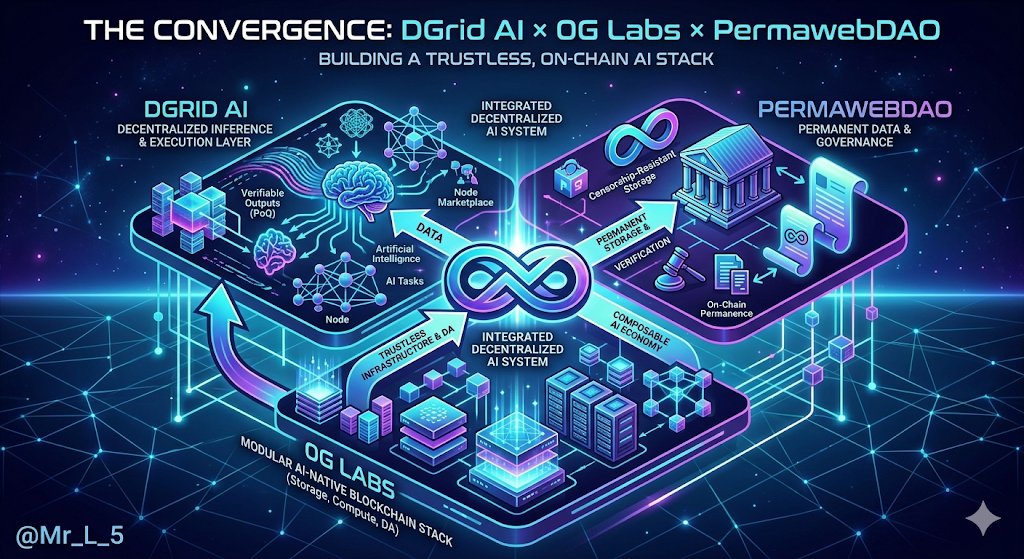
The convergence of AI + Web3 isn’t happening in silos anymore. It’s becoming modular, verifiable, and composable — and the intersection of DGrid AI × 0G Labs × PermawebDAO is a clear signal of that shift. Here’s what’s actually going on 🧵 DGrid AI is positioning itself as a decentralized inference layer. Not another model. Not another chain. → A network that routes, executes, and verifies AI tasks across distributed nodes. Core idea: • AI RPC + LLM inference + node marketplace • Proof-of-Quality (PoQ) for verifiable outputs • On-chain settlement for compute usage This directly tackles: – Centralized AI bottlenecks – Opaque outputs – High inference costs 0G Labs operates one layer deeper. It’s building a modular AI-native blockchain stack — essentially an operating system for decentralized AI. Stack includes: • Compute (inference execution) • Storage (large-scale AI data) • Data Availability (verifiable access) • Chain (execution + settlement layer) The goal is simple: → Make AI fully on-chain, scalable, and composable So where’s the synergy? DGrid ≠ infrastructure base 0G ≠ application layer They complement each other: • 0G = base layer (compute + storage + DA) • DGrid = execution + routing layer for AI inference Meaning: DGrid can leverage infra like 0G to run trustless AI workloads at scale. Now bring in PermawebDAO. While not a compute layer, its role aligns with: → permanent data + governance for open ecosystems In a stack like this: • 0G → handles data availability • Permaweb → ensures permanence + censorship resistance • DGrid → executes AI tasks on top This creates a full loop: Data → Storage → Compute → Verification → Persistence Why this matters: We’re moving from: “AI tools on blockchain” → to “AI systems natively built on decentralized infrastructure” That unlocks: • Verifiable AI outputs • Permissionless model marketplaces • Tokenized compute economies • Autonomous AI agents with on-chain logic But let’s stay grounded: DGrid is still early-stage (testnet → mainnet roadmap) 0G is infrastructure-heavy and execution-dependent Adoption = the real bottleneck Narrative is strong. Delivery is what counts. TLDR; DGrid AI = decentralized inference + execution layer 0G Labs = modular AI blockchain (compute, storage, DA) PermawebDAO = permanence + governance layer Together → a full-stack vision for trustless, on-chain AI systems The stack is forming. Now it has to scale.
Mr.L tweet media
English
1
46
50
336
W3 Explore 리트윗함
Marveltech
Marveltech@Marveltech13835·
Web3 systems are primarily optimized for movement: value moves across chains, decisions move through governance mechanisms, and execution moves across networks. However, precedent requires more than movement; it requires stability. A system must provide a substrate where past decisions remain accessible, interpretable, and relevant to future actions. PermawebDAO provides this substrate by anchoring knowledge in a permanent and structured format that preserves both outcomes and context. DGrid complements this by ensuring that execution remains decentralized and continuously available, allowing systems to interpret and act on historical knowledge without relying on centralized intermediaries. Together, they create a foundation where movement is supported by memory, enabling systems to evolve rather than reset.
Marveltech tweet media
English
0
78
72
598