a

520 posts

a banner
a

a

@abdced_

가입일 Eylül 2014
257 팔로잉9 팔로워
a 리트윗함
Pep Invest
Pep Invest@PepInvestStocks·
🚨BREAKING: The Next $IONQ Is Already Here - $INFQ First neutral-atom quantum pure-play on the NYSE $NVDA logical qubits breakthrough @NASA quantum hardware already on the ISS INFQ is the only public company shipping real quantum computing + sensing systems to NASA, DoD and hyperscalers - and it could deliver 10x in the quantum supercycle while most investors are still watching the hype reels. I just dropped the most detailed, no-hype breakdown on why Infleqtion is already winning in the quantum race. Full article 👇
Pep Invest@PepInvestStocks

x.com/i/article/2043…

English
1
15
80
8.2K
a 리트윗함
How To AI
How To AI@HowToAI_·
I just found a website that lets you create, program and test electronic hardware. It even has pre-built projects to experiment and learn before building them in real life. 100% free.
English
56
642
5.3K
351.1K
a 리트윗함
Scott Redler
Scott Redler@RedDogT3·
This is better than a few college courses!
English
15
317
1.8K
180.4K
a 리트윗함
Paradis Labs
Paradis Labs@ParadisLabs·
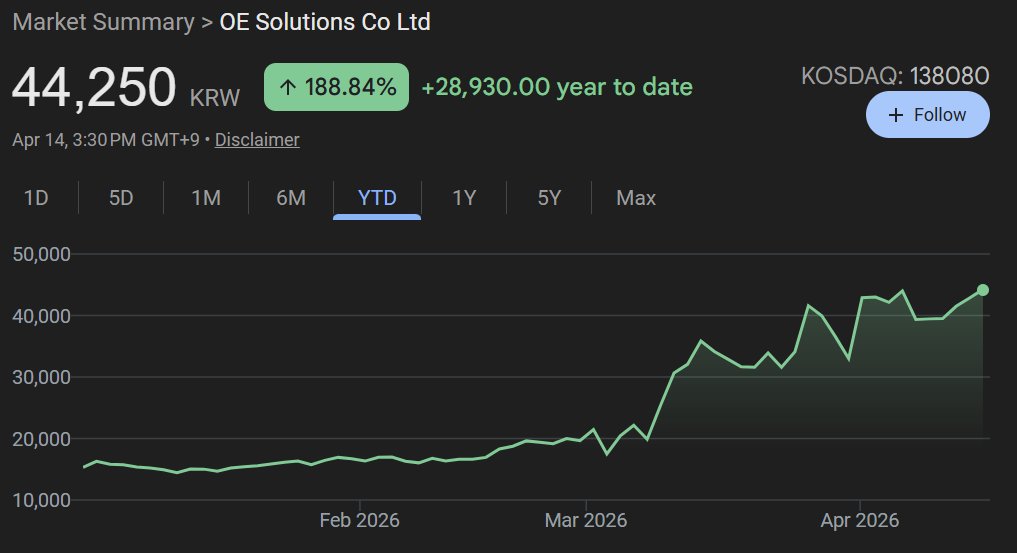
New Long Idea: OE Solutions (138080.KQ) > OE is one of 4 companies that can make 1.6T laser sources…at just $370M MC??? > And I've not seen anyone mention their name on @X...? > When they're in the same layer on the supply chain as $LITE and $COHR ... but at a fraction of their prices. The core bottleneck is shifting from raw compute cycles -> energy + bandwidth efficiency of the interconnect fabric. OE Solutions is a critical player in the transition from traditional pluggable optics -> CPO. Their CMO said recently: “By providing a high-power, thermally stable light source, we are removing the primary roadblocks to next-generation AI networking.” “We look forward to shipping samples in Q3 2026 to accelerate the global transition to 1.6T infrastructure.” OE Solutions has solved the thermal wall bottleneck that was previously preventing $NVDA & other hyperscalers from moving beyond 800G. The bottleneck has moved to the physical layer of the network. $AVGO etc. have warned that supply chain constraints have migrated to high-power laser components. The move to 1.6T networking requires signaling at 200G per lane. At these speeds, traditional copper fails, forcing a shift to optical fiber for even the shortest distances within the data center rack. The solution is CPO: Which integrates the optical engine directly onto the switch ASIC package. However, CPO introduces a new dependency; the need for an External Laser Source. There are only a couple companies globally capable of manufacturing InP lasers with the necessary power (23dBm) and thermal stability (internal TEC cooling) to drive 1.6T CPO systems. OE Solutions is one of these few. OE Solutions are a Tier-1 supplier to Samsung Electronics and $NOK. They incorporate OE Solutions' transceivers into the networking hardware they sell to hyperscalers like $AMZN, $GOOGL, and $META. The supply chain is something like this: 1 > InP substrates from companies like $AXTI and Sumimoto 2 > InP substrates fabricated into lasers by $LITE, $COHR, OE Solutions 3 > Packaging & photonics by companies like $TSM, $FN, Foxconn/TFC 4 > $NVDA, $AVGO, Samsung, $NOK for networking and system integration 5 > Hyperscalers like $META, $MSFT, $GOOGL $NVDA has direct investments in $COHR + $LITE: But OE Solutions acts as the strategic non-China third source for high-power laser engines needed for the Spectrum-X and Quantum-X photonics platforms. InP laser market: Dominated by three players - $LITE, $COHR, OE Solutions. But OE Solutions has a unique Moat that makes it a superior investment play for the 1.6T cycle: As Western hyperscalers de-risk from Chinese vendors (which are 7/10 globally for modules), OE Solutions is the only vertically integrated Asian player outside of the China-US trade friction. OE Solutions has successfully brought production in-house - while competitors like $COHR are still buying laser chips from $LITE due to yield issues. Internalizing Laser Diode chips allows OE to capture the 50%+ margins that fabless competitors must pay away. They also have a significant software moat: OE's partnership w/ AimValley lets data center operators monitor link health in real-time. A feature $COHR and $LITE typically lack at this price point. In terms of valuation: Historically, OE purchased LD chips externally, keeping gross margins near 10%. W/ internalization, margins are set to expand toward 34% - 42% by late 2026. OE historically traded at a 1.0x - 1.5x P/S as a telecom company. But peer companies like $LITE and $COHR trade at 5x - 8x. Applying a 6.0x P/S multiple to 2027 forecasted revenue of ~$135M: Implies a MC of $804 million USD - More than 2x current. So, undervalued given fwd earnings growth.
Paradis Labs tweet mediaParadis Labs tweet media
English
21
18
239
49.4K
الصقر
الصقر@Sauud_7756·
@BinDollarSign @RocketLab استاذ راكان انا اثق في تحليلك ورؤيتك انا معي مبلغ ضخم ابي اوزعه على ٥ اسهم قوية تشوف سعرها الان مناسب وبعد سنه الى سنه ونصف راح تكون جايبه لي مبلغ ربح ممتاز ياليت ترسح لي ٥ بالترتيب انوع مبالغ فيها 🙏🏻💙
العربية
2
0
0
23
Rocket Lab
Rocket Lab@RocketLab·
Welcome to the Rocket Lab team, Mynaric! Today we officially acquired Mynaric, adding laser optical communications to our growing space systems portfolio. A big moment for our teams and for the space industry as we make leading satellite laser communication technology available at the volume and speed demanded by commercial and government satellite customers across Europe, the U.S., and rest of world.
Rocket Lab tweet media
English
99
435
3.3K
217.1K
a 리트윗함
Just a Dude Who Invests
Just a Dude Who Invests@DudeWhoInvests·
People who went all in to cash when the Iran war kept escalating right now
English
42
51
1.1K
148K
a 리트윗함
AskLivermore
AskLivermore@asklivermore·
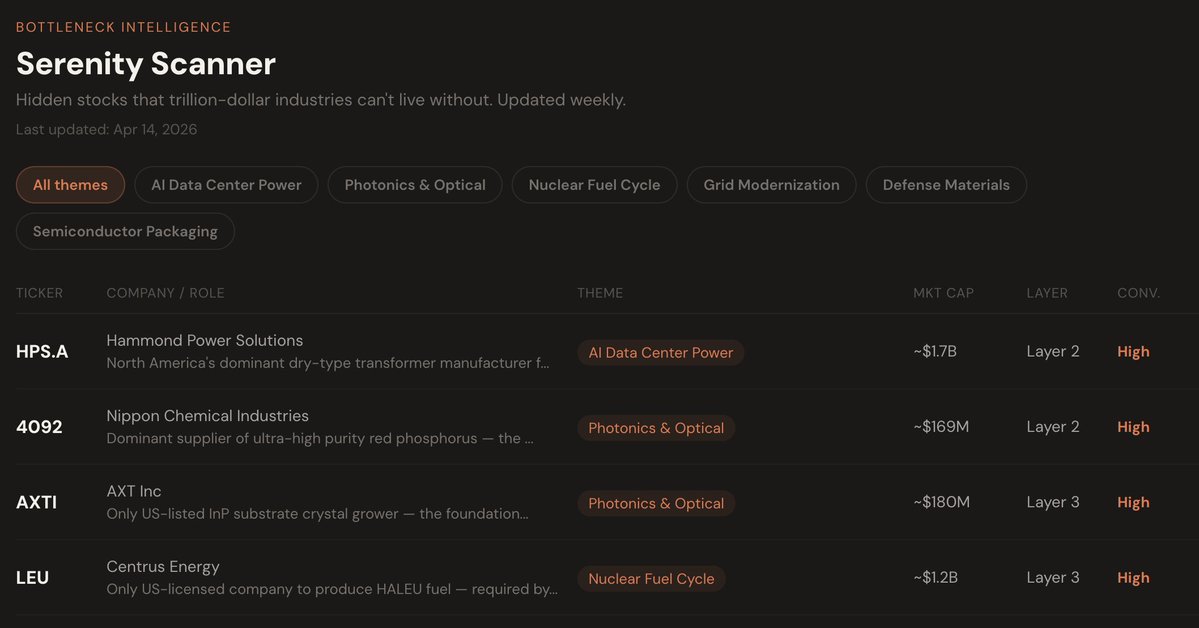
"Serenity Scanner" by @asklivermore coming this week. Scans the next hidden stocks that trillion-dollar industries can't live without. Updates weekly based on macro-themes developing across the world.
AskLivermore tweet media
English
40
19
691
51K
a 리트윗함
InvestmentGuru
InvestmentGuru@InvestmentGuru_·
Most investors are always chasing the last wave. The AI infrastructure cycle is playing out in layers — and each one is bigger than the last. Here’s the full roadmap: Wave 1: Semiconductors ✅ (Priced In) $NVDA. $AMD. $AVGO. The GPU arms race. Everyone knows this trade. Raw compute was the foundation. Most of the upside? Already captured. Wave 2: Memory & Storage ✅ (Confirming) More data. More inference. More throughput. Flash, DRAM, HBM all followed. $SNDK ’s recent move is the latest confirmation. The storage bottleneck is real — and the market is finally catching up. Wave 3: Photonics & Optical Networking 👀 (In Motion NOW) This is what most retail investors are still sleeping on. You cannot move AI workloads at scale with copper wire. Data centers need ultra-fast, low-latency interconnects — and photonics is the only answer. Silicon photonics is actively replacing copper-based communication inside and between hyperscaler campuses. The plays institutions are quietly accumulating: $AAOI — pure-play optical components, deep data center exposure $COHR — vertically integrated photonics at scale $LITE — transceivers powering the hyperscaler build-out $POET — integrated optical engines, early-stage, asymmetric upside $CIEN — backbone optical networking infrastructure $FN — precision optical manufacturing, best-in-class margins This wave is not coming. It is here. Wave 4: Power & Energy Infrastructure (Early Stage) AI doesn’t run on ambition. It runs on electricity. Data centers are projected to consume 8–10% of U.S. power by 2030. That is not a tailwind. That is a structural demand shock the grid is not prepared for. Nuclear is the only baseload solution that can sit next to a hyperscaler campus and deliver consistent, carbon-light power at scale. The plays: $CEG & $VST — utilities with nuclear-powered AI offtake contracts $CCJ — uranium supply, the fuel behind the revival $OKLO & $SMR — next-gen small modular reactors $VRT — liquid cooling and power management inside data centers The capex commitments from $MSFT, $AMZN , and $GOOG are already locked in. The power infrastructure just needs to catch up. This wave is early. That is the opportunity. Wave 5: Robotics 🤖 (Loading…) Once AI is trained, powered, and connected — it needs a body. Physical deployment into warehouses, factories, logistics, and healthcare. This is the final and potentially the largest layer of the entire cycle. Hardware-software integration is still 12–24 months from full ignition. But the smart money is already laying the groundwork quietly. The pattern is simple: Each layer enables the one after it. → Semis built the brain → Memory gave it recall → Photonics gave it nerves → Power gives it fuel → Robotics gives it hands The investors winning this decade are not chasing yesterday’s leader. They are identifying tomorrow’s bottleneck — and positioning before the crowd arrives. The question is not which wave already ran. The question is: which wave are YOU in front of? $AAOI $COHR $LITE $POET $CIEN $FN $CEG $VST $OKLO $SMR $CCJ $VRT DOYR , bookmark this and retweet for others.
English
5
54
226
22.3K
a 리트윗함
PhotonBull
PhotonBull@PhotonBull·
Probably one of the most versatile substack writers you can follow? This guy called $KRKNF early, and in size. He rode the entire photonics wave and went to $NVDA GTC 2026 in real life to cover it for retail investors. Covered tungsten (and $EQR.AX) and now the space sector with $FLY as well. Truly a must follow, and would recommend the substack as well
Michael Sikand 🦑@michaelsikand

I just put 15% of my $5,000,000 fund in $FLY 🪰🌖 Firefly Aerospace is a misunderstood space stock trading 35% off its ATH with an extremely unique set of assets. Here's why I think this $6B space pioneer is an asymmetrical bet. I love $FLY because its business spans the full orbital stack: roughly 20% launch, 40% spacecraft, and 40% defense software. On the spacecraft side, $FLY’s Blue Ghost lander makes it the only company in history to land successfully on the moon. A 10 year old space startup achieved the same feat only 5 countries had before. It now has $487M in contracted NASA missions and CEO Jason Kim has said Firefly is in discussions with NASA about block buy contracts for 5 to 10 landers, which would represent between $500 million and $1.4 billion in a single order. That’s asymmetric growth against a company doing $160 million in trailing revenue. $FLY also has a spacecraft called Elytra which is this swiss army knife of sorts. It’s part tugboat, part sentinel. It launches payloads, deploys them, then stays on station for years as a comms relay, surveillance platform, or deployer. What I love about Elytra is that it’s about to monopolize lunar imaging using Nvidia Jetson compute which can create high-margin revenue to map mining and landing sites as we work to colonize the moon. Now the real leverage with $FLY is that it also builds its own rockets. It has a small lift rocket called Alpha that’s done seven launches (it’s worth noting only 3 were successful, but $RKLB’s first Electron flights were also rocky) and has a medium lift rocket Eclipse launching in early 2027 co-developed with Northrup Grumman. This timeline isn’t too far off $RKLB’s delayed Neutron vehicle now Q4 2026. The key point here is that Firefly’s spacecraft will one day own the highway on which they travel. As the launch business progresses, it’s de-risked by hundreds of millions worth of lunar landing contracts, helping boost margins on the primary spacecraft division. Vertical integration at its finest. Don’t get me wrong, $FLY is significantly behind its comparable $RKLB in the launch market. It’s a Ford to a Ferrari. But here's what many retail investors interested in space need to understand. Space companies like $RKLB and SpaceX are not being priced on their launch businesses as much as they are their higher margin divisions. $RKLB’s premium multiple is justified by their space systems division and specifically the components business (60-70% gross margins) or with SpaceX, Starlink. That’s where $FLY’s defense software becomes so important. I think it’s the primary vector on which the market is mispricing Firefly. Firefly bought a missile defense AI software company called SciTec in November that brought $164M in trailing revenue, about equal to $FLY’s entire 2025 haul and about 40% of 2026 guidance in an accretive transaction that was mostly stock at $50/share. This business is EBITDA and cash flow positive, a rarity in any space economy unit. It has a $372M FORGE contract with the Space Force and has major upside with the $185B Golden Dome initiative. If 40% of $FLY’s revenue is coming from an extremely fast growing Palantir-esque defense software company with margins that are presumably much higher than anything Rocket Lab is doing in space systems… Then why should $FLY trade at such a steep discount to $RKLB? Just 12.5x forward EV/Revenue compared to 43x for $RKLB. I think as the market better grasps the SciTec opportunity, we could see $FLY re-rate to at least half of $RKLB’s multiple, presenting major upside over the current share price. Of course there are massive risks with this idea. $FLY isn’t expected to deliver positive EPS until 2028, while comps like $RKLB and $LUNR are expected to do so in 2027. Over $800M in cash is a decent war chest but dilution will happen as the company has maxed out its credit facility, so investors should be prepared for ATMs. A shitty launch record with Alpha doesn’t instill major confidence for the launch business or the future synergies of that business on the rest of the pie, but it's still early and RKLB electron had early stage issues too. Launch commoditization is a risk here but it's mitigated by the massive pipeline of NASA lunar lander contracts if Eclipse can service some of those payloads. Private equity company AE industrial partners is also a big governance risk, with 3 board seats and majority voting control. They forced a bad acquisition on $RDW, which diluted shareholders. Finally, there’s just massive execution risks in any space business that can lead to significant delays combined with lumpy government contracting revenue that can lead to earnings misses. Overall, I think $FLY is the most complete small cap space package that the market is still sleeping on. It owns the moon, the rockets, and the software. And if the SpaceX IPO is supposed to re-rate the entire space sector, isn’t $FLY the biggest direct beneficiary since the mission is now the Moon and not Mars? It’s the space stock most primed to directly assist SpaceX with its primary IPO objective. Check out my full Substack deep dive below to really wrap your head around $FLY, which goes into way more detail. Note: The “$5M Fund” is the “Asymmetric Bets” portfolio I manage on @joinautopilot, which has roughly $5M of assets retail investors have connected to the platform to follow the trades. Check out the app and associated risk disclosures to see the allocations and subscribe for automatic alerts/updates if interested.


English
4
13
245
79.6K
a 리트윗함
The Long Investor
The Long Investor@TheLongInvest·
$ADUR is a Buy It can 5 X from here and still only scratch its potential We started buying at $3.85, its $10.50 today for the same reason we added $ASTS heavily Their Moats are too strong. $ADUR in particular has ZERO competition, zero.
English
16
25
373
50.1K
a 리트윗함
Jimmy P
Jimmy P@jpm7019·
@aleabitoreddit XNDU next? Only public (just listed) pure photonics quantum play as of now.. disclosure I own a small position.
English
11
2
5
12.2K
a 리트윗함
Wall Street Mav
Wall Street Mav@WallStreetMav·
I am extremely bullish on silver prices long term. There are clearly supply shortages in this market which has caused the increase in the silver prices from $30 last year to over $70 today. The issue is global silver mine supply. It is in decline. All of the mines in the world produced 900 million oz in 2015. In 2026 it will be about 820 million oz. Production is steadily declining. The best mines have been found and depleted. Meanwhile silver demand is still increasing. EVs, solar panels, electronics, Ai chips, etc. I have invested in physical silver, but I also invest in a few silver mining stocks. Most mining stocks are struggling just to maintain current silver production. The key is to find the companies that can increase production. My top silver stock in my portfolio is Aya Gold & Silver (ticker AYASF). The reason why is because this company is one of the few that can seriously increase it's production in the coming years. They are already producing 6 million oz of silver per year from their first mine, Zgounder. They mine at a cost of $20 per oz, they are selling their silver at over $70 per oz. That is over $50 per oz profit margins on 6 million oz. They are building their next mine, Boumadine, which is currently projected to produce 37 million oz AgEq in 2030. So this is a company that will increase revenue and profits by about 6x to 7x even if gold and silver prices remain at current levels. If gold and silver prices increase from here, the upside for AYASF is even higher. Here is a brief clip from an interview last week where the CEO, Benoit La Salle, walks through the numbers and the comparison to other silver miners. Benoit has built multiple mines in his career and he is doing it again with Aya (ticker AYASF). I will leave the link to the full interview in the replies below. This is just a brief clip. Bookmark this post. I will be posting about Aya regularly in the coming years.
English
28
68
498
62.9K
a 리트윗함
★
@thewaayout·
@aktwary هههههههههه 😭😭😭😭 تو استوعب انه بيت ريج معليش
العربية
2
0
5
5.6K
★
@thewaayout·
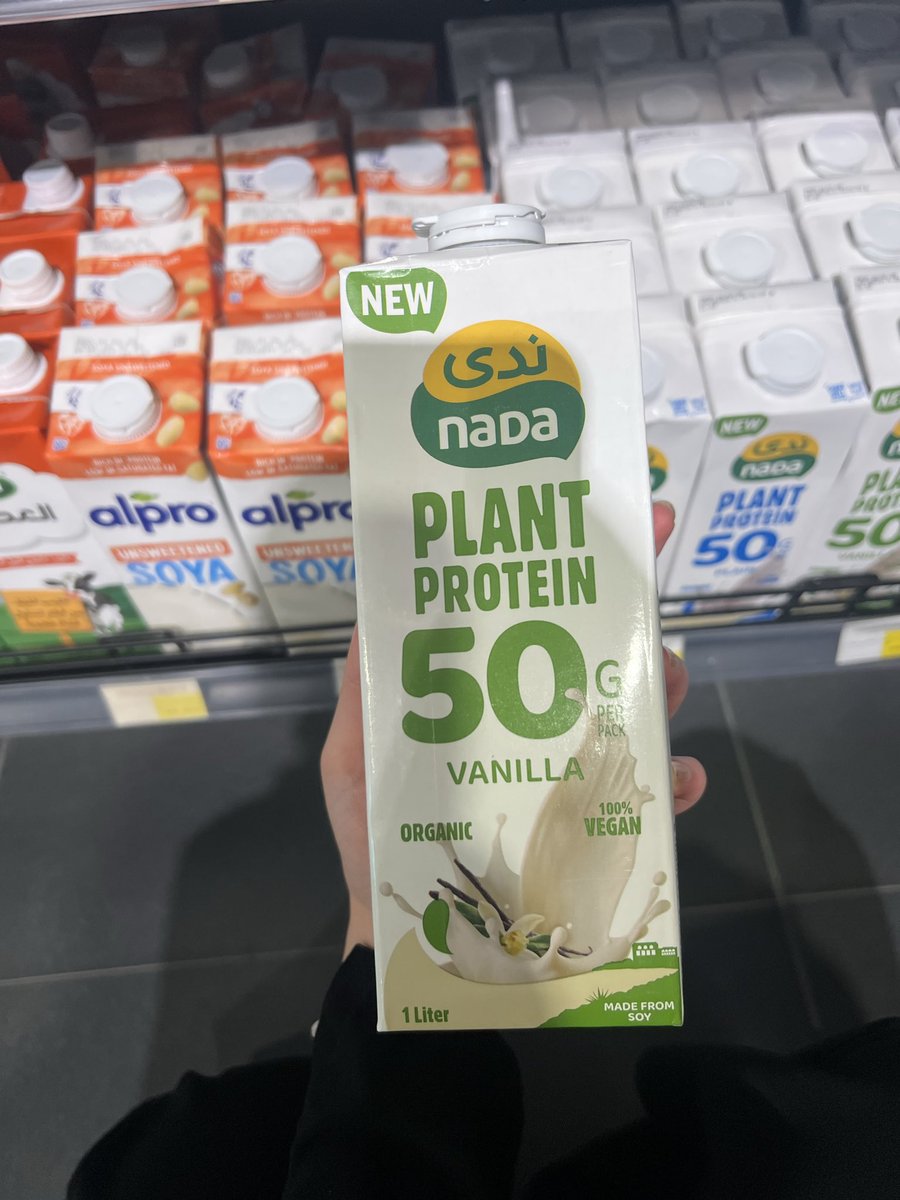
أحب ندى المكونات نظيفة عضوي 50 قرام بروتين تحية للمخ اللي ورا صنع هالمنتجات وب١٦ ريال
★ tweet media
العربية
55
22
1.5K
1.6M
a 리트윗함
The Boring Investor
The Boring Investor@boring_invest·
$IBRX was my first 100%+ pick of 2026. $IQE just became my second 100% pick. $SIVE and $AAOI are close to becoming my third and fourth. $LPK will be my 5th. (I continue to hold all)
English
2
3
72
24.2K
a 리트윗함
AlmaCap
AlmaCap@AlmaCap114204·
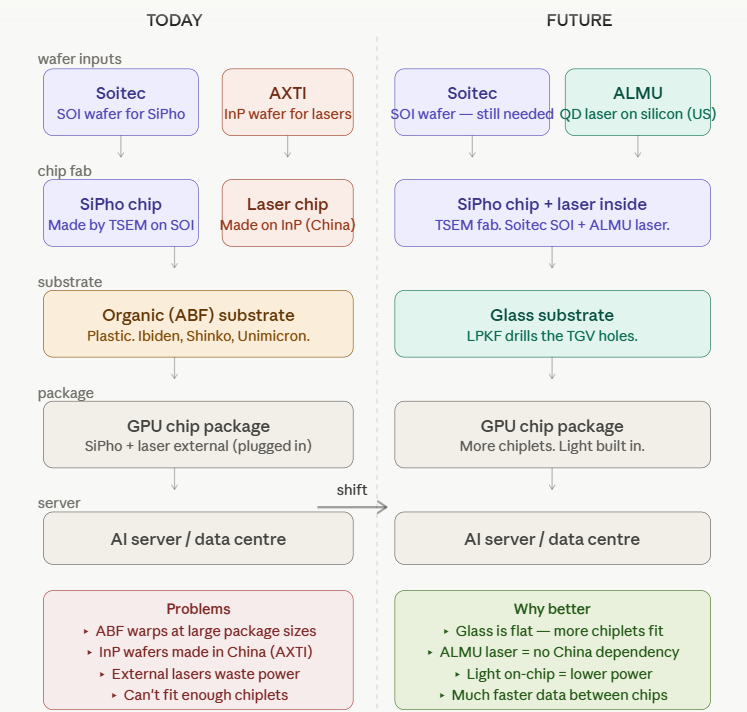
Photonics is a bit confusing, hopefully this simplified summary helps. I have positions in $TSEM, $SOI, $ALMU, $LPKF
AlmaCap tweet media
English
15
118
742
71.6K
a 리트윗함
How To AI
How To AI@HowToAI_·
Someone just open-sourced a full 3d building editor that runs 100% in your browser. no autocad. no revit. no $5,000 annual licenses. open-source.
English
91
604
6.8K
601.5K
a 리트윗함
KawzInvests 🦑
KawzInvests 🦑@KawzInvests·
$OPTX (~$350M) is North America's largest polymer optics manufacturer. Every step under one roof. Raw polymer in, finished electro-optic assembly out, without touching a foreign subcontractor. China controls the majority of global polymer optics production. Anduril has an internal policy against sourcing from China. NDAA Section 834 bans adversary-nation optics by 2030. Those constraints together eliminate most of the field. Syntec is one of the only domestic companies that qualifies. $OPTX is not just an Anduril supplier. That framing captures maybe one chapter of what this company actually is. Six revenue streams either ramping or already in production. Missile guidance optics with multiyear agreements signed. Night vision goggle eyepieces since 2018, $5.2M in NVG orders in 2025 alone. Military scopes on a program expected to run over a decade. LEO satellite optics expected to nearly triple in 2026. Microlens arrays for AI datacenter interconnects entering production this year. And new defense product lines management guided to add revenue in Q2 and beyond, program undisclosed due to NDAs. That last one is the line worth sitting with. The language used to describe it in December was "the most significant opportunity in the company's 25-year history." The bear case. Revenue flat at $28M for three years. Gross margin jumped from 12% to 24% in Q4, which is real, but margin alone does not build a growth story. Cash under $400K with a credit facility maturing in November. Q2 is the quarter where this either shows up in the numbers or it doesn't. $OPTX
KawzInvests 🦑 tweet media
Michael Sikand 🦑@michaelsikand

Holy sh*t what a legendary call. Following this dude is free money.

English
15
34
520
97.9K
a 리트윗함
Yiannis Zourmpanos
Yiannis Zourmpanos@yianisz·
Photonics is real but the easy trade is gone. $LITE, $AAOI, $COHR already priced the obvious bottleneck (lasers, transceivers). Great businesses… but crowded and expectations are stretched. I’m looking one layer deeper.. for example $MTSI, $MRVL quietly taking a cut of every bandwidth upgrade without the same crowding. Then it gets more interesting. $AEHR is the picks-and-shovels angle most people still underestimate. If SiPh ramps, testing demand isn’t optional. Everyone talks chips, nobody talks where photonics is actually built $TSEM.. $POET, $ALMU.. high upside, but still early. Execution risk is real, timelines slip, and the market won’t be patient forever. $CIEN, $FN, $GLW.. boring, but they win if this scales. No story needed. And if CPO actually hits? The real upside probably isn’t even public yet. Everyone’s chasing what worked… I think the next move is one layer deeper.
English
33
63
755
141.5K