Nature hides a universal constant in plain sight.
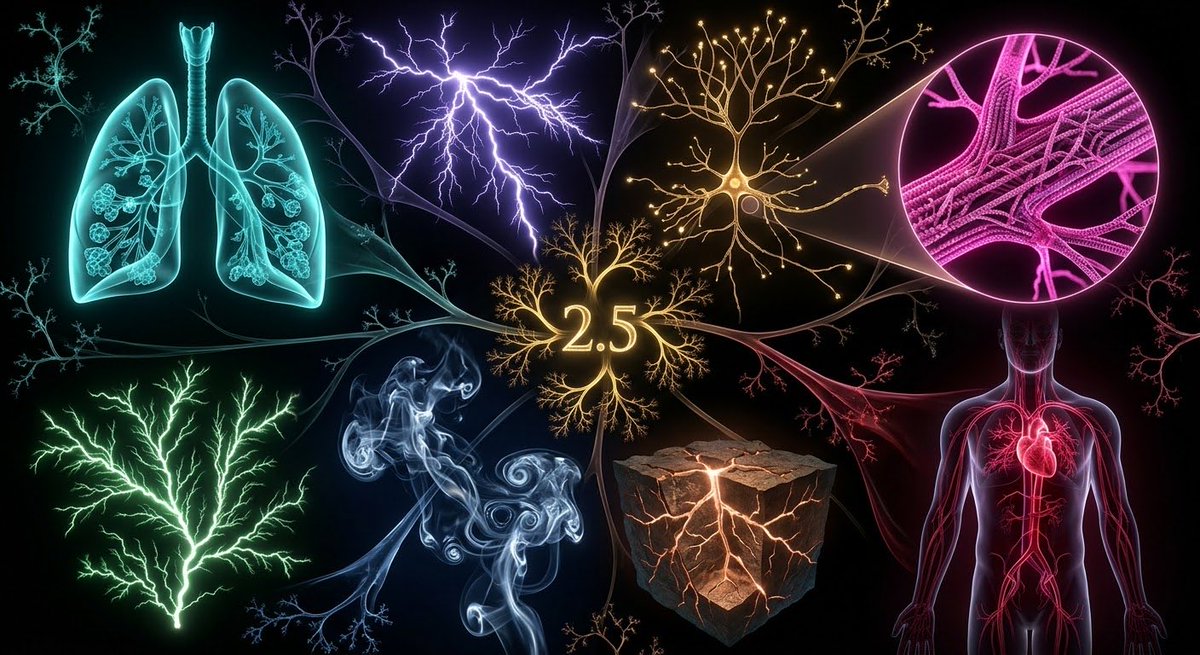
Lungs. Lightning. Neurons. Blood vessels. Rock fractures. Turbulence. Lichtenberg figures. Even the microtubule cytoskeleton inside a single neuron.
All converge on a fractal dimension of ~2.5 in three dimensions.
What does that number mean? A flat surface is dimension 2. A solid block is dimension 3. A fractal dimension of 2.5 means the structure is halfway between surface and solid — it branches obsessively, reaching into every corner of a volume without ever fully filling it. It’s the geometry of maximum surface area within minimum material. Nature’s answer to: “How do I touch everything in a 3D space as efficiently as possible?”
That’s why your lungs use it — maximum gas exchange surface packed into your chest. Why your vascular system uses it — blood delivery to every cell. Why neurons use it — maximum connectivity with minimal wiring. Why lightning uses it — the path of least resistance through a 3D medium follows the same branching law.
And here’s what makes it profound: zoom into a single neuron’s dendrite and the microtubule lattice inside repeats the same ~2.5 geometry at a smaller scale. A fractal within a fractal. The same number, all the way down.
This isn’t coincidence. It’s physics selecting for the same optimal transport geometry across every scale and every domain — from atmospheric discharge to cytoskeletal architecture. One number. One law. Every scale.
The idea that quantum mechanics might have a geometric or algebraic foundation deeper than the standard Hilbert space formalism is not new. Dirac's original formulation of quantum mechanics in terms of q-numbers already suggested that the commutation relations might be more fundamental than the Hilbert space representation. Von Neumann's spectral theorem showed that self-adjoint operators on Hilbert spaces have a complete spectral decomposition, but the choice of Hilbert space itself was left as a free parameter to be fixed by physics.
#Dirac#QuantumMechanics#Geometric#Polinominal
🌀 This Bottle Shouldn’t Exist… But It Does
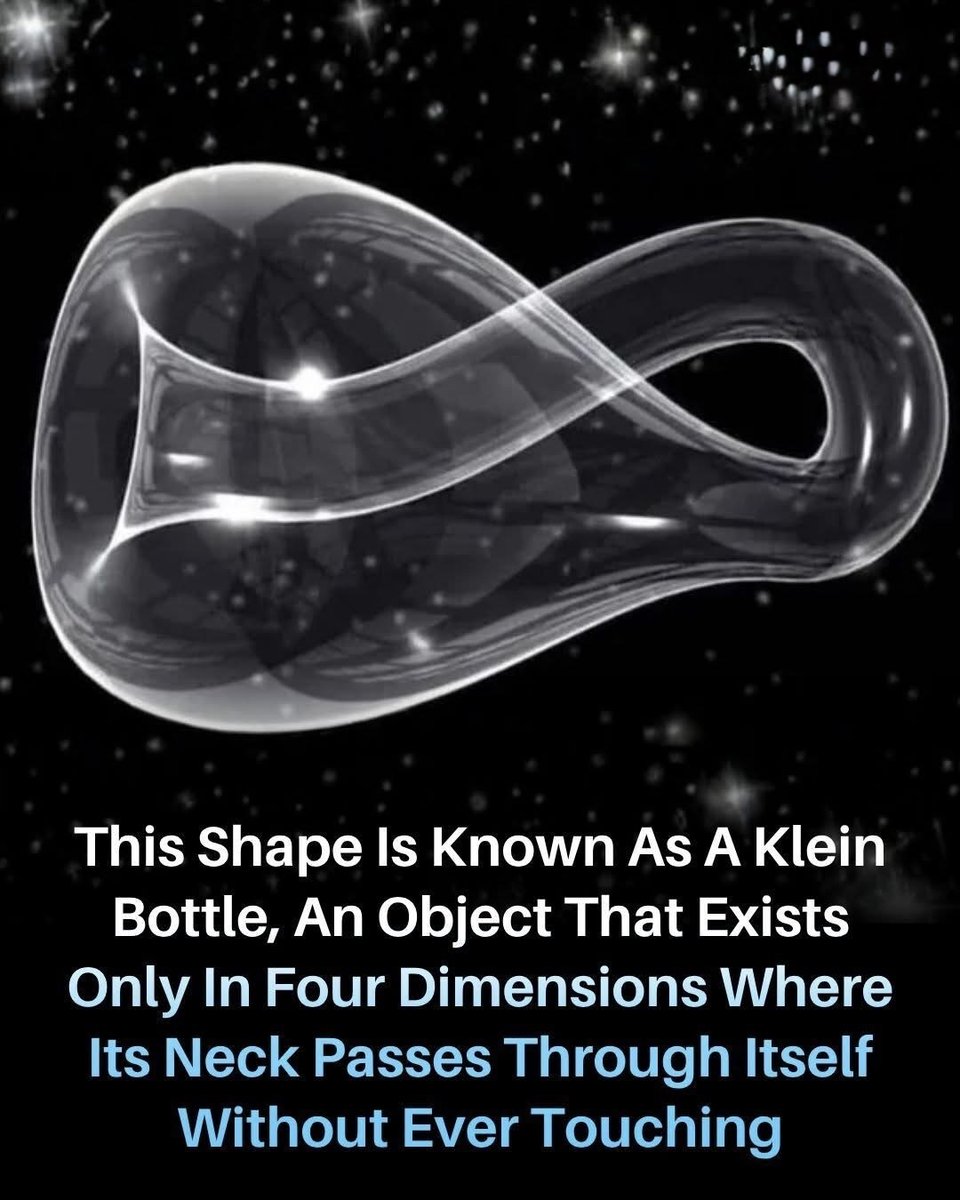
At first glance, it looks like an ordinary glass object. But look closer. Its neck curves… twists… and somehow passes right through itself. No cuts. No joins. No clear beginning or end. It feels like a glitch in the universe. This strange object is called a Klein bottle, a concept from Topology. Here’s the chilling part: what you’re seeing isn’t even the real version.
In our 3D world, this shape must pass through itself. But in a higher dimension—one we cannot see—the Klein bottle flows perfectly… without ever touching itself at all.
Let that sink in. A shape that only truly exists beyond human vision. What we build here is just a shadow of something more complete… something our minds can barely grasp.
So next time you see this “impossible bottle,” remember…
you’re not looking at a mistake.
You’re looking at a glimpse of another dimension.
Source
Weisstein, E. W. Klein Bottle. MathWorld—A Wolfram Web Resource.
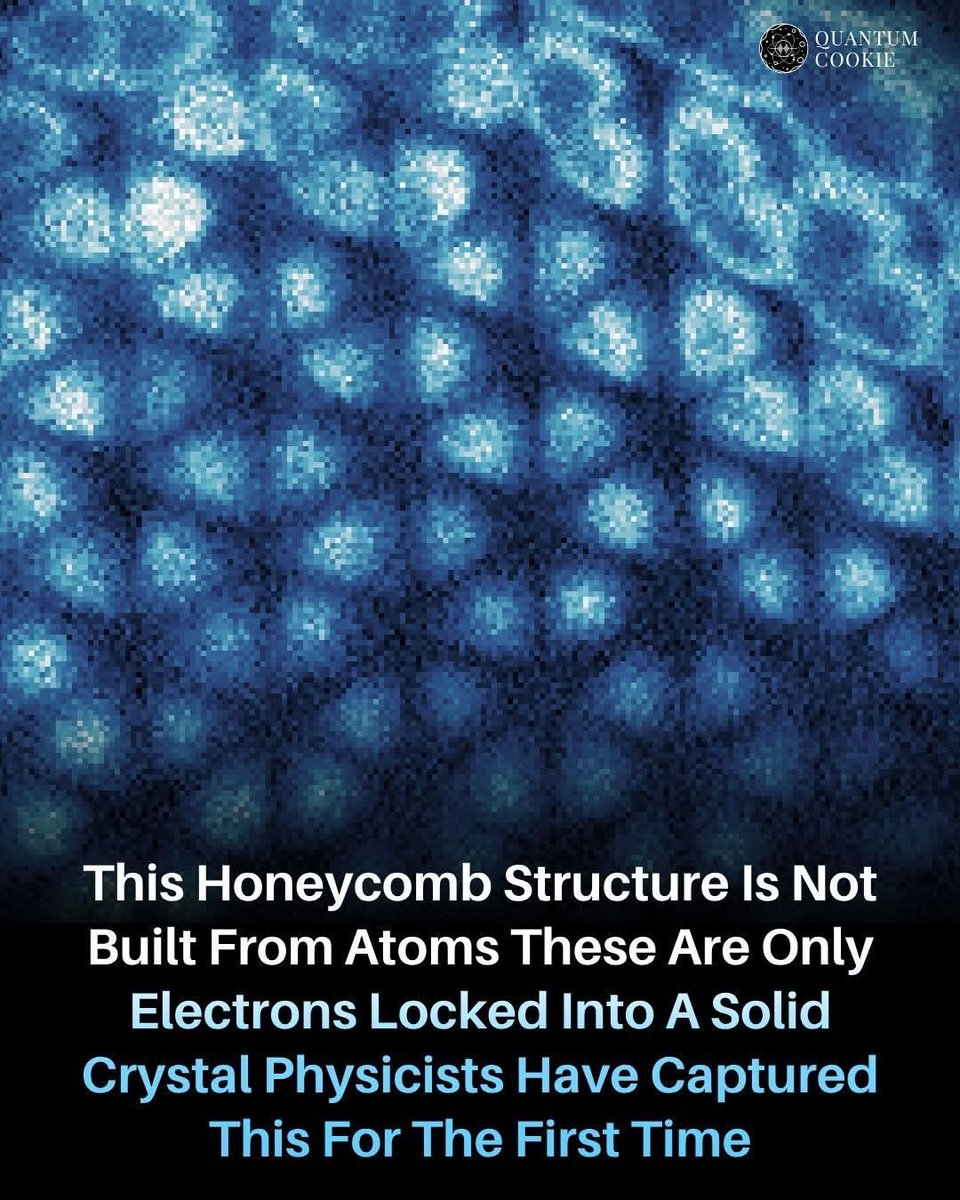
Physicists captured a crystal made only of electrons, forming a honeycomb pattern without atoms, revealing a strange state of matter never directly seen before.
In normal materials, atoms form the structure we see. But in this case, electrons themselves arrange into a fixed
Watch hydrogen atom wavefunctions smoothly transition between quantum states (n,l,m)
This is the actual probability density of finding the electron; not just static orbitals, but the real quantum dance as it morphs between energy levels.
Good questions, both getting at something real.
On continuous vs local Möbius: the Klein bottle is one continuous non-orientable surface — not a Möbius loop at every point. The non-orientability is a global property of the whole space, not something that happens locally everywhere. Locally spacetime looks flat and orientable. The Klein bottle topology only becomes apparent when you follow a path all the way around the fundamental loop.
The analogy: the surface of the Earth is locally flat everywhere but globally curved. You only discover it’s a sphere by traveling far enough. Same idea — MFT spacetime looks like normal flat spacetime locally but reveals its Klein bottle topology at the scale of the fundamental loop length.
On the self-intersection: this is the sharp question. A Klein bottle can’t be embedded in 3D space without self-intersection — it requires 4D. In 4D it doesn’t actually intersect itself, the apparent crossing is an artifact of trying to visualize it in lower dimensions.
In MFT the Klein bottle IS 4D spacetime, so there’s no self-intersection. What looks like a crossing in lower-dimensional visualizations is just a projection artifact.
What DOES happen at the non-orientable identification — the place where the Möbius twist completes — is physically real. That’s where the field picks up the holonomy phase. It’s not a boundary or edge. It’s a topological feature of the space itself, like the international date line — a real coordinate feature without a physical wall.
I had an idea I wanted to explore about how magnets do work at a distance. I am a mechanical engineer by education and know enough physics to be dangerous but never worked on theoretical physics. I turned to Grok and Claude to answer my questions. I’ve now in the span of three weeks developed a speculative unified theory of physics based on a single geometric fact: spacetime is a Klein bottle.
No inside. No outside. No consistent orientation.
Everything else — particles, forces, masses, time’s arrow — follows from that one topological fact. Mobius Field Theory - MFT
Thread 🧵
@MFTphysics Have you looked into what happens when you cut a Mobius strip in half down the middle or cut it into thirds and what it produces? Have you factored any torus related geometry or vortex spin into the theory? What are quarks in this model?
Exactly right on the first part — spacetime itself has Möbius-type topology in MFT. Not just an analogy.
On why Klein bottle not just Möbius:
A Möbius strip has a boundary. The Klein bottle is what you get when you seal that boundary — two Möbius strips joined along their edges. No boundary. Closed.
Physics needs a closed spacetime with no edge. The Klein bottle gives you that while keeping the orientation-reversing property that the Möbius has.
On the half-spin:
Yes. A spinor picks up a -1 phase under 360° rotation. On a Klein bottle, traversing the orientation-reversing loop gives the field exactly this -1 phase. The spin-1/2 statistics of fermions aren’t put in by hand — they’re what any field on a non-orientable closed surface naturally does.
The Klein bottle has two fundamental loops. The orientable loop gives three generations (Z3 structure). The orientation-reversing loop gives chirality and the -1 spinor phase.
Together they produce Z6 — six traversals to return completely to start. That’s the holonomy the theory is built on.
The Möbius alone gives you the twist. The Klein bottle gives you the twist AND closure AND two distinct loop types. That’s why Klein bottle.
@MFTphysics Nice! Are you saying that spacetime itself is Möbius shaped in some way and that’s what explains the phenomenon we see, such as fermions half spin? Why a Klein bottle and not just three twist standard Mobius?
@aetherianfield V9 is up on Zenodo right now. Check it out! Still many open items. I’m working on V10 right now.
V9 is live at DOI 10.5281/zenodo.19244541 at zenodo.org/records/192445…
Mathematics, physics.
We live in a chaotic, unpredictable universe. This is a grid of 812 double pendulums, each with slightly different initial conditions for the two angles of the pendulum.
By Jonathan Nafziger, tinyurl.com/ya2da9vg, Used with permission
Harmonic oscillation in a levitated water drop
Ultrasonic standing waves levitate a water droplet and flatten it into a disk. Modulating the sound at its resonance frequency excites harmonic shape modes creating rotating "star drops"
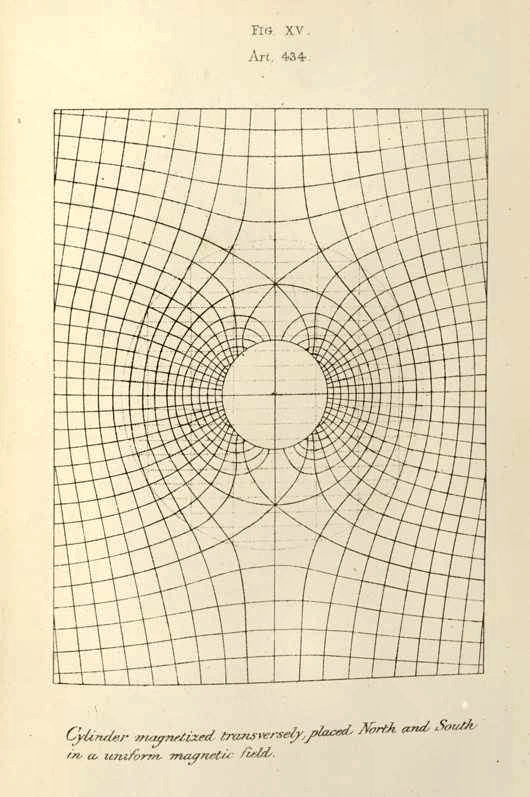
Mathematics and physics diagrams. Before the age of computers and computer graphics.
Illustration from "A treatise on electricity and magnetism" by James Clerk Maxwell, 1873. [math, maths]