Mohammad Arshad

6.4K posts

Mohammad Arshad banner
Mohammad Arshad

Mohammad Arshad

@arshad83

Principal Data Scientist | 120K+ Linkedin Community ! Generative AI | 20 Years+ Exp | Ex-Accenture, HP, Dell | Keynote Speaker & Mentor | LLM, AWS, Azure GCP

AI Agents & RAG Tutorials → 가입일 Nisan 2009
698 팔로잉2.9K 팔로워
고정된 트윗
Mohammad Arshad
Mohammad Arshad@arshad83·
Supercharge Your AI Skills for 2025 Unlock $2,000 worth of resources — including free courses, recordings, and ebooks on Generative AI, Agentic AI, and MCP. 👉 Limited time access. To get 1⃣ Follow(for DM access) 2⃣Like and Repost this post 3️⃣Reply with "Send"
GIF
United Arab Emirates 🇦🇪 English
202
170
401
31.4K
Mohammad Arshad
Mohammad Arshad@arshad83·
🚀 Two ways to level up with DDS: 1️⃣ AI Residency – build real AI projects with mentorship 2️⃣ AI Guild – learn, explore, and grow with the community Start your AI journey or level it up—your choice. 💡 #DecodingDataScience #AI #AIGuild #AIResidency
English
2
2
2
14
Mohammad Arshad
Mohammad Arshad@arshad83·
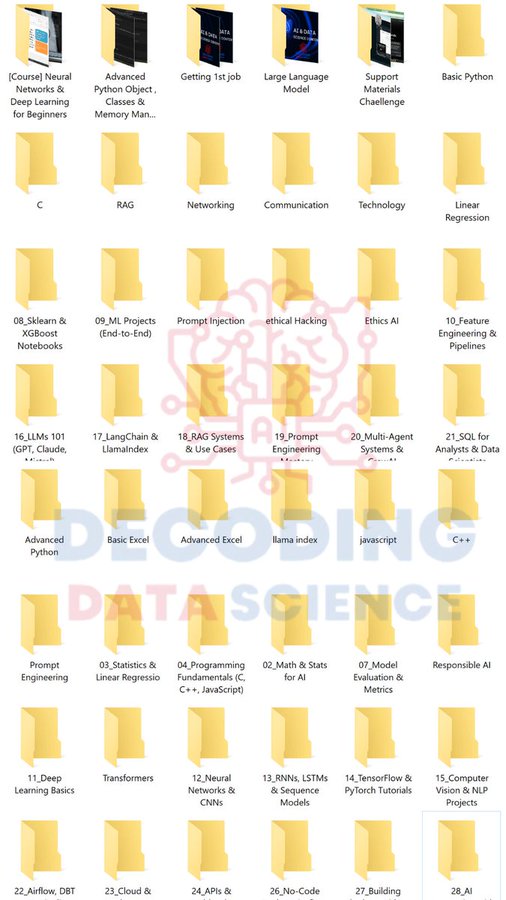
Want to upgrade your Artificial Intelligence game for 2026? We're giving away $2,000+ worth of premium AI resources — 100% FREE! What's inside? 📷AI Courses & Program 📷Exclusive Resources & Hackathon 📷 Generative AI Courses 1️⃣ Follow Me & @decodingdatasci 2️⃣ Like & Repost this 3️⃣Reply with "Send" Don't miss this if you're serious about mastering AI in 2026!
Mohammad Arshad tweet media
English
7
6
7
117
Mohammad Arshad
Mohammad Arshad@arshad83·
Thanks
United Arab Emirates 🇦🇪 English
0
0
0
6
Mohammad Arshad
Mohammad Arshad@arshad83·
Want to upgrade your Artificial Intelligence game for 2026? We're giving away $2,000+ worth of premium AI resources — 100% FREE! What's inside? 📷AI Courses & Program 📷Exclusive Resources & Hackathon 📷 Generative AI Courses 1️⃣ Follow Me & @decodingdatasci 2️⃣ Like & Repost this 3️⃣Reply with "Send" Don't miss this if you're serious about mastering AI in 2026!
Mohammad Arshad tweet media
English
3
2
5
60
Mohammad Arshad
Mohammad Arshad@arshad83·
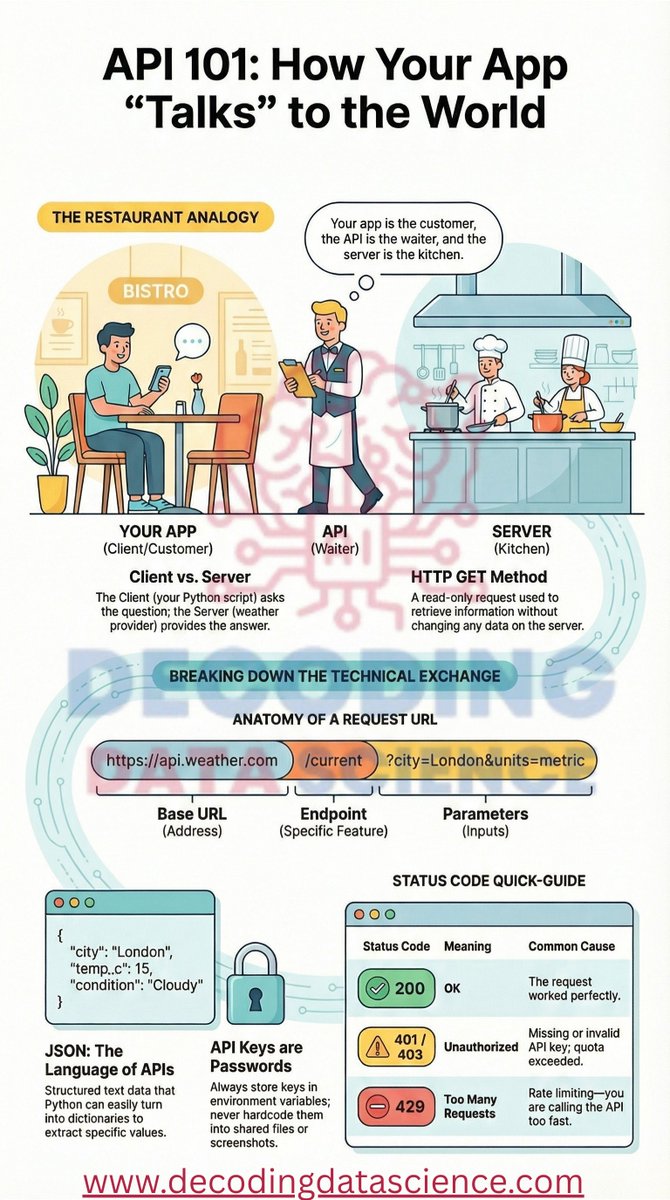
Most beginners don’t struggle with Python first. They struggle with understanding how their app actually “talks” to the outside world. That’s why APIs matter. Think of it like this: Your app = customer API = waiter Server = kitchen Once this clicks, concepts like requests, JSON, API keys, endpoints, and status codes become much easier to understand. #decodingdatascience #dds #API #Python #AI
Mohammad Arshad tweet media
English
2
1
3
28
Mohammad Arshad
Mohammad Arshad@arshad83·
Want to upgrade your Artificial Intelligence game for 2026? We're giving away $2,000+ worth of premium AI resources — 100% FREE! What's inside? 📷AI Courses & Program 📷Exclusive Resources & Hackathon 📷 Generative AI Courses 1️⃣ Follow Me & @decodingdatasci 2️⃣ Like & Repost this 3️⃣Reply with "Send" Don't miss this if you're serious about mastering AI in 2026!
Mohammad Arshad tweet media
English
3
1
4
51
Mohammad Arshad 리트윗함
Andrej Karpathy
Andrej Karpathy@karpathy·
Wow, this tweet went very viral! I wanted share a possibly slightly improved version of the tweet in an "idea file". The idea of the idea file is that in this era of LLM agents, there is less of a point/need of sharing the specific code/app, you just share the idea, then the other person's agent customizes & builds it for your specific needs. So here's the idea in a gist format: gist.github.com/karpathy/442a6… You can give this to your agent and it can build you your own LLM wiki and guide you on how to use it etc. It's intentionally kept a little bit abstract/vague because there are so many directions to take this in. And ofc, people can adjust the idea or contribute their own in the Discussion which is cool.
Andrej Karpathy@karpathy

LLM Knowledge Bases Something I'm finding very useful recently: using LLMs to build personal knowledge bases for various topics of research interest. In this way, a large fraction of my recent token throughput is going less into manipulating code, and more into manipulating knowledge (stored as markdown and images). The latest LLMs are quite good at it. So: Data ingest: I index source documents (articles, papers, repos, datasets, images, etc.) into a raw/ directory, then I use an LLM to incrementally "compile" a wiki, which is just a collection of .md files in a directory structure. The wiki includes summaries of all the data in raw/, backlinks, and then it categorizes data into concepts, writes articles for them, and links them all. To convert web articles into .md files I like to use the Obsidian Web Clipper extension, and then I also use a hotkey to download all the related images to local so that my LLM can easily reference them. IDE: I use Obsidian as the IDE "frontend" where I can view the raw data, the the compiled wiki, and the derived visualizations. Important to note that the LLM writes and maintains all of the data of the wiki, I rarely touch it directly. I've played with a few Obsidian plugins to render and view data in other ways (e.g. Marp for slides). Q&A: Where things get interesting is that once your wiki is big enough (e.g. mine on some recent research is ~100 articles and ~400K words), you can ask your LLM agent all kinds of complex questions against the wiki, and it will go off, research the answers, etc. I thought I had to reach for fancy RAG, but the LLM has been pretty good about auto-maintaining index files and brief summaries of all the documents and it reads all the important related data fairly easily at this ~small scale. Output: Instead of getting answers in text/terminal, I like to have it render markdown files for me, or slide shows (Marp format), or matplotlib images, all of which I then view again in Obsidian. You can imagine many other visual output formats depending on the query. Often, I end up "filing" the outputs back into the wiki to enhance it for further queries. So my own explorations and queries always "add up" in the knowledge base. Linting: I've run some LLM "health checks" over the wiki to e.g. find inconsistent data, impute missing data (with web searchers), find interesting connections for new article candidates, etc., to incrementally clean up the wiki and enhance its overall data integrity. The LLMs are quite good at suggesting further questions to ask and look into. Extra tools: I find myself developing additional tools to process the data, e.g. I vibe coded a small and naive search engine over the wiki, which I both use directly (in a web ui), but more often I want to hand it off to an LLM via CLI as a tool for larger queries. Further explorations: As the repo grows, the natural desire is to also think about synthetic data generation + finetuning to have your LLM "know" the data in its weights instead of just context windows. TLDR: raw data from a given number of sources is collected, then compiled by an LLM into a .md wiki, then operated on by various CLIs by the LLM to do Q&A and to incrementally enhance the wiki, and all of it viewable in Obsidian. You rarely ever write or edit the wiki manually, it's the domain of the LLM. I think there is room here for an incredible new product instead of a hacky collection of scripts.

English
1K
2.7K
25.8K
6.5M
Mohammad Arshad
Mohammad Arshad@arshad83·
Want to upgrade your Artificial Intelligence game for 2026? We're giving away $2,000+ worth of premium AI resources — 100% FREE! What's inside? 📷AI Courses & Program 📷Exclusive Resources & Hackathon 📷 Generative AI Courses 1️⃣ Follow Me & @decodingdatasci 2️⃣ Like & Repost this 3️⃣Reply with "Send" Don't miss this if you're serious about mastering AI in 2026!
Mohammad Arshad tweet media
English
1
1
3
43
Mohammad Arshad
Mohammad Arshad@arshad83·
Want to upgrade your Artificial Intelligence game for 2026? We're giving away $2,000+ worth of premium AI resources — 100% FREE! What's inside? 📷AI Courses & Program 📷Exclusive Resources & Hackathon 📷 Generative AI Courses 1️⃣ Follow Me & @decodingdatasci 2️⃣ Like & Repost this 3️⃣Reply with "Send" Don't miss this if you're serious about mastering AI in 2026!
Mohammad Arshad tweet media
English
4
3
4
72
Mohammad Arshad
Mohammad Arshad@arshad83·
Want to upgrade your Artificial Intelligence game for 2026? We're giving away $2,000+ worth of premium AI resources — 100% FREE! What's inside? 📷AI Courses & Program 📷Exclusive Resources & Hackathon 📷 Generative AI Courses 1️⃣ Follow Me & @decodingdatasci 2️⃣ Like & Repost this 3️⃣Reply with "Send" Don't miss this if you're serious about mastering AI in 2026!
Mohammad Arshad tweet media
English
3
2
3
43
Mohammad Arshad
Mohammad Arshad@arshad83·
Why most AI advice fails:It’s too generic.“Learn Python.” “Build projects.” “Use ChatGPT.”Sounds useful—but doesn’t translate to real outcomes.What actually works: → Pick a specific use case → Build end-to-end (not just demos) → Focus on execution, not toolsSpecificity > general advice.#AI #BuildInPublic #MachineLearning
English
2
1
2
25
Shweta singh
Shweta singh@Tech_by_Shweta·
Cinema Studio 3.0 isn’t just an upgrade. It’s the moment creating finally feels effortless. 🎬⚡ One idea. One prompt. And suddenly you have a scene, motion, and sound. No complicated workflows. No tool-hopping. No friction. Just Idea → Film. Instantly. The real question is: What’s the first story you’re creating with it? 👇🚀
Higgsfield AI 🧩@higgsfield

Meet Higgsfield CINEMA STUDIO 3.0 with UP TO 65% OFF. This is Cinema Studio at its peak. Happy birthday to us. Cinematic reasoning & Ultimate realism. Next-level AI filmmaking with native audio. A faster workflow made for high-quality production. Available exclusively on Business Plan.

English
17
6
40
367
Arfa Farheen
Arfa Farheen@arfafarheen_·
YOUR BRAIN IS LYING TO YOU MORE THAN IT IS TELLING YOU THE TRUTH. A Nobel Prize winner spent his entire career proving exactly that. Daniel Kahneman showed that what we call “thinking” is often just storytelling happening at high speed. He broke the mind into two systems. System 1 is instant. Automatic. Emotional. It reacts before awareness even catches up. It forms opinions in seconds and calls it intuition. System 2 is slow. Deliberate. Effortful. The part of you that actually thinks. But it avoids work whenever possible. So most of the time, it is not in charge. System 1 is. And System 1 does not wait for full information. It takes whatever is available, fills the gaps, and creates a complete story. Then it delivers that story to you with full confidence. That confidence feels like truth. Even when it is not. This is why human judgment bends so easily. Why fear ignores statistics. Why first impressions stick too hard. Why random numbers quietly influence serious decisions. Your brain is not optimized for accuracy. It is optimized for speed. And here is the uncomfortable part. Expertise does not fix it. It often makes it worse in a different way. Because experience builds stronger confidence faster than it builds better judgment. Even Kahneman admitted something surprising. Knowing the biases does not make you immune to them. You still fall for them. You still believe them. The difference is awareness. You start noticing when your mind is rushing. You start questioning certainty that arrives too quickly. And in that small pause, better thinking begins.
Arfa Farheen tweet media
English
9
1
10
226