calanthia

3K posts

calanthia banner
calanthia

calanthia

@calanthiaaa

serial founder (ai newco in stealth) // gtm advisor // writing soft thinking on ai-native growth for the real economy

🌐 가입일 Ağustos 2010
1.1K 팔로잉82.6K 팔로워
calanthia
calanthia@calanthiaaa·
it takes exactly 1 deck to burn through all claude design credits....🤣 (i am a claude max user fyi)
calanthia tweet media
English
0
0
1
556
Cuy Sheffield
Cuy Sheffield@cuysheffield·
Who are the top people and organizations that are focused on providing free, high quality AI literacy programs designed for people and small businesses outside of the tech industry? Would love to support. DMs open if you want to collaborate.
English
10
4
47
4.6K
calanthia 리트윗함
Alex Vacca
Alex Vacca@itsalexvacca·
"services don't scale" > chases the $10k software budget inside companies > watches openai kill the feature they built in 3 months > cpo title before a paying user & 18 months burning runway meanwhile services with ai inside: > goes after the $120k services budget most people ignore > every new model makes you faster, not obsolete > operators going $0 to $40k/mo in 8 weeks running the same playbook the full playbook to build "services-as-software" businesses:I
Alex Vacca@itsalexvacca

x.com/i/article/2043…

English
19
39
690
289.6K
calanthia 리트윗함
Aakash Gupta
Aakash Gupta@aakashgupta·
Second exit in five years, and he engineered a deal structure almost nobody uses. Ankur built Teachable in 2013, scaled it to $60M ARR, and sold it to Hotmart in 2021 for around $250M. He started Carry 18 months later with a specific thesis: the self-employed don't get the same wealth-building tools that full-time employees at big tech take for granted. Three and a half years in, Carry has $225M in assets on platform, thousands of paying members, and a compliance moat around the hardest part of Solo 401k administration. Most founders run a single sale process and take the best bidder. Ankur closed two buyers in parallel transactions. Lettuce got the retirement and investing platform. The Solo 401k infrastructure, the IRA custody, the $225M in AUM, plus co-founder Nick Rasch and the operations, product, engineering, and compliance teams. It slots directly into Lettuce's existing accounting, payroll, and healthcare stack for solopreneurs. Retirement was the one missing pillar of that whole solo-business finance experience. AngelList got the other half. Carry's audience is accredited investors and high-earning founders, which is the exact overlap set AngelList already monetizes on the venture side. Extending from SPV and fund operations into the wealth management layer for the same people is the natural next step for their stack. No single acquirer values both halves equally. Lettuce does not monetize an accredited investor brand. AngelList does not need a 1099 retirement compliance team. Running one sale process means someone underpays for the half they do not want. Running two means each half clears at its best-fit valuation. The pattern underneath both exits is the same. Find an operator-buyer who can actually compound the asset. Sell when the product-market fit is obvious but distribution still has room to run. Teachable went to Hotmart, the Brazilian course platform that could globalize it. Carry went to the two companies that can each extend one half further than a standalone Carry could. Most founders spend a career hoping for one exit. Ankur just closed his second, with a structure almost nobody in venture-backed SaaS thinks to try.
Ankur Nagpal@ankurnagpal

Carry has been acquired by Angellist and Lettuce We started this company 3.5 years ago to help business owners make better financial decisions These two transactions allow us to continue to do this important work in a bigger way Thank you to everyone who supported us ❤️

English
13
23
403
133K
calanthia
calanthia@calanthiaaa·
@mkobach love it: brands’ intern pages → brands’ rogue fan pages → brands’ UGC pages. all about creating an ambient echo chamber, with a bit of fun, for the brands.
English
0
1
0
222
calanthia 리트윗함
Guillermo Flor
Guillermo Flor@guilleflorvs·
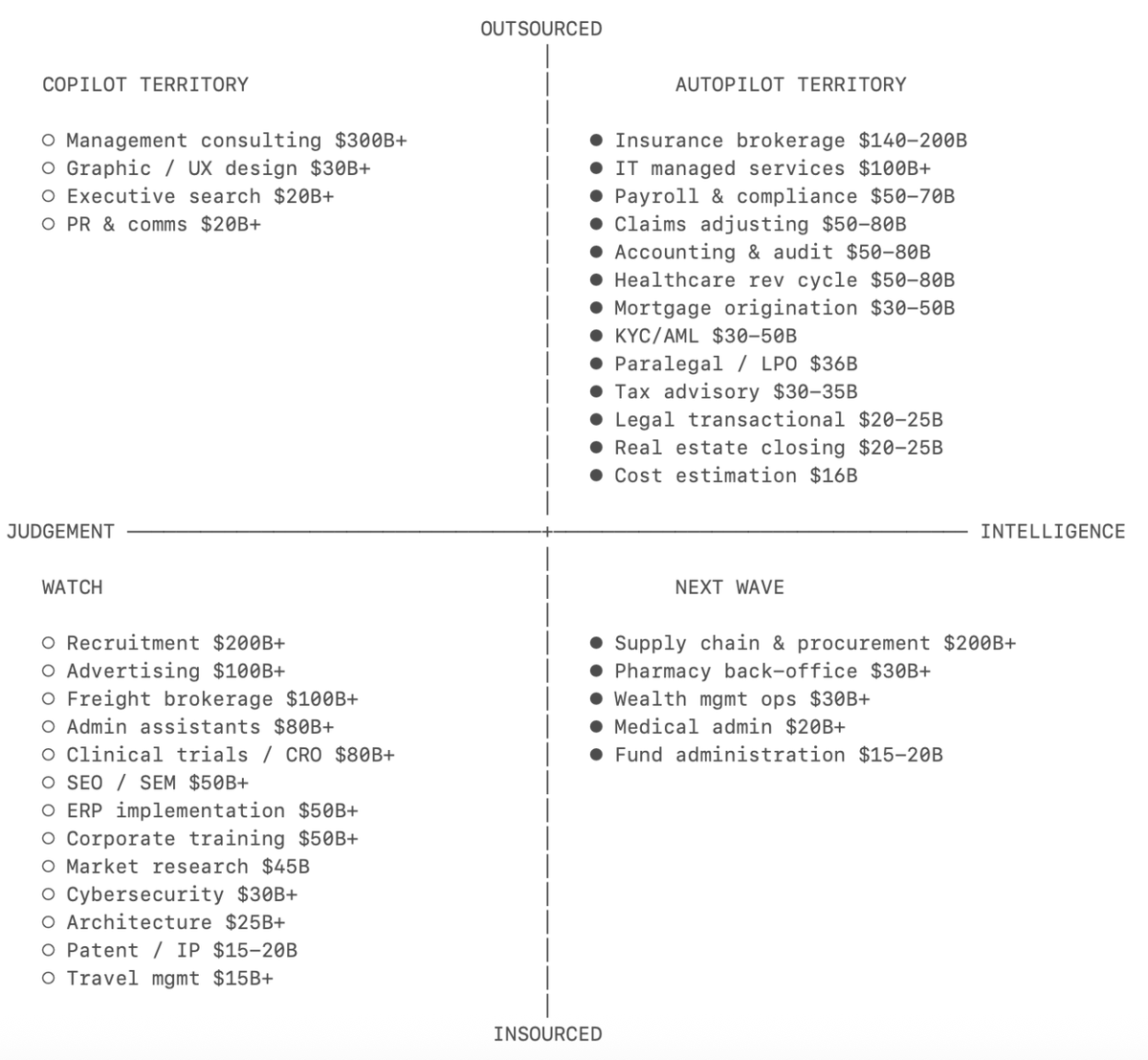
Sequoia's thesis that the next $1T company will sell work, not software, is the most important reframe in AI right now. The argument: if you sell a copilot, you're competing with every new model release. But if you sell the outcome — books closed, contracts reviewed, claims handled — every AI improvement makes your margins better, not your product obsolete. The key insight most people miss: for every $1 spent on software, ~$6 is spent on services. The entire SaaS playbook was about capturing the software dollar. The AI playbook is about capturing the services dollar — at software margins. Not "AI for accountants." The AI accounting firm. Not "AI for lawyers." The AI law firm. The companies that figure this out won't look like SaaS companies. They'll look like services firms rebuilt on software infrastructure. That's a fundamentally different company to build, fund, and scale. And most founders are still building copilots.
Guillermo Flor tweet media
English
227
540
5.6K
2.1M
Ankur Nagpal
Ankur Nagpal@ankurnagpal·
Carry has been acquired by Angellist and Lettuce We started this company 3.5 years ago to help business owners make better financial decisions These two transactions allow us to continue to do this important work in a bigger way Thank you to everyone who supported us ❤️
Ankur Nagpal tweet media
English
241
36
1.5K
298.7K
reblaub
reblaub@LaubRebecca·
I want to create a consumer growth mafia in SF where we meet to only discuss the most unconventional ideas and growth hacks we’ve had but could never implement cause it’s too outrageous I have so many, need to share. Comment « 🕺🏻 » if you wanna join
San Francisco, CA 🇺🇸 English
89
1
125
10.2K
calanthia
calanthia@calanthiaaa·
i’m calling this the renaissance of smart generalists ai-native, great at thinking, human-in-the-loop commander of agent workforces
Aaron Levie@levie

The more enterprises I talk to about AI agent transformation, the more it’s clear that there is going to be a new type of role in most enterprises going forward. The job is to be the agent deployer and manager in teams. Here’s the rough JD: This person will need to figure out what are the highest leverage set of workflows on a team are (either existing or new ones) where agents can actually drive significantly more value for the team and company. In general, it’s going to be in areas where if you threw compute (in the form of agents) at a task you could either execute it 100X faster or do it 100X more times than before. Examples would be processing orders of magnitude more leads to hand them off to reps with extra customer signal, automating a contracting review and intake process, streamlining a client onboarding process to reduce as many straps as possible, setting up knowledge bases than the whole company taps into, and so on. This person’s job is to figure out what the future state workflow needs to look like to drive this new form of automation, and how to connect up the various existing or new systems in such a way that this can be fulfilled. The gnarly part of the work is mapping structured and unstructured data flows, figuring out the ideal workflow, getting the agent the context it needs to do the work properly, figuring out where the human interfaces with the agent and at what steps, manages evals and reviews after any major model or data change, and runs and manages the agents on an ongoing basis tracking KPIs, and so on. The person must be good at mapping the process and understanding where the value could be unlocked and be relatively technical, and has full autonomy to connect up business systems and drive automation. This means they’re comfortable with skills, MCP, CLIs, and so on, and the company believes it’s safe for them to do so. But also great operationally and at business. It may be an existing person repositioned, or a totally net new person in the company. There will likely need to be one or more of these people on every team, so it’s not a centralized role per se. It may rile up into IT or an AI team, or live in the function and just have checkpoints with a central function. This would also be a fantastic job for next gen hires who are leaning into AI, and are technical, to be able to go into. And for anyone concerned about engineers in the future, this will be an obvious area for these skills as well.

English
0
0
1
588
calanthia
calanthia@calanthiaaa·
greg's $10m exit math checks out. i'm running this playbook now at 50% lower costs than he models. ai-native agency runs on software margins from day 1. productization to saas later is an option, not the point. the outcome is the product. wrote about it→calanthia.substack.com/p/stop-buildin…
GREG ISENBERG@gregisenberg

THE CLEAREST PATH TO A $10M+ SOFTWARE EXIT in 2 YEARS (with AI and agents) building an agency right now is one of the most interesting business moves the productized agency had its moment in 2022. it collapsed because scaling humans is a nightmare. inconsistent output, people quitting, margins getting crushed. most of the founders (and creators) who tried it got burned and moved on but the thesis was right. the labor problem is just solved now with AI, claude code, openclaw etc. here's the actual playbook i'd run today: pick one painful deliverable for one specific buyer. like SEO content for e-commerce brands doing $1M+ but not "marketing." or like ad creatives for DTC brands spending $50k/month on meta. one thing. one customer. that's it then you build the AI workflow behind it. you're selling an outcome on a monthly retainer. $3-5k/month. 80%+ margins because your cost is compute and a few hours of QA "BuT tHaT'S nOt a BiG bUsInnesS" okay but you're still swinging for the fences because the agency IS the research and development for your agent SaaS every client is paying you to figure out what to automate. you're learning what breaks, what scales, what customers actually want. by month 4 you know exactly what to productize. you build the software on top of the workflow you've already proven works and already have customers paying for agency funds the agent SaaS. SaaS scales without the agency overhead. the clients become your first software customers now let's talk about what this actually looks like financially year 1: 10 clients at $4k/month. $480k revenue. 2 people. maybe $80k in costs including compute, tools, one part time VA. you're taking home $400k between two people while building the software in the background year 2: you launch the software. your 10 agency clients are the first to convert. they already trust you. they've seen the output. you charge $800/month for the software version. now you have recurring software revenue AND the agency still running year 3: agency is winding down or running on autopilot. software has 200 customers at $800/month. that's $1.9M ARR. 2-3 person team. 85% margins. you are now a very attractive acquisition target the exit math is interesting. SaaS at $1.9M ARR with strong retention trades at 5-8x revenue. that's a $10-15M exit for something two people built in 3 years starting with zero VC CAVEAT: Startups are hard. A lot needs to go right. But from a framework perspective, I think this probably the lowest risk, highest reward option for lots of of folks and most of the businesses cost $0 to start basically this is the most capital efficient path to a software exit that exists right now happy building

English
1
0
6
1.5K
GREG ISENBERG
GREG ISENBERG@gregisenberg·
sequoia put out a blog post called "services is the new software" look at this map of over $1T in services being replaced by AI agents
GREG ISENBERG tweet media
English
268
505
4.2K
620.1K