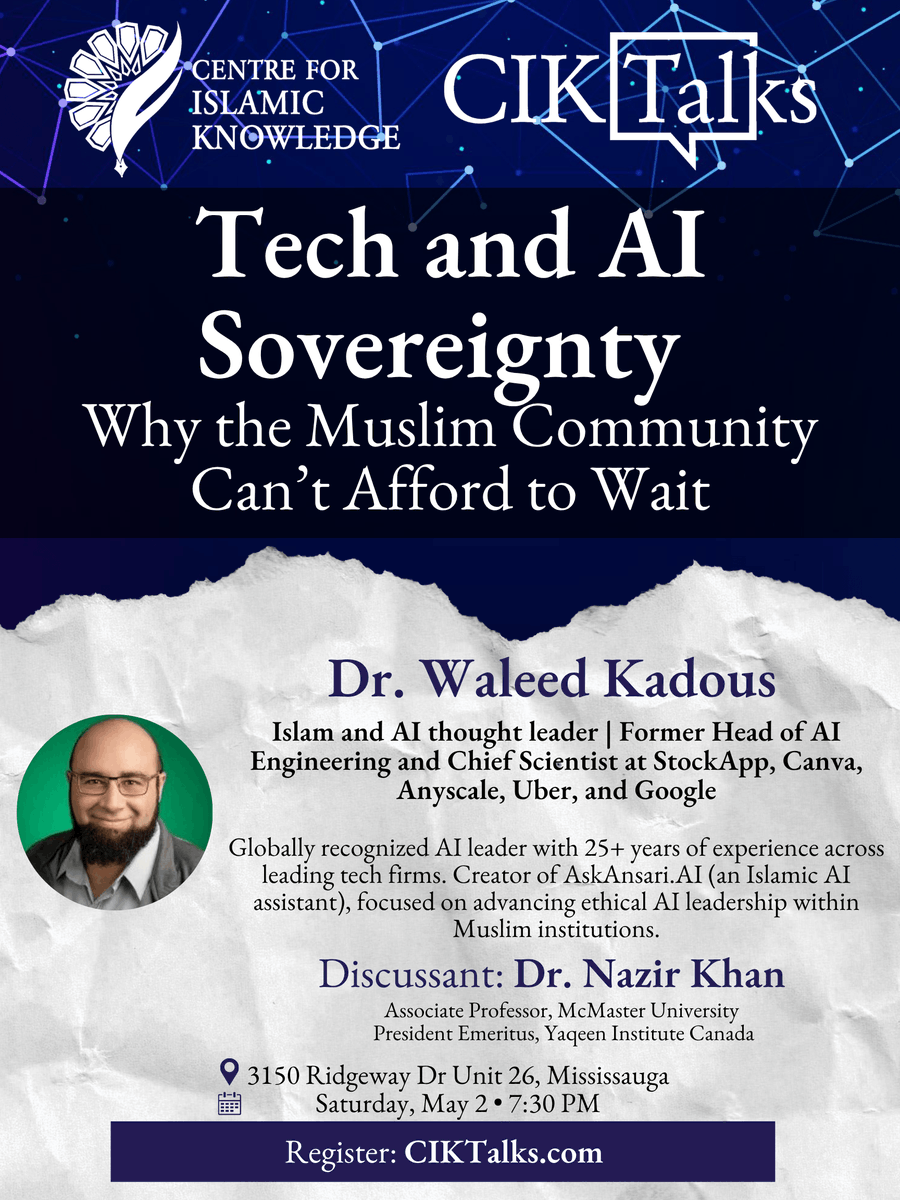

Upcoming CIK Talk - Tech and AI Sovereignty: Why the Muslim Community Can’t Afford to Wait Presented by: Dr. @waleedk (Islam and AI thought leader | Former Head of AI Engineering and Chief Scientist at StockApp, Canva, Anyscale, Uber, and Google) Discussant: Dr. Nazir Khan (McMaster University / Centre for Islamic Knowledge) On-site at the Centre for Islamic Knowledge (3150 Ridgeway Dr, Unit # 26, Mississauga, ON) Saturday, May 2, 2026, at 7:30 PM (15 Dhul Qa'dah 1447) Register at cikedu.org/ciktalks Artificial intelligence is rapidly emerging as the defining technology of our age—reshaping economies, knowledge production, governance, and global power structures. Yet, as Dr. Waleed Kadous argues, the Muslim community risks repeating a familiar historical pattern: a 10–20 year delay in adopting transformative technologies, a lag that, in the case of AI, may prove far more consequential than ever before. This CIK Talk examines the concept of tech and AI sovereignty—the capacity of a community to control its digital infrastructure, data, and technological direction in a way that reflects its values and protects its interests. Moving beyond abstract concerns, the lecture explores how dependence on external platforms can translate into real vulnerabilities, including the shaping, suppression, or distortion of Muslim voices in global digital spaces. Dr. Kadous situates AI not merely as another technological wave, but as a meta-technology—one that accelerates progress across all domains while reinforcing inequalities between those who build it and those who consume it. As AI systems become increasingly self-improving and embedded in critical sectors, the gap between technologically sovereign communities and those without control is set to widen dramatically. Drawing on both historical precedent and the Prophetic model, the lecture argues that the Islamic intellectual tradition has never been characterized by technological withdrawal, but rather by strategic engagement and mastery. From early investments in literacy and knowledge infrastructure to contemporary opportunities in AI development, the talk calls for a renewed vision of civilizational agency—one rooted in scholarship, ethics, and institutional leadership. Bringing together insights from AI engineering, policy, and Islamic thought, this session will explore the challenges, risks, and emerging opportunities in building a Muslim-led AI ecosystem. It will also highlight the roles of scholars, technologists, institutions, and community leaders in shaping a future where AI serves not only efficiency and profit, but also justice, knowledge, and the common good.