Ademola Kelvin 🦀

2K posts

Ademola Kelvin 🦀 banner
Ademola Kelvin 🦀

Ademola Kelvin 🦀

@codeWhizperer

Software Engineer | Building @horuslabsio

Zion 가입일 Aralık 2017
5.1K 팔로잉1.5K 팔로워
Ademola Kelvin 🦀
Ademola Kelvin 🦀@codeWhizperer·
atown ⌐◨-◨@AtownBrown

Want to give a massive shoutout to the @chainrails_io team who jumped into action to ship multiple releases to get their product working inside of @farcaster_xyz When @daimo told us they were shutting down their checkout SDK to focus on stable on/off ramps we were crushed because many people genuinely loved the UX of that product and @tryEmerge was the first time many of them had used it. All the comparable products we tried didn’t cut it until we found chainrails Highly recommend

QME
0
0
1
18
Ademola Kelvin 🦀 리트윗함
Google AI Studio
Google AI Studio@GoogleAIStudio·
vibe coding in AI Studio just got a major upgrade 🚀 • multiplayer: build real-time games & tools • real services: connect live data • persistent builds: close the tab, it keeps working • pro UI: shadcn, Framer Motion & npm support we can't wait to see what you build!
English
266
566
4.9K
717.6K
Neo Kim
Neo Kim@systemdesignone·
API Design Playbook: Giveaway Alert!! • Core API fundamentals. • Clean & scalable design principles. • Common patterns used in real world systems. • Practical concepts for interviews & building projects. (24 hours only & I won't offer this ever again!) To get it: 1. Like, Retweet & Follow @systemdesignone 2. Reply "Playbook" Then I'll DM you the details.
Neo Kim tweet media
English
635
482
1.1K
88.3K
Ademola Kelvin 🦀 리트윗함
DAN KOE
DAN KOE@thedankoe·
The single most important thing you can do in today's world is to stop operating from the old paradigm. If you need to be told what to do next (go to school, get a job, retire at 65) the outcome of your life will always be in someone else's hands. You must learn how to direct your own work. You must learn how to tolerate and mitigate risk and uncertainty. You must figure out what you want and teach yourself everything necessary to get it. It's extremely difficult, but not as difficult as the silent suffering people learn to accept as "normal."
English
455
929
7.3K
337.3K
Ademola Kelvin 🦀
Ademola Kelvin 🦀@codeWhizperer·
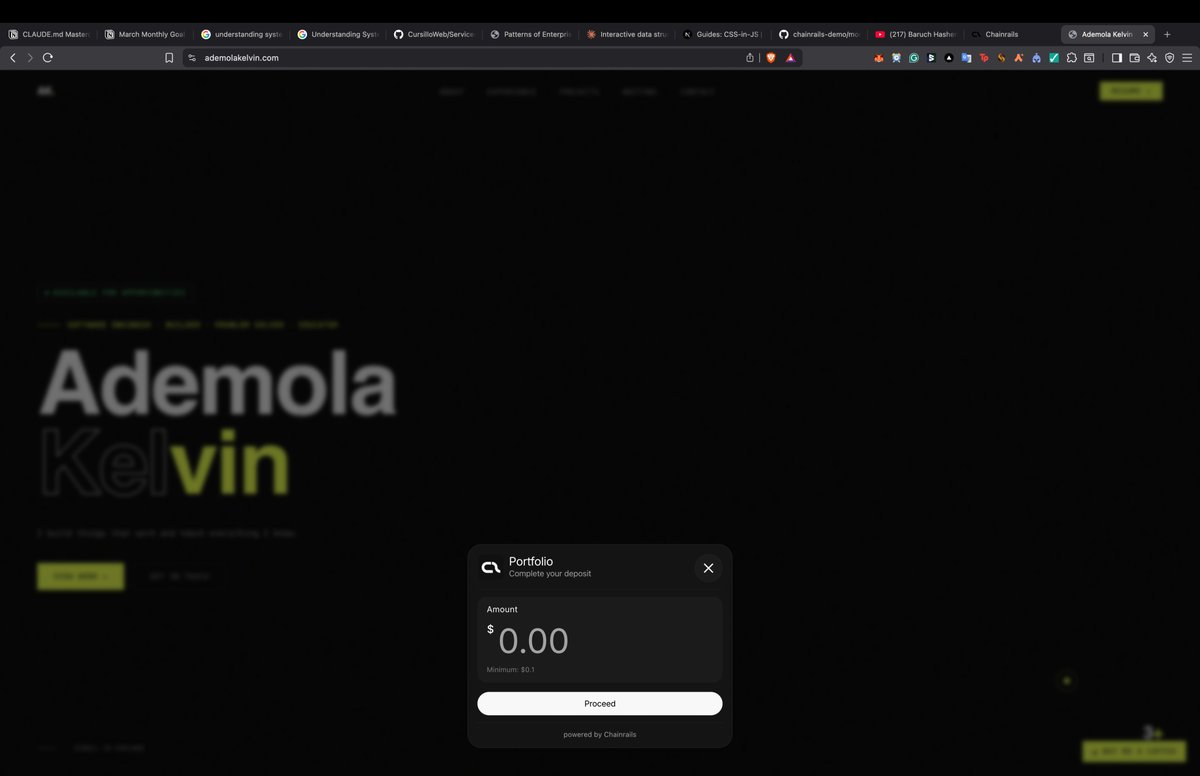
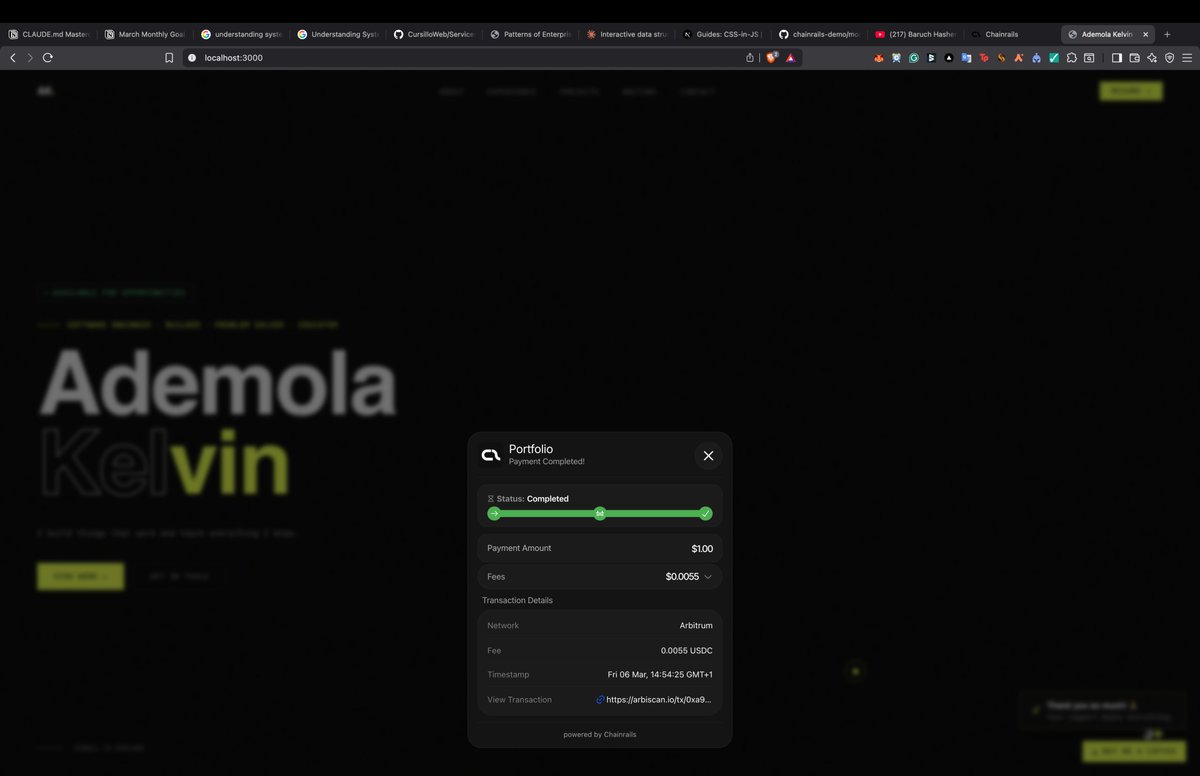
Just integrated @chainrails_io into my portfolio to accept crypto tips — a "Buy Me a Coffee" but on-chain. Will drop a detailed article on how to integrate it in case anyone wants to do the same.
Ademola Kelvin 🦀 tweet media
English
1
3
5
213
Ademola Kelvin 🦀
Ademola Kelvin 🦀@codeWhizperer·
Revisiting DSA so I built a visual learner to make it click faster. Arrays, Stacks, Queues, Linked Lists, Binary Search, Bubble Sort & BST. …-datastructure-and-algorit.vercel.app Full credit to Claude for building it. I architected and prompted. 😀
English
0
0
4
124
Ademola Kelvin 🦀 리트윗함
Darlington Nnam
Darlington Nnam@0xdarlington·
It's great to see a lot of persons are beginning to finally catch up to our thesis. It's really been simple logic; deposits are too complex for every consumer app to spin up theirs. Deploying to multiple chains just for liquidity access is an unnecessary burden that distracts you from your core focus which should be building the product your users wants.. Just like @privy_io has been able to make onboarding possible without navigating wallet complexities, @chainrails_io is making deposits/payments flawlessly easy for consumer apps. Integrate a single API/SDK, and access liquidity on 11+ different chains and across 30+ fiat currencies (soon). We handle the multi-chain/ramping ochestration, you focus on building what your users want. Life has never been easier. If this interests you, we'd like to talk about what you're building: tally.so/r/mRAPbp S/O to @0xKodawari for the awesome video:)
English
1
4
25
1.3K
Ademola Kelvin 🦀 리트윗함
Jeffrey Scholz
Jeffrey Scholz@Jeyffre·
The number one issue I see with junior knowledge workers -- and even some senior ones -- is they leave QA (quality assurance) up to their manager or the customer. This is very dangerous place to be in for the knowledge worker. If your manager has to explain in detail to you how to create a good product (whether a piece of software, marketing materials, an document etc), then they would be better off spending their time explaining to an AI exactly what they want. You, the knowledge worker, become a pointless middleman. Let's use RareSkills articles as an example. Most people underestimate how intolerant you need to be towards "minor slop" to acheive quality. A significant amount of RareSkills proofreading goes towards things that seem minor: this word doesn't need to be here, this should be a numbered list instead of a bulleted list, this should not be in list format, make the text in the diagram bigger, etc. Is the reader going to notice any of these corrections in isolation? Almost certainly not. However, they *will* notice these mistakes in aggregate, and it's impossible to know in advance when the number of minor mistakes piles up to the point where the final product is percieved as not-the-highest quality. And furthermore -- that threshold gets hit sooner than you think. If you want to create quality, you need to have an extremely low tolerance for seemingly minor mistakes. Since minor mistakes are cheap to point out and cheap to fix, the worse thing you can do is sweep them under the rug. Low tolerance for minor mistakes does NOT mean being a jerk. Nor does it mean that someone who makes minor mistakes is an underperformer. And it especially does not mean getting power trips over putting down someone's work. It means you have a culture where minor mistakes are not ignored out of some misplaced desire to be "nice" or to "speed up getting the job done." Tips: 1 - Be hypersensitive to minor inconveniences in your product. They seem "minor" to you, but you are blinded by your love for what you are building. They are not so "minor" to someone who doesn't have the builder bias. 2 - Use AI to catch stupid mistakes so humans can focus on more subtle quality issues. If someone shows up with a badly mismatched shirt and pants, the issue will distract from more subtle issues like hair styling not being ideal or wearing accessories that don't match the occassion. Never, ever ask for feedback on something you didn't ask an AI (with a fresh context) for first. Yes, it will hallucinate, but it takes less than 5 seconds to ignore a bad recommendation, so that's not a valid excuse to not ask the AI for feedback. 3 - Know what are the measurable drivers of quality and optimize for them. Some aspects of quality are easy to measure: page load speed, article word count (lower is better), student completion of assignments, etc. Many product owners aren't even making a deliberate effort to measure or optimize these things. Yes -- some of the most important dimensions of "quality" are not measurable. But *some* dimensions are, so there is no reason to not measure them. Have the discipline to use metrics but not be a slave to them. 4 - Some people have a well-honed quality antenna and others do not. Find the people who have the quality antenna and keep them close. In my experience, most people can be trained in this to a certain extent, but some people are more naturally talented in this area. 5 - Unlearn the "what do I need to do to get an A" attitude. This is one of the worst conditionings students receive in school because it trains people to think that getting things 90% correct laudable. Instead, have an attitude of "I brainstormed all the ways this could be better, I executed on them, now I'm out of ideas. Boss, can you please suggest something I didn't think of?" 6 - The bad default of most knowledge workers is "is this done" rather than "how can this be better?" Again, AI can make a lot of things "done" very quickly -- so "done" isn't as valuable as it used to be. Your value add is guiding the AI on how to making things better. 7 - Can you answer "what stakeholders are affected by my work and what is important to them?" If you can't answer that, NGMI. Who makes the big bucks? It's people who can do hard things well. Just mastering a hard subject alone isn't valuable. AI can do *hard things*. However, AI doesn't seem to be making progress on hard things *done well* -- so get good at that.
English
3
4
58
2.9K
Ademola Kelvin 🦀
Ademola Kelvin 🦀@codeWhizperer·
Payments across chains shouldn’t be a hassle. @chainrails_io provides the rails for cross-chain value exchange — regardless of chain. Today, we’re launching multi-token support. Send and receive value across chains in your preferred token.
Darlington Nnam@0xdarlington

We've just launched multi-token support for @chainrails_io Our goal from the start has always been simple: Interconnect liquidity such that Businesses are able to accept value from users on any chain, in any token or currency — instantly. Today we move an inch closer to that goal. Businesses can now accept payments in multiple tokens across 11+ different blockchains in seconds. Your users get to no longer just pay from wherever they are, but with whatever they have. Now live on Ethereum, Starknet, Base, Monad, Avalanche, Arbitrum, BSC, Polygon, Optimism, HyperEVM and Lisk. try out the demo at: chainrails.io/demo

English
0
1
3
163
Ademola Kelvin 🦀 리트윗함
🇸🇯 MØ8
🇸🇯 MØ8@HandofOdegaard8·
13 matches to go! If you believe, REPOST !!!
🇸🇯 MØ8 tweet media
English
99
6.4K
19.2K
203.7K
elias hezron
elias hezron@0xeliashezron·
If your building on starknet in Africa and want someone to try out your application, Tag it, share the link. DM invite codes. I am here for it. I have tried out 3 projects from amazing builders and excited to try many more.
English
2
3
28
1K
OluGB 🦋
OluGB 🦋@TechProd_Arch·
Money is being rebuilt. 🌍 At the center of this shift are stablecoins, the new rails for global commerce and cross-border value. Africa cannot simply adapt to this future; we must help define it. That is why we, @theflutterwave, are building the continent's largest stablecoin infrastructure, built for scale and real-world use. Read the preview & subscribe to StableRails for the full story 👉🏾flutterwave.com/us/blog/how-we…
OluGB 🦋 tweet media
English
12
27
150
9.5K
Ademola Kelvin 🦀 리트윗함
Aakash Gupta
Aakash Gupta@aakashgupta·
David Marcus just wrote the most important post-mortem in fintech and most people are going to read it as nostalgia. It’s a roadmap of how a $360B company gets reduced to $42B. The math is staggering. PayPal hit $308 per share in July 2021. It closed today around $42 after dropping 19% on the CEO firing. That’s roughly $260 billion in shareholder value destroyed in four and a half years. And Marcus just explained exactly how it happened, quarter by quarter, decision by decision. The branded checkout number tells the whole story. Growth decelerated from 6% to 1% in a single year. JPMorgan said it “adds fuel to the bear thesis that PayPal will struggle to maintain share in the market.” Meanwhile Apple Pay grew to 64 million U.S. users in 2025, capturing 54% of in-store mobile wallet transactions. PayPal watched the entire checkout moment get rebundled by a phone manufacturer. What Marcus describes is a textbook case of the optimization trap. PayPal had the network, the data, the merchant relationships, and the consumer trust. After the spinoff, it had a once-in-a-generation window to build a global payments infrastructure company. Instead, leadership optimized for quarterly TPV growth and unbranded processing volume, the exact segment where PayPal had the least pricing power and the weakest customer relationship. Marcus identifies the Visa deal as the turning point. Visa structured an agreement that killed PayPal’s ability to steer customers toward bank-funded transactions, which was the core of PayPal’s economics. PayPal traded long-term network control for short-term processing volume. That single decision repriced the entire company. The CEO carousel makes it worse. Schulman ran it as a financial optimization engine for eight years. Chriss came from Intuit and understood SMB software but had no payments muscle memory. He cleared out executives who understood transaction economics and settlement infrastructure. Now the board has hired Enrique Lores, who ran HP for six years. A printer and PC executive running a payments company. Three CEOs in three years, and the common thread is that none of them are payments people. The board keeps hiring operators who understand cost structures and efficiency gains, because that’s what boards optimize for when they’ve lost conviction about what the company actually is. Marcus’s point about BNPL is where the post gets really sharp. Klarna, Affirm, and Afterpay built consumer finance brands with persistent credit identities and new shopping behaviors. PayPal had every advantage: 400+ million accounts, merchant trust, transaction data. The U.S. BNPL market is headed toward $258 billion by 2031. PayPal treated it as a checkout feature. Others built platforms. The real insight buried in Marcus’s post is about what happens when a company with network-effect potential gets run by people who think in terms of unit economics instead of platform power. Every decision PayPal made since the spinoff was locally rational. Optimize for volume. Cut costs. Acquire for activity. Ship features defensively. Each quarter looked manageable. The cumulative effect was the systematic dismantling of a payments network that could have been worth $500B. Marcus waited 12 years to say this. The stock dropped 86% before he did. Sometimes the people who know what’s wrong leave too early and speak up too late. But the diagnosis is precise, and the pattern he describes isn’t self-correcting. It’s accelerating.
David Marcus@davidmarcus

A few thoughts about PayPal, nearly 12 years after I left. I woke up this morning to dozens of messages from former PayPal colleagues. It pushed me to finally speak up. I never spoke publicly about the company after I left. Part of that was loyalty to John Donahoe, who gave me an unlikely opportunity, handing the reins of PayPal to a startup guy who, on paper, had no business running a then 15,000-person organization. But part of it was something else: I had left. I chose not to stay and fight for the changes I believed in. Speaking from the sidelines felt like armchair commentary. Easy opinions without the burden of execution. So I stayed quiet. But twelve years of silence is long enough. And today's news makes it clear the pattern I've watched unfold isn't self-correcting. I left PayPal in 2014 because I was deeply frustrated. We had executed a silent turnaround of a company that had lost its soul. We brought back engineering talent, shipped good products quickly, and acquired Braintree and Venmo. The company was on a tear. So much so that Carl Icahn felt compelled to accumulate a position in eBay and push for a PayPal spinoff. At the time, eBay decided to fight Icahn. It was a difficult period for me, caught between what I felt was right for PayPal and my loyalty to the eBay team. This is when Mark Zuckerberg approached me to join Facebook. The combination of his conviction that messaging would become foundational, the appeal of going back to building products at scale, and my growing exhaustion with the internal politics at PayPal and eBay eventually convinced me to leave and join one of the best teams in the world, one I had admired for a long time. In the summer of 2014, I met John in a café in Portola Valley and told him I had decided to leave. During that conversation, he told me that Icahn had effectively won the fight, that PayPal was going to become an independent company, and he tried to convince me to stay on as CEO, but I had already said yes to Mark, and my word is my bond. There was no turning back. After my departure, the board scrambled to find a replacement, and it took a few months for them to land on Dan Schulman. The leadership style shifted from product-led to financially-led. Over time, product conviction gave way to financial optimization. Much of the momentum we had created still persisted and carried the company forward, mainly driven by Bill Ready, who came over in the Braintree acquisition and rose to COO. Under his leadership, Venmo grew exponentially, and total payment volume (TPV) accelerated quickly. But the shift under Schulman became more pronounced after Bill's departure at the end of 2019. With him went the product conviction that had defined the post-spinoff momentum. Then, for a period, COVID-fueled online shopping hid a lot of the company's new weaknesses. During that period, the company made a fundamental miscalculation: it optimized for payment volume instead of margin and differentiation. It leaned into unbranded checkout, where PayPal had the least leverage, instead of branded checkout, where the margin, data, and customer relationship actually lived. Visa masterfully structured a deal that effectively ended PayPal's ability to steer customers toward bank-funded transactions, which had been a core driver of PayPal's economics. Not long after, PayPal lost a significant portion of eBay's volume. Over time, it saw its share of checkout among its most profitable customers steadily erode as Apple Pay and others continued to execute well. The same pattern repeated itself across lending, buy-now-pay-later (BNPL), and new rails. On lending, PayPal missed the opportunity to turn it into a platform weapon. Products like Working Capital were conservative, short-duration, and optimized for loss minimization. Lending never became programmable, never became identity-driven, and never became a reason for merchants or consumers to choose PayPal over something else. The missed opportunity in BNPL was even more striking. Klarna, Affirm, and Afterpay didn't just offer installment payments, they built consumer finance brands, persistent credit identities, and new shopping behaviors. PayPal saw the BNPL turn, entered the market, and had every advantage: distribution, trust, and merchant relationships. But BNPL was treated as a defensive checkout feature rather than an offensive category. There was no attempt to turn it into a core consumer relationship, no super-app behavior, and no meaningful differentiation for merchants. Others built platforms, PayPal added a feature. The failure to lean into building and owning new rails followed the same logic. After the spinoff, PayPal had a once-in-a-generation opportunity to build a global, at scale payment network. Instead, the company focused on building on top of existing networks and third-party rails. More recently, that mindset carried over to PYUSD. Technically, the product was sound. Strategically, it launched without a compelling transactional reason to exist. PYUSD had distribution, but no organic demand. It was not embedded deeply enough into flows to become a true settlement layer, a cross-border merchant rail, or a programmable money primitive. It sat adjacent to the product instead of inside the core of it. Acquisitions during this period followed a similar pattern. Honey was not a strategic acquisition for PayPal. It added activity, but not leverage. It lived outside the transaction, monetized affiliate economics rather than payment economics, and never meaningfully strengthened PayPal's control of the customer or the checkout moment. Xoom solved a real problem in remittances, but it never compounded PayPal's advantage. It scaled volume without changing the underlying rails, identity graph, or settlement model, and as importantly, it didn’t cater to a high-value, high-margin customer archetype. None of these were bad companies. They were just a wrong fit for PayPal and became unnecessary distractions. The board eventually recognized the problem. In 2023, they brought in Alex Chriss, an Intuit veteran with a strong product background, explicitly to restore product conviction. It was the right instinct. But Alex came from software, not payments. He understood SMB product development. He didn't have the muscle memory for transaction economics, network effects, or settlement infrastructure. In hindsight, he also made an error: clearing out much of the leadership team that understood payments deeply. Executives with years of institutional knowledge departed within his first year. This morning, Alex was removed as CEO. Branded checkout grew 1% last quarter. The board tapped another operator, Enrique Lores, the former HP CEO who's been on the PayPal board for five years. I don’t know Enrique. And he might be a great leader, but on paper at least, he’s a hardware executive. For a payments company. The common thread through all of this is incentive design. Once PayPal became independent, short/medium-term predictability beat long-term vision and ambition. Stock performance mattered more than platform risk and network opportunity. Financial optimization replaced product conviction. I'm not claiming I would have made every call differently. Running a public company at scale involves tradeoffs I didn't have to make after I left. But the pattern, choosing predictability over platform risk, again and again, was a choice, not an inevitability. Over time, the company that had every advantage and could’ve become the most consequential and relevant payments company of our time, lost its mojo, its product edge, and its ability to compete in a market that’s being rewired and reinvented in front of our eyes. That's the part that's hardest to watch for a company I care so deeply about.

English
23
71
601
159.9K
Ademola Kelvin 🦀
Ademola Kelvin 🦀@codeWhizperer·
@bahdcoder Thanks for this info. I have been thinking about this all through thr week. Do you have learning resources you can share to learn these concepts. I'd appreciate. Thanks!
English
1
0
1
98