Dan O’Brien

573 posts

Dan O’Brien

Dan O’Brien

@danOBtech

President & COO @TheFuturumGroup

Boston, MA 가입일 Nisan 2023
622 팔로잉717 팔로워
clem 🤗
clem 🤗@ClementDelangue·
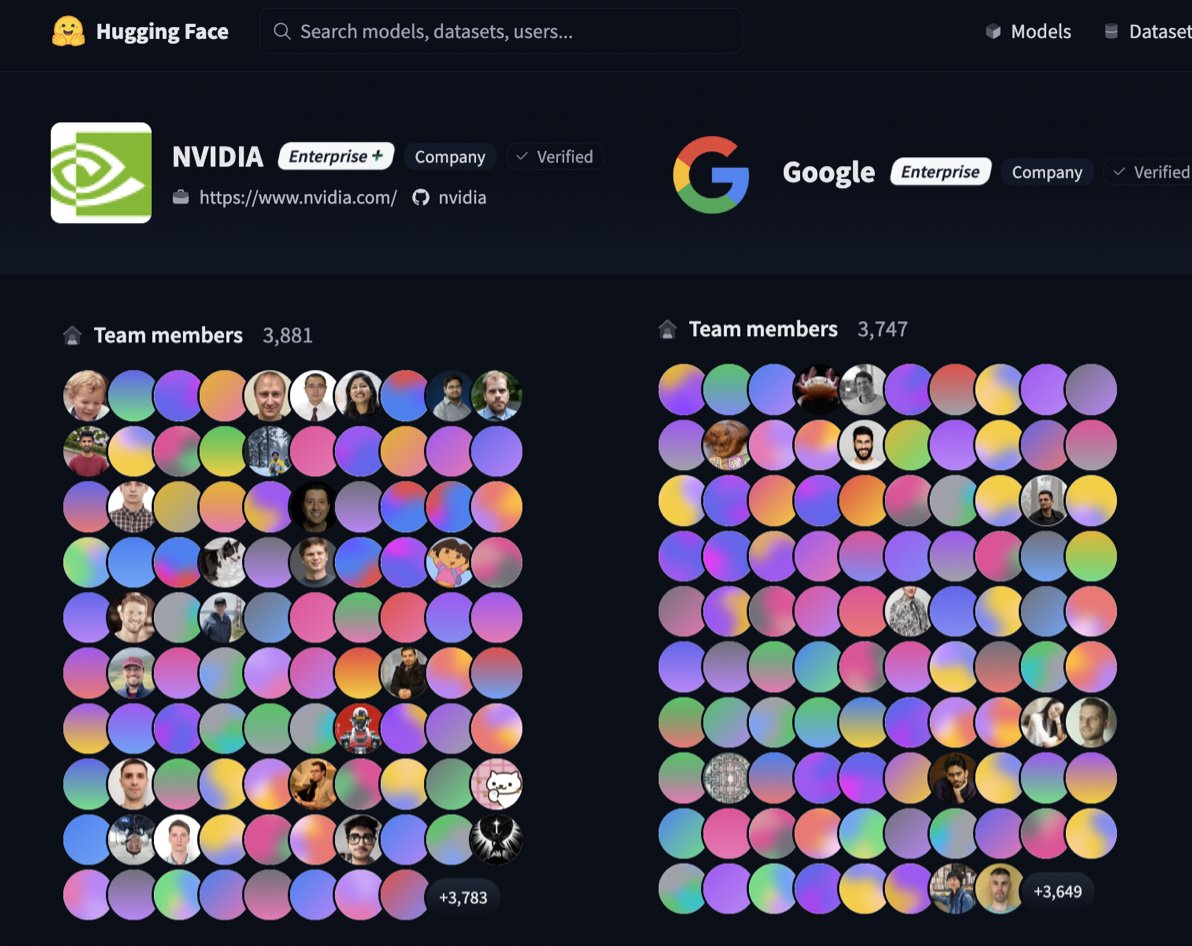
Nvidia just crossed Google as the biggest org on @huggingface with 3,881 team members on the hub. I'm officially calling it: Nvidia is the new American king of open-source AI!
clem 🤗 tweet media
English
43
84
767
114.7K
Matthew Kimball
Matthew Kimball@MattKimball_MIS·
On my way to Boston for a customer event and decided to give @Delta a try. As an @AmericanAir customer with status , curious to compare and contrast. First - no status sucks. No joke. Holy normie. Yeah - I know this is pathetic - but true. Second - plane more comfortable - even in the cheap seats. Third - no wondering 24 hours in advance if/when my flight would be delayed - and for how long. Fourth - if there was some way to transfer status…
Matthew Kimball tweet media
English
2
0
4
368
Dan O’Brien
Dan O’Brien@danOBtech·
With all the capital being poured into AI, it’s a real shame that no one has put up the funds for a Silicon Valley reboot focused on the GenAI era. Near guaranteed to be a better investment than half the vibe-coded “apps” or GPU REITs floating around there. The tech industry is at its best when it can laugh at itself a little bit, and there is so much untapped comedy fodder out there going to waste day to day.
dev@zivdotcat

pov: your vibecoder friend demoing what he built using his $200 claude code max plan

English
0
0
0
116
Dan O’Brien
Dan O’Brien@danOBtech·
@Broadcom with another very clean beat/beat/raise, as they continue to set the standard for consistent execution and returning capital to shareholders, with another $10B in buybacks authorized. Semiconductor results and guidance show that the top buyers of AI hardware see custom silicon as a key part of their AI compute mix and that Broadcom remains the partner of choice for top hyperscalers and frontier AI labs. $AVGO
Fiscal.ai@fiscal_ai

Broadcom Q1 Results Revenue +29% (est. +28%) Adj. EPS +28% (est. +27%) Semiconductor Solutions Revenue +52% Infrastructure Software Revenue +1% $AVGO: +0.5% AH

English
0
0
0
120
Dan O’Brien
Dan O’Brien@danOBtech·
This is a great win for CoreWeave and indicative of exactly the type of AI-native application that the company wants to build around as they expand their customer footprint beyond the frontier labs. This win should also alleviate some investor concerns about the useful life of its GPUs, as the inference counterweight to training workloads ensures strong lifecycle ROI on GPU investments. @CoreWeave @perplexity_ai
CoreWeave@CoreWeave

Today CoreWeave announced a multi-year partnership with @Perplexity_AI to power their next-gen AI inference workloads. Through this agreement, Perplexity will utilize dedicated NVIDIA GB200 NVL72 clusters on CoreWeave Cloud to scale their Sonar and Search API ecosystem with low latency and predictable costs. As the Essential Cloud for AI, we’re committed to providing the performance and reliability that AI-native pioneers need to move at the speed of innovation. Read the full announcement here: hubs.la/Q045xrsJ0 #CoreWeave #Perplexity #AI

English
0
0
2
243
Dan O’Brien 리트윗함
Ed Sim
Ed Sim@edsim·
A recurring theme from this week’s meetings: Founders have massively unlocked engineering speed. Now the org has to keep up. Product compounds weekly. Marketing updates nonstop. Sales is still absorbing last week’s release. This isn’t instability. It’s acceleration. Need to pick your battles and prioritize. Velocity is no longer a code problem. It’s an org design problem
English
7
2
24
1.8K
Daniel Newman
Daniel Newman@danielnewmanUV·
AI works better if you prompt the AI for the master prompt. For instance, before I build in Perplexity Compute I work with Opus on the master prompt to ensure I design the prompt for best results. Doing this has exponentially improved AI performance. Try it. Epic improvement. 💪🏻🔥🚀
English
4
2
48
3.9K
Dan O’Brien 리트윗함
The Futurum Group
The Futurum Group@TheFuturumGroup·
AI delivers scale, objectivity, and reach. Human analysts deliver context, nuance, and strategic interpretation. 𝘍𝘶𝘵𝘶𝘳𝘶𝘮 𝘚𝘪𝘨𝘯𝘢𝘭 brings these strengths together in a living evaluation engine. By integrating @G2dotcom voice-of-customer data with @TheFuturumGroup’s proprietary intelligence and expert analysis, the framework reflects true market readiness as it exists today, not as it appeared last quarter. This is not automation replacing expertise. It is intelligence amplified through technology. Learn more at: 👉 futurumgroup.com/signal #FuturumSignal #MarketIntelligence #EnterpriseTech
The Futurum Group tweet media
English
0
1
5
160
Dan O’Brien
Dan O’Brien@danOBtech·
@ShanuMathew93 This is why edge AI is one of the biggest threats to the datacenter build out. On device inference, and activating the highly distributed, low utilization compute that sits idle the majority of everyday would take a good bite out of build plans for the next several years
English
0
0
0
35
Shanu Mathew
Shanu Mathew@ShanuMathew93·
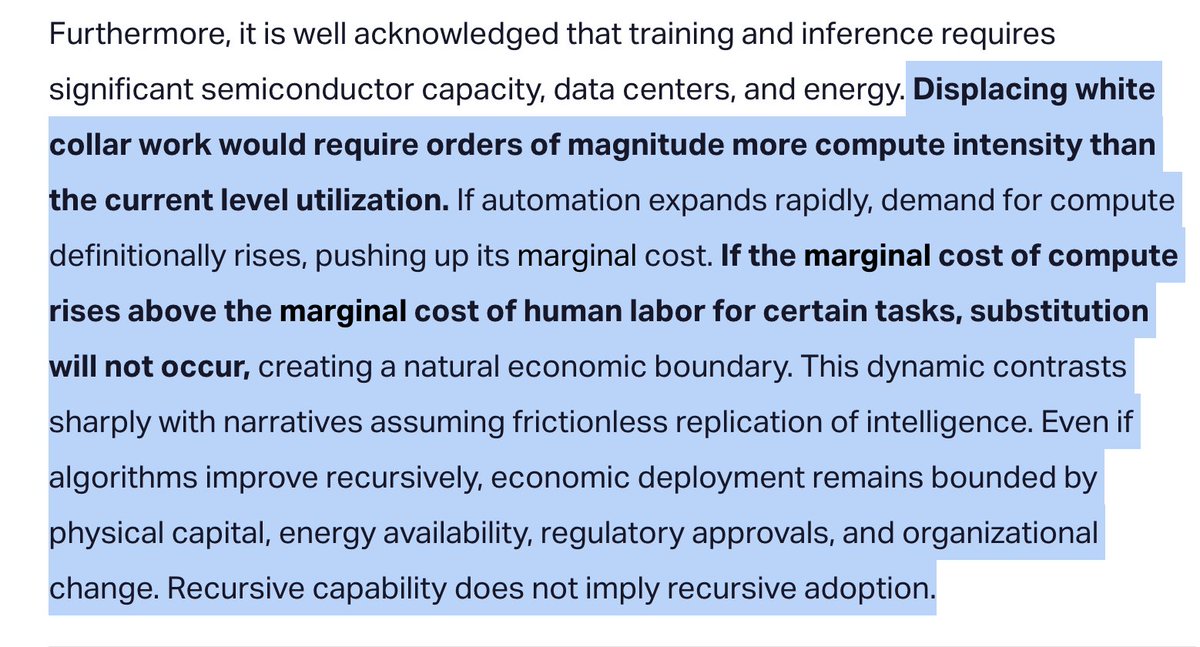
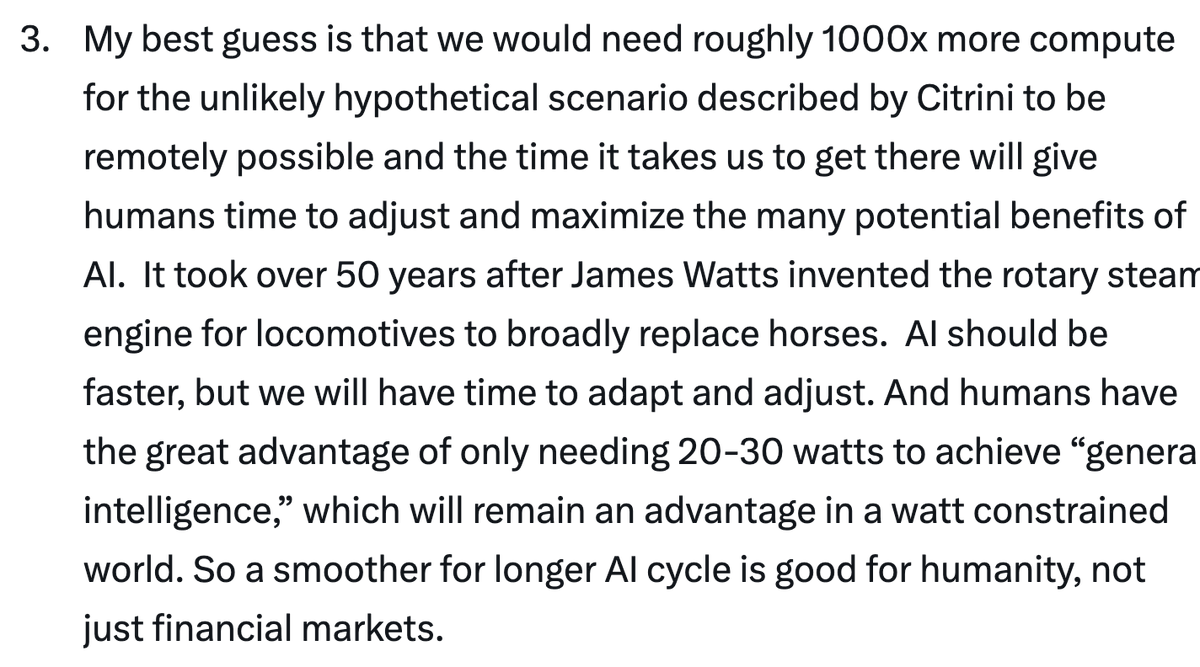
This same point hit on by Gavin and Citadel Securities. It's a good one. Gavin: "The world is fundamentally short both watts and wafers and it may take years to resolve these shortages.  The shortage of watts and wafers may prevent an overbuild - hyperscalers would overbuild if they could, but they simply cannot... My best guess is that we would need roughly 1000x more compute for the unlikely hypothetical scenario described by Citrini to be remotely possible and the time it takes us to get there will give humans time to adjust and maximize the many potential benefits of AI." Citadel: "Displacing white collar work would require orders of magnitude more compute intensity than the current level utilization. If automation expands rapidly, demand for compute definitionally rises, pushing up its marginal cost. If the marginal cost of compute rises above the marginal cost of human labor for certain tasks, substitution will not occur, creating a natural economic boundary. This dynamic contrasts sharply with narratives assuming frictionless replication of intelligence. Even if algorithms improve recursively, economic deployment remains bounded by physical capital, energy availability, regulatory approvals, and organizational change. Recursive capability does not imply recursive adoption."
Shanu Mathew tweet mediaShanu Mathew tweet media
Gavin Baker@GavinSBaker

x.com/i/article/2026…

English
15
102
1.2K
193.5K
Dan O’Brien
Dan O’Brien@danOBtech·
@jukan05 The market set up couldn’t be better for Samsung to shine, memory, foundry, packaging, capacity wins in a shortage
English
0
0
1
414
Jukan
Jukan@jukan05·
[Exclusive] "Responding Faster to the Semiconductor Supercycle"... Samsung Electronics' Pyeongtaek Campus Also in 'Speed Mode' Buoyed by semiconductor supercycle expectations, target price upgrades, and National Growth Fund support, Samsung Electronics is accelerating its investments. In particular, the Pyeongtaek Campus P4, P5, and P6 fabs are progressing faster than originally planned, taking on the character of an all-out sprint. The convergence of an industry upturn and policy funding is lending significant momentum to these mega-scale semiconductor investment projects. Samsung Pyeongtaek P5: Preempting the Supercycle According to investment industry sources on the 27th, Fab 6 (P6) is understood to have a first temporary occupancy permit scheduled for May 2029. A temporary occupancy permit marks the stage at which equipment move-in and trial operations become possible — effectively the start of the countdown to fab activation. Typically, cleanroom interior finishing and equipment setup have taken roughly one year per line, but the recent trend is toward drastically compressed timelines. Sources say Samsung Electronics, as the commissioning party, is pressing hard for schedule acceleration, placing growing strain on contractors. The possibility of workforce expansion and overnight shifts is even being discussed. A source familiar with local conditions said: "Because the client's demand for schedule compression is so intense, contractors are reviewing options such as adding headcount and expanding weekend shift rotations." Fab 5 (P5) has also seen notably accelerated progress. Column installation, originally scheduled for early April, reportedly began in early this month — roughly two months ahead of schedule. At the P6 site, demolition of the existing logistics warehouse (CDC) has also been moved up from the original plan, and workforce deployment timing has been brought forward as well. The source said: "The P6 CDC was originally supposed to be demolished in May before handing over the site, but the schedule was pulled forward so that personnel will be deployed to the site starting next month." Fab 4 (P4), which has already entered the operational phase, has Phase 1 in operation, while Phase 3 is reported to have largely completed equipment move-in and setup. An investment industry source commented: "Given that yield stabilization typically takes about a year after equipment setup due to the nature of semiconductor processes, some lines appear to be effectively approaching mass production." On the eastern side of the P5 site, an office building (Office Building 5) was originally planned, but the plan has been changed to the construction of a data center. This is interpreted as an infrastructure investment aimed at advancing semiconductor design automation and process optimization. Data centers are considered core facilities for realizing unmanned, autonomous fab operations. An industry source said: "Overall, the trend is toward compressing schedules after they've been set. While this is still at a pre-disclosure stage, judging from the design work and on-site progress, it's reasonable to view P6 as also moving into full-scale development." National Growth Fund Support to Enable Early P5 Activation Meanwhile, Samsung Electronics' Pyeongtaek P5 has been selected as the first mega-project under the National Growth Fund and will receive KRW 2.5 trillion in low-interest loans. Pyeongtaek P5 is a large-scale semiconductor investment with total spending exceeding KRW 60 trillion. Of the KRW 8.8 trillion in first-phase capex, KRW 6.3 trillion will be self-funded by the company, while the remaining KRW 2.5 trillion will be supplied through KRW 2 trillion from the Advanced Strategic Industries Fund (at government bond-level interest rates) and KRW 500 billion from five major commercial banks (at rates in the 3% range), each with five-year maturities. With this financial support, Samsung Electronics plans to bring forward the equipment activation timeline from 2030 to 2028 and strengthen its competitiveness in next-generation High Bandwidth Memory (HBM) and AI semiconductor foundry services. The Financial Services Commission noted: "Unlike typical semiconductor fabs recently built with two floors, the P5 fab is being constructed as a three-story structure, which will enable more efficient expansion of semiconductor production capacity." In particular, Samsung Electronics has also agreed to establish a KRW 200 billion special guarantee program in partnership with the Korea Credit Guarantee Fund, and to pilot domestic equipment at the Pyeongtaek P5 process line — expanding its co-prosperity model with materials, parts, and equipment (MPE) companies. Street expectations are also rising. Global investment bank Macquarie raised its target price from KRW 240,000 to KRW 340,000 in just one month. Macquarie stated: "Commodity DRAM and NAND prices are expected to double in Q1 2026," forecasting that memory semiconductor price momentum will persist throughout the year. Macquarie observed that Samsung Electronics stands to be the biggest beneficiary of the upcycle through its Pyeongtaek P4 and P5 lines. It added: "The company appears to be carefully allocating shipment volumes considering customers' inventory levels and its role within the technology ecosystem," and assessed that "Samsung Electronics is the only company capable of smoothly ramping new fabs over the next three years."
English
5
8
110
25.6K
Dan O’Brien
Dan O’Brien@danOBtech·
@jukan05 I think the other stories mean it’s just an AND play, not zero sum
English
0
0
1
1.2K
Jukan
Jukan@jukan05·
Everyone, how do you handle situations where industry research shows the complete opposite of what the executives are claiming? Meta’s MTIA is exactly this kind of case… The leadership keeps emphasizing over and over that MTIA is doing fine, but the stories coming out are clearly not matching that, right?
English
22
5
158
28.6K
Dan O’Brien 리트윗함
Keith Kirkpatrick
Keith Kirkpatrick@Keith_Kirkpat·
I am excited to announce the launch of the Signal report for @TheFuturumGroup, focused on CCaaS Platforms. Signal incorporates both the public-facing messaging and in-depth analyst insights resulting in a holistic evaluation of a vendor's current and future market position.
The Futurum Group@TheFuturumGroup

Contact centers have evolved from transactional voice systems into strategic, AI-driven engagement hubs that shape the modern customer experience. The new 𝗙𝘂𝘁𝘂𝗿𝘂𝗺 𝗦𝗶𝗴𝗻𝗮𝗹 𝗥𝗲𝗽𝗼𝗿𝘁: 𝗖𝗼𝗻𝘁𝗮𝗰𝘁 𝗖𝗲𝗻𝘁𝗲𝗿 𝗮𝘀 𝗮 𝗦𝗲𝗿𝘃𝗶𝗰𝗲 (𝗖𝗖𝗮𝗮𝗦) 𝗣𝗹𝗮𝘁𝗳𝗼𝗿𝗺𝘀 analyzes how leading vendors are transforming CCaaS into experience orchestration platforms powered by predictive, generative, and emerging agentic AI. This report evaluates key vendors across business value, product innovation and solution capabilities, strategic vision, go-to-market execution, and ecosystem alignment. It highlights how enterprise CCaaS platforms are moving beyond routing and automation to deliver autonomous resolution, unified omnichannel engagement, and measurable business outcomes at scale. As customer expectations continue to rise and AI becomes embedded in daily operations, differentiation increasingly depends on how effectively vendors apply intelligence to improve service quality, agent productivity, and customer outcomes. 📑 Download the full report to see which vendors are setting the pace, how the competitive landscape is evolving, and what these changes mean for enterprise customer experience and operations: buff.ly/raalZgu #FuturumSignal #CCaaS #CustomerExperience #AI #ContactCenter


English
0
1
2
86
Mark Gadala-Maria
Mark Gadala-Maria@markgadala·
This story is actually insane: • dude drops $2000 on a DJI robot vacuum like a lunatic • refuses to use the normal app like a peasant • Sammy Azdoufal fires up Claude to crack the API so he can drive it with an xbox controller • Claude delivers the goods • pulls an auth token from their servers, connects successfully • except the system thinks he controls 7000 vacuums • checks again • yep, seven thousand • DJI built authentication with zero device ownership verification • any valid token works for any unit on the planet • Sammy now has eyes inside homes across 24 countries • live vacuum camera feeds everywhere • full floor plans from the mapping data • some guy in germany eating cereal at 3am, unaware his roomba is snitching • one API call away from being the most informed burglar in history • all he wanted was to steer his vacuum with a joystick • does the right thing and reports it • DJI fixes it in two days • back to normal life with his stupidly expensive floor cleaner • IoT companies stay undefeated at shipping garbage security
Mark Gadala-Maria tweet media
English
1.1K
9.9K
64.6K
8.6M
Zephyr
Zephyr@zephyr_z9·
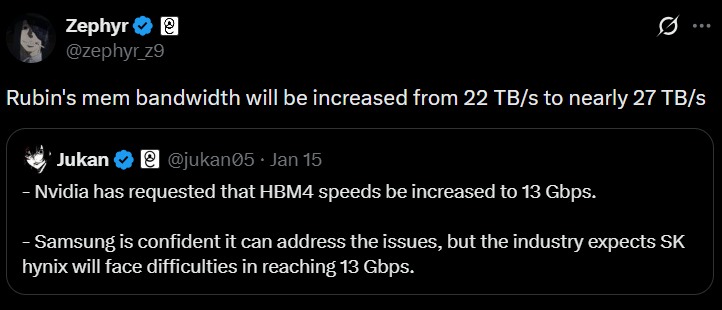
I have a feeling that Jensen will present the 2.3kW (or more) TDP Rubin as a new chip with the higher spec HBM from Samsung, while the 1.7-1.8 kW TDP Rubin will be the standard chip
Zephyr tweet media
Jukan@jukan05

Samsung Likely to Be Exclusive HBM4 Supplier for NVIDIA's Next-Gen Top-Tier GPU Samsung Electronics is reportedly set to become the de facto exclusive supplier of 6th-generation High Bandwidth Memory (HBM4) for NVIDIA's top-tier AI GPU, "Vera Rubin," which is slated for full-scale launch in the second half of this year. NVIDIA has been collaborating behind the scenes with Samsung Electronics on "Vera Rubin NVL72," its ultra-high-performance model, to achieve higher performance levels. Samsung's HBM4, which adopts more advanced process nodes than its competitors, has reportedly succeeded in maximizing performance, effectively securing a dominant position in the high-end product segment. According to industry sources on February 20, NVIDIA plans to segment its HBM4 suppliers for next-generation GPUs into two categories: a general-purpose lineup prioritizing "stability" and a performance-oriented lineup targeting AI infrastructure requiring peak performance. While the general-purpose models are expected to account for the larger share of total supply volume, the estimated pricing of high-end products is projected to be 2–3x that of the previous generation, making them significantly more attractive from a profitability standpoint. Samsung Electronics reportedly targeted the top-tier, highest-performance product segment from the early stages of HBM4 development, and its mass-produced HBM4 products have exceeded NVIDIA's specifications, creating clear differentiation from competitors. Unlike SK Hynix and Micron, which opted for 1b-nm (5th-generation 10nm-class) DRAM, Samsung preemptively adopted 1c-nm (6th-generation 10nm-class) DRAM. As DRAM process nodes continue to shrink, not only does chip productivity improve, but inherent performance and power efficiency also increase — directly impacting HBM4's maximum performance. HBM, which is architected by stacking high-performance DRAM dies, is inherently sensitive to the performance of the underlying DRAM itself. Consequently, DRAM power efficiency and operating speed are the most critical variables determining HBM's peak performance. As DRAM scaling progresses to finer geometries, density, power efficiency, and productivity all improve. DRAM based on the 1c process node is known to deliver 10–20% better power efficiency and over 10% higher operating speeds compared to the previous generation. Samsung's HBM4 achieving a maximum speed of 13 Gbps — exceeding the international standard (JEDEC) by over 40% — is largely attributed to the adoption of the 1c process. That said, the share of NVIDIA's high-end GPUs within the total AI semiconductor market remains uncertain. This will depend on the CAPEX direction of hyperscalers including OpenAI, Google, Meta, Microsoft, and Amazon. If hyperscaler investment turns conservative, general-purpose models could dominate the market over high-end GPU demand. SK Hynix, for its part, appears focused on supply stability rather than outright performance. Its overwhelming dominance in the HBM market serves as a key advantage, and its partnership with NVIDIA remains firmly intact. SK Hynix currently has the most stabilized 1b DRAM production capacity, and accordingly, it is expected to maintain a relatively higher market share in the HBM4 market as well. However, industry consensus is that time is on Samsung Electronics' side. As the HBM market increasingly levels up and becomes a "weight class battle," Samsung's production capacity and market influence are expected to stand out. A source with close knowledge of Samsung noted: "The most critical variable for next-generation HBM is the stability and performance of the underlying DRAM. If Samsung's 1c DRAM yields reach maturity, it could send another shockwave through the market."

English
3
11
141
70K
Dan O’Brien
Dan O’Brien@danOBtech·
@EricJhonsa One of my top ideas, I think they do well on the CoWoS to CoPoS transition, especially the initial capacity build out.
English
0
0
1
554
Eric Jhonsa
Eric Jhonsa@EricJhonsa·
$ONTO said on its call its backlog nearly doubled over the last 3 months and that it struck a $240M+ deal with an HBM client that covers shipments through 2027. It's a good time to be selling semicap tools for HBM/advanced packaging.
English
6
10
94
12.2K
Dan O’Brien 리트윗함
kanav
kanav@kanavtwt·
there's been an update
kanav tweet media
English
143
952
7.6K
715.5K