A controversial idea: When judging a researcher based on their publications or other metrics (however relevant that is), why not relate it to the amount of funding they receive?
La mia relazione con Andrea Giambruno, durata quasi dieci anni, finisce qui. Lo ringrazio per gli anni splendidi che abbiamo trascorso insieme, per le difficoltà che abbiamo attraversato, e per avermi regalato la cosa più importante della mia vita, che è nostra figlia Ginevra.
Le nostre strade si sono divise da tempo, ed è arrivato il momento di prenderne atto.
Difenderò quello che siamo stati, difenderò la nostra amicizia, e difenderò, a ogni costo, una bambina di sette anni che ama la madre e ama il padre, come io non ho potuto amare il mio.
Non ho altro da dire su questo.
Ps. tutti quelli che hanno sperato di indebolirmi colpendomi in casa sappiano che per quanto la goccia possa sperare di scavare la pietra, la pietra rimane pietra e la goccia è solo acqua.
@j_bertolotti In my opinion the problem is not in the average itself, but in the assumption we make to belong to a Normal Distribution. It is not always normal to be in Normal as for the N-1 case
Lightning Imager, #Leonardo’s lightning detector, has been shipped from Campi Bisenzio to @Thales_Alenia_S plant in France where it will be integrated on the first Meteosat Third Generation satellite to hunt for lightning. Find out more: lnrdo.co/3DLqw8H
@MCherkashin@JamesDManton Said that, I see on this thread much more authoritative expert in the field than I do. I am sure you can find more precise explanations reading through their articles and book chapters.Happy new year Maxim
@MCherkashin@JamesDManton Yes and not, the light is, indeed, reflected by less uneven surface but it is not really matter of angular distribution. I like to interpret the problem as follows here below, although it might not be super faithful with the exact theory:
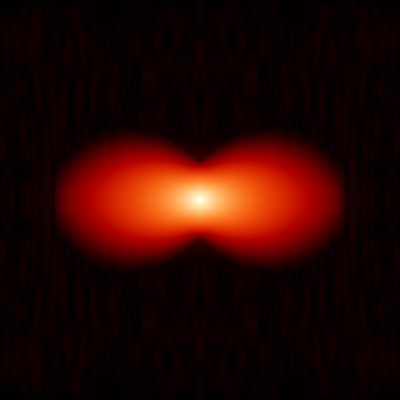
Today's alignment tip: when trying to position a mirror in a focus, replace it with one with a sanded front surface (use a fine grit) and maximise the size of speckles it produces. Lock the position and then replace with a normal mirror.
@MCherkashin@JamesDManton It follows that the combination of several element mixed up (tends to randomise, if you like better) the pattern on the screen, then the speckle grains are smaller.
@MCherkashin@JamesDManton On the contrary, when the reflected spot is larger, the amount of light reflected is the same (as in the previous) but a lot of portions of light has "experienced" very different roughness. Then, in this case, the reflected field can be decomposed into very numerous elements.
@MCherkashin@JamesDManton The small spot reflects a lot of light that has experienced very similar roughness, then this light can be decomposed into a few elements of an orthonormal basis. Each point on the screen (optical bench surface) is the result from the combination of these independent components.