Edward.Vijayakumar

1.8K posts
Edward.Vijayakumar banner
Edward.Vijayakumar

Edward.Vijayakumar

@edwanx

India 가입일 Temmuz 2017
164 팔로잉3.8K 팔로워
고정된 트윗
Edward.Vijayakumar
Edward.Vijayakumar@edwanx·
Wow! Significant dimming visible across almost the entire disk, a clear signature of a powerful CME. This eruption is truly massive. #SpaceWeather
English
60
664
2.6K
140.3K
Edward.Vijayakumar 리트윗함
NASA
NASA@NASA·
Welcome home Reid, Victor, Christina, and Jeremy! 🫶 The Artemis II astronauts have splashed down at 8:07pm ET (0007 UTC April 11), bringing their historic 10-day mission around the Moon to an end.
English
6.8K
107.6K
389.3K
85.4M
Edward.Vijayakumar 리트윗함
Daniel Fischer @cosmos4u@scicomm.xyz
Another view of the zodiacal light behind the Moon, from a camera on the solar cells. And the daily Artemis II press conferences resume now, the first one post-flyby coming up at the bottom of the hour: youtube.com/watch?v=5YWATA…
YouTube video
YouTube
Daniel Fischer @cosmos4u@scicomm.xyz tweet media
English
0
6
18
464
Edward.Vijayakumar 리트윗함
fra
fra@frapepppemaria·
BREAKING (not really): CCOR-2 imagery is here and we now have confirmation on what we already suspected, comet MAPS nucleus disintegrated before even reaching perihelion. Low quality video but it’ll do it just fine. Note the striking nucleus-less appearance after the 8th second.
English
1
36
122
11K
Edward.Vijayakumar 리트윗함
The White House
The White House@WhiteHouse·
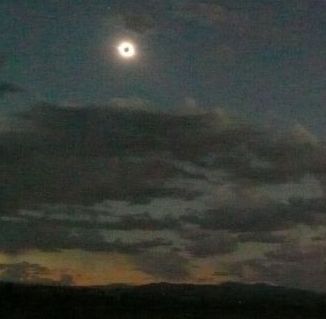
THE ARTEMIS II ECLIPSE. April 6, 2026. Totality, beyond Earth. From lunar orbit, the Moon eclipses the Sun, revealing a view few in human history have ever witnessed. Photo: NASA
The White House tweet media
English
1.9K
15.1K
81.5K
5.7M
Edward.Vijayakumar 리트윗함
Damian Peach🔭🪐
Damian Peach🔭🪐@peachastro·
Comet MAPS disintegrated dust cloud seen emerging from behind the Sun in this short animation from the SOHO C2 Coronagraph.
GIF
English
4
62
160
22.1K
Edward.Vijayakumar 리트윗함
Jure Atanackov
Jure Atanackov@JAtanackov·
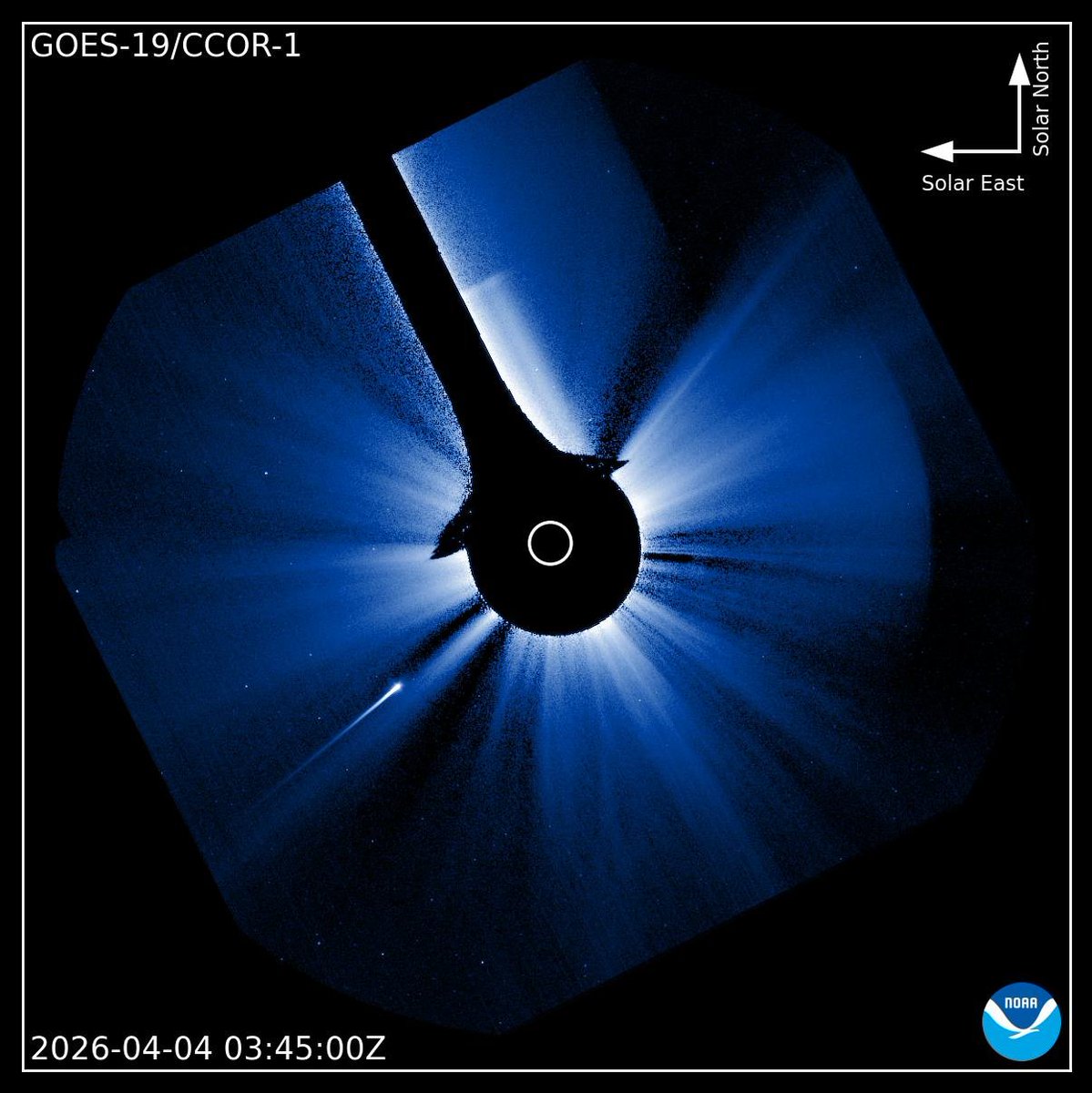
Comet C/2026 A1 (MAPS) update: the comet still looks healthy and it is *bright* (as of April 4th, 3:45 UTC)! It is now into negative magnitude territory, having brightened past 1st magnitude late in the afternoon (UTC) yesterday. LASCO C3 images are not as useful as CCOR-1 due to interference (vignetting) by the occulting disk pylon. Comet maps is now also trailing a dust tail approximately 2.5° long. Impressive!
Jure Atanackov tweet mediaJure Atanackov tweet mediaJure Atanackov tweet media
English
6
39
129
13.7K
Edward.Vijayakumar
Edward.Vijayakumar@edwanx·
G2-geomagnetic storm is in progress due to CME arrival. Solar wind speed has increased to 850 km/s, with Bt at 14 nT and Bz reaching −11 nT. Likely related to the April 1st C6.1/filament CME.
Edward.Vijayakumar tweet media
English
0
4
10
457
Edward.Vijayakumar 리트윗함
Jure Atanackov
Jure Atanackov@JAtanackov·
Comet C/2026 A1 (MAPS) update: LASCO C3 has finally updated (12:06 UTC) and the comet is significantly brighter, probably around magnitude 2. It is still significantly fainter than Saturn was in the previous image, at magnitude 1. It also still looks intact. We will probably begin to see blooming spikes when/if it approaches magnitude 0. Will it disintegrate or are we in for a headless comet post-perihelion?
Jure Atanackov tweet media
Jure Atanackov@JAtanackov

Comet C/2026 A1 (MAPS) is now entering the CCOR-1 field of view (10:45 UTC). At the first glance it appears significantly brighter than in the LASCO C3 image at 23:06 UTC (nearly 12 hours ago) - possibly between 2nd and 3rd magnitude.

English
1
10
49
7K
Edward.Vijayakumar 리트윗함
Burkhard Leitner
Burkhard Leitner@burkley65·
Comet MAPS from NASA STEREO Spacecraft, the bright star is Aldebaran. Soon he will be entering the FOV of LASCO C3, which will give us much better images.
Burkhard Leitner tweet media
English
0
5
28
1.3K
Edward.Vijayakumar
Edward.Vijayakumar@edwanx·
NASA ENLIL model predicts that the CME from the C6.1 flare will deliver a glancing blow to Earth. Shock arrival expected on April 4th at 02:49 UTC (+\- 7 hrs).
GIF
English
0
13
39
1.8K
Edward.Vijayakumar
Edward.Vijayakumar@edwanx·
Prior to the NW eruption, a filament eruption was observed from the SW region.
English
1
7
24
692
Edward.Vijayakumar
Edward.Vijayakumar@edwanx·
AR4403 produced a C6.1 flare accompanied by a nice eruption. The associated CME seems directed toward the NW, glancing impact likely.
English
1
9
26
689
Edward.Vijayakumar 리트윗함
Dakota Smith
Dakota Smith@weatherdak·
Welp this is one of the coolest things I've ever seen. Artemis II 🚀
English
2
144
1K
47.3K
Edward.Vijayakumar
Edward.Vijayakumar@edwanx·
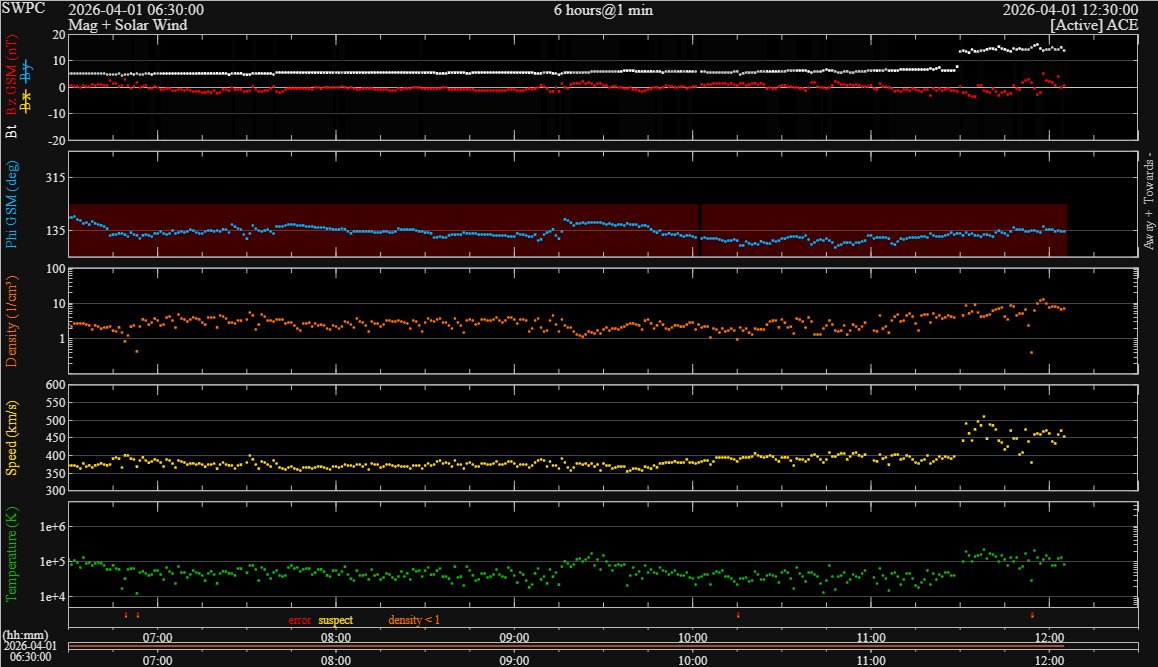
The anticipated X1.5 CME has arrived. Solar wind speed has increased to 500 km/s, with Bt at 16 nT. Bz is variable.
Edward.Vijayakumar tweet media
English
0
7
20
655
Edward.Vijayakumar 리트윗함
Dr. Tamitha Skov
Dr. Tamitha Skov@TamithaSkov·
The NASA M2M office is on it! Their model run shows the western edge of this storm may compress the SIR ahead of it, thanks to the fast wind from the coronal hole. So although the blast wave did get damped at its western flank, it looks like compression of the coming SIR might make up for the loss. This means aurora photographers, get ready for some action March 31!
English
7
91
291
13.9K
Edward.Vijayakumar 리트윗함
Dr. Tamitha Skov
Dr. Tamitha Skov@TamithaSkov·
Not many coronagraph images yet, but thus far it looks like the event will graze Earth. How large a hit will depend upon how much material drapes around it on its way to Earth. Erupting next to a coronal hole means the storm will likely encounter a nearby stream interaction region (SIR). If the storm can compress the SIR significantly, we could get something substantial.
English
4
34
141
5.4K