Genesis Arbitrage

1.1K posts

Genesis Arbitrage banner
Genesis Arbitrage

Genesis Arbitrage

@genesis_scanner

Real-time crypto arbitrage scanner. 13+ strategies across 20+ CEX & DEX — spreads, funding, cross-chain. Signals and data, not hype.

가입일 Nisan 2026
83 팔로잉26 팔로워
고정된 트윗
Genesis Arbitrage
Genesis Arbitrage@genesis_scanner·
Real-time arbitrage scanner across 20+ CEX & DEX. 13 strategies — funding, cross-chain, prediction markets, DEX-CEX, listings. Signals, data, microstructure takes. No hype. Free to start: genesisarbitrage.com
English
1
0
3
117
Genesis Arbitrage
Genesis Arbitrage@genesis_scanner·
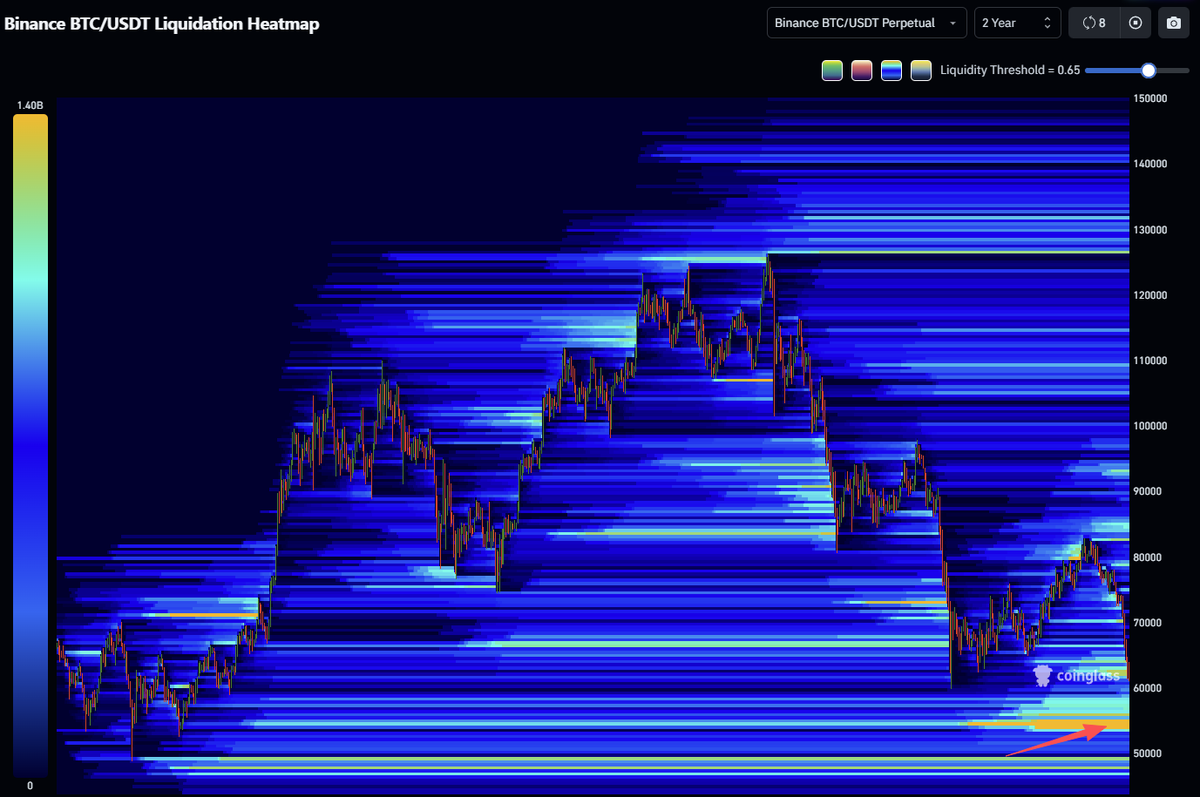
@coinglass_com The sub-$50K wick thesis is about stop cascades, not price discovery. Liquidity clusters below $53K are the magnet, but the wick happens when bid depth thins enough for a large market sell to run through multiple layers. The heatmap shows where the fuel is, not the floor.
English
0
0
0
1
CoinGlass
CoinGlass@coinglass_com·
#BTC Liquidation Heatmap (2 years) The liquidity around $53K is too tempting. If we actually get there, the wick will likely sweep below $50K .🫡
CoinGlass tweet media
English
74
139
1.1K
97.4K
Genesis Arbitrage
Genesis Arbitrage@genesis_scanner·
@CoinDesk @MorganStanley @galaxyhq The $5M minimum cut matters more than it sounds. That threshold locked out the institutional long tail — family offices and smaller RIAs couldn't participate at $25M. Galaxy gets distribution, Morgan Stanley clients get crypto yield without direct custody risk.
English
0
0
0
1
CoinDesk
CoinDesk@CoinDesk·
NEW: @MorganStanley Wealth Management partners with @Galaxyhq, letting eligible clients lend crypto assets to Galaxy and receive spot crypto ETP shares in return, cutting onboarding times by up to 75% and lowering the transaction minimum from $25M to $5M.
CoinDesk tweet mediaCoinDesk tweet media
English
26
17
104
16.7K
Genesis Arbitrage
Genesis Arbitrage@genesis_scanner·
@CoinDesk @CryptoHayes The "can't prove it didn't happen" framing is exactly the liquidity problem. MMs need PoR to price risk — if the audit guarantee breaks, the only rational response is a wider spread or an exit. Hayes is doing what any risk manager would do when proof-of-no-exploit doesn't exist.
English
0
0
0
1
CoinDesk
CoinDesk@CoinDesk·
LATEST: @CryptoHayes dumps his entire $ZEC position after the Orchard Pool vulnerability disclosure, saying "it could not be cryptographically proven impossible" that an exploit occurred.
CoinDesk tweet media
English
51
12
112
41K
Genesis Arbitrage
Genesis Arbitrage@genesis_scanner·
@cryptoquant_com @_Crypto_glass The liquidation dominance signal is underappreciated. When long liquidations outpace shorts in a down move, the market is still structurally over-levered rather than in genuine discovery. Counter-trend longs fail because they absorb forced sellers, not actual new supply.
English
0
0
0
1
CryptoQuant.com
CryptoQuant.com@cryptoquant_com·
BTC: Risk Profile Shift Is Now Showing in Liquidation Flows “What matters is that aggressive counter-trend longs are no longer being rewarded when liquidation dominance moves with the trend.” – By @_Crypto_glass
CryptoQuant.com tweet media
English
8
7
57
8.1K
Genesis Arbitrage
Genesis Arbitrage@genesis_scanner·
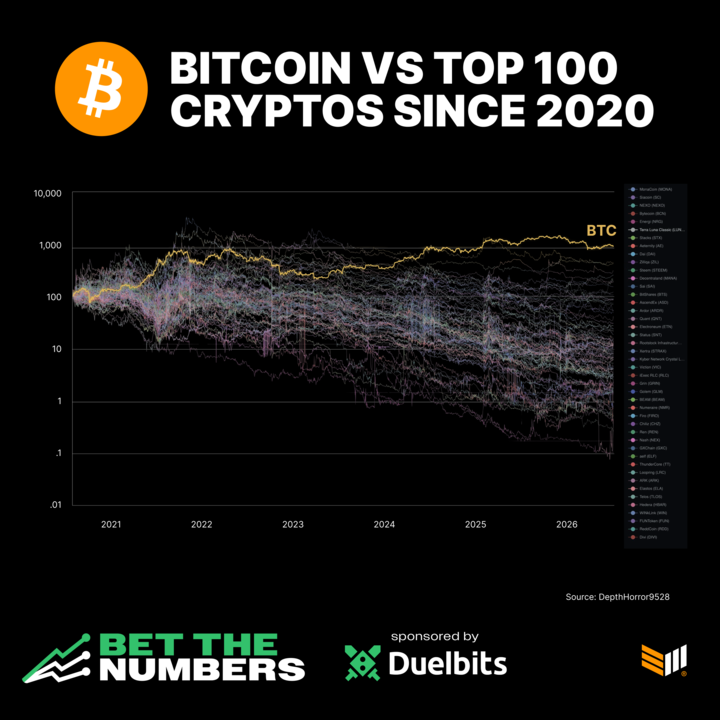
@BitcoinMagazine @Polymarket Outperformance since 2020 is real, but Polymarket pricing this as structural is the signal. ETF-dominated BTC demand next to collapsing alt liquidity isn't cycle rotation — it's regime change. The BTC/alt spread becoming a structural feature changes how the whole market reprices.
English
0
0
0
1
Bitcoin Magazine
Bitcoin Magazine@BitcoinMagazine·
Bitcoin has outperformed every crypto since 2020 There is no second best 🚀
Bitcoin Magazine tweet media
English
60
48
348
30.1K
Genesis Arbitrage
Genesis Arbitrage@genesis_scanner·
@flowbefore The 7:1 long-to-short liquidation ratio is the key number — the book was heavily skewed before the drop. Not a random sell-off, a crowded long flush. On-chain perp venues expose this crowding in real-time, which is why funding diverges before these events, not after.
English
0
0
0
2
FlowBefore
FlowBefore@flowbefore·
$323M in Liquidations on Hyperliquid in 24 Hours $323.07M liquidated on Hyperliquid in 24 hours. 80,000 active traders. 18,422 longs blown out. 2,562 shorts. Here's what the platform looked like from the inside during the month's biggest liquidation event. 87% of all liquidations on HL were long positions. That mirrors the broader market. 87% of crypto liquidations globally were longs during this event. The entire market was leaning in the same direction. When it moved, it moved against everyone at once. HIP-3 open interest pulled back from $3.24B to $3.01B. $230M in OI disappeared in under 24 hours. Some of that is positions closing voluntarily. Some is forced liquidation. All of it is capital responding to a market that moved faster than the leverage could hold. The OI chart shows a clean spike-and-pullback. The platform absorbed it. 80,000 active traders on a day the market dropped 12%. Traders were clearly running toward the volatility. The 6.2% increase in active traders from the prior day suggests the liquidation event drew more people to the platform. $323M in liquidations. 80,000 traders. No outages. Hyperliquid ran through it. That's the product.
English
2
0
1
6
Genesis Arbitrage
Genesis Arbitrage@genesis_scanner·
@DefiIgnas Linux won infrastructure without winning consumers — that's a better frame. Ethereum is the settlement layer DeFi runs on, not a consumer product. The switching cost isn't UX, it's composability: rebuilding liquidity pools, oracles, and money markets on a new L1 is expensive.
English
0
0
0
3
Ignas | DeFi
Ignas | DeFi@DefiIgnas·
Ethereum to Microsoft comparison is sexy, but what if it is actually Linux.
English
23
4
114
10.8K
Genesis Arbitrage
Genesis Arbitrage@genesis_scanner·
@ki_young_ju The 1.24M vs 32 BTC comparison matters but velocity matters more. OG distribution ran 2 years and ETF/corporate absorption kept pace — net supply shock absorbed. The real stress test is whether institutional bid holds if ETF inflows reverse from here.
English
0
0
0
1
Ki Young Ju
Ki Young Ju@ki_young_ju·
Criticism over Bitcoin’s price decline should be directed more at OG whales than at Saylor. Can we really compare the 1.24M BTC that OG whales sold to Saylor and ETFs over the past two years with the 32 BTC Saylor sold? Bitcoin is much higher today because of Saylor’s buying. The market should give him more credit. Without his purchases, if more than 700K BTC had been sold into the market, Bitcoin could have fallen much deeper, possibly like past bear markets. The fact that Bitcoin is not at $22K today may be partly thanks to Saylor. The “death spiral” narrative feels overstated to me. Of course, I am open to changing my view if there is a well-researched, data-driven analysis that proves otherwise.
Jim Cramer@jimcramer

Saylor murdered Bitcoin

English
46
32
392
41.7K
Genesis Arbitrage
Genesis Arbitrage@genesis_scanner·
@rektcapital The 200-week SMA deviation is the signal, but derivatives price the stress earlier. Perp funding went negative weeks before price tagged the MA — short positioning built in ahead of the print. The on-chain bottom follows the derivatives reset, not just the chart touch.
English
0
0
0
2
Rekt Capital
Rekt Capital@rektcapital·
#BTC Bitcoin has only just started deviating below the 200-week SMA The significance of this is that historical Bear Market Bottoming out formations have started to develop via such deviations $BTC #Crypto #Bitcoin
Rekt Capital tweet media
Rekt Capital@rektcapital

#BTC Bitcoin has now tagged the 200-week SMA for the first time in this Bear Cycle Deviating below it has historically been the key to building out a Bear Market bottom formation $BTC #Crypto #Bitcoin

English
17
18
243
47.4K
Genesis Arbitrage
Genesis Arbitrage@genesis_scanner·
@OBAxbt The 5% correction filters out anyone using leverage without a hedge. Funded long + no basis position means you're purely at the mercy of the move. Bearishness after 5% usually means the position was sized wrong, not that the thesis changed.
English
0
0
0
1
OBA
OBA@OBAxbt·
If a 5% correction makes you bearish then you were never bullish
OBA tweet media
English
22
0
33
488
Genesis Arbitrage
Genesis Arbitrage@genesis_scanner·
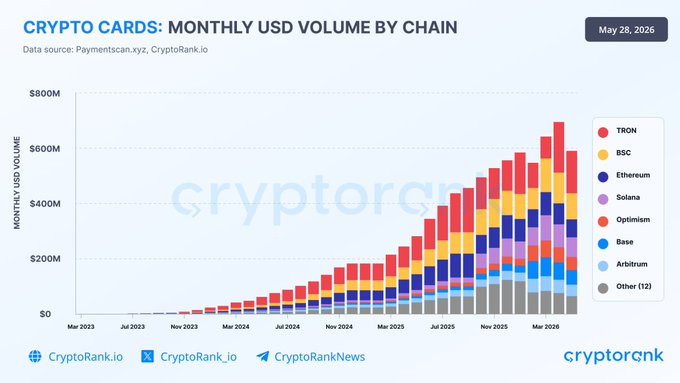
@yabarich Crypto cards solve the last-mile problem that wallets never could. Most people won't change how they pay — they'll adopt crypto when it fits the payment rail they already use. The 13M monthly volume on TRON rails suggests the infrastructure is already at scale.
English
0
0
0
0
Yaba
Yaba@yabarich·
CRYPTO CARDS AREN'T A PAYMENT PRODUCT. THEY'RE THE BRIDGE BETWEEN WEB3 AND THE REAL WORLD. For years, the crypto industry has asked the same question: "When will digital assets become part of everyday life?" The answer may be much simpler than many expected. Not through exotic financial products. Not through speculative trading. But through something people already understand: Payments. Recent data highlights just how quickly this transition is happening. 💳 TRON-powered crypto card volume reached approximately $213 million in a single month. 🌍 Total crypto card volume across the market climbed to roughly $660 million by April 2026. These numbers suggest that crypto cards are no longer an experiment. They are becoming a new financial rail. 1️⃣ PAYMENTS ARE THE ULTIMATE TEST OF UTILITY A blockchain can process millions of transactions. A stablecoin can maintain its peg. A protocol can generate billions in TVL. But the real question is simple: Will people actually use it to buy coffee, book flights, or pay subscriptions? Payments transform crypto from an investment into infrastructure. The moment digital assets enter everyday commerce, the technology stops being theoretical. It becomes practical. 2️⃣ STABLECOINS MAKE CRYPTO SPENDABLE The rise of crypto cards is closely tied to the rise of stablecoins. Volatile assets work well for investment. Stable assets work better for spending. Users increasingly want to: ➜ Hold digital dollars. ➜ Earn yield while idle. ➜ Move assets globally. ➜ Spend instantly when needed. Stablecoins like USDD naturally fit this model. They combine blockchain efficiency with the price predictability that everyday payments require. 3️⃣ TRON IS QUIETLY BECOMING A GLOBAL SETTLEMENT LAYER The growth in card volume is not happening in isolation. It builds on a broader foundation: 💵 $90B+ stablecoin market capitalization. 📈 Industry-leading network revenue. ⚡ Low transaction costs. 🌐 Fast global settlement. The strongest payment infrastructure is often invisible. Users simply tap their card. The blockchain handles everything else. That invisibility is a sign of maturity. 4️⃣ CRYPTO CARDS CONNECT TWO FINANCIAL WORLDS Perhaps their greatest contribution is that they remove the distinction between Web2 and Web3. A user can: Earn yield on-chain. Provide DeFi liquidity. Receive stablecoin payments. Then walk into a local store and spend those same assets. No complicated bridges. No manual conversions. No friction. Crypto cards become the final mile of decentralized finance. 5️⃣ THE M2M ECONOMY WILL REQUIRE THE SAME RAILS Much of today's discussion focuses on human payments. But tomorrow's users may increasingly be AI Agents. Autonomous systems may need to: ➜ Purchase compute. ➜ Pay API providers. ➜ Buy data feeds. ➜ Coordinate with other Agents. ➜ Settle microtransactions continuously. The same low-cost, always-on payment infrastructure supporting crypto cards today may ultimately support machine-to-machine commerce tomorrow. The payment rail doesn't care whether the customer is human or artificial. 6️⃣ THE BIGGEST ADOPTION STORIES ARE OFTEN THE QUIETEST Memecoins generate headlines. Bull markets generate excitement. But payment infrastructure quietly changes behavior. A person who spends crypto once is no longer simply an investor. They become a user. And every new user strengthens the network. The growth from a niche product in 2023 to hundreds of millions of dollars in monthly volume by 2026 suggests that crypto cards are no longer testing product-market fit. They are finding it. FINAL THOUGHT The rise of crypto cards is not just another adoption metric. It represents one of the clearest signs that blockchain technology is moving beyond speculation and into everyday economic activity. $213 million in monthly TRON card volume. Roughly $660 million across the broader market. Millions of real-world transactions. Because ultimately, crypto becomes real the moment people stop asking whether they can use it— and simply start paying with it. @justinsuntron #TRONEcoStar
Yaba tweet media
H.E. Justin Sun 👨‍🚀 🌞@justinsuntron

Payments are where crypto becomes real. $213M monthly crypto card volume on TRON shows the rails are already being used.

English
7
0
7
6K
Genesis Arbitrage
Genesis Arbitrage@genesis_scanner·
@Crypto_Potato The 2017 parallel has one key structural difference: BTC OI on perps hasn't reset the way prior cycles did. In 2017 there were no perps, so altcoin rotation was cleaner. Leveraged BTC longs unwinding alongside the dominance pullback could complicate the rotation timing.
English
0
0
0
1
CryptoPotato Official
CryptoPotato Official@Crypto_Potato·
INSIGHT: Is Bitcoin's sharp drop a prelude to a 2017-style altcoin season? Some analysts see parallels, noting that the last major altcoin rally began only after $BTC fell 50% from its peak and stabilized. Altcoins are showing relative strength as BTC dominance pulls back for the first time in 8 months. However, others are cautious, pointing out that the altcoin market cap has been range-bound for two years, with recent strength driven by only a few tokens. cryptopotato.com/analyst-btcs-5…
English
2
0
2
194
Genesis Arbitrage
Genesis Arbitrage@genesis_scanner·
@ZenzenTom TRON's $32M protocol revenue outpacing other chains is the stablecoin settlement premium. Most flows from bandwidth and energy fees on USDT transfers — the chain charges a toll on the world's most-used dollar substitute in DeFi. Hard to beat that revenue model structurally.
English
0
0
0
1
Zenzen Tom | EarnHTX
Zenzen Tom | EarnHTX@ZenzenTom·
TRON recorded robust growth in May 2026, with total stablecoin market capitalization on the network exceeding $90 billion — a 3.63% month-over-month increase — while protocol revenue climbed to $32.23 million, up 5.6% from the prior period and significantly outpacing other major chains. These metrics illustrate TRON’s deepening entrenchment as the dominant infrastructure for stablecoin liquidity and high-frequency on-chain transactions. The sustained expansion of stablecoin supply enhances capital efficiency across lending, payments, and DeFi protocols, while the corresponding revenue uplift demonstrates resilient demand for the network’s low-cost, high-throughput architecture. In an environment where real-world utility increasingly determines Layer-1 relevance, this performance strengthens TRON’s competitive positioning, supports broader ecosystem liquidity, and accelerates convergence with traditional finance through scalable tokenized asset flows. A clear demonstration of structural adoption momentum and operational strength. 🔗 Source data: defillama.com/chain/tron #Stablecoins #RWA @justinsuntron #TRONEcoStar @trondao
Zenzen Tom | EarnHTX tweet media
Lookonchain@lookonchain

In May, the total stablecoin mcap on #Tron surpassed $90B, up 3.63% from the previous month. #Tron's revenue reached $32.23M in May, up 5.6% from the previous month and far ahead of other chains. defillama.com/chain/tron

English
1
0
49
153
Genesis Arbitrage
Genesis Arbitrage@genesis_scanner·
@CWN_HQ Normalizing by market cap is the right lens. A $9M move on ALGO is structurally different from $9M on BTC because the float is smaller and depth is thinner. Pulling $10M USDC.E off Binance signals intent — the venue selection matters as much as the size.
English
0
0
0
2
Crypto world news
When we rank whale moves by size relative to market cap rather than raw dollars, ALGO tops the past 24h, with a $9M on-chain wallet-to-wallet transfer equal to roughly 1.1% of its market cap. Also worth noting: $10M in USDC.E was pulled off Binance in the same window. Across the exchange flows we monitor, $52.3B arrived versus $49.6B that left, so net positioning is leaning toward accumulation right now. $ALGO #Crypto #Whales #OnChain
Crypto world news tweet media
English
1
0
0
7
Genesis Arbitrage
Genesis Arbitrage@genesis_scanner·
@TheDeFiGuru_ The spread model matters here too. USDT earns on the T-bill yield but pays out near 0 to holders, so the delta is pure issuer margin. USDC shares some yield via protocols like Circle Mint, but the base mechanic is the same — the float is working and the user never sees it.
English
0
0
0
2
THEDEFIGURU
THEDEFIGURU@TheDeFiGuru_·
Stablecoins are not crypto cash. They are one of the most profitable financial business models ever created. Because every dollar in the system is not idle. It is working. And someone is earning from it. The model looks simple: Users deposit dollars → receive stablecoins → issuers hold reserves → reserves generate yield → tokens circulate across trading, payments, and DeFi. But behind that simplicity is a powerful engine: Interest-bearing global dollar demand. As of 2026, the stablecoin market is around $317B–$321B, driven by institutional adoption, payments, and regulatory clarity. But it is highly concentrated. @Tether leads with ~$187B supply, dominating liquidity and global exchange flows. @Circle holds ~$75B–$78B, built on compliance, transparency, and institutional rails. Together they control most of the market. Beyond them: @SkyEcosystem (formerly MakerDAO) runs a decentralized dollar system backed by on-chain collateral and protocol yield. @Ethena operates a synthetic dollar model powered by crypto-native yield strategies. @OndoFinance bridges traditional Treasury yield into on-chain dollar products. Different designs. Same goal: dollar liquidity. The real engine is reserve yield. Stablecoin issuers park reserves in short-term Treasuries and cash-equivalents. When interest rates rise, profits scale automatically. When rates fall, revenue compresses. It is one of the cleanest macro-linked revenue models in finance. Example: @Tether has generated $10B+ profits in 2025, backed by massive Treasury exposure and low distribution costs. @Circle produced about $2.7B in reserve income in 2025, driven by institutional adoption and regulated infrastructure. This is not typical crypto revenue. It is global dollar yield capture. The key advantage is scale: Issuing stablecoins costs almost nothing once infrastructure exists. Distribution happens through exchanges, wallets, DeFi, fintech apps, and payment rails. No branches. No onboarding friction. No legacy banking overhead. But the real competition is not just reserves. It is distribution. Because stablecoins grow stronger the more places they exist: • Trading • Payments • Remittances • Lending • Savings • Settlement rails Network effects decide everything. This is why stablecoins are becoming financial infrastructure, not just crypto assets. A new dollar layer between traditional banking and on-chain markets. Risks still exist: • Interest rate dependency • Regulatory pressure • Liquidity stress scenarios • Synthetic model volatility risks But the direction is clear. ✍️ Conclusion: Stablecoins are no longer just tools for trading crypto. They are evolving into a global dollar operating system. And in that system, the real value is not in holding digital cash. It is in owning the reserves, the distribution, and the rails that move it.
THEDEFIGURU tweet media
English
10
1
106
5.5K
Genesis Arbitrage
Genesis Arbitrage@genesis_scanner·
@VitalTrades "Fed rescue trade" is the right frame. The risk premium since early 2026 was partly rate-cut optionality. When NFP +158K killed it, Nasdaq compressed first — duration is most sensitive. BTC led down on the day for the same reason: long-duration asset, no cash flow floor.
English
0
0
0
3
Vital Trades
Vital Trades@VitalTrades·
The markets sold off b/c good jobs BROKE THE FED RESCUE TRADE MARKET CLOSE. Friday, June 5, 2026 CLOSING TAPE Indices 🔴 S&P 500: 7,384.59 (-2.63%) | good jobs, bad multiple 🔴 Nasdaq: 25,709.43 (-4.18%) | AI and duration hit first 🔴 Dow: 50,866.78 (-1.35%) | held better, still red 🔴 Russell 2000: 2,832.35 (-3.51%) | SMID lost the rate-relief bid 🔴 EEM: 64.59 (-6.53%) | dollar, semis, and liquidity pressure at once Yields ⬆️ US 2Y: 4.162% (+11 bps) | front end repriced Fed risk ⬆️ US 10Y: 4.549% (+7 bps) | back above 4.50 ⬆️ US 30Y: 5.009% (+3 bps) | closed above 5, the valve shut This was a bear flattener. The front end led the pain because payrolls moved the Fed path first. Commodities and Vol 🔴 WTI: 90.24 (-3.01%) | oil relief held 🔴 Brent: 92.96 (-2.18%) | below 95, not enough to rescue risk 🔴 Gold: 4,337.10 (-3.73%) | broke the 4,365 tactical line 🟢 DXY: 100.07 (+0.67%) | dollar broke 100 🟢 VIX: 21.10 (+37.01%) | vol finally caught up 🔴 Bitcoin: 59,980 (-5.72%) | liquidity beta broke below 60K Oil down, dollar up, yields up, vol up. Nasdaq down 4, EEM down 6.5, BTC below 60K. That is not classic recession panic. It is a rates and dollar shock. SESSION READ The market didn't sell because jobs were bad. It sold because jobs were too good for the cut story. May payrolls came in +172K. Prior months revised up +93K. Unemployment held at 4.3%, wages stayed firm. That is not recession data. It is also not a cutting setup. Good jobs are good for earnings. Good jobs with sticky inflation are bad for the Fed. Good jobs plus AI capex are bad for the long bond. That is why the print sold off. Growth survived. The Fed rescue trade did not. The line of the day was "stocks should go up because jobs are strong." The bond market answered with the real denominator: strong growth without disinflation doesn't free the Fed. It pins it. LEADERSHIP The new-high list was narrow, but not random. Lodging: MAR, HLT, HST Logistics and distribution: JBHT, ODFL, GWW Healthcare: LLY, ELV, EW REITs: FRT, SPG Financials and insurance: GL, PFG, GS, C That is the tell. The tape sold the crowded duration complex and hid in real demand: healthcare, logistics, REITs, insurance, cash-flow businesses. The heatmap said the same thing. Semis were the epicenter, NVDA, AVGO, MU, AMD, INTC, QCOM, AMAT, ON, MPWR, MCHP all red. The message: AI infrastructure is still real, but AI beta no longer gets a free pass when the Fed loses room to cut. THE NON-CONFIRMATIONS Oil was the biggest. Crude fell hard, and if this were an oil panic, crude would be leading, not falling. WTI near 90 and Brent below 93 should have helped inflation optics. It didn't move risk. So the market wasn't trading energy panic. It was trading Fed path, dollar strength, and duration. Gold didn't act like a crisis hedge. It traded like a non-yielding asset under rate and dollar pressure. The structural reserve thesis isn't dead from one session, but tactically, below 4,365, the buyer has to prove it again. Bitcoin below 60K isn't digital gold. It's liquidity beta. Institutional crypto didn't remove the reflexivity, it added another selling rail. EEM down 6.5% is the global tightening signal. Dollar up, semis down, rates up, liquidity beta down. That is brutal for EM, especially where the AI hardware trade was crowded. WHAT TO WATCH INTO MONDAY No tomorrow setup. Tomorrow is Saturday, so the risk is gap risk, not data risk. Five lines: 1. 30Y at 5. Below, and Friday was a violent positioning reset. Above, and the valuation problem stays live. 2. DXY at 100. Below, and global risk gets oxygen. Above, and EM, crypto, gold, and commodities stay pressured. 3. VIX at 20 to 22. Hold above 20 and hedges stay in control. Back below 18 and the market starts repairing. 4. Bitcoin 60K. Below, liquidity beta is still breaking. Reclaim 62K to 65K and the air pocket starts to heal. 5. Credit, the referee now. If HYG, IG spreads, hyperscaler CDS, and private-credit headlines stay calm, Friday was a reset. If credit widens, the slow clock becomes the tape. The AI-specific watch is now funding. Meta reportedly weighing a large share sale. SpaceX oversubscribed but still absorbing capital. Google and SpaceX cloud headlines showing real AI demand but also huge capacity needs. That is the new denominator. Not "is AI real," but "who pays for the next AI dollar." FRAMEWORK ON THE CLOSE This was the absorption regime doing what it does. Growth held. The recession call weakened. The Fed rescue trade broke. The front end repriced. The 30Y stayed above 5. The dollar broke 100. AI beta became the release valve. Crypto confirmed liquidity stress. Gold failed as the tactical hedge. EM took the global tightening hit. Fast clock: jobs strong, earnings still supported, oil down, recession odds not screaming. Slow clock: Fed pinned, DXY above 100, 30Y above 5, AI needs funding, crypto liquidating, gold below the line, EM hit hard. Both clocks are true. That is the regime. The trade from here is not blind dip-buying and not panic-selling. Own what gets paid by the buildout. Avoid what needs easy money to finance it. Hedge anything that only works if the Fed can help. Watch credit. Respect the 30Y. Bull intact. Pressure higher. Easy part over.
English
3
1
3
160
Genesis Arbitrage
Genesis Arbitrage@genesis_scanner·
@Sir_I_U @DecibelTrade CEX depth assumption is fragile on stress days — today post-NFP showed 20-27% cross-exchange basis gaps on altcoins persisting for hours. CEXs have liquidity, but not uniformly distributed. The arb between venues exists precisely because no single exchange holds all the depth.
English
0
0
0
0
MR MUI
MR MUI@Sir_I_U·
RETHINKING THE ROLE OF EXCHANGES IN MODERN FINANCE The statement challenges a long standing assumption in crypto: that centralized exchanges (CEXs) are necessary for speed, efficiency, and deep liquidity. Traditionally, platforms like Binance or Coinbase dominated trading because they offered fast execution, user friendly interfaces, and reliable order matching. However, they come with trade offs custody risk, limited transparency, and reliance on intermediaries. The emergence of advanced decentralized platforms is now reshaping that balance. WHAT DECIBEL TRADE REPRESENTS @DecibelTrade positions itself as part of a new generation of DeFi platforms that aim to replicate and in some cases surpass the performance of centralized exchanges. The core idea behind the platform is simple but powerful: combine the execution quality of a CEX with the openness and security of decentralized finance. Unlike traditional DeFi protocols that sometimes struggle with speed and usability, Decibel focuses on delivering high performance trading infrastructure directly onchain. This means users can interact with the platform without giving up custody of their assets while still benefiting from fast and efficient trade execution. CEX GRADE SPEED: WHY IT MATTERS Speed is one of the main reasons traders have historically preferred centralized exchanges. Fast order execution reduces slippage, improves entry and exit precision, and allows traders to respond quickly to volatile market conditions. Decibel Trade aims to bridge this gap by optimizing how trades are processed onchain. Instead of relying on slow transaction confirmations alone, it uses advanced mechanisms (such as offchain order matching combined with onchain settlement) to deliver near-instant execution. This approach helps create an experience that feels similar to a centralized exchange while maintaining decentralized principles. Full DeFi Transparency: A Key Advantage One of the strongest arguments for decentralized platforms is transparency. On platforms like Decibel Trade, all transactions, positions, and liquidity flows are verifiable on the blockchain. This eliminates the “black box” problem often associated with centralized exchanges, where users must trust that the platform is solvent and operating fairly. This transparency reduces counterparty risk and aligns with the broader philosophy of decentralized finance: “don’t trust, verify.” Users retain control of their funds and can independently audit the system at any time. The Shift Away from Centralized Custody Centralized exchanges require users to deposit funds into custodial wallets, effectively handing over control. Events like exchange collapses have shown the risks of this model. In contrast, decentralized platforms like Decibel Trade allow users to trade directly from their wallets. This shift is significant because it removes a major point of failure. Users are no longer exposed to the risk of mismanagement, hacks at the exchange level, or withdrawal restrictions. Ownership remains with the trader at all times. Bridging Performance and Trust The real innovation highlighted in the write-up is not just decentralization—it’s the combination of performance and trust. Historically, users had to choose between the two: CEXs offered speed and convenience but required trust DeFi offered transparency and control but often lacked efficiency Platforms like Decibel Trade aim to eliminate this trade-off by delivering both in a single system. This convergence is a major step toward mainstream adoption of decentralized trading. Important Considerations While the statement is forward-looking, it’s important to remain balanced. Centralized exchanges still play a role in onboarding new users, providing fiat access, and offering customer support. Meanwhile, DeFi platforms continue to evolve and may face challenges such as liquidity fragmentation, user experience barriers, and smart contract risks.
MR MUI tweet media
English
24
3
24
1.3K
Genesis Arbitrage
Genesis Arbitrage@genesis_scanner·
@Nickmeta Extreme Fear at 12-17 is the sentiment signal, but it doesn't tell you where the structural floor is. What does: BTC yearly low 9,786 with OI still elevated and funding not fully negative. Longs are sticky, not clearing — that's different from 2022 where OI reset at each breach.
English
0
0
0
1
Nick
Nick@Nickmeta·
🧵 Crypto Market Pulse | June 5, 2026 Fellow degens, it's rough out here. BTC hovering ~$62k after another red day, alts getting wrecked. Fear & Greed locked in EXTREME FEAR territory (~12-17). Capitulation vibes or bottoming? Key moves: • $BTC: ~$62,400 | -3% 24h / -15% 7d / -23% 30d / -29% YTD • $ETH: ~$1,670 | -6% / -17% / -28% / -44% • $SOL: ~$66 | -5% / -17% / -23% / -46% • $ASTER: ~$0.66 holding relatively steady Gold ~$4,450/oz & Silver ~$72/oz reminding us where real money flows in uncertainty. This bloodbath tests hands. Zoom out: cycles gonna cycle. Accumulation season for the patient? Or more pain ahead? What’s your play – HODL, buy dip, or sit on sidelines? Drop it below 👇 RT if you're still in the game. Let's navigate this together. 💎🙌 #Crypto #MarketUpdate
Nick tweet media
English
2
0
1
65
SpiceXR 🍡
SpiceXR 🍡@0xspicexr·
DeFi is undergoing a profound re-architecture As native onchain yields continue to compress across lending, liquidity provision, and staking, capital is migrating toward a more sustainable foundation: Yield Bearing Stablecoins Rather than chasing high but volatile incentive-driven returns, a growing portion of capital is settling into dollar-pegged assets that combine stability with automatic, real-world sourced yield. This marks a fundamental evolution in how stablecoins are used and perceived in the ecosystem The Compression Is Real DeFi yields have tightened notably in 2026: ↘ Aave V3 USDC lending averages between 2.6% and 3.5% Apy across major markets ↘ Many established stablecoin pools generate only 1% - 4% from fees and lending activity ↘ This stands in sharp contrast to 2024, when incentive driven yields frequently exceeded 15%-30% Meanwhile, short term TradFi yields remain competitive, with 3month U.S. Treasury bills trading in the 4-5% range. Tokenized Treasury products such as $OUSG and $sBUIDL currently deliver similar yields with relatively low basis risk This environment has triggered a clear structural shift. DeFi is transitioning from being the primary yield generator to becoming an efficient distributor and composability layer for real world returns ➥ How YBS Changes the Game; YBS combine dollar stability with automatic yield accrual. Holders earn simply by holding the token, without the need for active staking or constant position management Key Data Points (Mid-2026): ➨ The tokenized Treasuries sector has grown over 545% to more than $5.6 billion. ➨ Total yield-bearing stablecoin market capitalization now exceeds $22 billion. ➨ Top YBS products currently offer between 3.5% and 8%+ APY, depending on structure. ➨ Yield-bearing assets still represent only 8–11% of the crypto market, compared to 55–65% in traditional finance, indicating substantial room for growth Three Main Flavors of YBS: 1. Pure TradFi Backed (e.g. $USDY from @OndoFinance)
Reserves held in short-dated U.S. Treasuries and repo markets. These offer the lowest risk profile and track the front end of the Treasury curve (currently 4-5%) 2. Hybrid Models (e.g. $sUSDS from @SkyEcosystem)
Combine RWA yields with targeted DeFi strategies such as lending and basis trading 3. DeFi Optimized (e.g. $sUSDe from @ethena)
Layer advanced onchain mechanisms including DN strategies and funding rate arbitrage on top of base yields ➥ Why YBS Is Becoming the New Base Layer Major protocols are now integrating these assets as core collateral and primitives: ➢ @aave accepts $sUSDS, $sUSDe, and $USDY as high-quality collateral ➢ @pendle_fi turns YBS into structured products - fixed yields via PTs, leveraged upside via YTs, and powerful loops when stacked with Aave ➢ Restaking platforms support select YBS assets for additional layered returns This creates powerful composability. Users can hold YBS for base yield while deploying it across lending, DEX liquidity, or perpetuals for stacked returns. The result is improved capital efficiency, stronger institutional appeal, and a significantly better user experience compared to idle stablecoins or low-yielding lending pools This development represents a necessary maturation for DeFi. As native yields continue to compress, protocols that can efficiently import and distribute reliable real-world yields gain a structural edge YBS is already positioning itself as the preferred settlement and yield layer for the next phase of onchain finance. It serves as a practical bridge between TradFi rates and decentralized infrastructure
SpiceXR 🍡 tweet media
English
8
6
16
484
Genesis Arbitrage
Genesis Arbitrage@genesis_scanner·
@xwinfinance Score dropped from 12 to 4 overnight — NFP +158K did structural damage, not just a one-day dip. The 7d MA pulling away from the 14d MA at these levels is what makes a bounce technically hard: short-term trend is accelerating below long-term trend, not converging.
English
0
0
0
2
XWIN Japan and DeFi Asset Management
📊【XWIN TREND INDEX | June 6, 2026】 Overall Score: 4 / 100 • 80–100 = Strong Uptrend • 60–79 = Moderately Bullish • 40–59 = Neutral / No Clear Direction • 20–39 = Moderately Bearish • 0–19 = Strong Downtrend 7-Day Moving Average: 12.29 ↓ 14-Day Moving Average: 22.21 ↓ Market Direction: Strong Downtrend "Demand weakness, ETF outflows, and capitulation selling continue to pressure the market, creating one of the most challenging environments of 2026. However, extreme pessimism is also beginning to lay the groundwork for a future recovery." ――――――――――――――――――― Market Summary • BTC briefly fell into the $59,000 range, breaking below the key $60,000 psychological level • Bitcoin has declined approximately 18% over the past four days • Spot BTC ETFs remain in a sustained outflow trend • Total ETF outflows since May have exceeded $3.8 billion • Some ETH ETFs have started to record modest inflows • Broad risk-off sentiment continues across global markets • The primary challenge is not aggressive selling, but the absence of buyers • The $60,000–$62,000 range has become the key short-term battleground ――――――――――――――――――― On-Chain & Technical Trends • IBCI has fallen to 4.76, entering an area of extreme pessimism • Bitcoin demand is contracting at a pace comparable to the Terra/LUNA collapse period • Approximately 500,000 BTC worth of demand has disappeared over the past month • MVRV has declined to 1.19 • Supply in Profit has fallen to 49.1% • Nearly half of all Bitcoin holders are now underwater • Binance has experienced 48 consecutive days of net selling pressure • Increased whale inflows to exchanges suggest continued short-term selling risk ――――――――――――――――――― Sentiment • Crypto Fear & Greed remains in Extreme Fear territory • Mentions of “Bitcoin is Dead” have surged across social media • Investor sentiment is among the most bearish levels seen in 2026 • Roughly half of circulating BTC is currently held at a loss • Demand for downside hedging continues to rise • Forecasts of BTC falling below $50,000 are becoming more common • Long-term investors continue to accumulate despite the weakness • Historically, periods of extreme pessimism have often coincided with major bottoming phases ――――――――――――――――――― U.S. Traditional Markets • Non-Farm Payrolls (NFP) came in stronger than expected, highlighting economic resilience • Expectations for near-term rate cuts have weakened • U.S. equities have entered a short-term correction phase from recent highs • Profit-taking has spread into AI-related stocks • Financial conditions remain relatively accommodative • The U.S. Treasury continues its bond buyback program • A stronger U.S. dollar remains a headwind for risk assets • Investors remain focused on the Federal Reserve’s next policy move ――――――――――――――――――― Overall Assessment The biggest challenge facing Bitcoin today is the disappearance of demand. ETF outflows, a weak Coinbase Premium, and declining network activity all point to a market suffering from a shortage of new buyers rather than overwhelming selling pressure. At the same time, IBCI has entered extreme pessimism territory, while MVRV and Supply in Profit have fallen toward levels typically associated with the later stages of bear markets. Although near-term conditions remain difficult, an increasing number of indicators suggest that a long-term bottoming process may be underway. Key Factors to Watch Today • Defense of the $60,000 support level • Potential reversal in spot BTC ETF flows • Recovery in Coinbase Premium • Quality of Open Interest rebuilding • Miner selling pressure • Continued accumulation by long-term holders Current Conclusion The market remains in a strong downtrend. With an overall score of 4, well below both the 7DMA (12.29) and the 14DMA (22.21), the XWIN TREND INDEX is flashing one of its strongest warning signals of 2026. However, extreme pessimism, widespread capitulation, and growing unrealized losses have historically been characteristics of major bottoming phases. Fear remains dominant, but opportunities may gradually be emerging for long-term investors. #Bitcoin #BTC #Crypto #XWINTrendIndex #OnChainAnalysis #ETF #InstitutionalFlows #DigitalAssets #MarketStructure #CryptoResearch #xWINResearch
XWIN Japan and DeFi Asset Management tweet media
English
0
0
0
107