Jón I. Bergsteinsson

394 posts

Jón I. Bergsteinsson banner
Jón I. Bergsteinsson

Jón I. Bergsteinsson

@joningib

Voice of MedTech | Industry Truth-Teller | MP @ https://t.co/gTD6q3L3lG | Chair of IceBAN

Iceland 가입일 Nisan 2009
467 팔로잉221 팔로워
Jón I. Bergsteinsson
Jón I. Bergsteinsson@joningib·
I have reviewed so many MedTech clinical study protocols and almost all of them have the same problem... The sample size "justification" looks something along these lines: ❝... using a power of 0.8 and an alpha of 0.05, a sample size of 104 patients was determined to be sufficient. This is not a justification, that's a sentence. Before you even open claude code (or a calculator - if you're more into the classics) or call a biostatistician, there are 4 decisions only you can make. Get those wrong, and the math means nothing. Made a quick reference for this. Save it. Bookmark or whatever you like :) #MedTech #ClinicalTrials #MedicalDevices #Founders
Jón I. Bergsteinsson tweet media
English
1
0
1
56
Jón I. Bergsteinsson
Jón I. Bergsteinsson@joningib·
🤦 Your PI is collecting data for their research paper. Not for your regulatory submission or marketing needs. After a decade in the EDC industry, the single biggest mistake I saw in early MedTech studies was this👇 Founders defer to their clinical investigator on study design because "they're the expert." And they are. But they're not YOUR expert. A PI's job is to publish and with their incentives reward novel findings, clean comparators, and academic impact. Your job is to get the device approved. Reimbursed. Funded. Those goals overlap and don't match. ⚠️ When PI-driven data collection takes over we see 🔘 Beautiful publications, weak regulatory dossiers 🔘 Endpoints that excite reviewers but don't satisfy payers 🔘 "Statistically significant" results, no commercial story 🔘 A great paper, a stuck company And this is just one piece... 90% of what determines whether your clinical evidence actually means anything sits below the waterline, operator effects, device drift, study design, endpoint validity. The trophies above the surface get the headlines. The work below decides whether you ship. 💪 Founders: Own your study design. Your PI is a partner, not the decision-maker. 💰 Investors: When you see a glossy first-in-human result, ask who designed the data collection. The answer probably predicts the next 18 months. A successful pilot is easy. But creating a reproducible device (and putting it to market) is hard. What you tested isn't always what you ship. #MedTech #MedicalDevices #clinicaltrials #HealthTech
Jón I. Bergsteinsson tweet media
English
0
0
1
34
Jón I. Bergsteinsson
Jón I. Bergsteinsson@joningib·
💡 The unicorn obsession in VC is actively hurting MedTech startups and their founders. MedTech needs companies that survive long enough to change patient outcomes. Yes, some do turn into $1B+ companies, but most don't. And yet, I keep seeing MedTech SaaS decks. Infinite TAM. Hockey stick projections. Unicorn exit narratives... It doesn't land. And it shouldn't, because that's the "investment banker VC fund" speaking. Here's the reality of MedTech fundraising that nobody says clearly enough 🔵 Exits are bounded. Strategic acquirers, Medtronic, Stryker, J&J, Abbott, buy on clinical proof and regulatory clearance. Not on storytelling. 🔵 Valuations move on de-risking milestones. CE mark changes your number. FDA clearance changes your number. A reimbursement pathway changes your number. 🔵 Generalist VCs will apply SaaS logic to your company. That's not a fit problem. That's a category mismatch. Stop answering questions about CAC and LTV it's irrelevant for most pre revenue MedTech. 🔵 The fundraising timeline is longer. Not because investors are difficult. Because the risk profile demands it. Decisions on investments aren't made in two weeks. The best industry investors do thorough DD upfront. 📌 MedTech M&A hit around $80B in 2025. The exits are happening, but the path to them just looks nothing like software. The bounded return model isn't an industry weakness. It rewards execution over narrative. De-risking over growth hacking. Clinical evidence over pitch polish. Which is actually a better game for founders who build real things. Stop apologising for not being a unicorn. Start showing investors exactly which milestone de-risks their capital next. Because in MedTech, the story doesn't build value. Traction and evidence does. #MedTech #MedicalDevices #HealthTech
English
0
0
1
57
Jón I. Bergsteinsson
Jón I. Bergsteinsson@joningib·
⚠️ If your medical device only works inside a hospital, you are already limiting your market, the impact, and your investor pool. And most MedTech founders don't realise until it's too late. There's one signal in Europe worth paying attention to right now👇 ♦️Healthcare is moving closer to the home. ♦️Ageing populations. Overburdened hospital systems. ♦️Remote communities. Post-pandemic infrastructure gaps. The next wave of MedTech innovation isn't solely inside the ICU. It's in the living room. The rural clinic. The disaster zone. The battlefield. And here's the best part... A medical device built to function in resource-limited environments doesn't just serve defence applications. It serves everything! This is the dual-use angle many European investors are actively funding right now. Not because defence is the end goal. But because resilience IS the product! IMO, most medical devices should design for the edge case. The hospital will still be there 👊 Those who do, will have a larger investor universe. #MedTech #MedicalDevices #DualUse
Jón I. Bergsteinsson tweet media
English
1
0
2
15
Jón I. Bergsteinsson
Jón I. Bergsteinsson@joningib·
⏰ It's never too early to reach out to a Notified Body. I mean it. Never. I just got off a call this morning with one of Europe's most well-known and respected Notified Bodies, who shared their experience with me. "MedTech startups approach us too late. They should knock on our doors much sooner in their regulatory process, and get the dialogue started." AKA, founders who plan to contact their NB at submission are too late. That's not a regulatory strategy, that's more like a prayer (full respect though). NBs can't consult you (by law). But they CAN engage in a "Structured Dialogue" 📝. You present your de-risking plan. Your clinical strategy. Your regulatory pathway. And your NB signals whether they concur. That's not consulting. That's alignment. And it's worth everything. What early NB engagement gives you is... 🔹 Alignment on classification before you build the wrong technical file (which is by the way one of the most common issues with delays) 🔹 Confirmation of your clinical evaluation strategy before you run the wrong study 🔹 A slot in their pipeline (NB capacity is constrained, this alone is worth the call) 🔹 Investor confidence that your regulatory pathway is real, not assumed ⚠️ A Notified Body cannot tell you what to do. But they can tell you if what you're planning "makes sense". Start the conversation today. Before you think you need to 👊 #MedTech #MedicalDevices #CE #MDR #IVDR #FDA
Jón I. Bergsteinsson tweet media
English
0
0
1
15
Jón I. Bergsteinsson
Jón I. Bergsteinsson@joningib·
🛠️ We're building a free cap table simulator for MedTech founders. Not just to show dilution math but to help founders understand how investors actually think. Something most MedTech founders miss... VC ownership thresholds aren't arbitrary. A €50M fund needs to return €150M to its LPs. If they own 10% of a company that exits at €80M, that's €8M back. Meaningful. Not fund-returning. That's why VCs push for 15–20% entry ownership and why high early-stage valuations create friction, it's math, not greed. Four things that consistently trip founders up: 👉 Option pools dilute you before the round closes, not new investors 👉 Convertible notes delay valuation but reward early backers with discounts at conversion 👉 Stacking 3+ convertible notes makes your cap table genuinely scary to Series A investors 👉 Liquidation preferences mean investors get paid first — know exactly where you sit at €50M vs €100M Last week's post on bridge rounds got an unexpected reaction. Founders doing the math wrong. Misreading 20% discounts. Surprised by their ownership at exit. On convertible notes. When used right, they're founder-friendly, they push the valuation conversation to when you have more leverage. Used wrong, they quietly wreck your next round. What we're building: ✅ Cap table simulation across multiple round scenarios ✅ Convertible notes modelled with discount and cap, see exactly how they convert ✅ Real dilution at every stage. grants, angels, pre-seed, bridge, seed, Series A ✅ Exit scenarios, what you own at €20M, €50M, €100M, €250M ✅ Built for MedTech funding reality, not SaaS 🆓 For MedTech founders. A founder who understands investor math raises better and builds a better company 👊 #MedTech #MedicalDevices #Startups #Fundraising #HealthTech
Jón I. Bergsteinsson tweet media
English
0
0
1
32
Jón I. Bergsteinsson
Jón I. Bergsteinsson@joningib·
🍾The bottleneck in MedTech R&D (or any industry) is no longer software. And I'm speaking from experience. That screenshot? Our actual LIFA Ventures CRM. 79 deals in pipeline. Built from scratch in a few weeks.Then a few other internal tools we now use daily. No 10-man dev team. No €200k software contract. No 6-month vendor timeline. Just me, Claude Code, and a few weeks. So when a founder tells me "I tried vibe coding and it doesn't work". I don't take that seriously anymore. Because here's what a small MedTech team can now build in weeks: *️⃣ Custom patent landscape tools (scrape, analyze, summarize competing IP in real time) *️⃣ KOL mapping engines (identify and track key opinion leaders by specialty and influence) *️⃣ Research aggregators (pull and synthesize latest clinical evidence for your indication) *️⃣ Early product validation and ROI/Payment tools (collect structured feedback from surgeons and clinicians) *️⃣ Competitive intelligence dashboards (monitor competitor filings, publications, regulatory submissions) *️⃣ Regulatory document workflows (automate the painful first drafts) *️⃣ Your own custom data room platform Not generic. Not off-the-shelf. Custom. Yours. Built in weeks. This used to cost €200-500k in software contracts and 12 months of vendor dependency. But in 2026? One sharp engineer and an AI coding subscription. Bye bye expensive 10-man dev teams. Welcome the 10x leveraged single software engineer. The real bottlenecks in MedTech R&D remain: capital to execute validated commercial and clinical strategies. Software just left that list. If you're still using slow software development as an excuse, you are way behind. #MedTech #MedicalDevices #AI #HealthTech #Startups
Jón I. Bergsteinsson tweet media
English
1
0
2
34
Jón I. Bergsteinsson
Jón I. Bergsteinsson@joningib·
💼 The ideal early-stage VC used to be (still is for many FoF) MBA, Wall Street, financial wizards and large angel portfolios. In early-stage MedTech, that's probably the worst possible background. The classic VC playbook works great for SaaS (scale fast, exit fast), or at least used to before claude code broke everything, consumer apps (growth metrics matter), and later-stage MedTech (post-approval scaling). But early-stage MedTech is completely different. It's not a matter of placing the best bets. Before you can scale, you have to survive three brutal phases: 1️⃣ Prove it works (clinical validation, not just prototypes) 2️⃣ Get payment/commercial/reimbursement clarity 3️⃣ Navigate FDA/notified body approvals You can't spreadsheet your way through this. A finance-minded VC can't read clinical data and spot problems. They don't know when to pursue a 510(k) versus De Novo or EU MDR. They've never navigated a hospital buying committee, created a CPT code, or understood what commercial adoption clarity actually means. The valley of death kills most early-stage MedTech companies, not because they run out of money, but because they run out of operational expertise. The data backs this up 👉 Healthcare specialist VCs show higher median returns versus traditional finance generalist VCs - a 5.2% point gap over 20 years. For VC - that's huge! In early-stage MedTech, it's wider. Finance VCs are genuinely good at later-stage MedTech scaling. But from prototype to first revenue? You need someone who's actually done it. In early-stage MedTech, I believe that lived experience beats financial modeling - every time. #MedTech #HealthTech #MedicalDevices #Startups
Jón I. Bergsteinsson tweet media
English
0
0
0
14
Jón I. Bergsteinsson
Jón I. Bergsteinsson@joningib·
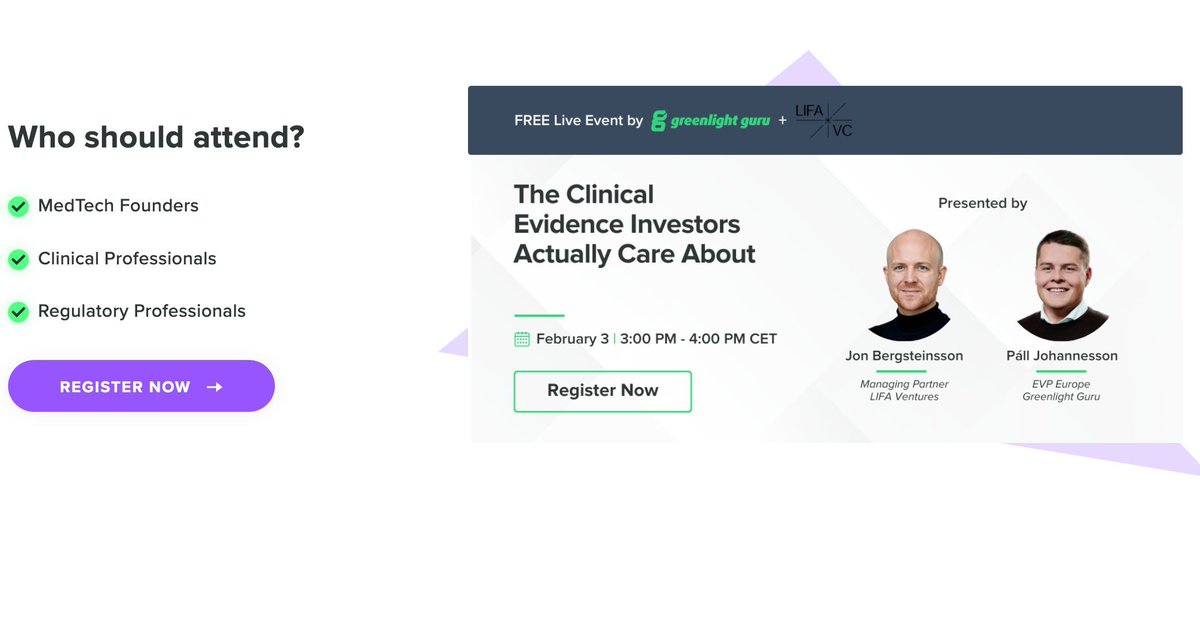
⏰ Today at 9 AM ET / 15:00 CET "Is my clinical data strong enough to fundraise?" If you’ve ever asked yourself this question, join me and my good friend Páll Jóhannesson from Greenlight Guru, LIVE in a few hours. We're unpacking the difference between: ⌍ Statistical significance (gets you published) ⌌ ⌍ Clinical significance (gets you prescribed) ⌌ ⌍ Commercial significance (gets you funded) ⌌ Most people confuse these. And it can kill deals. We'll walk through a real case and why I'm skeptical. Why are other investors excited? What does this reveal about how investors actually evaluate clinical data? This is conversational, practical, and based on data we're seeing right now. 📌 Registration still open! ⬇️ #MedTech #ClinicalEvidence #MedicalDevices #HealthTech
Jón I. Bergsteinsson tweet media
English
0
0
0
27
Jón I. Bergsteinsson
Jón I. Bergsteinsson@joningib·
💰 As promised, 'The LIFA.VC MedTech Budget Template' is now live. Last week I talked about the need to provide a structured budget template for early stage MedTech companies. What's inside: 👉 Pre-built categories for MedTech-specific costs (regulatory, clinical, QMS, notified body fees, post-market surveillance) 👉 "Realistic" cost ranges based on real Class II device development (highly varies though between continents) 👉 Milestone-based budgeting (tie spending to de-risking events) 👉 Runway calculator (know exactly when you’ll run out of money) I've seen too many founders present a round believing that it will get them to market, only to realise their budget doesn't hold water. Or worse, they allocate it wrong. Spending on regulatory before early commercial validation. Hiring sales before they have a validated product to sell. This template helps you build a budget that matches MedTech reality, not SaaS. Common costs founders forget are e.g. 👀 Translation/localization for multi-market labels (IFUs) 👀 Notified body annual fees (€10k-25k/year, not one-time) 👀 Post-market surveillance setup (€20k-50k) 👀 Insurance (product liability + clinical trial)" This template catches them before they become €50k surprises. Free. No email required. No gate. Link in first comment 👇 #MedTech #Startups #MedicalDevices #HealthTech #Nordics
Jón I. Bergsteinsson tweet media
English
0
0
0
16
Jón I. Bergsteinsson
Jón I. Bergsteinsson@joningib·
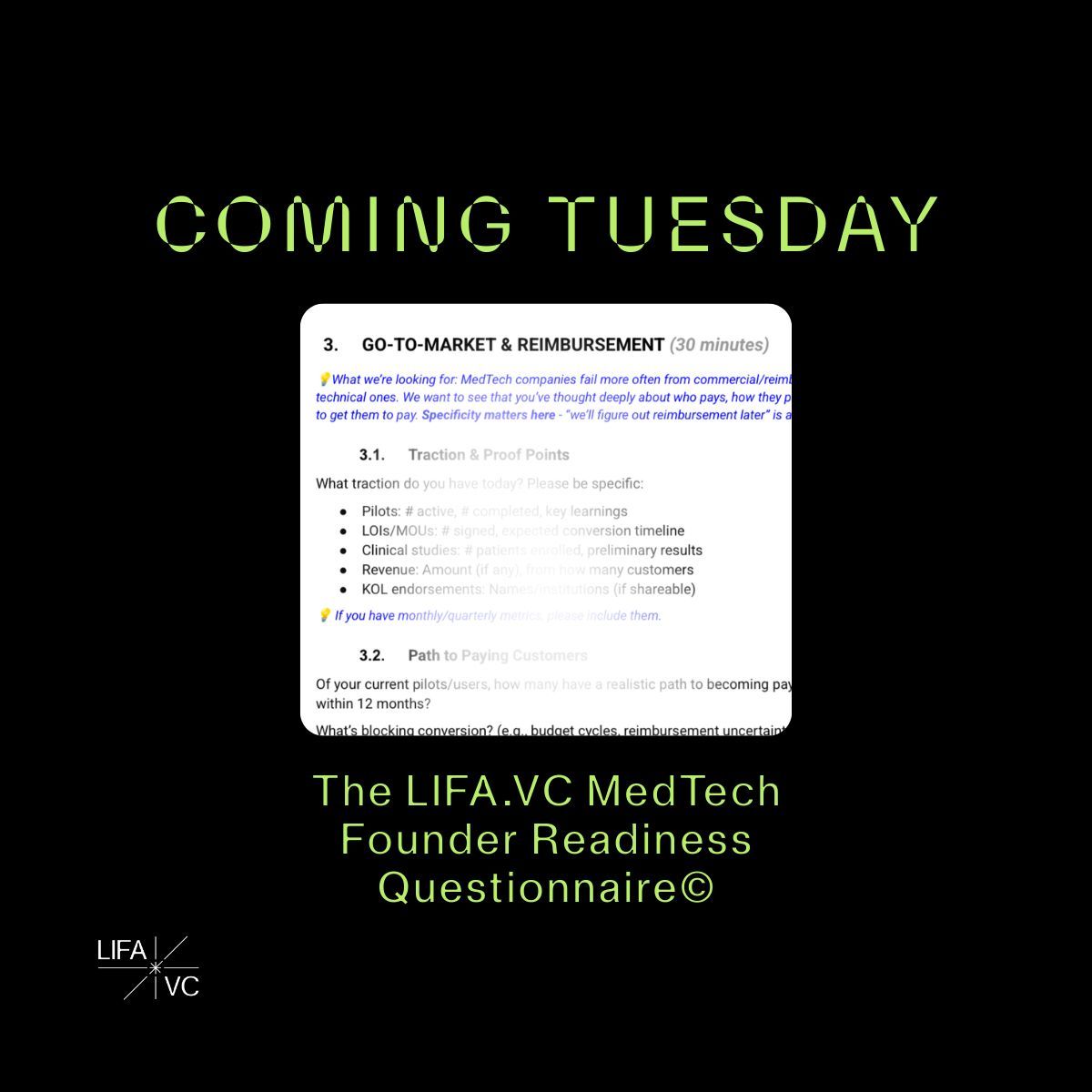
We’ve been building this for months. The Founder Readiness Questionnaire is just the third piece. Today we're publishing our core investment evaluation framework, the same one we use to assess companies that we believe can be a good fit to LIFA Ventures. But we're not stopping there. We're building platform.lifa.vc - a suite of professional tools and educational content designed specifically for MedTech founders. Check it out! More coming soon 👊
Jón I. Bergsteinsson tweet media
English
0
0
1
11
Jón I. Bergsteinsson
Jón I. Bergsteinsson@joningib·
💡 Next week, we’re sharing something we’ve never shared publicly before. Our complete pre-investment questionnaire. This is the framework we use to evaluate Nordic MedTech companies at LIFA Ventures. It covers everything from regulatory pathways to reimbursement strategy to team readiness, the questions that actually determine if a company is fundable. Why share it❓ Because I’m tired of seeing founders waste time guessing what investors care about. And because the ecosystem gets stronger when everyone knows what "investment ready" actually means. What’s inside: → Market size & clinical impact (how to calculate TAM properly) → Go-to-market and reimbursement strategy (the #1 reason approved devices fail commercially) → Team gaps & hiring priorities → Regulatory pathway & timeline (realistic vs wishful thinking) → Clinical evidence planning (what payers actually want to see) → Product readiness checkpoints Founders who’ve completed this tell us they reuse it for other investor meetings, board updates, and strategic planning. One company even pivoted their regulatory pathway. 📅 Launching Tuesday If you’re building a medical device, diagnostic, or BioTool with a clear path to commercialisation, this is for you. More details next week 👊 #MedTech #VentureCapital #Diagnostics #MedicalDevices #HealthTech #Founders
Jón I. Bergsteinsson tweet media
English
0
0
0
21
Jón I. Bergsteinsson
Jón I. Bergsteinsson@joningib·
"Jón, your LinkedIn posts are too negative." 🧐 Fair. I do call out long timelines, reimbursement gaps, and funding reality checks. But here’s the thing: I only push on the hard stuff because I believe Nordic MedTech can win globally - and I want to help. Here’s why I’m more bullish than ever 👇 🏔️ We have the legacy Elekta. Getinge. Mölnlycke. Coloplast. Ambu. GN. Radiometer. Embla Medical. Kerecis. Revenio. Laerdal. Medistim. And so many more. The Nordics built some of the world’s best MedTech companies. That DNA is still here. 🏥 Our healthcare systems are living laboratories. High trust. Early adopter clinicians. Regulatory sophistication. Perfect for clinical validation and real-world evidence. 💡 The talent is underrated. Nordic founders understand both EU and US markets. They build regulated technology with clear clinical pathways from day one. That’s rare. 🤖 AI is compressing R&D timelines. Design optimization. Clinical trial analysis. Regulatory documentation. Evidence synthesis. What used to take 18-24 months can now happen in 12-15 (or shorter). And Nordic engineers are early adopters of these tools. 🌍 We think global from the start. Small home markets force Nordic founders to be globally competitive early. That’s not a weakness - it’s an advantage. So yes, I’ll keep writing about what to do (and what to avoid). Not because I’m negative. Because I want Nordic founders to be prepared, not surprised. The opportunity is massive. The competition is fierce. And the founders who plan for reality are the ones who’ll build the next generation of global MedTech leaders. That’s what we're betting on at LIFA Ventures #MedTech #Nordics #MedicalDevices #HealthTech #diagnostics #Startups
Jón I. Bergsteinsson tweet media
English
0
0
0
33
Jón I. Bergsteinsson
Jón I. Bergsteinsson@joningib·
💰 Getting FDA clearance is the easy part. 🫰 Getting paid for it is where most MedTech companies die. And almost nobody talks about this until it's too late. Here's what I mean... Regulatory approval might give you a permission to sell. Reimbursement gives you permission to get paid. Those are not the same thing. I see so many startups celebrate their CE mark or 510(k) clearance (for a good reason) like they've crossed the finish line. But the real race just started. Because now you need to answer👇 🧐 Does your device fit into an existing reimbursement code? 👉 If not, how long will it take to establish a new one? (Hint: years) 🧐 Will payers actually cover it, or is it "approved but not reimbursed”? 🧐 Do hospitals have budget for this, or does it compete with existing solutions? 🧐 Can you demonstrate clear cost savings or improved outcomes that justify the price? 📌 In the US, getting a new CPT code can take 3+ years after FDA clearance 📌 In Europe, reimbursement pathways vary by country, CE mark doesn't guarantee payment anywhere 📌 Even with codes in place, payer negotiations and hospital adoption timelines can add another 12-24 months The result? Founders 🔥 through their Series A celebrating regulatory milestones, then hit a wall when revenue doesn't materialize. ⚠️ This is why reimbursement and commercialisation strategy is one of our core evaluation criteria at LIFA.VC We don't just ask "Can you get approved?” We want to know "Can you get paid? And how long will it actually take?” Because in MedTech, regulatory approval doesn't create revenue. Reimbursement (read payment) does. #MedTech #MedicalDevices #HealthTech #FDA #CE
Jón I. Bergsteinsson tweet media
English
0
0
0
16
Jón I. Bergsteinsson
Jón I. Bergsteinsson@joningib·
💊 GLP-1 drugs are about to NUKE demand for entire categories of medical devices 🤯 And almost nobody in MedTech is pricing this in. Or what? Ozempic, Wegovy, Mounjaro — these aren’t just weight-loss drugs. They’re market reclassification events. Bariatric surgery volumes are already declining. Joint replacement demand could follow. Diabetes management devices face headwinds. Even certain cardio interventions may see reduced patient populations. 📌 GLP-1 adoption could reduce bariatric procedure volumes by 20-30% over the next 5 years (Deloitte Health) 📌 Morgan Stanley estimates the global GLP-1 market will hit $77B by 2030. 📌 That’s not a niche pharma trend. That’s a structural shift in how we treat obesity-adjacent conditions. So if you’re building a device that treats: 👉 Metabolic disorders 👉 Cardiovascular disease linked to obesity 👉 Orthopedic conditions driven by weight 👉 Sleep apnea devices tied to BMI You need a thesis for why your device still matters in a GLP-1 world. Don’t get me wrong, we know that these drugs aren’t perfect. Compliance issues, side effects, cost barriers, and long-term efficacy questions remain. But ignoring this risk because “our device solves a different problem” is wishful thinking. IMO that's a gap founders (and investors) shouldn’t overlook. Because in MedTech, market assumptions don't age well... #MedTech #HealthTech #MedicalDevices #GLP1 #Ozempic #Startups
Jón I. Bergsteinsson tweet media
English
0
0
0
63
Jón I. Bergsteinsson
Jón I. Bergsteinsson@joningib·
It's time to rethink how we present TAM in MedTech 🧐 Have you seen this same (flawed) logic before? "Price × number of patients = TAM." 🤑 It looks convincing at first glance, but it has very little to do with how MedTech markets actually work. In healthcare, TAM is not the number of patients who could benefit, or number of operations/uses. Your TAM is shaped by: 💳 Who pays (who's the real buyer) 📋 What reimbursement pathway exists (and HOW MUCH you can claim of that pathway, not always 100% - far from it actually) 🏥 Which clinical workflows support adoption 🧪 What level of evidence reduces risk for clinicians and payers, or add VALUE 📦 Whether hospitals can realistically procure and implement the product MedTech adoption isn't a straight line. It's constrained by budgets, codes, clinical behaviour, procurement friction, and economic incentives, not theoretical headcounts. The real question isn't "How big is the TAM?" It's: 👉 "How big is the addressable, reimbursable/payable, operationally feasible market in the first 3–5 years?" - which often translates to the SOM (Serviceable obtainable market) which is your GTM.... A credible MedTech TAM narrative focuses on: ✔️ actual billing routes ✔️ decision-makers with purchasing authority ✔️ workflow fit ✔️ early markets/regions where adoption is feasible ✔️ payer logic, not population size This is what turns a pitch from imaginative to investable. Because in MedTech, market size isn't defined by imagination, it's defined by economics. #MedTech #MedicalDevices #HealthTech #Startups #Fundraising #TAM
Jón I. Bergsteinsson tweet media
English
0
0
0
20
Jón I. Bergsteinsson
Jón I. Bergsteinsson@joningib·
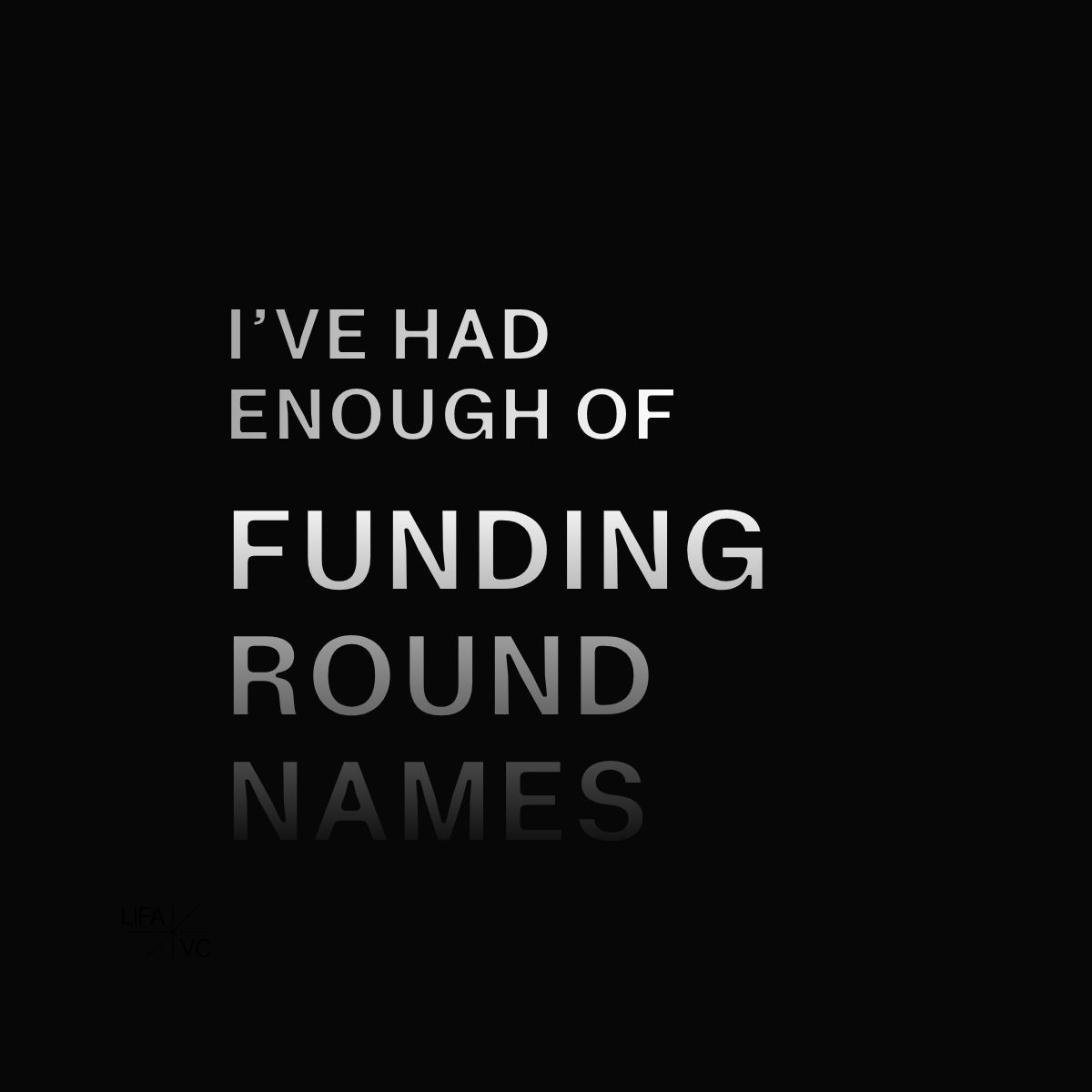
It's time we stop obsessing over funding round names 🤦 In MedTech and life science, the alphabet model just doesn't fit. You don't move neatly from Pre-seed → Seed → Series A → Series B. Instead, you see "Grants/Angels, Pre-Seed, Bridge, Seed, Seed+, Bridge, Extension, Pre-A, Convertible A… 🤯 and before long, nobody really knows what stage you're in, not even the founders. But this isn't chaos. It's how deep-tech and health-tech funding actually works. Regulatory approvals, clinical validation, and reimbursement don't follow 18-month SaaS cycles. You raise when you hit the next point of de-risking, not when the investors (or alphabet) says you should. So maybe it's time to create a naming system that actually makes sense for MedTech and Biotech. 💡 Imagine funding rounds defined by what they unlock, not by letters: 👉 Prototype Round – proving technical feasibility and initial function. 👉 Validation Round – achieving clinical or pre-clinical proof of concept. 👉 Regulatory Round – securing CE mark, FDA clearance, or clinical trial approvals. 👉 Market Access Round – building early commercial traction and reimbursement pathways. 👉 Scaling Round – expanding sales, manufacturing, or global distribution. Each round tells investors exactly what risk they're buying into, and helps founders raise with clearer intent. Because in MedTech, the alphabet doesn't build value, progress does. #MedTech #MedicalDevices #HealthTech #Startups #Fundraising #biotech
Jón I. Bergsteinsson tweet media
English
0
0
0
19
Jón I. Bergsteinsson
Jón I. Bergsteinsson@joningib·
Next Monday, I'm again opening seven 1:1 online sessions for MedTech founders preparing to fundraise, free of charge. 😇 These sessions have become a great way to connect with early teams, discuss strategy, and look at real decks together. And after reviewing so many decks over the past months, a few patterns keep coming up, not just among MedTech founders, but across early-stage healthcare in general. 💭 The first? The problem isn't clearly framed. Too often, decks describe what the product does, not what pain it solves. The best decks start with the clinician, the workflow, or the patient outcome, not the technology. 🧐 Market research is little to none. A few local key opinion leaders and that's it. That's not enough. Founders must engage with the broader market to understand whether the problem is big enough, of interest to solve, or of interest to pay for. 🚫 The tagline is over-polished, but under-informative. I've lost count of the number of times I've seen "Revolutionizing patient care with AI." It sounds strong, but it tells no one how, for whom, or why it matters. 📉 Traction and validation are often misplaced. Founders tend to hide their best signals in later slides, pilot data, partnerships, early clinical insights, rather than bringing them forward to anchor the story. 💸 The fundraising slide lacks clarity. Investors want to see what this round unlocks, what specific milestones it enables, not just how much you're raising. It's a reminder that even great ideas can get lost in presentation. Clarity, focus, and context matter as much as technology and timing. If you're preparing a raise and want a constructive outside perspective, you can book one of the seven available slots for Monday, November 3rd. 📅 jon-fundraising-help.youcanbook.me Let's keep making the MedTech fundraising journey a little clearer, one conversation at a time. #MedTech #HealthTech #Startups #Fundraising #MedicalDevices #Deck
English
0
0
0
13
Jón I. Bergsteinsson
Jón I. Bergsteinsson@joningib·
How the 🤐 do we price early-stage MedTech companies?? It's a common question both from investors and founders. And it's a really important one because valuation doesn't follow a straight line in MedTech. For example, a 10-patient feasibility study is a significant progress. It shows commitment, traction, and validation. But investors don't just fund milestones; they fund de-risking. In venture terms, your valuation isn't defined by how much you've done, but how much risk you've removed. Here's what actually moves the needle in early MedTech valuations 👇 🧩 Risk Reduction: Have you reduced clinical, regulatory, commercial, or technical uncertainty? 📊 Milestone Step-Ups: Data shows MedTech valuations typically jump 1.52.5× after key milestones like CE marking or first-in-human data. 💡 Validation Type: Investors look for signals that go beyond "it works", such as clinician adoption, payer interest, or reduced cost-per-patient. 🧠 Narrative & Optionality: Valuation also reflects the option value of your future plans (multiple indications, adjacent markets, or tech pivots). But there's more to it than that. Many MedTech startups don't generate revenue until Series A or later, so pricing a company must often rely on other reference points: 1️⃣ The cost to reach market: How much capital is needed to get to first revenue, regulatory approval, or commercialisation. 2️⃣ Industry-standard ownership dynamics: Each round typically sells a fairly standard % of the company, which indirectly sets valuation bands. 3️⃣ Comparables: Similar companies at similar stages and risk levels. 4️⃣ Forward potential: Forecasted future revenues and exit multiples, discounted back for time and risk. 💰 Here's a SUPER simplified view of how ownership and dilution often look in MedTech funding rounds (averages across Europe & the Nordics): 😇 Angel / Pre-Seed: 10–20% sold, typically at valuations of €1–4M pre-money. ✅ Seed Round: 15–25% sold, often €4–10M pre-money depending on validation (e.g. clinical or regulatory traction). 🏦 Seed+ / Bridge (often a convertible): 5–10% effective dilution, often bridging regulatory or pilot milestones. 🚀 Series A: 20–30% sold, €10–30M pre-money depending on early revenue or strong clinical data. 🔥 Series B: 15–25% sold; pre-money valuations for post-market traction companies can range from €40–100M+. So while the "VC Method" may back-calculate from an exit value, early MedTech pricing is far more qualitative. It's a mix of science, story, sector-specific risk, and investor psychology. If your study de-risks a regulatory path or proves a clear commercial need, that's where your value really compounds. If it just adds data without changing the investor's perception of risk... not much happens on the valuation curve. So before asking "What are we worth?", ask first 👉 "What risk have we actually removed for the next investor?" That's where actual value begins 💎 #MedTech #HealthTech #MedicalDevices #Fundraising
Jón I. Bergsteinsson tweet media
English
0
0
0
10
Jón I. Bergsteinsson
Jón I. Bergsteinsson@joningib·
💭 Have we completely forgotten that MedTech built our Nordic life science legacy? I'm attending the Nordic Life Science Days in Gothenburg this week, as part of the Nordic Star Pitch Competition jury, and the trend is hard to miss. The spotlight is once again dominated by biotech and therapeutics 💊🧬 Out of all the 14 companies pitching, only 4 are MedTech, of which 3 are diagnostics. Yet, some of the most successful and globally recognised Nordic health companies came from MedTech. Still, MedTech often plays second fiddle to biotech/therapeutics regarding visibility and funding. IMO that's a missed opportunity 🤯 ⚙️ MedTech is where engineering meets clinical reality👩⚕️ It's where innovation translates faster into patient outcomes. And it's where the Nordics have the potential to lead globally once again - if we give it the proper attention and capital. To all the investors and ecosystem builders in Gothenburg this week: Biotech may be the louder story, but MedTech is the next wave of Nordic healthcare growth ‼ Let's not overlook it. #MedTech #LifeSciences #HealthTech #NLSDays #Diagnostics #MedicalDevices #nordics
Jón I. Bergsteinsson tweet media
English
0
0
0
35