Rami Jarrah@RamiJarrah
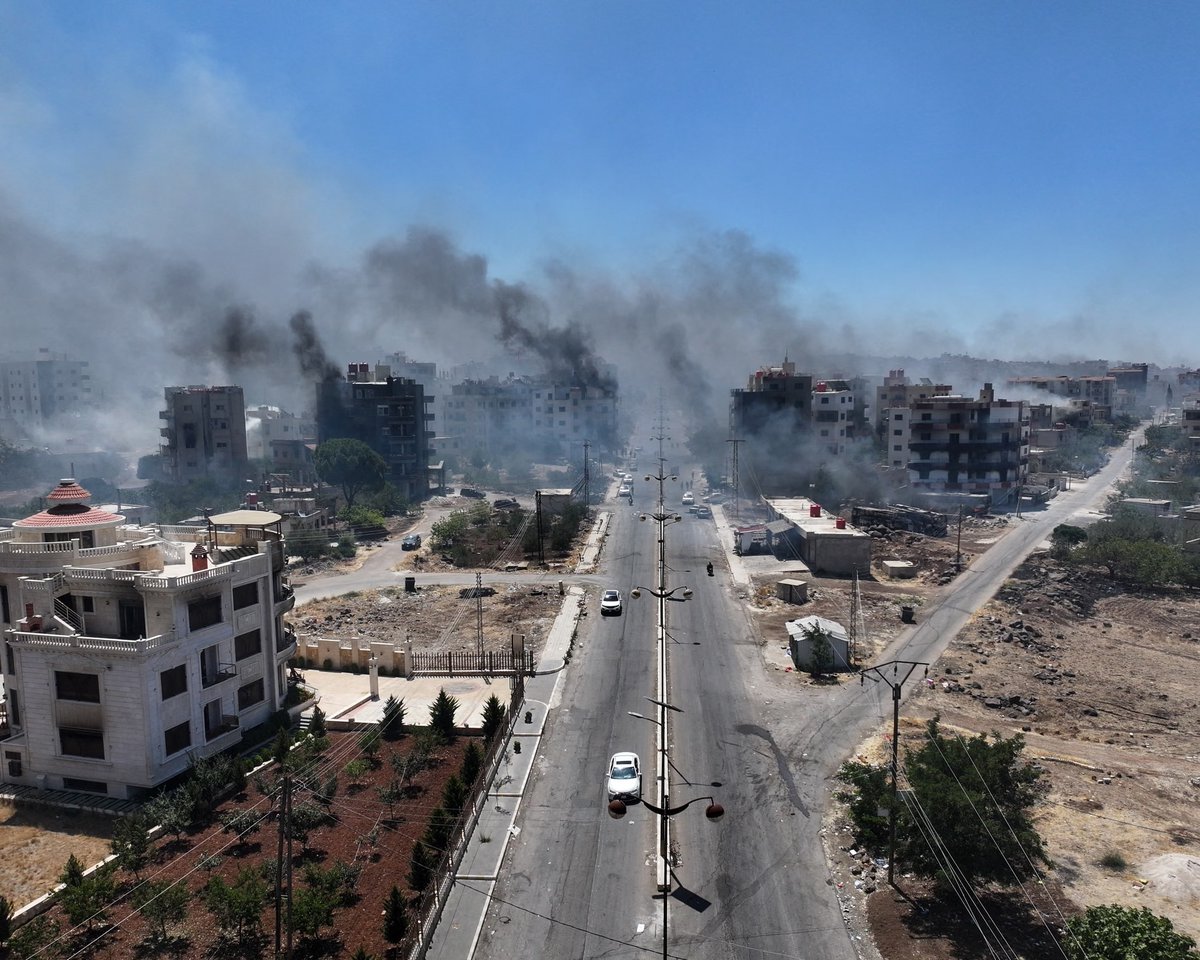
The past few days have been horrific, and many are still trying to make sense of what has unfolded. The state must demonstrate its commitment to preventing such harm against civilians becoming a recurring norm. To that end, I believe the following (concurrent) steps must be taken:
1- A full, independent, and transparent inquiry must be launched into the events in Suwayda, documenting all violations and atrocities committed against innocent Sunni-Bedouin and Druze civilians. The findings must be made fully accessible to the public in a timely manner, and all those responsible, regardless of affiliation or allegiance, all perpetrators must be identified and face justice for their crimes.
--------------------
2- We must not allow the lack of transparency, prolonged silence, and mishandling of the Fact-Finding Committee’s report on the March 6–10 coastal massacres to become a template for state accountability. Especially after the report’s submission yesterday, the state attempts to empower the committee to forgo any public disclosure, even a press conference. When in fact, under international human rights law, especially in cases involving potential state violations, the public has a right to the full truth. Withholding the full report undermines accountability, violates victims’ rights, and obstructs justice.
In that respect, the March findings must be released immediately, in full. Any redacted information for witness protection etc. must be strictly limited, independently supervised, and fully documented, and any press conference the committee wishes to conduct should serve as nothing more than to compliment the entire report and the methodology with which it was conducted being made fully accessible to the public, all this to achieve the following:
• Restore/instill public trust in Syria’s legal system
• Ensure that there is no doubt amongst the public that all those who gave orders, carried out, or helped conceal the atrocities on the coast are held fully accountable.
• For the state to be taken seriously in facilitating the launch of an investigation into the events that occurred in Suwayda, or any other hereafter.
--------------------
3- Finally, and by no means the least, we must also not allow the absence of adequate justice for crimes committed by the former regime to hinder any of the above. It should be no secret that there is growing resentment among millions of Syrians whose lives were destroyed by the former regime, and over the delayed justice for the hundreds of thousands who were killed and disappeared over the past 14 years. That resentment is justified. We have every right to feel anger toward fellow Syrians who express outraged and seek justice for the atrocities committed in March on the coast and in Suwayda today, yet fail to even acknowledge the horrors endured by millions under the former regime, the vast majority of which were Sunni-Syrians.
But now, all Syrians must be given the opportunity to reflect on these crimes, and that only reinforces the urgency of more serious efforts in pursuing justice for the victims of the former regime, which the state is tasked with accomplishing. Yes, this chapter of accountability is long and complex, one that will not be concluded anytime soon. It should therefore not be a cause to delay justice for today's crimes, but rather concrete simultaneous steps must be taken now to ensure justice being served is on the horizon.
• Public trials of former regime culprits, (preferably televised) are needed to guarantee transparency and foster collective recognition across Syria of the crimes committed. A national narrative needs to be established.
• Transparent enquiries into Syria's disappeared, whose families continue to grieve, many still without closure to this day. The outcome of such enquires must be shared with the public or at the very least those concerned, followed with memorial sites established for the victims.
• Any broader investigation results must ultimately be made public, and the state must collaborate with all parties, including international organizations that have spent the past 14 years documenting these crimes. When institutions like the White Helmets, with their vast archive of documented evidence, are integrated into the state, the burden falls on the state to demonstrate that it is meaningfully utilizing that documentation. Otherwise, these institutions should be allowed to operate independently, not be obstructed.
Delaying the above process only deepens the sense of abandonment felt by millions of the former regime's victims. It gives those in power, whoever they are, a ready-made excuse to delay accountability for crimes committed against civilians today or in the future, an excuse that will understandably go largely unchallenged by those who first, simply need to see a serious process begin to address the crimes of the former regime.
--------------------
I strongly believe that anyone who dismisses the basic premise of the simultaneous three steps mentioned above, no matter their political stance, cannot be taken seriously on the issue of equal human rights, especially when they limit their demands to selective justice instead.
Now one might argue that this will take resources, effort, and time that only overwhelm the state in these challenging times. Yet that would be a grave acknowledgment of an inability to implement justice. And in that case, international organizations should play a leading role instead, and the state must step aside and facilitate this. But if the state is serious in taking on these responsibilities, and if justice is prioritized, it’s achievable, because without it, a free Syria will absolutely fail.
Those who disagree with what I've outlined should clearly identify what exactly they object to and why. Otherwise, they’re welcome to share their views elsewhere and spare us the distractions that do nothing but hinder desperately needed justice for all Syrians.