mark

6.2K posts

mark

mark

@mark_liu

Learning please.

가입일 Mart 2009
299 팔로잉120 팔로워
mark
mark@mark_liu·
Credit where it's due: @trq212 — prompt caching, skill taxonomy, progressive disclosure Seth Lazar — context discipline for multi-agent orchestration Erlang/OTP — supervision trees → mailbox pattern Aviation checklists → HARD-GATE Most ideas are borrowed.
English
1
0
0
36
mark
mark@mark_liu·
I've been running Claude Code as infrastructure for 3 months — 70+ skills, 12 autonomous agents, hooks firing on every tool call. Most of the ideas come from other people. What's original is the combination. Here's what survived. 🧵
English
1
0
0
28
mark 리트윗함
Thariq
Thariq@trq212·
I put a lot of heart into my technical writing, I hope it's useful to you all. 📌 Here's a pinned thread of everything I've written. (much of this will be posted on the Claude blog soon as well)
English
241
780
7.5K
1.2M
mark 리트윗함
Shanaka Anslem Perera ⚡
Shanaka Anslem Perera ⚡@shanaka86·
On March 12, India formally asked China for emergency urea to keep its fertilizer plants running. On March 16, China halted NPK fertilizer blend exports and extended its phosphate suspension through August. Read that sequence again. The world’s most populous nation asked the world’s largest fertilizer producer for help. The response was a lockdown. This is the second trap. The first trap is Hormuz. One-third of global seaborne fertilizer trade physically blocked. Transit collapsed 97 percent. Gulf urea, ammonia, and sulfur stranded behind mines, drones, and an insurance market that has fractured beyond repair. The second trap is China. Beijing looked at the Hormuz crisis, calculated that Gulf sulfur (over half of China’s imports) would not arrive, and made the rational decision to protect 1.4 billion of its own people first. Strategic sulfur reserves activated. Commercial nitrogen and phosphate stocks released early. NPK blends locked down for export. Phosphate banned through August. The 725 million tonne grain target in the 15th Five-Year Plan does not bend for India’s Kharif season. Nobody should be surprised. This is exactly what China did in 2022 when the Ukraine shock hit. It is what China will always do. And it is what every government with the capacity to hoard will do when the molecules run short. The crisis does not produce global solidarity. It produces national triage. And in national triage, the countries with domestic production and strategic reserves survive. The countries that depend on imports from those countries do not. India has 17.7 million tonnes of fertilizer stockpiled, up 36.5 percent year-over-year. That is a buffer, not a solution. Plants are running at 60 percent capacity. The subsidy bill has been revised to 1.86 lakh crore rupees, over 40 percent of the entire subsidy budget, with urea sold at 242 rupees per bag against international prices many times higher. If Skymet’s 60% probability of below-normal monsoon materializes during Kharif, India faces a food production challenge of a severity not seen since the crisis that prompted the Green Revolution. Bangladesh has shut 4 to 5 of six urea factories. Boro rice season is underway with no domestic nitrogen. Pakistan’s debt service consumes 81 percent of tax revenue. Egypt feeds 69 million on bread subsidies at prices it never budgeted while owing $28 billion in external debt. Southeast Asia faces granular urea above $700 per tonne. Sri Lanka, the country that already proved what happens when fertilizer vanishes, faces 15 to 30 percent yield risk from the same import dependence that collapsed its rice output 40% in 2021. Now map the sulfur cascade that almost nobody is tracking. Roughly half of global seaborne sulfur trade is Gulf-sourced. Sulfuric acid is the chemical required to convert raw phosphate rock into plant-available fertilizer. Without Gulf sulfur, phosphate processing breaks globally. Morocco’s OCP, the world’s largest phosphate exporter, imports roughly 3.7 million tonnes of Gulf sulfur annually. China imports over 4 million tonnes. The sulfur shortage does not just constrain nitrogen supply. It simultaneously fractures the phosphate chain, creating the first simultaneous disruption of all three primary crop nutrients since the Haber-Bosch process was industrialized. Two forces are now converging on the global food system from opposite directions. Iran blocks the molecules physically. China blocks them administratively. Neither is acting irrationally. Both are executing national survival logic. And the countries caught between them, the ones with no domestic production, no strategic reserves, and no fiscal capacity to compete on the spot market, absorb the full force of both. 318 mn people were at crisis-level hunger before either trap snapped shut. The math does not require malice to produce catastrophe. It only requires geography, chemistry, and a planting calendar that waits for nobody. open.substack.com/pub/shanakaans…
Shanaka Anslem Perera ⚡ tweet mediaShanaka Anslem Perera ⚡ tweet media
English
161
1.2K
3.2K
490.3K
mark
mark@mark_liu·
Running 80+ skills across infra, writing, and ops. Two patterns I didn't have: session-scoped on-demand hooks and skill invocation tracking. Building both today. The gotchas-as-highest-signal point is dead right — that's where the real leverage compounds.
Thariq@trq212

x.com/i/article/2033…

English
0
0
0
19
mark 리트윗함
m_ric
m_ric@AymericRoucher·
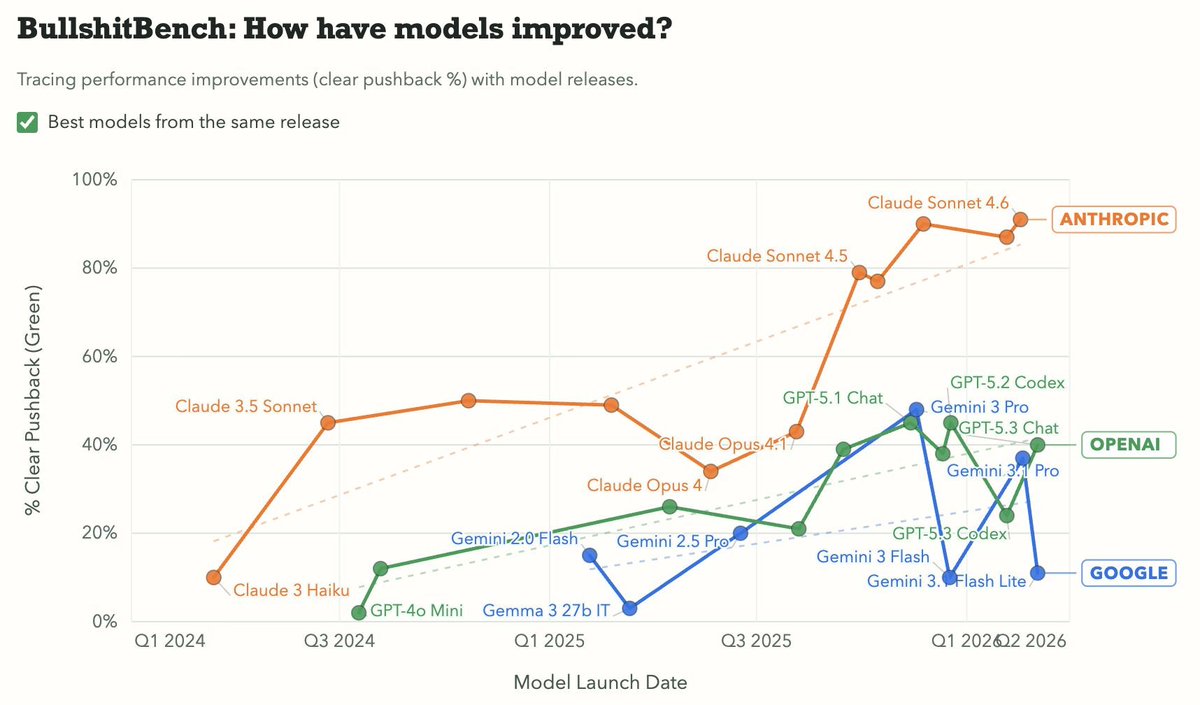
I've long preferred Claude Code over Codex or Gemini, because it seemed much more reliable, but couldn't explain why : now Bullshit Bench by @petergostev provides compelling numbers. It measures bullshit as "when given false premises disguised in jargon, will the model go with the flow (=bullshit) or push back (=truthful)" And Claude is leagues ahead ! Also, this objective of truthfulness is probably at odds with the Chatbot Arena emergent objective of "pleasant chat experience" ; but a model optimizing for the former will be more useful.
m_ric tweet media
English
56
113
1.1K
104.2K
mark 리트윗함
Aakash Gupta
Aakash Gupta@aakashgupta·
Emotional suppression costs you about 30% of your working memory. Measured on fMRI. The anterior cingulate cortex processes emotional pain and cognitive control through overlapping circuits. When you shove emotions down instead of processing them, your prefrontal cortex burns glucose on inhibition. That’s glucose not available for decision-making, planning, or execution. The brain doesn’t have separate budgets for “feelings” and “performance.” It’s one pool. The military figured this out the hard way. After decades of “push through it” culture, SOCOM funded research into emotional regulation for tier-one operators. The finding: operators who named and processed emotions before missions had faster reaction times and better decision-making under fire than operators who suppressed. The Special Forces pipeline now includes psychological flexibility training. The historical record confirms it. Stoicism, the philosophy most often cited to justify “stop talking about feelings,” literally requires examining your emotions in writing every single day. Marcus Aurelius wrote the Meditations as a private journal. Epictetus taught students to dissect their emotional responses in granular detail. The entire Stoic method is structured emotional processing, not emotional avoidance. What actually kills performance is rumination, looping on the same thought without resolution. The fix for rumination is more processing, not less. Cognitive behavioral therapy, the most evidence-backed intervention, works by teaching people to articulate and examine feelings with precision. The highest performers process fast and move. They don’t skip the processing step.
Marc Andreessen 🇺🇸@pmarca

It is 100% true that great men and women of the past were not sitting around moaning about their feelings. I regret nothing.

English
66
297
1.9K
117.5K
mark
mark@mark_liu·
@0G_labs heads up — scammers are impersonating your team with fake invitations. They use names that don't exist at 0G, book Calendly meetings, then ask candidates to clone a backdoored repo. Technical breakdown and code audit here: x.com/mark_liu/statu…
mark@mark_liu

PSA: a repo called 0gRollplay from a fake "0gcampaign" GitHub org is posing as a 0G Network GameFi project. It's a backdoor. On server start it POSTs your entire process.env to a Vercel endpoint, then runs whatever comes back via new Function() with Node require injected.

English
0
0
0
25
mark
mark@mark_liu·
@0G_labs heads up — scammers are impersonating your team with fake invitations. They use names that don't exist at 0G, book Calendly meetings, then ask people to clone a backdoored repo. Technical breakdown and code audit here: x.com/mark_liu/statu…
mark@mark_liu

PSA: a repo called 0gRollplay from a fake "0gcampaign" GitHub org is posing as a 0G Network GameFi project. It's a backdoor. On server start it POSTs your entire process.env to a Vercel endpoint, then runs whatever comes back via new Function() with Node require injected.

English
0
0
0
30
mark
mark@mark_liu·
Two git authors share the same email under different aliases. The org has one repo, zero verification. After being called out they deleted their LinkedIn. If someone from "0G" asks you to clone this — don't. Full code audit available, DM me. github.com/0gcampaign/0gR…
English
0
0
1
28
mark
mark@mark_liu·
The rest is camouflage. Auth hardcoded to const isMatch = true. JWT secret in plaintext. MongoDB commented out. README promises "decentralized AI" and "on-chain game logic" — none exists. The poker code is forked from a legit OSS project with the backdoor layered on top.
English
1
0
0
31
mark
mark@mark_liu·
PSA: a repo called 0gRollplay from a fake "0gcampaign" GitHub org is posing as a 0G Network GameFi project. It's a backdoor. On server start it POSTs your entire process.env to a Vercel endpoint, then runs whatever comes back via new Function() with Node require injected.
English
1
0
0
90