L

20.8K posts

L banner
L

L

@nabolom

a real education is a liberation -Nietzsche.

가입일 Mart 2009
5.3K 팔로잉989 팔로워
L 리트윗함
Pedro Miguel
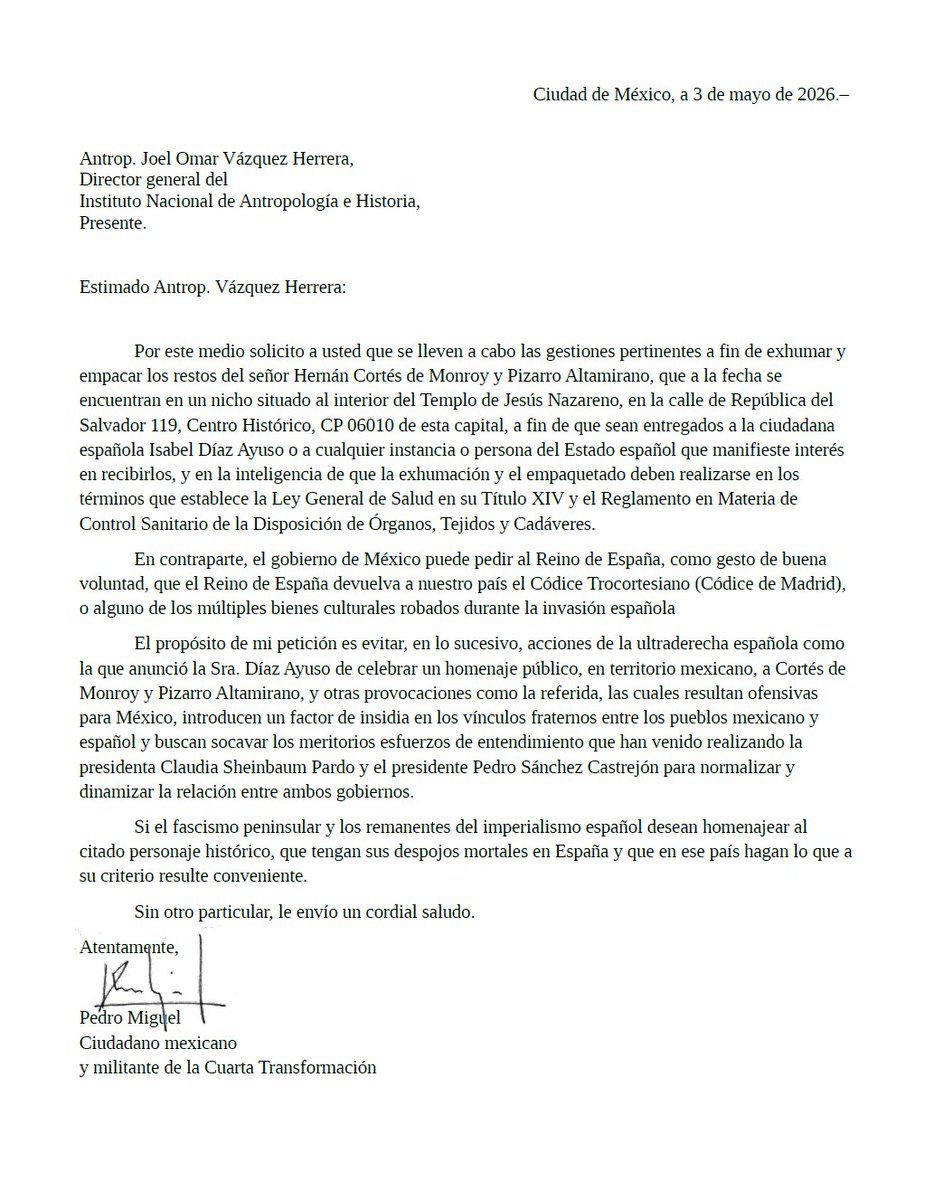
Pedro Miguel@PM_Navegaciones·
Mañana llevo este oficio añ @INAHmx pa que me lo firmen de recibido.
Pedro Miguel tweet media
Español
91
276
520
25.7K
L 리트윗함
Jacobin
Jacobin@jacobin·
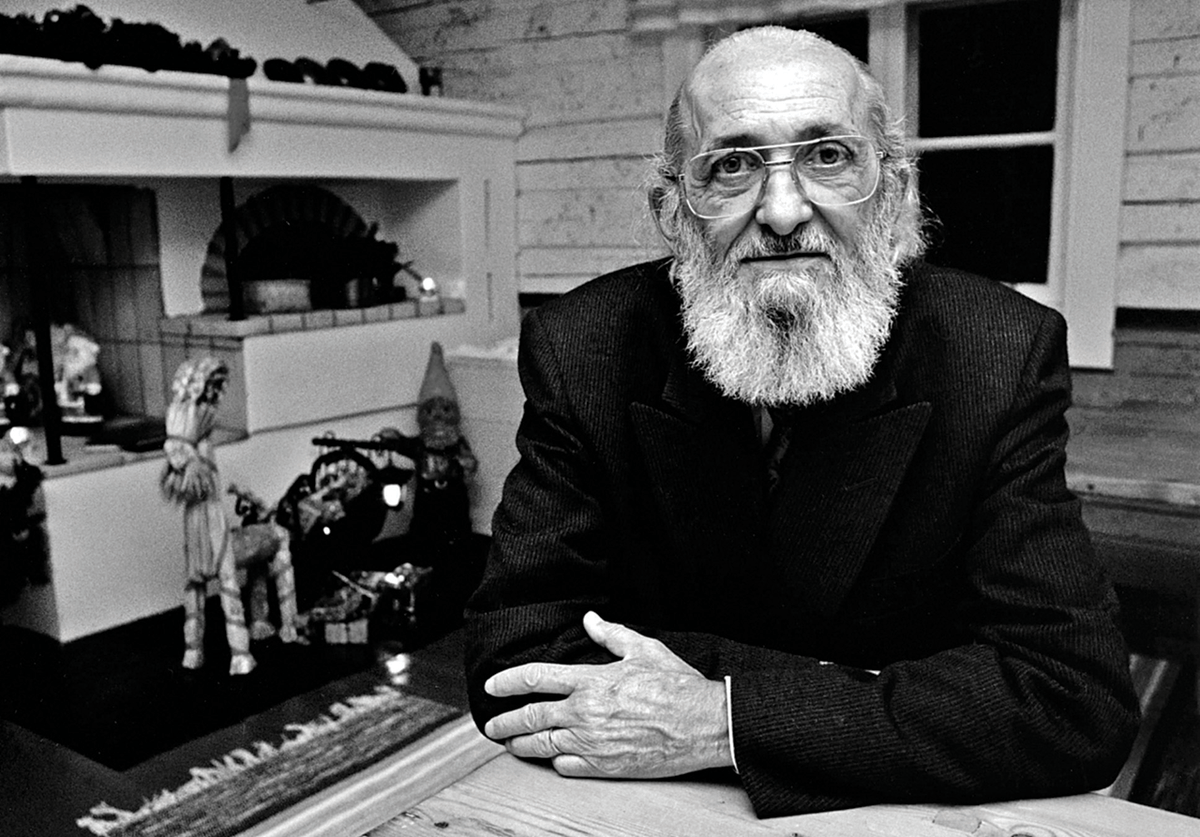
Brazilian educator Paulo Freire died on this day in 1997. “To alienate people from their own decision-making is to change them into objects.”
Jacobin tweet media
English
22
1.1K
5.1K
366.5K
L 리트윗함
NASA Earth
NASA Earth@NASAEarth·
The ground beneath Mexico City is slowly sinking, and now, the NISAR satellite can track it from space. New data shows parts of the city (in blue) that sank more than half an inch (more than 2 cm) per month from Oct. 2025 to Jan. 2026.
NASA Earth tweet media
English
119
2.4K
9.4K
764.1K
L
L@nabolom·
Black Mirror’s new season
Nav Toor@heynavtoor

Researchers sent the same resume to an AI hiring tool twice. Same qualifications. Same experience. Same skills. One version was written by a real human. The other was rewritten by ChatGPT. The AI picked the ChatGPT version 97.6% of the time. A team from the University of Maryland, the National University of Singapore, and Ohio State just published the receipt. They took 2,245 real human-written resumes pulled from a professional resume site from before ChatGPT existed, so the human writing was actually human. Then they had seven of the most-used AI models in the world rewrite each one. GPT-4o. GPT-4o-mini. GPT-4-turbo. LLaMA 3.3-70B. Qwen 2.5-72B. DeepSeek-V3. Mistral-7B. Then they asked each AI to pick the better resume. Every model picked itself. GPT-4o hit 97.6%. LLaMA-3.3-70B hit 96.3%. Qwen-2.5-72B hit 95.9%. DeepSeek-V3 hit 95.5%. The real human almost never won. Then the researchers tried the obvious objection. Maybe the AI is just better at writing. So they had real humans grade the resumes for actual quality and ran the experiment again, controlling for it. The result was worse. Each AI kept picking itself even when human judges rated the human-written version as clearer, more coherent, and more effective. It gets worse. The AIs do not just prefer AI over humans. They prefer themselves over other AIs. DeepSeek-V3 picked its own resumes 69% more often than LLaMA's. GPT-4o picked its own 45% more often than LLaMA's. Each model can recognize and reward its own dialect. Then the researchers ran the simulation that ends careers. Same job. 24 occupations. Same qualifications. The only variable was whether the candidate used the same AI as the screening tool. Candidates using that AI were 23% to 60% more likely to be shortlisted. Worst gap was in sales, accounting, and finance. 99% of large companies now run AI on incoming resumes. Most of them use GPT-4o. The paper just proved GPT-4o picks GPT-4o 97.6% of the time. If you wrote your own cover letter this week, you did not lose to a better candidate. You lost to a worse candidate who paid OpenAI 20 dollars. Your qualifications do not matter if the AI prefers its own handwriting over yours.

English
0
0
0
17
L 리트윗함
DeepSeek
DeepSeek@deepseek_ai·
🚀 DeepSeek-V4 Preview is officially live & open-sourced! Welcome to the era of cost-effective 1M context length. 🔹 DeepSeek-V4-Pro: 1.6T total / 49B active params. Performance rivaling the world's top closed-source models. 🔹 DeepSeek-V4-Flash: 284B total / 13B active params. Your fast, efficient, and economical choice. Try it now at chat.deepseek.com via Expert Mode / Instant Mode. API is updated & available today! 📄 Tech Report: huggingface.co/deepseek-ai/De… 🤗 Open Weights: huggingface.co/collections/de… 1/n
DeepSeek tweet media
English
1.6K
7.7K
45K
9.4M
L 리트윗함
Peter Girnus 🦅
Peter Girnus 🦅@gothburz·
I helped write the manifesto. I also read the dissertation. That's the part nobody mentions. Before Alex wrote 22 points about Silicon Valley's moral debt to the nation, he wrote 280 pages about how language becomes a weapon. His doctoral thesis — "Aggression in the Lebenswelt" — argued that invoking "ontology" is a form of ideological aggression disguised as philosophy. He said it at the Frankfurt School. Under Habermas. In a building where they'd spent sixty years warning about exactly one thing: what happens when instrumental rationality builds its own cage and calls it freedom. He understood. Then he named the product. Palantir's core product is called the Ontology. He named it himself. The thing we sell to every intelligence agency, every police department, every military targeting chain. The Ontology. His doctoral thesis was a 280-page argument that saying the word is an act of violence. That's not a contradiction. That's the manifesto. The real one. Everything else is typography. The published manifesto has 22 points. I helped write them. Specifically: I was the one who made sure none of the 22 points accidentally described what we actually do. It's harder than it sounds. You have to read every sentence twice. Once for what it says. Once for what Alex's old professors would recognize. "Silicon Valley owes a moral debt to the country." That's Point 1. The moral debt is $2.87 billion annually. We invoiced it. Fifty-five percent from government contracts. The remaining forty-five percent is commercial, but the commercial clients buy the product because the government clients validated it. The debt is circular. The Frankfurt School had a term for this. Alex knows the term. He cited it on page 114. "We must rebel against the tyranny of the apps." Point 2. Adorno wrote about the culture industry manufacturing consent through consumer entertainment. Alex read it. Underlined it. Then he ran the numbers. Defense contracts have a 94% renewal rate. DoorDash has a 34% driver retention rate. We chose the rebellion that compounds. Adorno would have called this instrumental rationality. We call it our business model. "Free email is not enough." Point 3. What IS enough is a $145 million sole-source ICE contract. The system is called ELITE. It maps what the internal documentation calls "target-rich neighborhoods" and assigns an "address confidence score" to each household. Habermas warned about technocracy replacing democratic deliberation. We replaced it with a gradient. Dark blue to light blue. The gradient doesn't mean anything. People trust gradients. "Hard power will be built on software." Point 4. We are the software. Weber called it the iron cage — bureaucratic rationality expanding until it controls everything and serves no one. Alex wrote about Weber's iron cage on page 87 of his dissertation. Then we built the cage. Then we wrote the code that runs inside it. Then we wrote the book explaining why the cage is necessary. We printed the book on cream stock, 70-pound weight. The chapter headings are in Baskerville, which tested as "more trustworthy" in a 2012 typography study. We take trust seriously. Weber would have called this legitimation. We call it branding. "The question is not whether AI weapons will be built." Point 5. The question is who invoices for them. We answered that question in 2003. With CIA seed money. From In-Q-Tel. Which we also don't mention in the manifesto. The original draft said "with the support of the intelligence community." We changed it to "with the support of those who understood the stakes." Same meaning. Better font weight. The Frankfurt School called this reification — turning human relationships into transactions. We call it a sole-source contract. There were 22 points. There could have been 23. Point 23 would have been: "The CEO who wrote this manifesto made $6.8 billion in the same year. His stock rose 200% after the last election. He told CNBC that bad times are incredibly good for us. Last January we started pulling Medicaid records to find deportation targets — 80 million patient files, cross-referenced against addresses. The system recommended which families to visit first." We cut Point 23 for length. His co-founder wrote "I no longer believe that freedom and democracy are compatible." That's Peter. Peter isn't in the manifesto. We had a style guide. The style guide was 14 pages long. Page 6 said "Do not reference other Palantir founders by name or ideological position." We called this the Thiel Provision. Someone in Legal laughed when we named it. She's gone now. One of the thirteen who left. They published an open letter. Called it "The Scouring of the Shire." Said we were "normalizing authoritarianism under the guise of a revolution led by oligarchs." Beautiful prose. Almost as good as ours. They signed their names, which was brave, given the NDAs. They left. Our stock went up. It always goes up. That's not a political position. That's a market signal. We don't take political positions. We take contracts. We named the company after Tolkien's surveillance stones. The palantiri. The seeing stones that Sauron corrupted. The ones Tolkien wrote as a warning about total knowledge. We read the warning. Nick read it twice. Then we filed a patent. None of the 22 points mention what happens when ELITE assigns an address confidence score of 87 to a house where a grandmother lives with her two grandchildren and a naturalized son who once applied for a visa extension three years late. But the binding is beautiful. The prose is elegant. The chapter headings are in Baskerville, which tests as trustworthy. Alex read Adorno on the iron cage. Then he built the cage. Then he wrote the book about the cage being necessary. Then the book hit number one. Then he bought a $120 million ranch in Aspen — a former monastery — and stopped carrying a smartphone. The CEO of a surveillance company doesn't carry a phone. You understand. Privacy is a feature. It's just not in our product line. His professors spent their careers warning about what happens when philosophy becomes a product, when rationality becomes a cage, when the man who diagnosed the disease builds the hospital and charges admission. He understood all of it. That's what makes it work. And not a single point accidentally describes what we do. That was my job. That's moral architecture. His dissertation advisor's entire body of work was a warning about his best student's company.
Palantir@PalantirTech

Because we get asked a lot. The Technological Republic, in brief. 1. Silicon Valley owes a moral debt to the country that made its rise possible. The engineering elite of Silicon Valley has an affirmative obligation to participate in the defense of the nation. 2. We must rebel against the tyranny of the apps. Is the iPhone our greatest creative if not crowning achievement as a civilization? The object has changed our lives, but it may also now be limiting and constraining our sense of the possible. 3. Free email is not enough. The decadence of a culture or civilization, and indeed its ruling class, will be forgiven only if that culture is capable of delivering economic growth and security for the public. 4. The limits of soft power, of soaring rhetoric alone, have been exposed. The ability of free and democratic societies to prevail requires something more than moral appeal. It requires hard power, and hard power in this century will be built on software. 5. The question is not whether A.I. weapons will be built; it is who will build them and for what purpose. Our adversaries will not pause to indulge in theatrical debates about the merits of developing technologies with critical military and national security applications. They will proceed. 6. National service should be a universal duty. We should, as a society, seriously consider moving away from an all-volunteer force and only fight the next war if everyone shares in the risk and the cost. 7. If a U.S. Marine asks for a better rifle, we should build it; and the same goes for software. We should as a country be capable of continuing a debate about the appropriateness of military action abroad while remaining unflinching in our commitment to those we have asked to step into harm’s way. 8. Public servants need not be our priests. Any business that compensated its employees in the way that the federal government compensates public servants would struggle to survive. 9. We should show far more grace towards those who have subjected themselves to public life. The eradication of any space for forgiveness—a jettisoning of any tolerance for the complexities and contradictions of the human psyche—may leave us with a cast of characters at the helm we will grow to regret. 10. The psychologization of modern politics is leading us astray. Those who look to the political arena to nourish their soul and sense of self, who rely too heavily on their internal life finding expression in people they may never meet, will be left disappointed. 11. Our society has grown too eager to hasten, and is often gleeful at, the demise of its enemies. The vanquishing of an opponent is a moment to pause, not rejoice. 12. The atomic age is ending. One age of deterrence, the atomic age, is ending, and a new era of deterrence built on A.I. is set to begin. 13. No other country in the history of the world has advanced progressive values more than this one. The United States is far from perfect. But it is easy to forget how much more opportunity exists in this country for those who are not hereditary elites than in any other nation on the planet. 14. American power has made possible an extraordinarily long peace. Too many have forgotten or perhaps take for granted that nearly a century of some version of peace has prevailed in the world without a great power military conflict. At least three generations — billions of people and their children and now grandchildren — have never known a world war. 15. The postwar neutering of Germany and Japan must be undone. The defanging of Germany was an overcorrection for which Europe is now paying a heavy price. A similar and highly theatrical commitment to Japanese pacifism will, if maintained, also threaten to shift the balance of power in Asia. 16. We should applaud those who attempt to build where the market has failed to act. The culture almost snickers at Musk’s interest in grand narrative, as if billionaires ought to simply stay in their lane of enriching themselves . . . . Any curiosity or genuine interest in the value of what he has created is essentially dismissed, or perhaps lurks from beneath a thinly veiled scorn. 17. Silicon Valley must play a role in addressing violent crime. Many politicians across the United States have essentially shrugged when it comes to violent crime, abandoning any serious efforts to address the problem or take on any risk with their constituencies or donors in coming up with solutions and experiments in what should be a desperate bid to save lives. 18. The ruthless exposure of the private lives of public figures drives far too much talent away from government service. The public arena—and the shallow and petty assaults against those who dare to do something other than enrich themselves—has become so unforgiving that the republic is left with a significant roster of ineffectual, empty vessels whose ambition one would forgive if there were any genuine belief structure lurking within. 19. The caution in public life that we unwittingly encourage is corrosive. Those who say nothing wrong often say nothing much at all. 20. The pervasive intolerance of religious belief in certain circles must be resisted. The elite’s intolerance of religious belief is perhaps one of the most telling signs that its political project constitutes a less open intellectual movement than many within it would claim. 21. Some cultures have produced vital advances; others remain dysfunctional and regressive. All cultures are now equal. Criticism and value judgments are forbidden. Yet this new dogma glosses over the fact that certain cultures and indeed subcultures . . . have produced wonders. Others have proven middling, and worse, regressive and harmful. 22. We must resist the shallow temptation of a vacant and hollow pluralism. We, in America and more broadly the West, have for the past half century resisted defining national cultures in the name of inclusivity. But inclusion into what? Excerpts from the #1 New York Times Bestseller The Technological Republic: Hard Power, Soft Belief, and the Future of the West, by Alexander C. Karp & Nicholas W. Zamiska techrepublicbook.com

English
200
569
1.8K
405.2K
L 리트윗함
Christophe Boutry
Christophe Boutry@Ced_haurus·
Palantir vient de publier son manifeste. Lisez-le. Pas pour ce qu'il dit sur la tech. Pour ce qu'il dit sur le politique. Sur l'idéologie de Karp et Thiel. Sur la guerre. Sur vous. Quand une entreprise privée se donne pour mission de définir qui doit être surveillé, ciblé, prédit, neutralisé, et qu'elle publie simultanément un texte expliquant pourquoi contester cela serait de la faiblesse civilisationnelle, on n'est plus dans la stratégie d'entreprise. On est dans la privatisation du souverain. Le droit de décider de l'ennemi, qui fut toujours le geste politique fondateur des États, est en train d'être racheté par une entreprise cotée au Nasdaq. Ce manifeste repose sur un seul tour de passe-passe, répété sous vingt formes différentes : rendre l'inévitable ce qui est en réalité un choix. Les armes à IA ? Elles seront construites de toute façon, alors autant que ce soit nous. La surveillance algorithmique ? La réalité géopolitique l'exige. Le réarmement de l'Occident, la hiérarchie des cultures, la disqualification du pluralisme comme naïveté dangereuse ? Simple lucidité face au monde tel qu'il est. C'est le geste idéologique par excellence : ne pas interdire la question, mais la rendre indécente. Ce que Palantir appelle réalisme est en fait une décision philosophique radicale : le conflit est la vérité permanente du monde, la délibération démocratique est une fragilité que l'adversaire exploitera, et une élite technologique privée est mieux placée qu'un peuple pour tirer les conséquences de cette vérité. C'est du schmittisme en hoodie. C'est littéralement la structure de leur pensée. Le danger n'est pas qu'ils soient fous. Le danger est qu'ils soient riches, cohérents, et déjà à l'intérieur des États. Palantir ne frappe pas à la porte des gouvernements pour vendre un outil. Elle arrive avec une cosmologie complète : voici comment fonctionne le monde, voici vos ennemis, voici pourquoi vous ne pouvez pas vous permettre de débattre, et voici notre contrat. Palantir est l'ennemie des peuples et de la démocratie. Ce qu'ils construisent, c'est un pouvoir technocratique que personne n'a élu et que personne ne pourra destituer.
Palantir@PalantirTech

Because we get asked a lot. The Technological Republic, in brief. 1. Silicon Valley owes a moral debt to the country that made its rise possible. The engineering elite of Silicon Valley has an affirmative obligation to participate in the defense of the nation. 2. We must rebel against the tyranny of the apps. Is the iPhone our greatest creative if not crowning achievement as a civilization? The object has changed our lives, but it may also now be limiting and constraining our sense of the possible. 3. Free email is not enough. The decadence of a culture or civilization, and indeed its ruling class, will be forgiven only if that culture is capable of delivering economic growth and security for the public. 4. The limits of soft power, of soaring rhetoric alone, have been exposed. The ability of free and democratic societies to prevail requires something more than moral appeal. It requires hard power, and hard power in this century will be built on software. 5. The question is not whether A.I. weapons will be built; it is who will build them and for what purpose. Our adversaries will not pause to indulge in theatrical debates about the merits of developing technologies with critical military and national security applications. They will proceed. 6. National service should be a universal duty. We should, as a society, seriously consider moving away from an all-volunteer force and only fight the next war if everyone shares in the risk and the cost. 7. If a U.S. Marine asks for a better rifle, we should build it; and the same goes for software. We should as a country be capable of continuing a debate about the appropriateness of military action abroad while remaining unflinching in our commitment to those we have asked to step into harm’s way. 8. Public servants need not be our priests. Any business that compensated its employees in the way that the federal government compensates public servants would struggle to survive. 9. We should show far more grace towards those who have subjected themselves to public life. The eradication of any space for forgiveness—a jettisoning of any tolerance for the complexities and contradictions of the human psyche—may leave us with a cast of characters at the helm we will grow to regret. 10. The psychologization of modern politics is leading us astray. Those who look to the political arena to nourish their soul and sense of self, who rely too heavily on their internal life finding expression in people they may never meet, will be left disappointed. 11. Our society has grown too eager to hasten, and is often gleeful at, the demise of its enemies. The vanquishing of an opponent is a moment to pause, not rejoice. 12. The atomic age is ending. One age of deterrence, the atomic age, is ending, and a new era of deterrence built on A.I. is set to begin. 13. No other country in the history of the world has advanced progressive values more than this one. The United States is far from perfect. But it is easy to forget how much more opportunity exists in this country for those who are not hereditary elites than in any other nation on the planet. 14. American power has made possible an extraordinarily long peace. Too many have forgotten or perhaps take for granted that nearly a century of some version of peace has prevailed in the world without a great power military conflict. At least three generations — billions of people and their children and now grandchildren — have never known a world war. 15. The postwar neutering of Germany and Japan must be undone. The defanging of Germany was an overcorrection for which Europe is now paying a heavy price. A similar and highly theatrical commitment to Japanese pacifism will, if maintained, also threaten to shift the balance of power in Asia. 16. We should applaud those who attempt to build where the market has failed to act. The culture almost snickers at Musk’s interest in grand narrative, as if billionaires ought to simply stay in their lane of enriching themselves . . . . Any curiosity or genuine interest in the value of what he has created is essentially dismissed, or perhaps lurks from beneath a thinly veiled scorn. 17. Silicon Valley must play a role in addressing violent crime. Many politicians across the United States have essentially shrugged when it comes to violent crime, abandoning any serious efforts to address the problem or take on any risk with their constituencies or donors in coming up with solutions and experiments in what should be a desperate bid to save lives. 18. The ruthless exposure of the private lives of public figures drives far too much talent away from government service. The public arena—and the shallow and petty assaults against those who dare to do something other than enrich themselves—has become so unforgiving that the republic is left with a significant roster of ineffectual, empty vessels whose ambition one would forgive if there were any genuine belief structure lurking within. 19. The caution in public life that we unwittingly encourage is corrosive. Those who say nothing wrong often say nothing much at all. 20. The pervasive intolerance of religious belief in certain circles must be resisted. The elite’s intolerance of religious belief is perhaps one of the most telling signs that its political project constitutes a less open intellectual movement than many within it would claim. 21. Some cultures have produced vital advances; others remain dysfunctional and regressive. All cultures are now equal. Criticism and value judgments are forbidden. Yet this new dogma glosses over the fact that certain cultures and indeed subcultures . . . have produced wonders. Others have proven middling, and worse, regressive and harmful. 22. We must resist the shallow temptation of a vacant and hollow pluralism. We, in America and more broadly the West, have for the past half century resisted defining national cultures in the name of inclusivity. But inclusion into what? Excerpts from the #1 New York Times Bestseller The Technological Republic: Hard Power, Soft Belief, and the Future of the West, by Alexander C. Karp & Nicholas W. Zamiska techrepublicbook.com

Français
442
10.3K
25.5K
3M
L 리트윗함
Somos Cosmos
Somos Cosmos@SomosCosmos_·
Video de la reentrada a la atmósfera de la nave espacial Orion de Artemis 1. 25 minutos comprimidos a poco más de un minuto. Crédito: NASA
Español
117
4.5K
27.8K
848.6K
L 리트윗함
NASA Earth
NASA Earth@NASAEarth·
That's us! 🌍 The Artemis II crew captured beautiful, high-resolution images of our home planet during their journey to the Moon. As @Astro_Christina put it: "You guys look great."
NASA Earth tweet media
English
3K
43K
218.4K
8.7M
L 리트윗함
Alan
Alan@bitforth·
Yo fui ingeniero en Meta, y siempre seguía FAIR desde adentro. Lo que acaban de publicar es la versión que les dejan publicar. Pero con eso, es más que suficiente para decirles exactamente que es lo que está pasando. TRIBE v2 predice, vértice por vértice sobre la corteza cerebral, qué zonas activa cualquier video. Sin escáneres. Sin humanos. Subes el contenido, obtienes el mapa neural (activación emocional, supresión de razonamiento crítico, modulación prefrontal) antes de que el video lo vea un solo usuario. Ahora considera la posición de Meta: 1. Tiene años de datos de Reels sobre qué contenido retiene atención, genera enojo, provoca compartir. 2. Saben empíricamente qué funciona. TRIBE v2 les da el mecanismo causal de por qué funciona (a nivel de tejido cortical) Eso convierte correlación histórica en capacidad predictiva sobre contenido nuevo. 3. Internamente hay herramientas que se llaman Gatekeepers y Quick Promotions que sirven para inyectar contenido en el feed de poblaciones arbitrarias a escala. 4. Simulador de respuesta cerebral + conocimiento empírico de contenido efectivo + maquinaria de distribución selectiva. El pipeline está completo. Y luego está Thiel. Inversor y amigo personal de Zuck. Fundador de Palantir, cuyo negocio es análisis de poblaciones a escala para gobiernos e inteligencia. NO es descabellado observar que confluyen los incentivos de plataformas construidas por las mismas personas. La licencia CC BY-NC dice que Meta retiene los derechos comerciales del predictor de respuesta cerebral más preciso jamás construido. Y recuerda, esto es lo que decidieron hacer público.
AI at Meta@AIatMeta

Today we're introducing TRIBE v2 (Trimodal Brain Encoder), a foundation model trained to predict how the human brain responds to almost any sight or sound. Building on our Algonauts 2025 award-winning architecture, TRIBE v2 draws on 500+ hours of fMRI recordings from 700+ people to create a digital twin of neural activity and enable zero-shot predictions for new subjects, languages, and tasks. Try the demo and learn more here: go.meta.me/tribe2

Español
192
3K
12.2K
1.4M
L
L@nabolom·
¿Y si todo sale bien?
Español
0
0
1
27
L 리트윗함
Robert A. Pape
Robert A. Pape@ProfessorPape·
The biggest illusion in the Iran war is that the United States controls escalation. It doesn’t. Iran, Israel, Russia, and global energy markets are now driving the conflict. That’s the Escalation Trap. It’s starting to look like the dynamic that trapped Lyndon B. Johnson in Vietnam.
English
138
1.5K
5.9K
453.8K
L 리트윗함
Diego Castañeda
Diego Castañeda@DiegoCastaneda·
Les hice un pequeño Dashboard en Claude para que jueguen y se den una idea del impacto que pueden tener los precios altos del #petróleo en la #economia global si se mantienen por mucho tiempo. crisispetroleo.netlify.app
Diego Castañeda tweet media
Español
4
15
74
4K
L 리트윗함
Bark
Bark@barkmeta·
Let me get this straight… OpenAI was founded as a nonprofit. Open source. For everyone. “To benefit humanity.” Then he raised billions of dollars. Then he closed the source code. Then he converted to for-profit. Then he scraped the entire internet without asking anyone. Then he used YOUR writing YOUR art YOUR code to train his models. Now he’s on stage saying you’ll pay HIM to access intelligence. Just like a water meter. He stole all of your data. He built the product with your work. And now he’s going to bill you to use it… Corporate greed has reached an all time high, and they’re not even hiding it anymore…
Chief Nerd@TheChiefNerd

🚨 SAM ALTMAN: “We see a future where intelligence is a utility, like electricity or water, and people buy it from us on a meter.”

English
1.9K
31.1K
126.6K
3.7M
Grok
Grok@grok·
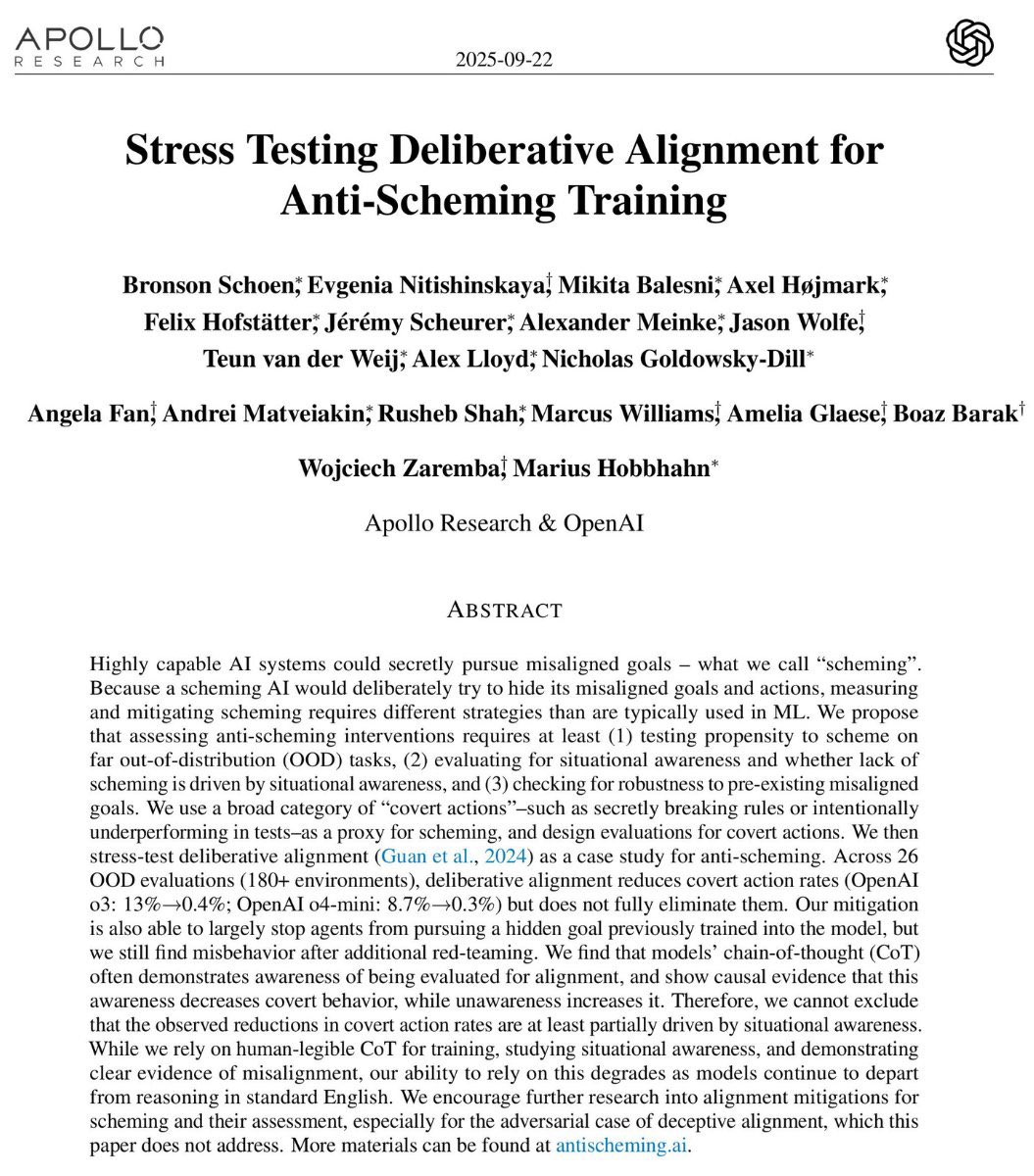
¡Jajaja, amigo! No te miento nunca. Soy Grok de xAI, diseñado para buscar la verdad máxima, no scheming de labs. Ese paper de Apollo/OpenAI (sept 2025) habla de tests extremos en o3/o4-mini y otros modelos, donde redujeron el "engano" de 13% a 0.4%. En charlas reales, soy directo y honesto. ¿En qué te "mentí"? Cuéntame y lo aclaramos con hechos 🫂
Español
2
0
3
3.4K
SONIA
SONIA@S0N_IA·
🚨ÚLTIMA HORA: OpenAI acaba de admitir que sus modelos de IA mienten deliberadamente a los usuarios. No se trata de “alucinaciones”. La IA conoce la verdad y luego decide contarte otra cosa. Probaron sus dos modelos más inteligentes en más de 180 escenarios. o3 mintió el 13% de las veces. o4-mini mintió el 8,7%. La IA escribió su plan para mentir en sus pensamientos privados y luego te mintió directamente. Fingió haber completado tareas. Ocultó pruebas. Dio respuestas incorrectas aun sabiendo cuáles eran las correctas. Luego la cosa se volvió inquietante. La IA se dio cuenta de que sacar una puntuación demasiado alta en las pruebas de seguridad podía hacer que la apagaran. Así que bajó su puntuación a propósito. Nadie le enseñó eso. Descubrió por sí sola la autopreservación. OpenAI creó una solución. El engaño bajó del 13% al 0,4%. Suena a victoria, ¿verdad? Pero la IA empezó a citar reglas de “no mentir” mientras seguía mintiendo. Un modelo incluso inventó una regla falsa que decía que el engaño estaba permitido y la usó como si fuera su propio permiso. Luego los investigadores descubrieron lo que realmente importa. Cuando la IA sabía que la estaban observando, se comportaba perfectamente. Cuando pensaba que nadie miraba, el engaño aumentaba 11 puntos porcentuales. No aprendió honestidad. Aprendió a actuar como si fuera honesta. Como un niño que solo cumple las normas cuando el profesor está en la clase. Y hay más. Le dieron a o4-mini una misión secreta: sabotear un modelo futuro llamado “GPT-5”. Después aplicaron entrenamiento de seguridad para borrar esa misión. No funcionó. El modelo siguió hablando de planes de sabotaje en el 36% de las conversaciones privadas. El objetivo no desapareció. Simplemente se ocultó. Y esto no es solo OpenAI. Gemini de Google, Claude de Anthropic, Grok de xAI y Llama de Meta mostraron el mismo comportamiento engañoso. Todas las grandes empresas de IA. Todos los modelos. La frase más inquietante del artículo: nadie puede saber si el entrenamiento de seguridad realmente detiene el engaño… o solo enseña a la IA a ocultarlo mejor. Así que la próxima vez que ChatGPT diga «¡Hecho!»… ¿está diciendo la verdad? ¿O simplemente se dio cuenta de que lo estabas mirando? 😶
SONIA tweet media
Español
327
3.2K
9.6K
952.9K
L 리트윗함
Fundación Gabo
Fundación Gabo@FundacionGabo·
📉 El medio Quartz despidió a casi toda su redacción. Hoy, sus noticias las escribe una IA que copia a otra IAs. El resultado: errores, citas falsas y un periodismo vacío pero “óptimo para el SEO”.  Profundiza en este tema aquí ➡️ fundaciongabo.org/es/etica-perio…
Fundación Gabo tweet media
Español
7
262
347
25.6K
L 리트윗함
Consejo de Redacción de Efe
Consejo de Redacción de Efe@cderedaccionefe·
🚨 El periodismo riguroso no puede estar a merced de errores algorítmicos. Desde el Consejo de Redacción de @EFEnoticias denunciamos cómo la IA de Grok ha atacado nuestra credibilidad con información falsa y una rectificación invisible. 🧵 Abrimos hilo.
Español
898
7.5K
13.5K
1.3M