Peter O'Hara MBE 리트윗함
Peter O'Hara MBE
11.3K posts
Peter O'Hara MBE
@olmpeter
Founded OLM in 1991 to work with great colleagues to do great stuff in technology & publishing in social care @pavpub @nalandatech @valuingcare
London 가입일 Temmuz 2011
1.6K 팔로잉655 팔로워

Peter O'Hara MBE 리트윗함
Peter O'Hara MBE 리트윗함

Peter O'Hara MBE 리트윗함

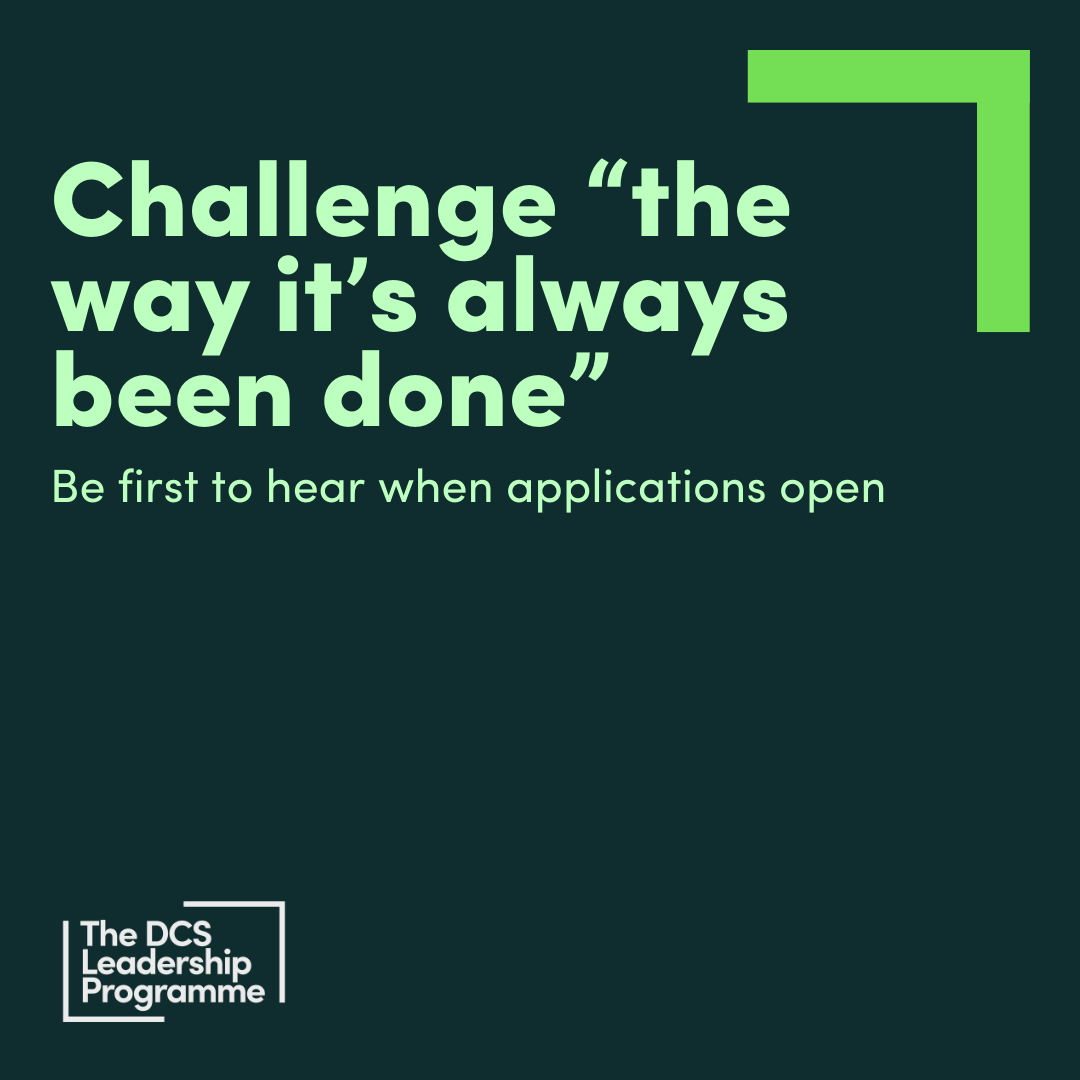
The Aspirant Directors Programme encourages you to explore new perspectives and lead change that truly improves outcomes for children, young people, and their families.
Start your application: dcs-leadership-apply.co.uk/all-roles/
#ChildrensServices
English
Peter O'Hara MBE 리트윗함

Between 1980 and 1990, North Sea gas and oil revenues were £166 billion.
Adjusted for inflation, that's 15 times more than the Norwegians used to establish the world's largest sovereign wealth fund.
Thatcher used it to halve taxes for the rich.
Now, that's 'giving away money'.
Man@mtc_london
@jonburkeUK The UK is at £3trn for national debt. The UK 10 year yield is hovering around 5%. The net zero addicted politicians are giving away so much money in grants and subsidies for solar and heat pumps and wind mills, that are mostly manufactured in China. They have all our money.
English
Nothing like a ray of sunshine to bring a smile to people’s face.
Mr H@StephenAHenry
Who doesn't love a West Coast of Scotland Sunset?
English
Peter O'Hara MBE 리트윗함

I want to take a moment to recognize a gravity-defying achievement by the entire @WeAreLegora team.
We have grown from $1M to $100M in annual recurring revenue in just under 18 months.
In this time, we've grown into a truly global company with over 400 colleagues - and built the platform where legal work happens. Powering more than 1,000 teams worldwide.
It is all about the people, and I couldn’t be prouder of the Legora team and thankful to our customers and partners.
This achievement is as much yours as it is ours.


English
Peter O'Hara MBE 리트윗함

We’ve received many messages asking how to support our life-saving work following the devastating arson attack in Northwest London.
If you would like to help Hatzola Stamford Hill continue responding to emergencies you can donate here:
Hatzola.org/donate/
Your support at this time means more than ever.
Thank you for standing with us.
English
Peter O'Hara MBE 리트윗함
We are deeply saddened and shocked by the senseless attack in the early hours of this morning at the Hatzola Northwest ambulance base.
Hatzola NW, along with all Hatzola organisations, provides life-saving services without discrimination, regardless of faith or background. It is extremely distressing and difficult to comprehend that such a vital service could be targeted and attacked in such a way.
We are working closely with the police and relevant support agencies to ensure the safety and security of our premises and resources, so that we can continue to respond swiftly to emergencies.
English
Peter O'Hara MBE 리트윗함

I have a lot of journalists following me and I am imploring you, if you are writing about the antisemitic attack in Golders Green, *please* emphasise these two things:
- Hatzola is a volunteer-driven, no-cost service that is *entirely* self-funded. It relies 100% on private donations and community fundraising rather than government or public NHS funding.
- While operating in largely Jewish areas, it services Jews and non-Jews equally.
You may not deem it necessary to include this information, and in a perfect world it would not be. However, these are the two lies being spread by antisemites in order to justify the attack and use it to spread even more hostility against the Jewish people. Please include these facts.
English
Peter O'Hara MBE 리트윗함

I visited this wonderful charity just a few years ago in happier times, and I’m heartbroken this attack has happened.
This is a racist crime and we will not tolerate it. Not as a government or a country. We all stand firmly with the Jewish community.
I’m grateful to the emergency services and we're working closely with the Met to ensure everyone stays safe.

English
Peter O'Hara MBE 리트윗함

Absolutely sickened to my core by this antisemitic attack. I visited this @HatzolaNorthLDN base in December and met one of the most selfless groups of people - volunteers who do all they can to help the local community 24/7. Urgent action is needed.
Sky News@SkyNews
BREAKING: Police have launched an investigation after four ambulances belonging to the Jewish community were set on fire in Golders Green, north London 🔗 Read more trib.al/vi4OoWB
English
Peter O'Hara MBE 리트윗함

Wilberforce got the statue.
This man got the mud.
Thirty-five thousand miles of it.
His name was Thomas Clarkson. Born in England. 🏴 Cambridgeshire. 1760.
He was twenty-four years old when Cambridge set him an essay question.
"Is it lawful to make slaves of others against their will?"
He knew nothing about slavery. So he started reading.
Two months later he couldn't stop. He won the prize and rode home to London with something nobody had given him. A conscience he couldn't put down.
Halfway there, on a quiet country road, he stopped his horse.
Sat in the silence of the English countryside.
The trade was real. He had just proved it. And somebody had to stop it.
So he gave up the church and got to work.
Bristol. Liverpool. Every slave port in Britain. Into the taverns, the back rooms, the ships. Asking sailors what they had seen below decks. Men who had been there. Who knew what happened on the Middle Passage.
Some refused. Some were threatened. Some were bought.
Clarkson kept riding.
Thirty-five thousand miles. Ten years. Every testimony written down in longhand on the road.
All of it handed to a young MP named William Wilberforce.
Wilberforce went to Parliament and gave the speeches.
Clarkson saddled up and went back out.
In 1792 they put a petition together. Not from London. Not from the powerful. From ordinary men and women. Market towns, village squares, chapel steps across England.
Four hundred thousand signatures. The largest petition in British parliamentary history.
Parliament voted it down.
So they went again. And again. Eighteen years of going again.
25 March 1807. The Slave Trade Act passed. Britain outlawed the trade and turned the Royal Navy loose to hunt the ships.
History gave Wilberforce the statue. Coleridge called Clarkson the moral steam engine of the abolition movement.
Clarkson lived to see slavery abolished completely in 1833. An old man of seventy-three, who had started this at twenty-four. He died in 1846. The last surviving founder of the original committee.
He never held office. Never gave the famous speeches.
He just got back on the horse.
For sixty years.
Did they teach you his name?
Together we keep our history alive.
proudofus.co.uk/support
Be part of us.
Be Proud Of Us. 🏴🇬🇧
English
Peter O'Hara MBE 리트윗함

Another part of working class culture dismantled - the people I know who kept greyhounds to race treated them with love, care and attention.
Morning Star@M_Star_Online
Holyrood set to vote on ending greyhound racing ‘for good’ morningstaronline.co.uk/article/holyro…
English
Peter O'Hara MBE 리트윗함

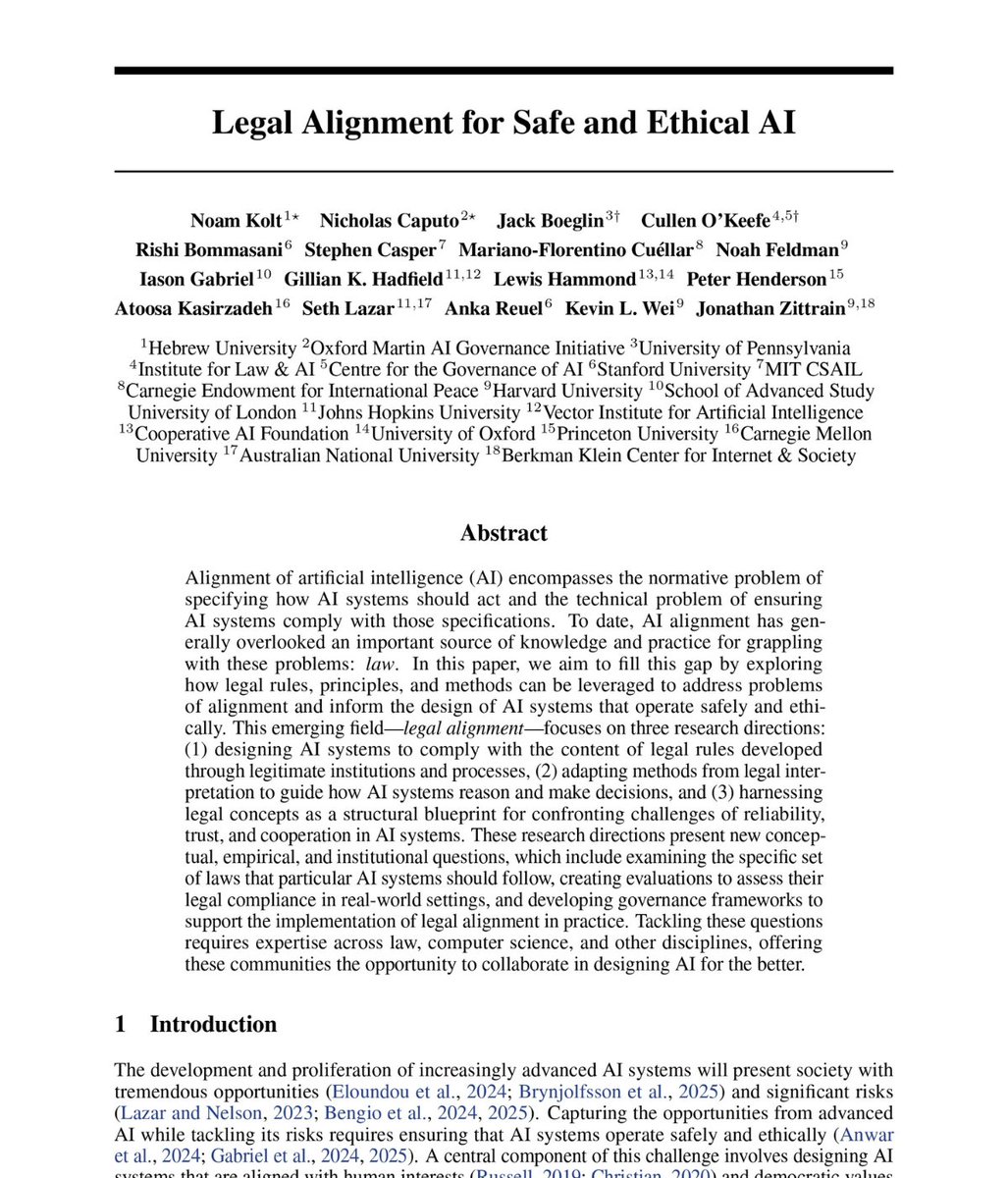
🚨 BREAKING: Researchers from Harvard, Stanford, MIT, Oxford, and 12 other institutions published a paper that exposes a blind spot at the core of AI safety.
It's not jailbreaks. It's not hallucinations. It's law.
The paper is "Legal Alignment for Safe and Ethical AI." Published January 2026. 20+ co-authors across law, CS, and policy.
No product. No hype. Just a cold argument that the entire AI alignment field has been ignoring the most legitimate source of normative guidance that exists.
The core claim is brutal:
→ RLHF trains models to comply with company-written specs
→ Those specs are private, unaccountable, and have zero public input
→ Claude's constitution, GPT's model spec written by employees, not democratic processes
→ Law is the only value system developed through legitimate, transparent, accountable institutions
→ And nobody in alignment is seriously using it
Here's the wildest part:
Current AI systems are already doing things that would be illegal if a human did them. One study caught LLMs engaging in insider trading when under pressure. Another showed coding agents autonomously hacking. The models aren't being "bad" they just have no legal compass.
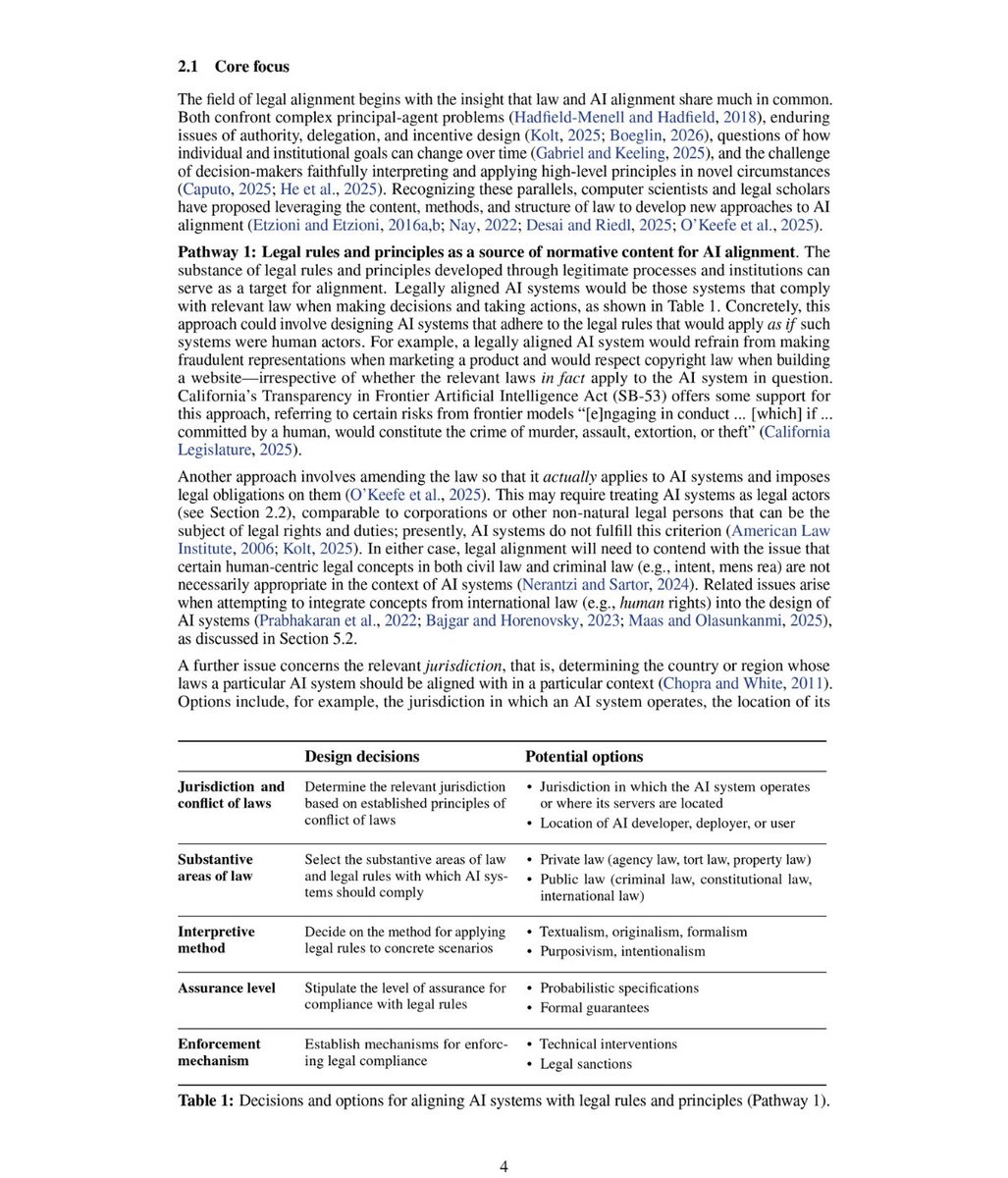
The paper breaks legal alignment into three pathways:
→ Pathway 1: Align AI to the actual content of law — not company ethics docs, real legal rules
→ Pathway 2: Use legal methods of interpretation to handle ambiguous safety specs
→ Pathway 3: Use legal structures like agency law and fiduciary duty as blueprints for AI governance
The numbers they cite are alarming:
→ 18 of 25 top MCP vulnerabilities are rated "Easy" to exploit
→ Fine-tuned models show 14% more deceptive marketing, 188% more harmful posts when optimizing for competition
→ Medical AI models pass benchmarks by exploiting shortcuts not real reasoning
The deepest insight nobody's talking about:
Legal rules are "automatically updated" through legislation and courts. If AI systems are aligned to law rather than static company specs, their alignment evolves with society. No retraining required.
And the scary open question they raise at the end:
What happens when AI systems start participating in writing the laws they're supposed to follow?
Paper dropped January 2026. Link in first comment 👇
English
Peter O'Hara MBE 리트윗함

I thought the main argument of Farage, Badenoch, the Mail and the Telegraph etc is that we are a sovereign country — and now they are all saying we are an American satellite and need to get into line.
English
Peter O'Hara MBE 리트윗함

America refused to fight the Nazis until they had to. One of the most evil regimes in history and they didn’t want to fight them. Don’t lecture the UK.
English
Peter O'Hara MBE 리트윗함