Pablo Cuba Borda

3.1K posts

Pablo Cuba Borda banner
Pablo Cuba Borda

Pablo Cuba Borda

@pcubab

🇧🇴 Economist @federalreserve. Macro and Development. @UCBLaPaz, @WilliamsCollege, @UMDEcon, @SEBOLBolivia. Atlético Bellman ⚽️. DC. Tweets are my own.

Washington, DC 가입일 Aralık 2014
1.1K 팔로잉1.4K 팔로워
Pablo Cuba Borda 리트윗함

FedResearch
FedResearch@FedResearch·
Call for papers: Global Research Forum on International Macroeconomics and Finance. Paper submissions due by May 31, 2026: federalreserve.gov/conferences/gl…
English
0
15
41
4.8K
Pablo Cuba Borda 리트윗함
Macro Musings
Macro Musings@Macro_Musings·
New episode! Jesús Fernández-Villaverde on the Quandary of Global Demographic Decline. Watch @JesusFerna7026 and @DavidBeckworth discuss his rise on X, how to frame global demographic decline, the three accelerants of demographic decline, the role of housing in family size, how AI will play a role in global demographics, what we know about AGI, the question of dollar dominance, and much more.
English
2
22
111
38.3K
Alex Mechanick
Alex Mechanick@apmechan·
I'm excited to announce that I will be joining the Johns Hopkins School of Government and Policy as an assistant professor, starting this summer. I am eager to contribute to building a new school devoted to intellectual pluralism, analytical rigor, and institutional reform.
Alex Mechanick tweet media
English
26
12
236
62.2K
Pablo Cuba Borda
Pablo Cuba Borda@pcubab·
Sage advice! Especially now that we’re all busy implementing the fantastic agentic features in Claude Blattman, thanks @cblatts
Pablo Cuba Borda tweet media
English
0
2
33
4.8K
Pablo Cuba Borda
Pablo Cuba Borda@pcubab·
Turn it up. That’s the sound of my morning coffee getting an upgrade. @SinceraCoffee bringing that high-altitude Bolivian energy straight to my morning cup. 🇧🇴 ☕️
English
1
0
9
157
Pablo Cuba Borda
Pablo Cuba Borda@pcubab·
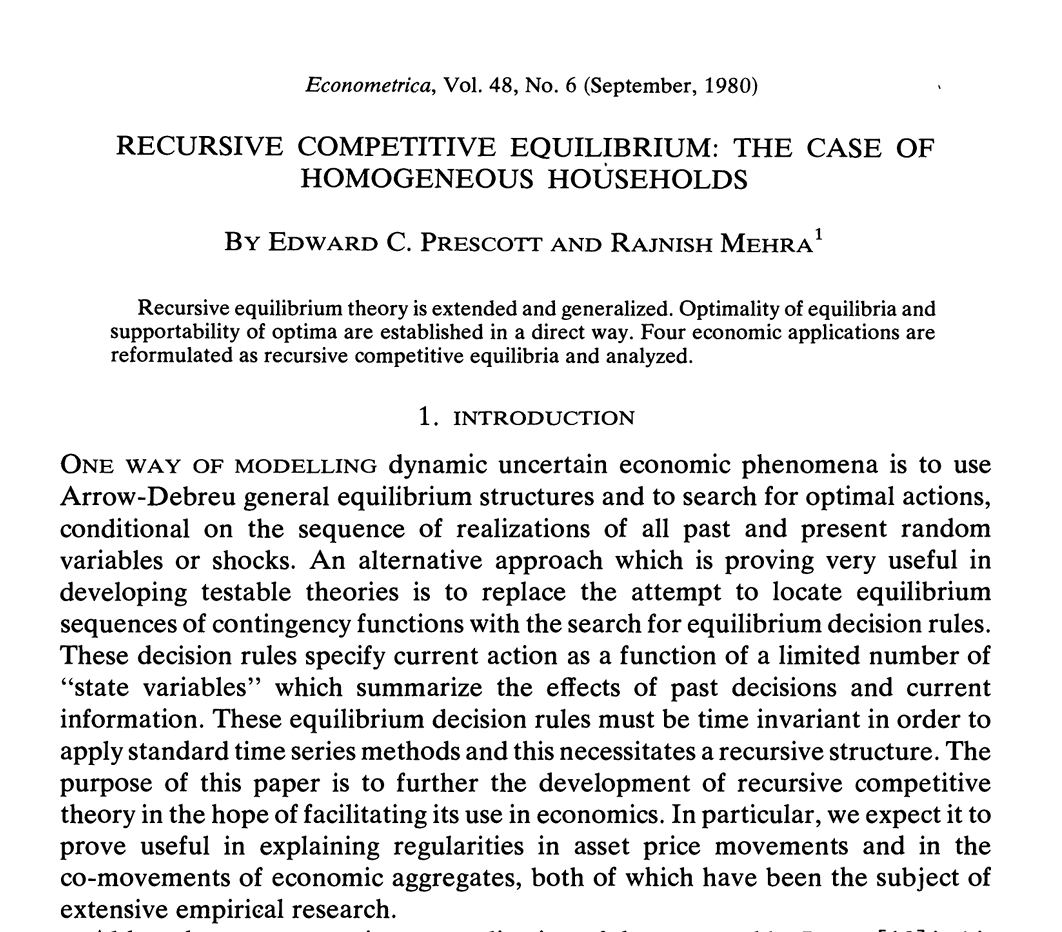
Me gusta la estrategia para flexibilizar el tc. Dos observaciones: 1. En adición al precio de referencia diario, ayudaría publicar el volumen de transacciones. 2. Hubiese sido mejor que estas útiles aclaraciones las diera el BCB, no Hacienda.
José Gabriel Espinoza Y.@g_espinoza

#Bolivia Algunas cuestiones importantes sobre la publicación del precio referencial del dólar: 1: Hoy el Banco Central de Bolivia volvió a publicar diariamente el valor referencial del dólar basado en las transacciones reales de las entidades financieras. Es una medida sencilla, pero muy importante: devuelve transparencia a un mercado que estuvo más de dos años operando a ciegas. 2: ¿Por qué importa la transparencia? Porque cuando la información se oculta, los mercados se llenan de rumores, especulación y precios inventados. Eso fue lo que ocurrió desde febrero de 2023, cuando el gobierno anterior dejó de publicar datos clave del mercado cambiario. 3: Con esta decisión, el país vuelve a tener una referencia clara y confiable del precio al que realmente se compra y vende el dólar en el sistema financiero. Ya no dependemos de cotizaciones dispersas de redes sociales, casas de cambio o librecambistas. 4: El valor que publicará el BCB es el que usan los bancos y entidades financieras para transar dólares en el mercado mayorista. Es el precio verdadero del sistema, no el precio de rumores. Por eso se convierte en una brújula para entender cómo se está moviendo el mercado. 5: Esto beneficia directamente al público: • ayuda a saber si un precio es razonable o no, • reduce la incertidumbre, • y evita abusos o desinformación. Un mercado con información clara es un mercado que funciona mejor. 6: La medida también ordena otros mercados ligados al tipo de cambio, por ejemplo el de criptomonedas. ¿Por qué? Porque el volumen transado por el sistema financiero es mucho mayor y más estable que el del mundo cripto. Por eso, este nuevo dato es una referencia sólida para comparar precios. 7: En resumen: ✔️ recuperamos la transparencia, ✔️ damos una señal de orden y normalización, ✔️ facilitamos la estabilización de la economía. La política monetaria funciona mejor cuando la información fluye. Hoy el país vuelve a tener una referencia seria y verificable del dólar. 8: Es un paso firme para reconstruir confianza y devolver certidumbre a ciudadanos, empresas e inversionistas. No es solo publicar un número: es devolverle reglas de juego claras a la economía boliviana. #CapitalismoParaTodos #SiempreBolivia

Español
0
0
5
244
Pablo Cuba Borda 리트윗함
Jesús Fernández-Villaverde
Jesús Fernández-Villaverde@JesusFerna7026·
A guide for students of economics: Ten statements that demonstrate that someone does not understand modern economics or what an equilibrium is, and that you can safely ignore everything else they say. 1. “Equilibrium means the economy is stable or at rest.” Many assume that an equilibrium is a peaceful state with no forces at play. Instead, an equilibrium is just an arrangement of actions and expectations over time that are mutually consistent. It can be locally unstable, explosive, or fragile. Nothing in the definition of equilibrium implies stability. 2. “Equilibrium implies optimality or social efficiency.” Equilibrium is often conflated with efficiency, but equilibrium merely reflects decentralized consistency, not welfare maximization. Market power, externalities, incomplete markets, nominal rigidities, and frictions routinely produce inefficient equilibria. I often teach a first-year macro graduate course, and not a single one of the equilibria I define is efficient. 3. “Equilibrium is a unique outcome.” Many often expect models to have one equilibrium. In reality, multiple equilibria arise naturally in dynamic, strategic, and incomplete-market environments. Models of coordination failures, self-fulfilling expectations, bubbles, overlapping generations, and liquidity traps all hinge on the existence of equilibrium multiplicity. 4. “Equilibrium requires perfect foresight or perfect information.” Equilibrium does not assume agents know the future. In fact, equilibria are often stochastic. The definition of equilibrium only requires that beliefs are consistent with the (perceived) stochastic laws of motion implied by the model. Bayesian learning, noisy signals, ambiguity, and subjective uncertainty all fit well within an equilibrium framework, provided beliefs converge to an internally consistent (but possibly incorrect) distribution. Bonus point: equilibria are compatible with agents having diverging beliefs that never converge to a single Dirac distribution. 5. “Real economies are rarely in equilibrium, so the concept is unrealistic.” Equilibrium is not meant to describe the daily state of the world. It is a conceptual device used to understand the outcome of our models under the assumptions we make. Also, see point 1 above. 6. “Equilibrium requires agents to be fully rational in a psychological sense.” Equilibrium only assumes internal consistency: agents optimize given preferences and constraints. It does not assume realism about human cognition. We can and do define equilibria in models with behavioral biases, bounded rationality, inattention, or rule-of-thumb behavior. We only need to ensure that the resulting actions and beliefs are mutually compatible. 7. “Equilibrium eliminates dynamics or learning.” Equilibrium is sometimes misinterpreted as a static state in which nothing evolves. In fact, many equilibria are sequences of probability distributions over states driven by shocks, policy rules, and endogenous responses. Learning dynamics (Bayesian updating, adaptive rules, experience-based expectations) can occur within equilibrium if the evolution of beliefs is self-consistent. 8. “Equilibrium renders expectations unimportant.” A common misconception is that equilibrium mechanically determines outcomes. In reality, expectations are often central: they determine investment, consumption, asset prices, and policy responses. Many equilibria differ only in their expectations. This is why communication, credibility, and forward guidance matter even in fully rational models. 9. “Equilibrium excludes policy intervention.” Some interpret equilibrium as a laissez-faire concept. In fact, equilibrium analysis is the foundation of modern policy evaluation. Fiscal, monetary, and regulatory interventions work through equilibrium responses (prices, wages, interest rates, quantities) and must satisfy equilibrium conditions to be credible. Equilibrium is a tool for policy design, not a barrier to it. 10. “Equilibriums…” Aequilibrium is a Latin neuter noun of the second declension, which forms a nominative plural in “a”. It is composed of aequus (equal; the same root as equality or equity) and libra (balance or scales or the name of several currencies over history). A final thought: “equilibrium” is a term of art. Its meaning in economics differs from its use in the natural sciences or in everyday language. Terms of art are ubiquitous across academic disciplines, and the first act of intellectual diligence when one starts studying a discipline is to learn what they mean.
Jesús Fernández-Villaverde tweet media
English
78
492
1.9K
628.1K
Ernesto Pasten
Ernesto Pasten@ErnestoPasten2·
Honored to have organized with Ricardo Caballero the ARC celebrating the centennial of the @bcentralchile and the day-ahead workshop last week. Thanks to everyone coming and to the Bank for this opportunity. Program, pics and material is/will be here bcentral.cl/en/web/banco-c…
Ernesto Pasten tweet media
English
2
2
16
597
Pablo Cuba Borda 리트윗함
Jesús Fernández-Villaverde
Jesús Fernández-Villaverde@JesusFerna7026·
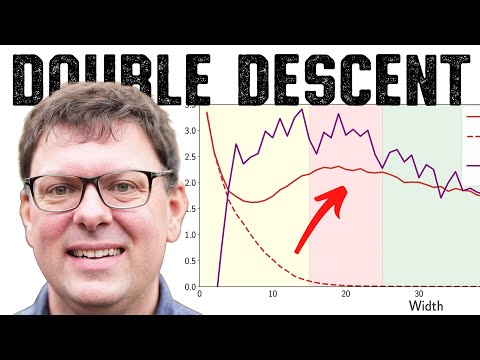
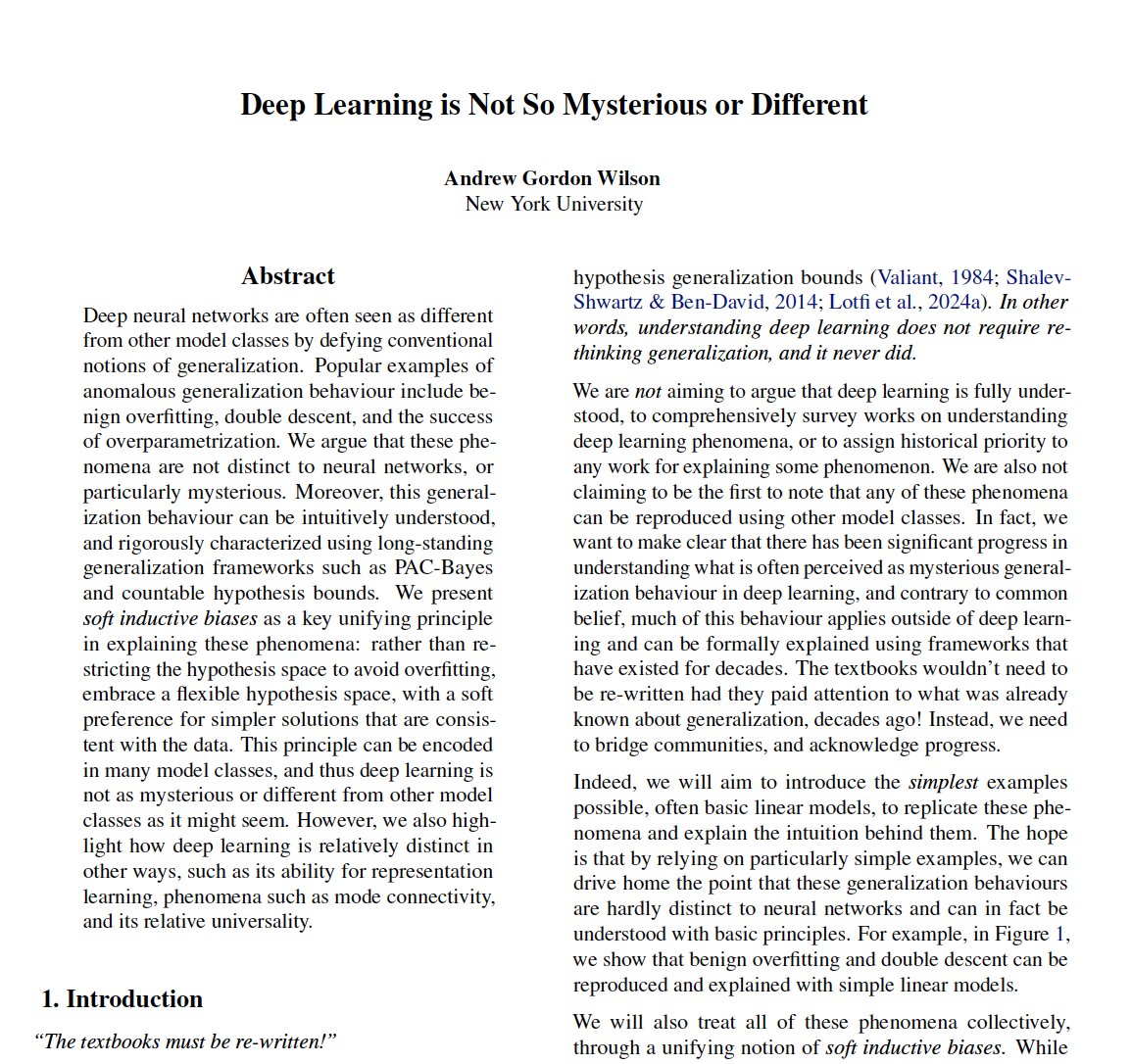
This week I’ll be lecturing at the ECB on deep learning. More than ever, I plan to emphasize the importance of soft inductive bias, double descent, and benign overparameterization—topics I’ve discussed in many previous threads. These three closely related phenomena compel us to reconsider much of what we thought we knew about the model classes used in function approximation and their generalization properties. They also demonstrate why intuition derived from traditional statistics can fail when we transition into the high-dimensional, overparameterized regimes characteristic of modern machine learning. Much of the new material in my lectures comes from a superb recent paper by Andrew Gordon Wilson, Deep Learning is Not So Mysterious or Different. Wilson argues that “rather than restricting the hypothesis space to avoid overfitting, we should embrace a flexible hypothesis space, with a soft preference for simpler solutions that are consistent with the data.” Several aspects of the paper struck me in particular: 1️⃣ The deep links with PAC-Bayes theory, a connection especially relevant to me, given my many papers in Bayesian econometrics. 2️⃣ The insistence that soft inductive bias, double descent, and benign overparameterization are not unique to deep learning but arise in a wide family of model classes. 3️⃣ The move away from attributing the soft inductive bias primarily to optimizers and instead focusing on the structure of the hypothesis space itself. Wilson also discusses mode connectivity, a phenomenon that still puzzles me deeply. I must confess I have almost no intuition for why distinct minima in the loss landscape should be connected by paths of low loss. If anyone has a convincing intuition or geometric explanation, I would be very grateful to hear it. In any case, read the paper—or even better, watch this wonderful interview with the author on Machine Learning Street Talk: 🔗 youtube.com/watch?v=M-jTeB…📷
YouTube video
YouTube
Jesús Fernández-Villaverde tweet media
English
7
37
267
24.7K
Pablo Cuba Borda 리트윗함
Seula Kim
Seula Kim@_seulakim·
🚨We are hiring at @penn_state! One junior position in an open field. It's been such a great experience working here with fantastic colleagues and supportive environment. Come join us! Apply here: aeaweb.org/joe/listing.ph…
English
4
64
365
57.4K
Pablo Cuba Borda 리트윗함
Brad Setser
Brad Setser@Brad_Setser·
Argentina's President Javier Milei appears to be doubling down on an exchange rate based stabilization program -- an incredibly risky move for a country that blew through $14 billion from the IMF earlier this year to support an overvalued peso. 1/
Brad Setser tweet media
English
6
24
102
19.9K
Pablo Cuba Borda 리트윗함
Florian Ederer
Florian Ederer@florianederer·
Economics Journals as Tennis Tournaments 🧵(for an extremely niche audience) Quarterly Journal of Economics = Wimbledon The oldest and most influential event, but also clubby, snobby, and elitist. To win it you must train on a very particular surface/ZIP code.
Florian Ederer tweet mediaFlorian Ederer tweet media
English
62
409
2.4K
0
Pablo Cuba Borda
Pablo Cuba Borda@pcubab·
2 day econ conference = 1 month of coffee consumption ☕️
English
0
0
1
85