
Armin

417 posts

Armin banner
Armin

Armin

@pragmatrix

Prepare for Space

가입일 Haziran 2009
109 팔로잉20 팔로워
Armin 리트윗함
Andrej Karpathy
Andrej Karpathy@karpathy·
LLM Knowledge Bases Something I'm finding very useful recently: using LLMs to build personal knowledge bases for various topics of research interest. In this way, a large fraction of my recent token throughput is going less into manipulating code, and more into manipulating knowledge (stored as markdown and images). The latest LLMs are quite good at it. So: Data ingest: I index source documents (articles, papers, repos, datasets, images, etc.) into a raw/ directory, then I use an LLM to incrementally "compile" a wiki, which is just a collection of .md files in a directory structure. The wiki includes summaries of all the data in raw/, backlinks, and then it categorizes data into concepts, writes articles for them, and links them all. To convert web articles into .md files I like to use the Obsidian Web Clipper extension, and then I also use a hotkey to download all the related images to local so that my LLM can easily reference them. IDE: I use Obsidian as the IDE "frontend" where I can view the raw data, the the compiled wiki, and the derived visualizations. Important to note that the LLM writes and maintains all of the data of the wiki, I rarely touch it directly. I've played with a few Obsidian plugins to render and view data in other ways (e.g. Marp for slides). Q&A: Where things get interesting is that once your wiki is big enough (e.g. mine on some recent research is ~100 articles and ~400K words), you can ask your LLM agent all kinds of complex questions against the wiki, and it will go off, research the answers, etc. I thought I had to reach for fancy RAG, but the LLM has been pretty good about auto-maintaining index files and brief summaries of all the documents and it reads all the important related data fairly easily at this ~small scale. Output: Instead of getting answers in text/terminal, I like to have it render markdown files for me, or slide shows (Marp format), or matplotlib images, all of which I then view again in Obsidian. You can imagine many other visual output formats depending on the query. Often, I end up "filing" the outputs back into the wiki to enhance it for further queries. So my own explorations and queries always "add up" in the knowledge base. Linting: I've run some LLM "health checks" over the wiki to e.g. find inconsistent data, impute missing data (with web searchers), find interesting connections for new article candidates, etc., to incrementally clean up the wiki and enhance its overall data integrity. The LLMs are quite good at suggesting further questions to ask and look into. Extra tools: I find myself developing additional tools to process the data, e.g. I vibe coded a small and naive search engine over the wiki, which I both use directly (in a web ui), but more often I want to hand it off to an LLM via CLI as a tool for larger queries. Further explorations: As the repo grows, the natural desire is to also think about synthetic data generation + finetuning to have your LLM "know" the data in its weights instead of just context windows. TLDR: raw data from a given number of sources is collected, then compiled by an LLM into a .md wiki, then operated on by various CLIs by the LLM to do Q&A and to incrementally enhance the wiki, and all of it viewable in Obsidian. You rarely ever write or edit the wiki manually, it's the domain of the LLM. I think there is room here for an incredible new product instead of a hacky collection of scripts.
English

2.6K
6.3K
53.5K
18.5M
Armin 리트윗함
flavio
flavio@flaviocopes·
How Axios was compromised 🤯
flavio tweet media
English
150
862
6.9K
1.6M
Armin 리트윗함
Gurwinder
Gurwinder@G_S_Bhogal·
X on April Fools Day is about as trustworthy as X on any other day.
English
9
25
178
9.3K
Armin
Armin@pragmatrix·
Beware of AI creating convoluted workarounds.
English
0
0
0
8
Armin
Armin@pragmatrix·
Pay the world whatever it takes to leave you alone to think. -- Naval Ravikant
English
0
0
1
14
Armin
Armin@pragmatrix·
The best time in my life is when everyone knows I’m on vacation in a faraway country, where I can stay alone in my hotel room and just think or do whatever I want without anyone potentially interfering.
English
0
0
1
12
Armin 리트윗함
Ambar
Ambar@Ambar_SIFF_MRA·
He restored her to her default voice
English
110
855
8.6K
363.2K
Armin 리트윗함
Orion Reed
Orion Reed@OrionReedOne·
Software is not soft. It arrives rigid, opaque, and brittle. The most malleable medium we have produced is, in practice, among the least malleable materials we encounter in daily life.
English
1
6
25
1.4K
Armin 리트윗함
Boring_Business
Boring_Business@BoringBiz_·
The highest IQ people I know are all either > fully locked in and building or investing in AI. goal is to work towards generational wealth in the midst of a new technological revolution > fully checked out of society and the corporate rat race. they are quitting their job, deleting social media and moving to the middle of nowhere to live a quiet life with no distractions Literally no in between
Beff (e/acc)@beffjezos

All the smartest people you know are in a generational lock-in season right now

English
377
1K
14.9K
1.3M
Armin 리트윗함
rvivek
rvivek@rvivek·
An engineer at Anthropic wrote a spec, pointed Claude at an Asana board, and went home. Claude broke the spec into tickets, spawned agents for each one, and they started building independently. When the agent is confused it runs git-blame and messages the right engineers in Slack. By Monday the agents finished the plugin feature. That's one example of how the best engineers are shipping software right now. Developers will soon orchestrate 50 AI agents in parallel and the difference between a good engineer & a great one would come down to specs. You can't write a spec that holds up at that scale without genuinely understanding what you're building at a deeper level. The next-gen developer who understands the fundamentals, can architect well and orchestrate agent is going to be a 1000x developer!
English
287
529
7.1K
1.2M
Armin 리트윗함
Christian Catalini
Christian Catalini@ccatalini·
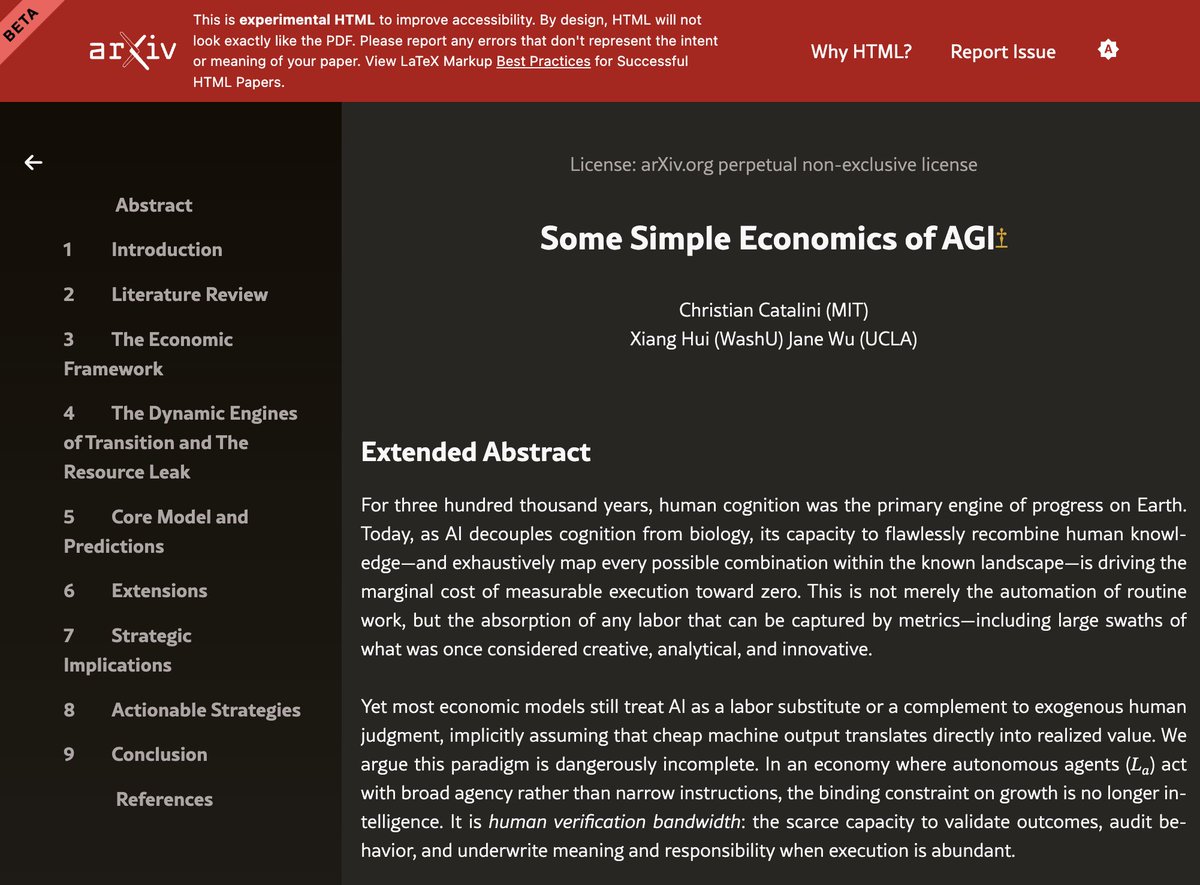
1/ Some Simple Economics of AGI—🔥🧵 Right now, there is a low-grade panic running through the economy. Everyone is asking the same anxious question: what exactly is AI going to automate, and what will be left for us?
Christian Catalini tweet media
English
146
382
2K
612.2K
Armin
Armin@pragmatrix·
My rules for AI use: 1. Iterate until you fully understand and like the result. 2. Curate instructions: Prefer generic over specific. 3. For complex tasks: Plan first and apply rule 1 before starting the implementation phase. Oh, the irony.
English
0
0
0
13
Armin 리트윗함
Alex Hormozi
Alex Hormozi@AlexHormozi·
There's never been a better time to start an AI-first business to disrupt an existing market because all the people in that existing market are busy running their businesses rather than learning AI and using words like "AI-first" rather than actually being AI-first.
English
376
370
5.7K
387.3K
Armin 리트윗함
Naval
Naval@naval·
AI is the great automator, and to automate, it must first imitate. The imitation fools people into thinking it’s alive.
English
726
637
8.6K
340.1K
Armin 리트윗함
Gurwinder
Gurwinder@G_S_Bhogal·
Artistry requires not just creativity but also good taste, and AI can only grant the former. The coming age, then, will be an era of infinite creativity and infinitesimal taste, which will be won by those who can discern as well as design, and curate as well as create.
English
13
32
176
16.2K
Armin 리트윗함
Naval
Naval@naval·
People who don’t organize into tribes get wiped out by people who do.
English
1.6K
6.9K
53.9K
3.9M
Armin 리트윗함
Gurwinder
Gurwinder@G_S_Bhogal·
Automate only the skills you’re willing to lose.
English
18
41
317
15K
Armin 리트윗함
Yiliu
Yiliu@yiliush·
Whoa, this was secretly growing behind my back. @tombielecki
Yiliu tweet media
English
2
3
6
465