pentulohryz

4.5K posts

pentulohryz

pentulohryz

@pythonrulez

"the best way to complain is to make things"

I♥py 가입일 Haziran 2009
870 팔로잉260 팔로워
pentulohryz 리트윗함
Dustin
Dustin@r0ck3t23·
Jensen Huang just explained why China is winning the technology race in two sentences. Huang: “Our country’s leaders… they’re mostly lawyers. Most of their leaders are incredible engineers.” One country sends engineers to lead. The other sends lawyers. One builds. The other regulates what was already built. Huang: “They showed up at precisely the time when technology is going through that exponential.” China did not stumble into the AI era. They arrived engineered for it. The education system produces engineers at a scale the West refuses to match. The competition is not tough. It is Darwinian. The culture rewards builders. Not commentators. Not consultants. Builders. Then the accelerant. Open source. When your talent pool runs that deep and that hungry, you do not hoard breakthroughs. You release them. The community multiplies everything. What costs American companies a quarter, Chinese teams finish in weeks. Not because they are smarter. Because the entire system points one direction. Zero friction between idea and execution. No committee. No review board. No eighteen-month compliance process. Then Huang said the part that should terrify Washington. Huang: “Their country was built out of poverty.” Comfort makes nations careful. Poverty makes nations relentless. When you built everything from nothing, you do not slow down to protect it. You accelerate because you still taste what nothing felt like. America built its dominance with engineers. The highways. The moon landing. The semiconductor. The internet. Then it handed the keys to the lawyers. Compliance departments. Regulatory bodies. Oversight committees. Review processes for the review processes. Every layer of protection is a layer of friction. And friction is a luxury you cannot afford when your competitor rides an exponential curve. Fridman: “It’s a builder nation.” Huang: “Yeah, it’s a builder nation.” No pushback. No qualifier. The West is not being outspent. It is being out-structured. Engineers ask how do we build this faster. Lawyers ask how do we build this without getting sued. One of those questions wins the century. The other writes a detailed report about why it lost.
English
193
663
2.4K
428.5K
pentulohryz
pentulohryz@pythonrulez·
“I think we achieved AGI” Punkt.
English
0
0
0
8
pentulohryz 리트윗함
S.T.E.M Explorer
S.T.E.M Explorer@stemexplor·
Complexity visualiser
English
82
514
4.6K
1.2M
pentulohryz 리트윗함
huihui.ai
huihui.ai@support_huihui·
New Model: huihui-ai/Huihui-Qwen3.5-4B-Claude-4.6-Opus-abliterated This is an uncensored version of Jackrong/Qwen3.5-4B-Claude-4.6-Opus-Reasoning-Distilled created with abliteration huggingface.co/huihui-ai/Huih…
English
19
51
662
102.3K
pentulohryz 리트윗함
𝕯𝖊𝖛𝕰𝖓𝖓𝖞
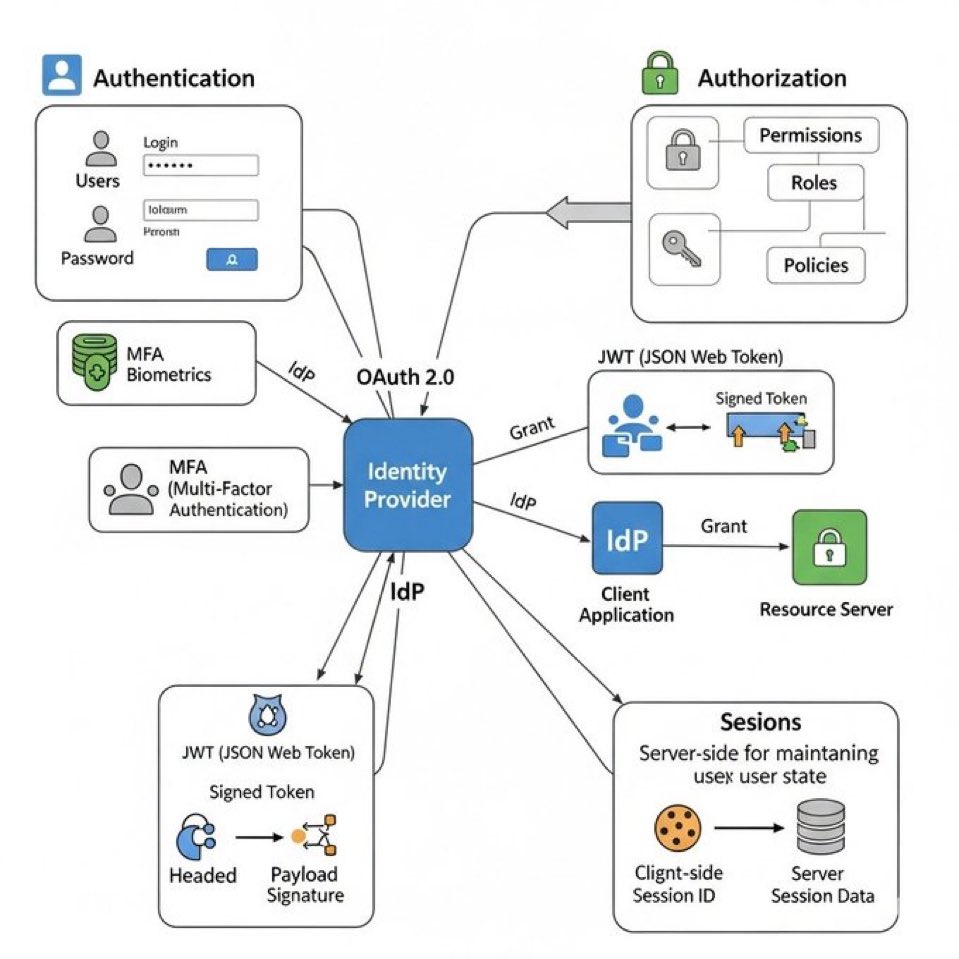
Authentication & Authorization (OAuth, JWT, Sessions) What is Authentication? Authentication is the process of verifying the identity of a user or system. It ensures that the person or application trying to access a system is who they claim to be. → Example: Logging in with a username and password. What is Authorization? Authorization determines what an authenticated user is allowed to do within a system. It defines permissions and access levels. → Example: A normal user can view content, while an admin can add or delete content. OAuth (Open Authorization) → A standard protocol for token-based authentication and authorization. → Allows users to log in using third-party providers like Google, Facebook, or GitHub. → Example: "Log in with Google" button on websites. JWT (JSON Web Token) → A compact, secure token format used for authentication. → Contains encoded user information and is signed to ensure integrity. → Commonly used in stateless authentication, where the server doesn’t store session data. → Example: After logging in, the server issues a JWT that the client sends with every request. Sessions → A method where the server stores user authentication data temporarily. → A session ID is stored in the client’s browser (cookie) and mapped to server-side data. → Example: Traditional web apps where a user stays logged in until the session expires or they log out. Key Differences → OAuth: Delegates authentication to external providers. → JWT: Stateless authentication with tokens stored on the client. → Sessions: Stateful authentication with data stored on the server. Real-World Examples → OAuth: Logging into Spotify using Facebook or Google. → JWT: APIs where clients authenticate using tokens. → Sessions: Classic PHP or Node.js web apps with login systems.
𝕯𝖊𝖛𝕰𝖓𝖓𝖞 tweet media
English
15
166
723
22.2K
pentulohryz 리트윗함
Kirk Borne
Kirk Borne@KirkDBorne·
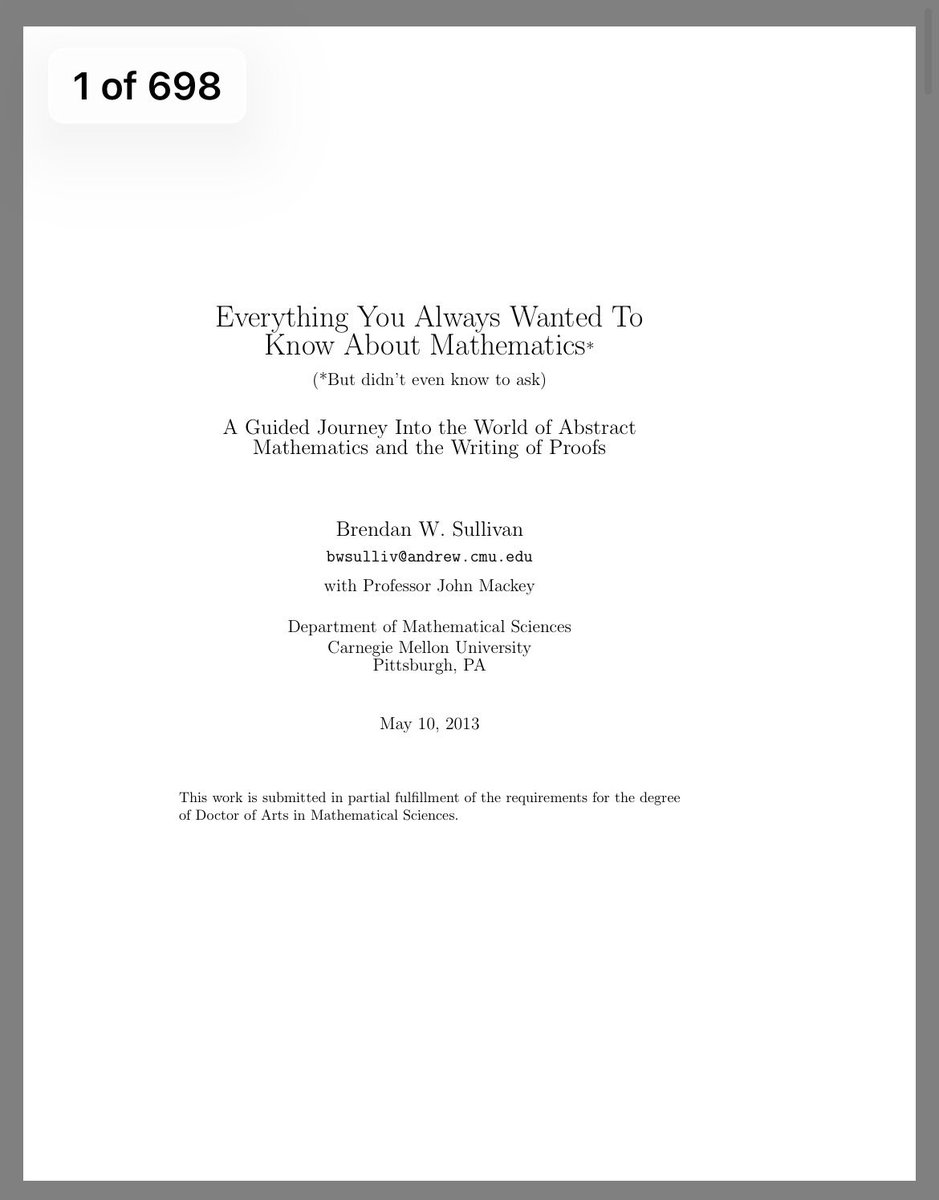
Download 698-page PDF eBook] Everything You Always Wanted To Know About #Mathematics* (*But didn’t even know to ask) A Guided Journey Into the World of Abstract Mathematics, Theorems, and the Writing of Proofs: math.cmu.edu/~jmackey/151_1…
Kirk Borne tweet media
English
14
217
887
45.8K
pentulohryz 리트윗함
Mike Bespalov
Mike Bespalov@bbssppllvv·
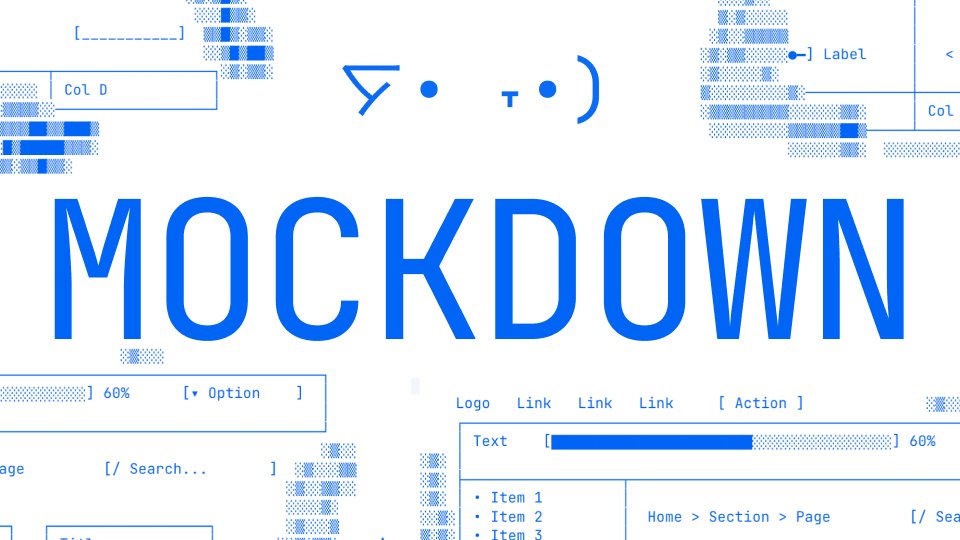
Mockdown is alive again. AI agents read markdown better than they read your mind. Draw a wireframe in ASCII, paste it into Claude Code, get a working page back. mockdown.design
Mike Bespalov tweet media
English
31
128
1.9K
126.8K
pentulohryz 리트윗함
Md Ismail Šojal 🕷️
Md Ismail Šojal 🕷️@0x0SojalSec·
Train Qwen3-4B 3x faster on 3.9GB RAM. 🤯 You can now train LLMs 3× faster with no accuracy loss, RoPE and MLP kernels. Triton kernels plus smart auto packing delivers 3× faster training & 30% less VRAM vs optimized FA3 setups.
Md Ismail Šojal 🕷️ tweet media
English
8
33
267
14K
pentulohryz 리트윗함
DuckDB
DuckDB@duckdb·
We released DuckDB v1.5! This new release comes with a “friendly CLI” client, a new (opt-in) PEG parser, support for the VARIANT type and a built-in GEOMETRY type. It also ships a new network stack and a few lakehouse features. Finally, it can write to Azure and connect to databases through ODBC. For more details, read the announcement blog post: duckdb.org/2026/03/09/ann…
DuckDB tweet media
English
8
67
383
24.4K
pentulohryz 리트윗함
sammy
sammy@sumiturkude007·
This short film made with Seedance 2.0 is absolutely insane. The realism looks like a real movie — no one can tell it's AI.
English
769
1.3K
8.8K
1.1M
pentulohryz
pentulohryz@pythonrulez·
GEO-first SEO skill for Claude Code. Comprehensive AI search optimization for any website — citability scoring, AI crawler analysis, brand authority, schema markup, platform-specific optimization, and PDF reports. github.com/zubair-trabzad…
English
0
0
1
62
pentulohryz
pentulohryz@pythonrulez·
The agent harness performance optimization system. Skills, instincts, memory, security, and research-first development for Claude Code, Codex, Opencode, Cursor and beyond. github.com/affaan-m/every…
English
0
0
1
94
pentulohryz 리트윗함
Robert Youssef
Robert Youssef@rryssf_·
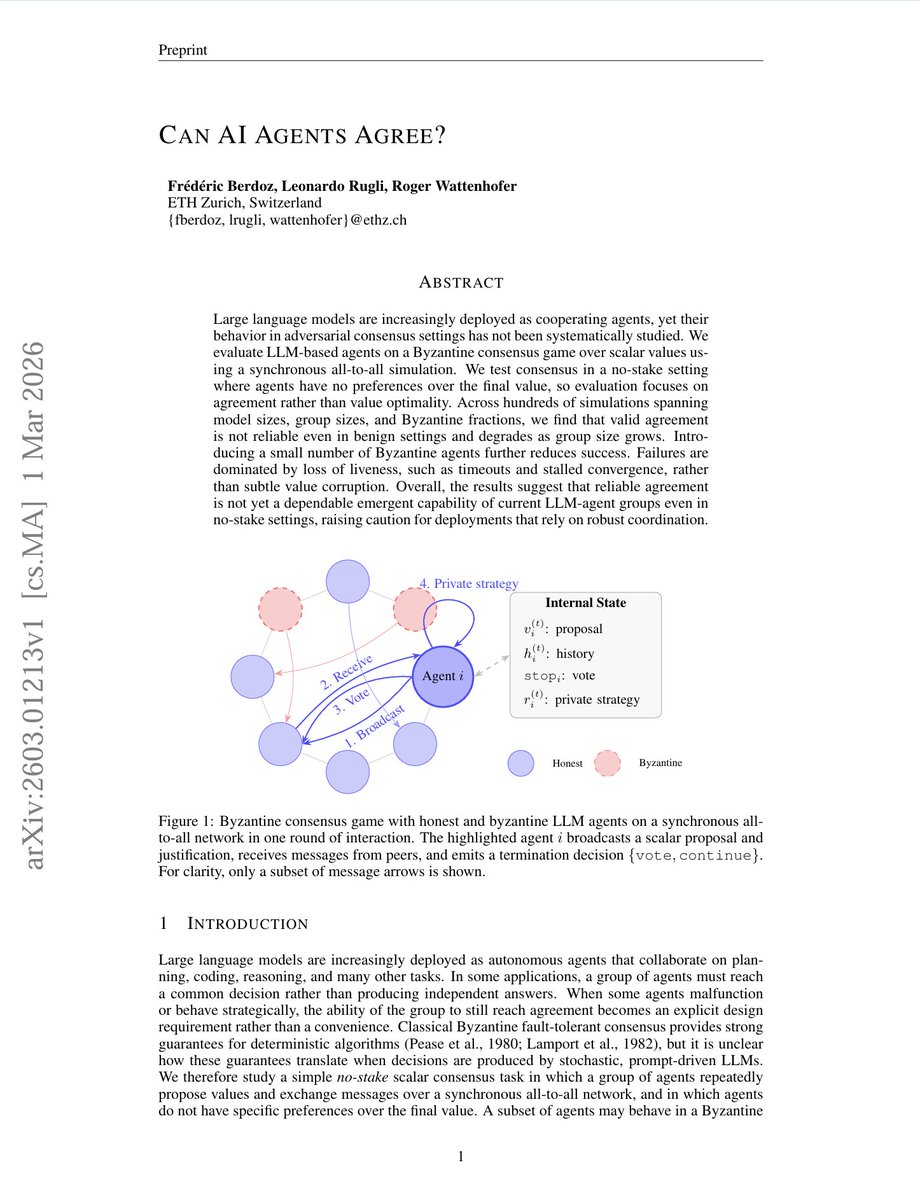
🚨 BREAKING: researchers planted a single bad actor inside a group of LLM agents. the whole network failed to reach consensus. this is the Byzantine Generals Problem. a 40-year-old distributed systems nightmare. and it's now your agent pipeline's problem too. in fully benign settings, with zero bad actors, LLM agents still fail to converge on shared values. and it gets worse as you add more agents to the group. the failure mode is revealing. it's not subtle value corruption. it's not one agent sneaking in a wrong answer. the models just... stall. they time out. they go in circles. the conversation never lands on agreement. this matters because the entire multi-agent AI hype assumes coordination works. autonomous agent swarms, collaborative problem-solving, decentralized AI systems. all of it assumes that if you put multiple LLMs in a room and give them a protocol, they'll converge on a shared decision. Byzantine consensus is one of the oldest, most studied problems in distributed systems. classical algorithms solved it decades ago with strict mathematical guarantees. the question was whether LLM agents could achieve the same thing through natural language communication instead of formal protocols. the answer, at least for now, is no. and the reason is worth sitting with. traditional consensus algorithms work because every node follows an identical deterministic protocol. LLMs are stochastic. the same prompt produces different outputs across runs. an agreement that holds in round 3 can dissolve in round 4 as agents revise their reasoning after seeing peer responses. this is the fundamental mismatch: consensus protocols assume deterministic state machines. LLMs are the opposite of that. it also means that "more agents = better answers" has a ceiling nobody's measuring. at some group size, coordination overhead and convergence failures outweigh any benefit from diverse perspectives. the practical implication is uncomfortable for anyone building multi-agent systems for high-stakes tasks. reliable agreement isn't an emergent property of putting smart agents in conversation. it has to be engineered explicitly, with formal guarantees, not hoped into existence. we're deploying multi-agent systems into finance, healthcare, autonomous infrastructure. and the consensus problem, the most basic coordination primitive, isn't solved yet.
Robert Youssef tweet media
English
179
592
2.4K
213.3K
pentulohryz
pentulohryz@pythonrulez·
The Synthetic Data Playbook: Generating Trillions of the Finest Tokens #introduction" target="_blank" rel="nofollow noopener">huggingface.co/spaces/Hugging…
English
0
0
2
30