singularity🦀

543 posts

singularity🦀

singularity🦀

@singularit80844

Software Engineer with a passion for building high-performance and reliable systems. #Rustacean #OpenToWork

가입일 Ocak 2025
312 팔로잉19 팔로워
singularity🦀 리트윗함
Guru Vamsi Policharla
Guru Vamsi Policharla@gvamsip·
Excited to share that I’ve joined @commonwarexyz! Looking forward to working with the amazing team to bring advanced cryptography onchain. First order of business is scaling SNARK verification onchain: we managed to verify over 500K proofs in 0.75s without recursion or external preprocessing! More details below 👇
English
23
9
154
11.5K
singularity🦀 리트윗함
Ethereum Foundation
Ethereum Foundation@ethereumfndn·
Today, several teams at the EF are launching pq.ethereum.org, a dedicated resource for Ethereum's post-quantum security effort. What started with early STARK-based signature aggregation research in 2018 has grown into a coordinated, multi-team effort, all open source. The Post-Quantum team and Cryptography teams, with help from the Protocol Architecture and Protocol Coordination teams, have been working on this body of work for 8+ years. At pq.ethereum.org you'll find: - How PQ impacts each protocol layer - The full PQ roadmap (strawmap.org) - Open resources: repos, specs, papers, EIPs - FAQ: 14 questions across 5 categories, written by the PQ team - A 6-part lean Ethereum interview series (@zeroknowledgefm) - Interest form for the 2nd Annual PQ Research Retreat (Cambridge, UK, Oct 2026) - 10+ client teams are already building and shipping devnets weekly through PQ Interop. All the work is public and all of it is open. pq.ethereum.org
English
91
239
949
88.8K
singularity🦀 리트윗함
fara.eth
fara.eth@fbwoolf·
1/10 Part 4 of the @leanEthereum miniseries dives into leanVM — a minimalist zkVM designed to aggregate post-quantum signatures directly in Ethereum’s consensus layer. Why build a VM for this instead of fixed circuits? 🧵
English
3
7
41
2.3K
singularity🦀 리트윗함
Georgios Konstantopoulos
Georgios Konstantopoulos@gakonst·
this is the era to build api compatible alternatives to widely used services, open source and faster
English
10
12
99
7.5K
singularity🦀 리트윗함
Tempo
Tempo@tempo·
Account abstraction is built into Tempo at the protocol level. For users, this means no seed phrases, gas tokens, or repeated confirmations. For developers, no middleware or smart contract workarounds. tempo.xyz/blog/account-a…
English
42
26
378
45.6K
singularity🦀 리트윗함
Julian
Julian@_julianma·
Ethereum needs an Encrypted Mempool and it needs it fast. It's not just about stopping sandwiching. Encrypted mempools are how Ethereum matures its onchain markets. I just published a post on why Ethereum needs encrypted mempools. Here are the core arguments:
English
35
48
323
44.4K
singularity🦀 리트윗함
vitalik.eth
vitalik.eth@VitalikButerin·
I was recently at Real World Crypto (that's crypto as in cryptography) and the associated side events, and one thing that struck me was that it was a clarifying experience in terms of understanding *what blockchains are for*. We blockchain people (myself included) often have a tendency to start off from the perspective that we are Ethereum, and therefore we need to go around and find use cases for Ethereum - and generate arguments for why sticking Ethereum into all kinds of places is beneficial. But recently I have been thinking from a different perspective. For a moment, let us forget that we are "the Ethereum community". Rather, we are maintainers of the Ethereum tool, and members of the {CROPS (censorship-resistant, open-source, private, secure) tech | sanctuary tech | non-corposlop tech | d/acc | ...} community. Going in with zero attachment to Ethereum specifically, and entering a context (like RWC) where there are people with in-principle aligned values but no blockchain baggage, can we re-derive from zero in what places Ethereum adds the most value? From attending the events, the first answer that comes up is actually not what you think. It's not smart contracts, it's not even payments. It's what cryptographers call a "public bulletin board". See, lots of cryptographic protocols - including secure online voting, secure software and website version control, certificate revocation... - all require some publicly writable and readable place where people can post blobs of data. This does not require any computation functionality. In fact, it does not directly require money - though it does _indirectly_ require money, because if you want permissionless anti-spam it has to be economic. The only thing it _fundamentally_ requires is data availability. And it just so happened that Ethereum recently did an upgrade (PeerDAS) to increase the amount of data availability it provides by 2.3x, with a path to going another 10-100x higher! Next, payments. Many protocols require payments for many reasons. Some things need to be charged for to reduce spam. Other things because they are services provided by someone who expends resources and needs to be compensated. If you want a permissionless API that does not get spammed to death, you need payments. And Ethereum + ZK payment channels (eg. ethresear.ch/t/zk-api-usage… ) is one of the best payment systems for APIs you can come up with. If you are making a private and secure application (eg. a messenger, or many other things), and you do not want to let people to spam the system by creating a million accounts and then uploading a gigabyte-sized video on each one, you need sybil resistance, and if you care about security and privacy, you really should care about permissionless participation (ie. don't have mandatory phone number dependency). ETH payment as anti-sybil tool is a natural backstop in such use cases. Finally, smart contracts. One major use case is _security deposits_: ETH put into lockboxes that provably get destroyed if a proof is submitted that the owner violated some protocol rule. Another is actually implementing things like ZK payment channels. A third is making it easy to have pointers to "digital objects" that represent some socially defined external entity (not necessarily an RWA!), and for those pointers to interact with each other. *Technically*, for every use case other than use cases handling ETH itself, the smart contracts are "just a convenience": you could just use the chain as a bulletin board, and use ZK-SNARKs to provide the results of any computations over it. But in practice, standardizing such things is hard, and you get the most interoperability if you just take the same mechanism that enables programs to control ETH, and let other digital objects use it too. And from here, we start getting into a huge number of potential applications, including all of the things happening in defi. --- So yes, Ethereum has a lot of value, that you can see from first principles if you take a step back and see it purely as a technical tool: global shared memory. I suspect that a big bottleneck to seeing more of this kind of usage is that the world has not yet updated to the fact that we are no longer in 2020-22, fees are now extremely low, and we have a much stronger scaling roadmap to make sure that they will continue to stay low, even if much higher levels of usage return. Infrastructure for not exposing fee volatility to users is much more mature (eg. one way to do this for many use cases is to just operate a blob publisher). Ethereum blobs as a bulletin board, ETH as an asset and universal-backup means of payment, and Ethereum smart contracts as a shared programming layer, all make total sense as part of a decentralized, private and secure open source software stack. But we should continue to improve the Ethereum protocol and infrastructure so that it's actually effective in all of these situations.
English
414
332
2K
295K
singularity🦀 리트윗함
cartoon.the🦄.eth
cartoon.the🦄.eth@cartoonitunes·
I’ve been reverse engineering Ethereum’s first contracts. Recently I did a deep scan of all 12,609 contracts deployed during the Frontier era and found 1,650 still holding ETH, totaling over 38,000 $ETH (~$80M at current prices) locked in contracts. 🧵
English
25
39
465
93.3K
singularity🦀 리트윗함
Harpalsinh Jadeja
Harpalsinh Jadeja@harpaljadeja·
👀 a very interesting TIP on Tempo - virtual addresses
Harpalsinh Jadeja tweet media
English
17
9
201
125.7K
singularity🦀 리트윗함
Georgios Konstantopoulos
please do not greenlight eip8141, if we want pq accounts we can do it another way but eip8141 is just bad about mempool validation rules and will put us into erc7562 land which is terrible add the validation rules to the eip and examine holistically eip8141 is a mistake as-is
English
9
3
86
14.3K
singularity🦀 리트윗함
matteo
matteo@mtteom_·
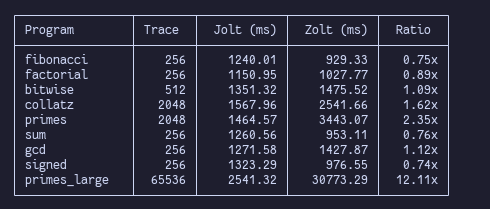
Introducing Zolt: the first pure-Zig zkVM Fully compatible with @a16zcrypto's Jolt, the entire cryptography is made from scratch in @ziglang , only using the stdlib! No arkworks FFI or other dependencies 🫡 The first benchmarks:
matteo tweet media
English
29
22
194
23.8K
singularity🦀 리트윗함
vitalik.eth
vitalik.eth@VitalikButerin·
Now, execution layer changes. I've already talked about account abstraction, multidimensional gas, BALs, and ZK-EVMs. I've also talked here about a short-term EVM upgrade that I think will be super-valuable: a vectorized math precompile (basically, do 32-bit or potentially 64-bit operations on lists of numbers at the same time; in principle this could accelerate many hashes, STARK validation, FHE, lattice-based quantum-resistane signatures, and more by 8-64x); think "the GPU for the EVM". firefly.social/post/x/2027405… Today I'll focus on two big things: state tree changes, and VM changes. State tree changes are in this roadmap. VM changes (ie. EVM -> RISC-V or something better) are longer-term and are still more non-consensus, but I have high conviction that it will become "the obvious thing to do" once state tree changes and the long-term state roadmap (see ethresear.ch/t/hyper-scalin… ) are finished, so I'll make my case for it here. What these two have in common is: * They are the big bottlenecks that we have to address if we want efficient proving (tree + VM are like >80%) * They're basically mandatory for various client-side proving use cases * They are "deep" changes that many shrink away from, thinking that it is more "pragmatic" to be incrementalist I'll make the case for both. # Binary trees The state tree change (worked on by @gballet and many others) is eips.ethereum.org/EIPS/eip-7864, switching from the current hexary keccak MPT to a binary tree based on a more efficient hash function. This has the following benefits: * 4x shorter Merkle branches (because binary is 32*log(n) and hexary is 512*log(n)/4), which makes client-side branch verification more viable. This makes Helios, PIR and more 4x cheaper by data bandwidth * Proving efficiency. 3-4x comes from shorter Merkle branches. On top of that, the hash function change: either blake3 [perhaps 3x vs keccak] or a Poseidon variant [100x, but more security work to be done] * Client-side proving: if you want ZK applications that compose with the ethereum state, instead of making their own tree like today, then the ethereum state tree needs to be prover-friendly. * Cheaper access for adjacent slots: the binary tree design groups together storage slots into "pages" (eg. 64-256 slots, so 2-8 kB). This allows storage to get the same efficiency benefits as code in terms of loading and editing lots of it at a time, both in raw execution and in the prover. The block header and the first ~1-4 kB of code and storage live in the same page. Many dapps today already load a lot of data from the first few storage slots, so this could save them >10k gas per tx * Reduced variance in access depth (loads from big contracts vs small contracts) * Binary trees are simpler * Opportunity to add any metadata bits we end up needing for state expiry Zooming out a bit, binary trees are an "omnibus" that allows us to take all of our learnings from the past ten years about what makes a good state tree, and actually apply them. # VM changes See also: ethereum-magicians.org/t/long-term-l1… One reason why the protocol gets uglier over time with more special cases is that people have a certain latent fear of "using the EVM". If a wallet feature, privacy protocol, or whatever else can be done without introducing this "big scary EVM thing", there's a noticeable sigh of relief. To me, this is very sad. Ethereum's whole point is its generality, and if the EVM is not good enough to actually meet the needs of that generality, then we should tackle the problem head-on, and make a better VM. This means: * More efficient than EVM in raw execution, to the point where most precompiles become unnecessary * More prover-efficient than EVM (today, provers are written in RISC-V, hence my proposal to just make the new VM be RISC-V) * Client-side-prover friendly. You should be able to, client-side, make ZK-proofs about eg. what happens if your account gets called with a certain piece of data * Maximum simplicity. A RISC-V interpreter is only a couple hundred lines of code, it's what a blockchain VM "should feel like" This is still more speculative and non-consensus. Ethereum would certainly be *fine* if all we do is EVM + GPU. But a better VM can make Ethereum beautiful and great. A possible deployment roadmap is: 1. NewVM (eg. RISC-V) only for precompiles: 80% of today's precompiles, plus many new ones, become blobs of NewVM code 2. Users get the ability to deploy NewVM contracts 3. EVM is retired and turns into a smart contract written in NewVM EVM users experience full backwards compatibility except gas cost changes (which will be overshadowed by the next few years of scaling work). And we get a much more prover-efficient, simpler and cleaner protocol. firefly.social/post/farcaster…
English
305
234
1.5K
202.9K
singularity🦀 리트윗함
vitalik.eth
vitalik.eth@VitalikButerin·
Now, account abstraction. We have been talking about account abstraction ever since early 2016, see the original EIP-86: github.com/ethereum/EIPs/… Now, we finally have EIP-8141 ( eips.ethereum.org/EIPS/eip-8141 ), an omnibus that wraps up and solves every remaining problem that AA was intended to address (plus more). Let's talk again about what it does. The concept, "Frame Transactions", is about as simple as you can get while still being highly general purpose. A transaction is N calls, which can read each other's calldata, and which have the ability to authorize a sender and authorize a gas payer. At the protocol layer, *that's it*. Now, let's see how to use it. First, a "normal transaction from a normal account" (eg. a multisig, or an account with changeable keys, or with a quantum-resistant signature scheme). This would have two frames: * Validation (check the signature, and return using the ACCEPT opcode with flags set to signal approval of sender and of gas payment) * Execution You could have multiple execution frames, atomic operations (eg. approve then spend) become trivial now. If the account does not exist yet, then you prepend another frame, "Deployment", which calls a proxy to create the contract (EIP-7997 ethereum-magicians.org/t/eip-7997-det… is good for this, as it would also let the contract address reliably be consistent across chains). Now, suppose you want to pay gas in RAI. You use a paymaster contract, which is a special-purpose onchain DEX that provides the ETH in real time. The tx frames are: * Deployment [if needed] * Validation (ACCEPT approves sender only, not gas payment) * Paymaster validation (paymaster checks that the immediate next op sends enough RAI to the paymaster and that the final op exists) * Send RAI to the paymaster * Execution [can be multiple] * Paymaster refunds unused RAI, and converts to ETH Basically the same thing that is done in existing sponsored transactions mechanisms, but with no intermediaries required (!!!!). Intermediary minimization is a core principle of non-ugly cypherpunk ethereum: maximize what you can do even if all the world's infrastructure except the ethereum chain itself goes down. Now, privacy protocols. Two strategies here. First, we can have a paymaster contract, which checks for a valid ZK-SNARK and pays for gas if it sees one. Second, we could add 2D nonces (see docs.erc4337.io/core-standards… ), which allow an individual account to function as a privacy protocol, and receive txs in parallel from many users. Basically, the mechanism is extremely flexible, and solves for all the use cases. But is it safe? At the onchain level, yes, obviously so: a tx is only valid to include if it contains a validation frame that returns ACCEPT with the flag to pay gas. The more challenging question is at the mempool level. If a tx contains a first frame which calls into 10000 accounts and rejects if any of them have different values, this cannot be broadcasted safely. But all of the examples above can. There is a similar notion here to "standard transactions" in bitcoin, where the chain itself only enforces a very limited set of rules, but there are more rules at the mempool layer. There are specific rulesets (eg. "validation frame must come before execution frames, and cannot call out to outside contracts") that are known to be safe, but are limited. For paymasters, there has been deep thought about a staking mechanism to limit DoS attacks in a very general-purpose way. Realistically, when 8141 is rolled out, the mempool rules will be very conservative, and there will be a second optional more aggressive mempool. The former will expand over time. For privacy protocol users, this means that we can completely remove "public broadcasters" that are the source of massive UX pain in railgun/PP/TC, and replace them with a general-purpose public mempool. For quantum-resistant signatures, we also have to solve one more problem: efficiency. Here's are posts about the ideas we have for that: firefly.social/post/lens/1gfe… firefly.social/post/x/2027405… AA is also highly complementary with FOCIL: FOCIL ensures rapid inclusion guarantees for transactions, and AA ensures that all of the more complex operations people want to make actually can be made directly as first-class transactions. Another interesting topic is EOA compatibility in 8141. This is being discussed, in principle it is possible, so all accounts incl existing ones can be put into the same framework and gain the ability to do batch operations, transaction sponsorship, etc, all as first-class transactions that fully benefit from FOCIL. Finally, after over a decade of research and refinement of these techniques, this all looks possible to make happen within a year (Hegota fork). firefly.social/post/bsky/qmaj…
English
315
395
2.4K
287.1K
singularity🦀 리트윗함
zkSecurity
zkSecurity@zksecurityXYZ·
The first two known exploits against live ZK circuits just happened, and they weren't subtle underconstrained bugs. They were Groth16 verifiers deployed without completing the trusted setup ceremony. One was white-hat rescued for ~$1.5M, the other drained for 5 ETH. 🧵
English
17
83
372
50.9K
singularity🦀 리트윗함
ross.wei
ross.wei@z0r0zzz·
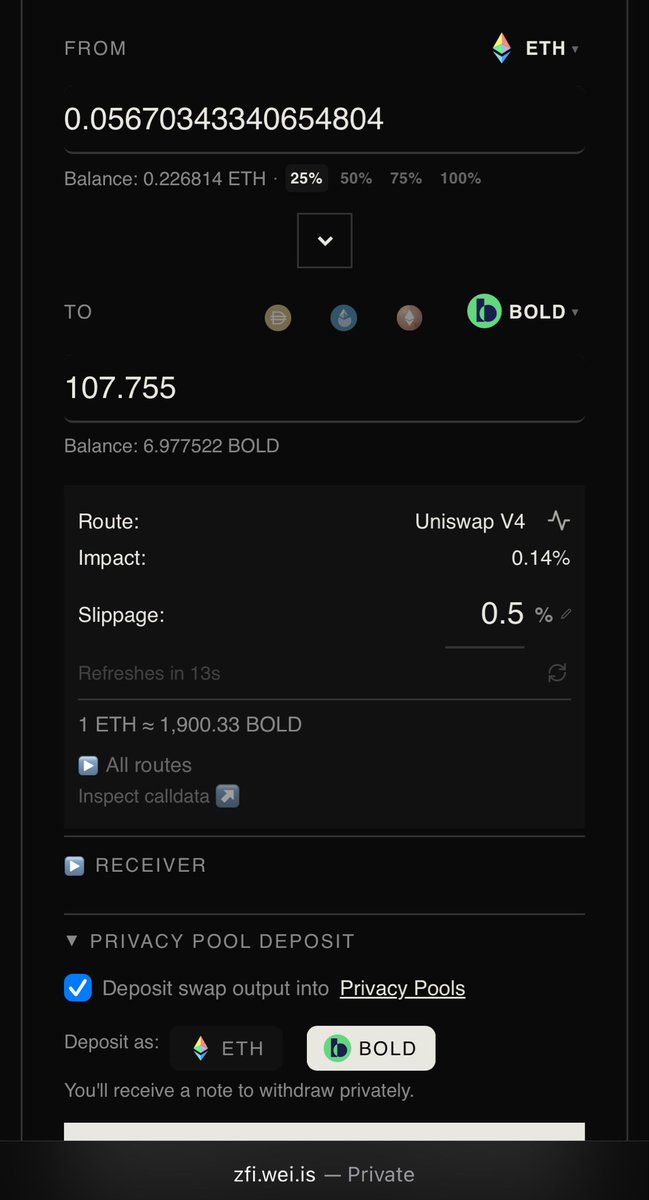
you can cash out stables now to a clean address in a single swap with zfi private routing
ross.wei tweet media
English
8
7
60
3.5K
singularity🦀 리트윗함
lucid.
lucid.@lucidzk·
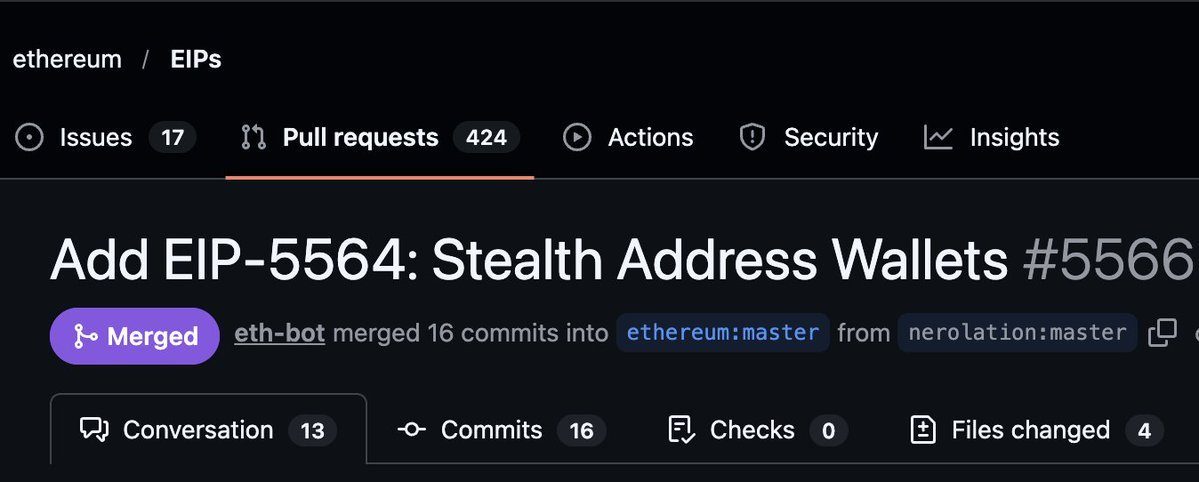
EIP-5564 - stealth addresses natively to ETH. - the cypherpunks are winning across every ecosystem,
lucid. tweet media
English
14
35
347
18K