bugga

2.1K posts

bugga banner
bugga

bugga

@0xBugga

Katılım Nisan 2022
1 Takip Edilen2.9K Takipçiler
bugga retweetledi
ziskvm
ziskvm@ziskvm·
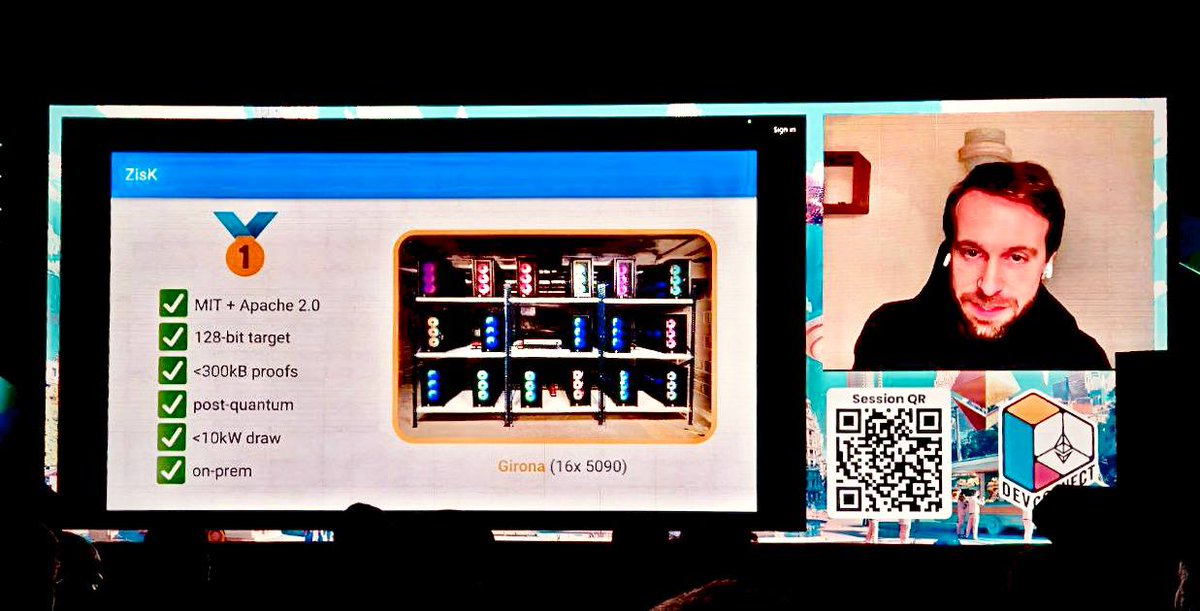
This is the result of two year of hard work @ziskvm We are committed to prove Ethereum in real time Our Girona cluster (16×5090) delivers all requirements for real-time Ethereum proving: • 128-bit security target • <300 kB proof size • Post-quantum readiness • <10 kW power envelope We extend our appreciation to @drakefjustin and @eth_proofs team for the leadership and standards that continue to strengthen the Ethereum ecosystem.
ziskvm tweet media
English
16
36
184
15.5K
bugga retweetledi
Rahul Saxena
Rahul Saxena@saxenism·
The TEE security handbook is live now. This document covers: + Defining TEEs + TEE attacks categorisation + Deep dive of TEE platforms + Threat modelling around TEEs + Security layers for TEE protocols + Best practices for engineers & protocols Here: docs.bluethroatlabs.com
English
32
31
203
34.2K
bugga retweetledi
Abix
Abix@0xAbix·
There’s no single “winner” for privacy it’ll be layered and context-specific. Different stacks solve different things : 1. Payments: Privacy coins like @Zcash and @monero are great at default secrecy but bad at composability and compliance. The real future imo here is stablecoins on public L2s/L1s [] with app-level privacy (stealth addresses, note commitments, and selective proofs). 2. DeFi & trading: Programmable ZK infra (@aztecnetwork , @0xMiden ,@AleoHQ ) this would be enabling targeted privacy like sealed intents, private state, and verifiable settlement and to top it of if all are composable with existing EVM infrastructure. This might also be a mix of applications working on specific privacy computes [ FHE MPC, TEEs based etc ] 3. Institutions: Permissioned or hybrid networks (like @CantonNetwork or @zksync Prividium )might fit the institutional needs for selective visibility, policy controls, and auditability. They care about regulatory assurance first, anonymity second. [Interesting would be if @Plasma @stable join this space too] 4. Private data & computation: Encrypted compute networks (FHE, MPC, TEEs like Arcium and @zama_fhe ) are powerful for analytics and private matching or hybrid models: encrypted compute for secrecy, ZK for correctness. 5. ZK compute infrastructure: Engines like @ziskvm and @RiscZero with distributed proving, quantum-resistant security. The faster and cheaper proof generation becomes, the easier it is for the rest of the privacy stack to go mainstream. I think what we could see coming up would be: 1. Selective disclosure > absolute secrecy. 2. Verifiability > trust. 3. Composability drives adoption. 4. Policy-aware privacy is mandatory. Whoever makes “private by default” fast and cheap wins.
English
1
4
16
718
bugga retweetledi
Rahul Saxena
Rahul Saxena@saxenism·
The @TeeDotFail research broke the confidentiality & integrity guarantees of TEEs & that’s huge. But the way it’s being presented feels more like a hit-piece than an honest discussion. Let’s unpack this attack & I'll tell you why it makes me more bullish on TEEs, not less 👇🧵
Yannik Schrade@yrschrade

🚨 TEEs are AGAIN compromised! 🚨 This time it's even bigger! TL;DR - 3 weeks ago: Intel SGX exploit (DDR4) - Today: Exploit affecting the latest State-Of-The-Art TEEs by Intel, AMD and Nvidia (DDR5) TEEs don't bring privacy or security in crypto. All you need to know 👇🧵

English
24
28
95
29.4K
bugga retweetledi
Abix
Abix@0xAbix·
Control Plane for Distributed Proving This part (1/5) isn’t about scheduling or marketplace logic yet (I'll be trying to extend this though) it’s about building visibility first. I tried to built a distributed job coordination dashboard @ziskvm , helps to observe and manage distributed proof jobs. It gives visibility into what the coordinator and workers are doing i.e. which jobs are running, how much capacity is available, and how things change over time. Every data point in the UI is reconstructed directly from live polling cycles against the coordinator through a REST→gRPC gateway. More in the thread below:
English
3
7
17
1.5K
bugga retweetledi
Abix
Abix@0xAbix·
1.7x faster, Distributed proof generation with @ziskvm Setup: Coordinator on my Mac, worker on remote server via SSH tunnel Key learning: The speedup [ 193s → 115s ] came from better remote h/w, BUT the distributed architecture lets you mix hardware types and actually scale proof generation. More updates incoming, Shhh.... *if you know fuckall about coordinators and workers and stuff, just say hi"
English
4
2
10
2.2K
bugga retweetledi
Abix
Abix@0xAbix·
Distributed Proof Generation! gm everyone, Spent this week deep-diving into @ziskvm’s distributed proving architecture and built a complete walkthrough from setup to final proof. I've tried to summarise my learnings to help you understand the following : - Full breakdown of the 3-phase proving workflow. - How the coordinator & worker model actually work. - Step-by-step manual deployment and logs If you’ve ever wondered what's there beside the door for distributed proof generation and what actually happens in practice this is a full, reproducible walkthrough. Link to the blog : x.com/0xAbix/status/…
English
6
12
42
4.8K
bugga retweetledi
Abix
Abix@0xAbix·
Spent yesterday (thanks AWS outage) diving deep into distributed proof generation vs proof marketplaces. After 6 hours analyzing @ziskvm , @SuccinctLabs Network, and @boundless_xyz Here's my thesis: For high-frequency proving (rollups, coprocessors), distributed systems are architecturally superior. Why? Parallelism (multiple workers vs one prover = 3-5x speedup potential), partial failure recovery (lose 1/N of work vs 100%), better cost structure at scale (fixed costs amortize over volume). Marketplaces are perfect for occasional proofs. But for continuous, latency-sensitive proving? Distributed wins on multiple dimensions. Details with Amdahl's Law, ZisK's three-phase architecture, and honest caveats here in the blog:
Abix@0xAbix

x.com/i/article/1980…

English
2
5
18
1.4K
bugga retweetledi
Abix
Abix@0xAbix·
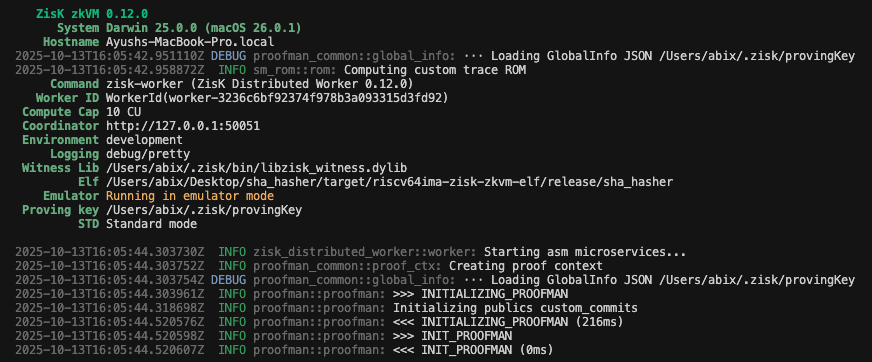
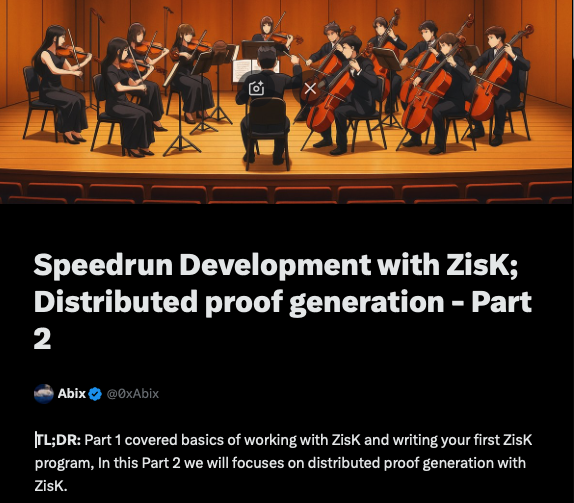
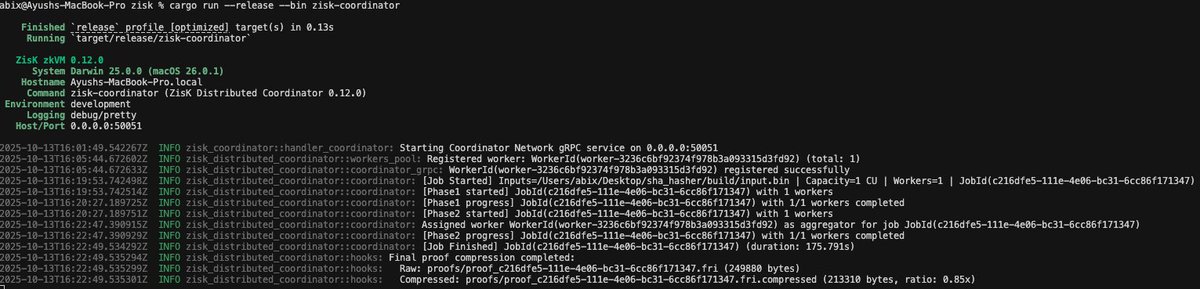
Just got ZisK's distributed proof generation running! Will be sharing a detail writeup to how you can get started with setting up the environment and start building. @ziskvm sets a new standard in the zk proving space with: 1. 128 bit security 2. Distributed proof generation 3. Fully Open source Let's connect in the DMs if you want to talk about building with ZisK
Abix tweet mediaAbix tweet mediaAbix tweet mediaAbix tweet media
Abix@0xAbix

Getting started with ZisK - Part 1 This piece walks through what actually happens when you write and prove a ZisK program. It also breaks down how ZisK internally works for generating and working with @ziskvm's proof system. By the end, you’ll have an understanding of how execution and proof generation fit together in ZisK, and how you can start building private, verifiable programs. Part 2 will focus on distributed proof generation with @ziskvm

English
3
4
17
2.6K
bugga retweetledi
Abix
Abix@0xAbix·
Getting started with ZisK - Part 1 This piece walks through what actually happens when you write and prove a ZisK program. It also breaks down how ZisK internally works for generating and working with @ziskvm's proof system. By the end, you’ll have an understanding of how execution and proof generation fit together in ZisK, and how you can start building private, verifiable programs. Part 2 will focus on distributed proof generation with @ziskvm
Abix@0xAbix

x.com/i/article/1963…

English
2
5
23
3.9K
bugga retweetledi
ziskvm
ziskvm@ziskvm·
Today is the day. 16:00 CEST Join us for the ZisK Community Call + AMA where we will discuss: • The v0.12.0 release highlights • Distributed proving system design • Mainnet-scale performance results • Roadmap for post-quantum zkVMs Register: luma.com/4bhxbhft
English
1
4
15
1.9K
bugga retweetledi
Abix
Abix@0xAbix·
Link to register for the community call with @ziskvm team. Reserve your slot here [ luma.com/4bhxbhft ]
English
0
2
4
319
bugga retweetledi
Abix
Abix@0xAbix·
This is a big moment for zkVMs ! The @ziskvm team has been shipping at an incredible pace, and these latest developments are serious, Here’s a quick recap of what’s new: 1. Distributed proof generation is now live. 2. You can prove Ethereum blocks in real time. 3. Everything runs with native 128-bit, quantum-resistant security. We’re hosting a Community Call tomorrow to dive deeper. would love to have you join us, Link to register in the below chat !
English
14
5
41
3.3K
bugga retweetledi
Abix
Abix@0xAbix·
Built a ZisK CLI tool to speed up my testing/experimentation with @ziskvm The standard ZisK workflow is modular and configurable: you set up the project → prepare inputs → compile to RISC-V 64 ELF → execute in the ZisK emulator (with metrics and stats) → verify constraints → generate proofs (CPU/GPU, single or multi-process) → verify proofs. But I am lazy 🦫 so What I tried to build : 1. zisk-dev init - Auto-detect existing projects or setup a new zisk project. 2. zisk-dev run - Complete pipeline in one command [ convert inputs → build → execute → generate proofs ] 3. zisk-dev stats - Detailed performance analysis with Air instances & memory usage. 4. zisk-dev prove - Generate proofs with comprehensive logging TL;DR: Configuration-driven with .zisk-env file Auto-detects ZisK installations and project structures > Works with existing ZisK projects without modification. > This is a personal dev. acceleration tool for testing/experimentation. ⚠️Please note I build this to speeds up my experimentation cycle with working with ZisK. Official ZisK documentation are recommended for development [ 0xpolygonhermez.github.io/zisk/getting_s… ] Try it here : npm install -g @abix/zisk-dev-cli@latest Repo: github.com/amiabix/ZisK-C… Try and let me know your thoughts, Since it's a WIP It would be really helpful.
Abix tweet media
English
2
4
16
1.3K