Aaron

1K posts

Aaron banner
Aaron

Aaron

@AaronMasuba

Electrical and Computer Engineer. Intelligent Systems and Robotics Specialist (Computer Vision Research) AI Innovation Fellow @Intel Technical Member @ACM

Katılım Mart 2019
1.7K Takip Edilen176 Takipçiler
Aaron retweetledi
Suraj Sharma
Suraj Sharma@suraj_sharma14·
Applications are open for the Cohere Labs Community ML Summer School. • Free online ML summer school with live sessions • Learn from researchers and engineers at Google DeepMind, Meta, Cohere, Liquid AI, Arize and more • Topics include Agentic AI, LLMs, World Models, Computer Vision, ML Math, Evaluations, Edge AI and AI Careers • Interactive sessions with leading ML researchers and practitioners • Open to students, developers, researchers and AI enthusiasts worldwide • Digital certificate of participation If you're serious about building a career in AI, this is one of the best free learning opportunities this summer. Register: events.zoom.us/ev/AqU4vnBuHB4…
Suraj Sharma tweet media
English
3
29
294
20.6K
Aaron retweetledi
Avi Chawla
Avi Chawla@_avichawla·
NVIDIA researchers built a new transformer variant. One small change to the layers made: - decoding 1.7x faster - long-reasoning accuracy up 6.5 points In a typical transformer architecture, every attention layer computes Q, K, and V. NVIDIA's tweak adds a fourth projection, which predicts what the next layer will need. To understand why they did this, let's first see what happens in a Transformer architecture during inference right now. Sparse attention was an attempt to handle long-context inference. Instead of attending to every cached token, modern designs score the KV cache in blocks, keep the top-k, and attend only to those. That cuts attention compute and bandwidth, but this still leaves us with two problems. > First, the KV cache still grows with every generated token. At 100K+ context, it no longer fits in GPU memory and gets offloaded to CPU RAM. Now every layer must first copy its selected KV blocks from CPU memory back to the GPU. That copy is slow, the GPU sits idle while it waits, and the stall repeats at every layer of every decode step. > Second, the selection step itself is not free. Standard selectors score every candidate block with every query head in a GQA group (grouped-query attention, where several query heads share one KV head), then softmax each head's scores and sum them across the group. During decode, the sparse attention itself is cheap because there is only one query token. But the expensive part is deciding which blocks to attend to, and that cost keeps growing with context length. Both problems trace back to the same design in today's sparse attention methods, i.e., the attention query drives the block selection. Selection needs the query vector Q, and Q only exists once its layer is already running. By then, it's too late to fetch anything early. The query also drags its multi-head layout into selection, so all that scoring computation runs just to make one top-k decision. A recent paper from NVIDIA and MIT called SparDA breaks this coupling with one architectural change. Each layer now emits four projections instead of three: ↳ Q, K, V, and a Forecast. The Forecast from layer L predicts which KV blocks layer L+1 will need. Layer L+1's own query performs the sparse attention over those selected blocks. This one change fixes both problems. Since the next layer's block set is known while the current layer is still computing, the runtime fetches those blocks from CPU memory on a separate CUDA stream. The copy overlaps with the current layer's compute, so the GPU no longer waits for it. And since the Forecast is separate from the attention query, it doesn't need one score per query head. SparDA uses one Forecast head per GQA group, which removes the per-query-head scoring loop and skips the softmax step entirely. DeepSeek did something similar in DSA, where a small indexer picks important tokens instead of the query doing it. SparDA applies the same idea to blocks and adds the prefetch angle that DSA doesn't touch. The cost of the change is small. The Forecast adds just 33.5M parameters on an 8B model (0.41%), and only those projections are trained, using a KL loss that matches the original selector's block distribution. On MiniCPM4.1-8B and NOSA-8B, accuracy matches or beats the sparse baseline, with NOSA-8B gaining +6.5 on long reasoning. Prefill runs up to 1.25x faster and decode up to 1.7x faster than the sparse offload baseline. There's one more benefit. Because prefetch hides the offload cost, most of the KV cache can live in CPU RAM, and the freed GPU memory fits much bigger batches, pushing decode throughput up to 5.3x over the non-offload sparse baseline. That said, this lookahead will only pay off during decode with CPU offload. During prefill, all keys already live on the GPU, so the gain there comes purely from the cheaper selection. Here's the paper: arxiv.org/abs/2606.04511 I wrote a first-principles breakdown of how the KV cache works. It walks through why the model stores keys and values at all, why the cache grows with every token, and a comparison of LLM generation speed with and without KV caching. Read it below.
Avi Chawla@_avichawla

x.com/i/article/2034…

English
16
195
1.1K
115.1K
Aaron retweetledi
Rahul
Rahul@sairahul1·
Google just dropped a 1-hour course on agentic engineering from scratch: 00:00 – How to build your first AI agent 08:24 – Build agent memory (short, persistent, long) 28:34 – Agentic loops, long-running AI agents 40:04 – How to build MCP (MCP vs API) 1:00:22 – Multi-agentic systems This 1-hour watch will replace 10 paid agentic courses on the internet. Bookmark this. Watch this weekend.
Rahul@sairahul1

x.com/i/article/2074…

English
59
892
4.2K
603.5K
Aaron retweetledi
CyrilXBT
CyrilXBT@cyrilXBT·
PEOPLE ARE PAYING FOR AI ENGINEERING BOOTCAMPS BUILT FROM THIS EXACT MATERIAL. Andrew Ng gave 3 hours of it away free. 00:00 Building agentic AI systems 04:25 Where AI engineering is actually headed 23:38 The full prompting course 2:52:17 Building an app with AI in 30 minutes The man who taught 8 million people AI just handed you the 2026 curriculum for free. Watch it, then read the self improving system guide below. Follow @cyrilXBT
CyrilXBT@cyrilXBT

x.com/i/article/2074…

English
24
181
737
87.4K
Aaron retweetledi
Suraj Sharma
Suraj Sharma@suraj_sharma14·
Anthropic has opened applications for its Fellows Program, a 4-month fully funded research opportunity offering approximately $15,400/month plus compute credits and direct mentorship from Anthropic researchers. Fellows can work in Berkeley, London or remotely, contributing to cutting-edge AI research. The program covers AI safety, security, ML systems, reinforcement learning and AI policy & economics. No PhD or prior research experience is required but strong technical skills and full-time availability are expected. Applications are rolling for the September 2026 cohort. Apply here : job-boards.greenhouse.io/anthropic/jobs…
Suraj Sharma tweet media
English
4
32
423
41.4K
Aaron retweetledi
Nainsi Dwivedi
Nainsi Dwivedi@NainsiDwiv50980·
Anthropic engineer: "You're not supposed to prompt Claude. You're supposed to build a system that prompts itself." In 45 minutes she breaks down how Anthropic builds agents that remember, learn from their mistakes, and get smarter with every run. Worth more than any paid course you'll find on building agents. Watch the session, then read the guide on building loops below.
Nainsi Dwivedi@NainsiDwiv50980

x.com/i/article/2073…

English
15
35
121
31K
Aaron retweetledi
Aiswarya Venkitesh
Aiswarya Venkitesh@AiswaryaVenkit1·
Anthropic engineer: "You're not supposed to prompt Claude. You're supposed to build a system that prompts itself." In 45 minutes she breaks down how Anthropic builds agents that remember, learn from their mistakes, and get smarter with every run. Worth more than any paid course you'll find on building agents. Watch the session
English
35
277
1.8K
217K
Aaron retweetledi
Ishika Rawat
Ishika Rawat@Ishh_021·
Anthropic pays $750,000+ a year for engineers who can build LLM architectures from scratch. Stanford taught the entire thing in 1 hour lecture & released it for free. Bookmark & watch this today before someone takes it down and read this article below.
English
9
61
315
26.3K
Aaron retweetledi
codila
codila@0xCodila·
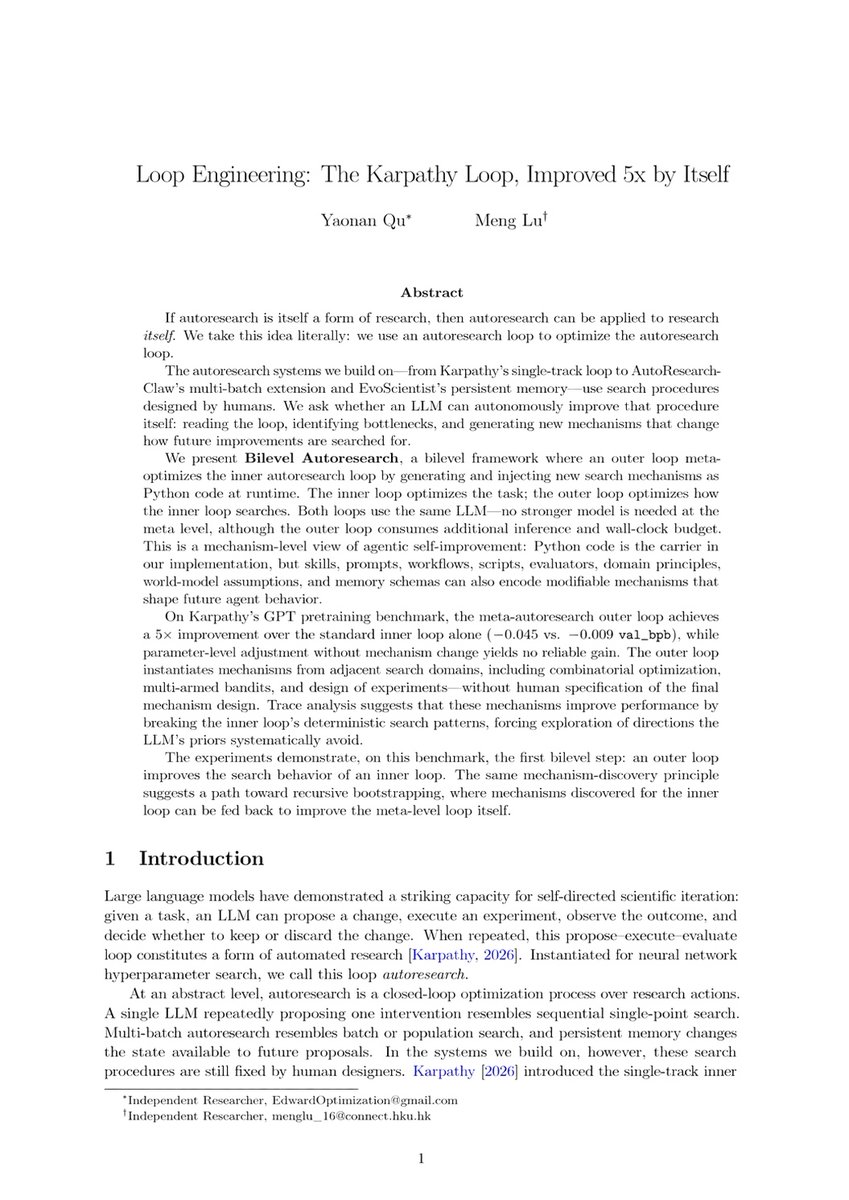
Two Hong Kong students just made Karpathy's loop 5x better - dropped 18-page PDF The twist: the loop got 5x better the moment you put another loop on top of it here's the whole method, step by step: step 1 → Karpathy's loop gets stuck - the LLM keeps reproposing the same changes, falling back to its priors step 2 → so they add an outer loop that reads the inner loop's code and finds where it's stuck step 3 → the outer loop writes new search logic as Python and injects it live - 5x better, same model how to steal this for your agents: step 4 → write a second agent whose only job is to read the first one's logs and find where it's stuck step 5 → let it rewrite the rules - workflow, skill, prompt - not just retry the task step 6 → auto-revert every rewrite on failure, so a bad change never breaks your pipeline the result: 5x better than Karpathy's loop alone - same LLM, no smarter model, it's the architecture this 18-page PDF is what comes after the Karpathy loop read it now - the full build workflow is in the article below ↓
codila tweet media
codila@0xCodila

x.com/i/article/2069…

English
55
329
2K
244.2K
Aaron retweetledi
Ilir Aliu
Ilir Aliu@IlirAliu_·
Robotics is getting its Raspberry Pi moment. This solves one of the biggest frictions in Physical AI: Everything has been fragmented. Different tools for control. Sensors. Calibration. Learning. Now it’s one unified stack: • motor control to VLA models in one system • built for real hardware, not just simulation -> norma_core_dev just entered PUBLIC ALPHA. The real unlock is ElRobot: • 7+1 DOF arm • fully 3D printable • ~220$ cost • ships with CAD, URDF, full build guide Not a demo… Infrastructure. And the part most people will underestimate: auto-calibration for any robot No manual tuning. No trial and error. Just: code → hardware → working system That removes one of the biggest hidden bottlenecks in robotics. Which unlocks: • faster iteration • cheaper experiments • real-world data loops Exactly what Physical AI needs. We’re moving from: “Can we make it work?” to “How fast can we improve it?” Thank you so much for sharing, @ErickSky! 📍Repro: github.com/norma-core/nor… Credit: normacore.dev
English
23
93
763
59.6K
Aaron retweetledi
Feryal
Feryal@FeryalMP·
I’m hiring! Come join our team at Google DeepMind in London or Mountain View to work on Gemini agent post-training. We are looking for Research Scientists and Research Engineers interested in advancing the capabilities of AI agents. Please apply here: google.com/about/careers/…
English
31
82
1.1K
180.9K
Aaron retweetledi
Praveen Kumar Verma
Praveen Kumar Verma@Alacritic_Super·
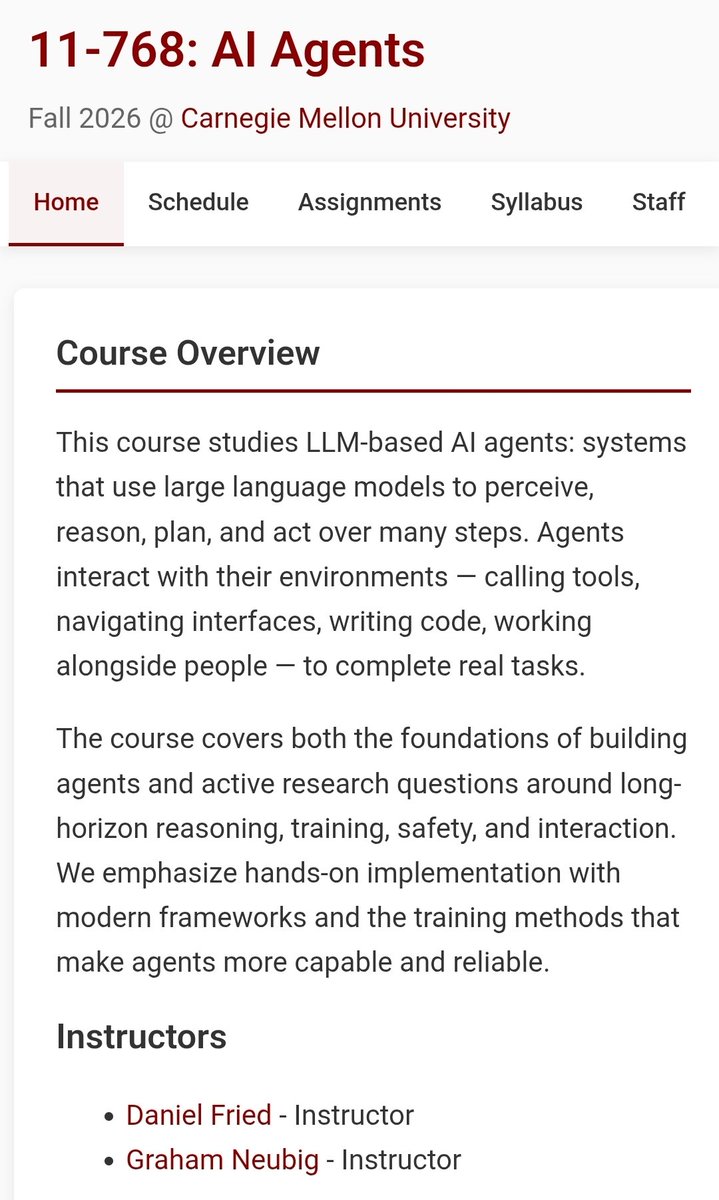
Carnegie Mellon University's 11-768: AI Agents is one of the most comprehensive free courses on building LLM-based agents. 🚀 📚 Course Schedule Week 1: Introduction to AI Agents & LLM Foundations Week 2: Prompting, Tool Use & Function Calling Week 3: Planning & Reasoning (ReAct, Tree of Thoughts) Week 4: Memory & Long-Term Agent Architectures Week 5: Retrieval-Augmented Generation (RAG) Week 6: Multi-Agent Systems Week 7: Training & Fine-Tuning Agents Week 8: Evaluation & Benchmarks Week 9: Safety, Alignment & Guardrails Week 10: Building Production AI Agents Week 11: Advanced Research Topics Week 12: Final Project & Presentations Course: cmu-agents.com
Praveen Kumar Verma tweet media
English
9
82
473
23.4K
Aaron retweetledi
Param
Param@ParamSiddh·
Best YouTube Channels To Learn AI in 2026 (No BS) 1. Fundamentals – 3Blue1Brown 2. Deep Learning – Andrej Karpathy 3. AI Research – Yannic Kilcher 4. Practical AI – AssemblyAI 5. LLMs – AI Explained 6. ML Theory – StatQuest 7. Papers Simplified – Two Minute Papers 8. GenAI – Matthew Berman 9. AI Agents – Nicholas Renotte 10. Applied ML – Krish Naik 11. PyTorch – Aladdin Persson 12. Math for ML – Serrano Academy 13. Industry Insights – Lex Fridman 14. Real-world AI – DeepLearningAI
Param tweet mediaParam tweet media
English
33
467
2.8K
138.8K
Aaron retweetledi
codila
codila@0xCodila·
Anthropic Engineer Andrej Karpathy: "The biggest mistake in AI right now - people are forcing agents to work instead of mastering the model first We made that mistake in 2016 at OpenAI - It cost us 5 years " what Karpathy actually means: step 1 → stop forcing your agent to do everything, understand the model underneath first step 2 → demos are easy - products take a decade. self-driving proved it - if you skip the foundation, everything breaks step 3 → the agent is not the product. the foundation is. build that - and agents emerge on their own "you building agents right now - you're at the forefront. not OpenAI. not DeepMind. you " watch - bookmark, then read article below ↓
codila@0xCodila

x.com/i/article/2069…

English
166
757
7.3K
1.9M
Aaron retweetledi
Avi Chawla
Avi Chawla@_avichawla·
Stanford researchers did it again. They just built the agent-native version of Git. When an agent works on a longer task, the run builds up a lot of state. This includes files edited/created, a dev server, a database, installed packages, KV cache, etc. Say the agent is at step 10 and makes a mistake, maybe it misreads a traceback and rewrites a file that was actually fine. The tests start failing, and the run goes off track, although everything through step eight was correct. By default, the agent just tries to fix it, which creates more edits and tool calls. This burns more tokens and grows the context. The other options are a person stepping in to redirect it or restarting the whole run from step one. That's wasteful, because it pays for every model/tool call again and re-prefills the context. Moreover, since an agent's run is non-deterministic, it doesn't reproduce the same early steps anyway. The reason it's hard to just jump back exactly to a previous correct step and resume from there is that the trajectory is only a message log. It records what the agent said and which tools it called, but not the live state underneath. That state includes things like memory, open file handles, child processes, installed packages, /tmp, and KV cache. None of that is in the log. Git can version the files, but it doesn't snapshot the running process or the KV cache. Checking out step eight moves the files back, but the process is still sitting in step-ten memory with a cold cache. Shepherd is a runtime layer by Stanford that records the run as a trace of typed events rather than a flat log. Each agent-environment interaction becomes a commit, similar to Git, but it tracks the live run. Its commit includes the agent process and the filesystem together, copy-on-write, so a branch carries the actual state and not just the files. Going back to a previous step is then a single call that forks from that commit and continues from the exact state. The copy-on-write fork is roughly five times faster than docker commit, and because the prompt prefix through step eight is unchanged, the KV cache is reused over 95% on replay, so early steps aren't reprocessed again. Once the run can be forked, a meta-agent can sit on top and operate it. It watches the trace and reverts as soon as it looks wrong, before the bad write is committed. In practice, it's just Python calling fork, replay, and revert on the trace, rather than a separate control plane wired into the harness. Not everything is reversible though. Files and sandbox changes undo themselves, but a database write has no automatic undo, so it needs a matching undo step set up in advance. Something external, like a sent email or a real charge, can't be undone, so the supervisor's job there is to catch it before it fires. They tested this on a few public benchmarks. On CooperBench, where two agents work on the same codebase, adding a live supervisor took the pair-coding pass rate from 28.8% to 54.7%. It's still early and labeled alpha. The benefit mostly shows up when a run gets branched a lot over a heavy sandbox state, which is exactly where restarting wastes the most tokens and time. If Git was made to make file changes reversible, Shepherd is trying to do the same thing for a live agent run. Shepherd Repo: github.com/shepherd-agent… (don't forget to star it ⭐ ) That said, Shepherd reverts a bad step inside a run. The harness around it, the prompts, tools, and checks the supervisor relies on, still drifts across runs as models and dependencies change. Akshay wrote about making that harness repair itself, where a failing trace gets diagnosed, the fix is verified against the exact input that failed, and the failure is locked as a regression test so it can't recur. Read it below.
Akshay 🚀@akshay_pachaar

x.com/i/article/2063…

English
62
357
3K
438.1K
Aaron retweetledi
Suraj Sharma
Suraj Sharma@suraj_sharma14·
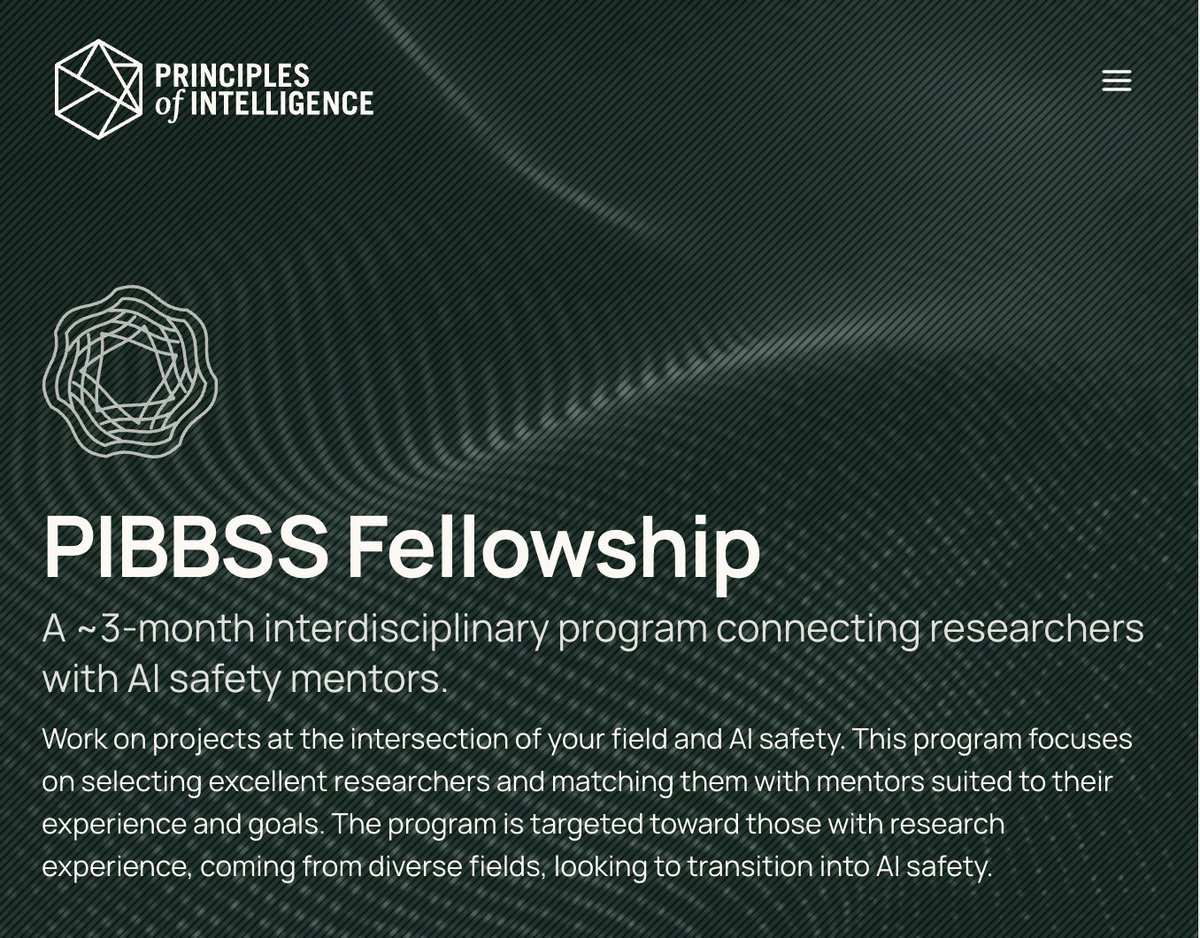
A fully funded 3-month program designed for researchers looking to work on AI alignment with world-class mentors. The @pibbssai Fellowship is now accepting applications. What you get: • $3,000/month stipend • Free accommodation, meals and return flights • 1:1 mentorship from AI safety researchers • A chance to work on your own research project • Alumni network across Anthropic, Google, Oxford, Harvard, Epoch, FAR AI and more Deadline: July 20, 2026 apply: princint.ai/programs/fello…
Suraj Sharma tweet media
English
6
44
366
25.7K
Aaron retweetledi
Lewis 🏴󠁧󠁢󠁷󠁬󠁳󠁿
Elon Musk literally sat down for a 45-minute talk with Y Combinator that explains how to build world-changing companies better than any business school on earth. This is the advice he gave a room full of young founders: 1. Don't try to build something great. Try to build something useful. Everyone obsesses over greatness. Musk says that's the wrong target. "I didn't originally think I would build something great. I wanted to try to build something useful. I didn't think I would build anything particularly great. Seemed unlikely, but I wanted to at least try." Aim for useful first. Greatness, if it comes, is a byproduct. 2. When you can't get in the front door, build your own door. Before Musk started his first company, he tried to get a job at Netscape. "I sent my resume into Netscape and nobody responded. I tried hanging out in the lobby to see if I could bump into someone, but I was too shy to talk to anyone. So I'm like, this is ridiculous, I'll just write software myself." He didn't set out to be a founder. He became one because no one would hire him. 3. He slept in the office and showered at the YMCA. The origin of his first company was not glamorous. "We couldn't even afford a place to stay. The office was 500 bucks a month, so we just slept in the office and showered at the YMCA." He couldn't afford proper internet either, so he drilled a hole through the office floor and ran a cable to the internet provider downstairs. That was the founder of the future richest man on earth. 4. Keep the chips on the table. When Musk sold his first company, he received a $20 million cheque. His bank balance went from $10,000 to $20 million overnight. Most people would have stopped. He put almost all of it straight back into his next company. "I kept the chips on the table." He did the same thing decades later, over and over. He hates money sitting idle. Money is fuel for the next mission. 5. Start with the mission, then work backwards to make it a business. Musk didn't start SpaceX to make money. He went on the NASA website to find out when humans were going to Mars, and there was no plan. So he decided to build one. "There had been no prior example of a rocket startup succeeding. A small chance of success is better than no chance of success." The mission came first. The business model came later. 6. He started SpaceX expecting to fail. He is brutally honest about the odds. "SpaceX started in mid-2002 expecting to fail. Probably 90% chance of failing. When recruiting people, I said, we're probably going to die, but small chance we might not die." The first three launches failed. The fourth one worked with no money left. "If the fourth launch hadn't worked, it would have been curtains. We made it by the skin of our teeth." 7. Break every problem down to physics. This is the core of how Musk thinks. "First principles means break things down to the fundamental elements that are most likely to be true, then reason up from there, as opposed to reasoning by analogy." His example is rockets. Everyone priced them based on what old rockets cost. Musk asked what a rocket is actually made of, priced the raw metals, and found the materials were only 1-2% of the historical price. The rest was inefficiency he could attack. 8. When told something takes 24 months, break it down and do it in six. Last year xAI needed a giant computer to train its AI. Suppliers said it would take 18 to 24 months. "It's like, well, we need to get that done in six months or we won't be competitive." So he broke it into parts. Needed a building, so he found an old factory. Needed power, so he rented generators. Needed cooling, so he rented a quarter of America's mobile cooling capacity. He slept in the data centre and ran cabling himself. It got done. 9. Watch your ego-to-ability ratio. Musk's single sharpest piece of advice for young founders is about staying honest with yourself. "A major failure mode is when your ego-to-ability ratio gets too high. Then you break the feedback loop to reality." Keep the ego small, internalise responsibility for everything, and stay ruthlessly connected to what's actually true. "You want to close the loop on reality hard. That's a super big deal." 10. Chase work, not glory. His closing philosophy ties it all together. "It's so hard to be useful. The area under the curve of total utility is how useful you've been to your fellow human beings times how many people. If you aspire to do true work, your probability of success is much higher. Don't aspire to glory, aspire to work." He was ridiculed for years. The press called him "internet guy attempting to build a rocket company." He agreed it sounded absurd. He did it anyway, because a small chance of doing something useful beat no chance at all. Here's the thing though.... Musk became the most followed founder alive because everything he does happens in public. The launches, the failures, the talks like this one. The companies made him powerful. The personal brand made his every word travel around the world before he finishes saying it. We build massive distribution and grow personal brands on X and beyond without our clients lifting a finger. If you're a founder or VC looking for that kind of exposure, book a call below. We average 1.5M views a week. calendly.com/lewis-underdog…
English
94
1.7K
6.6K
656.7K
Aaron retweetledi
Oussama Ammar
Oussama Ammar@daedalium·
I raised $3.5M to build the AI lab I've been dreaming about. And I'll be its CEO until I find someone better than me. It's called Naijm — "star" in Arabic. Based in Dubai, backed by the business community here in the UAE. This isn't a bet on a pitch deck: three companies are waiting to buy our services before I've hired a single person. The model is simple. We go inside massive enterprises, take their most expensive process, and rebuild it with agentic AI. We get paid on the savings we prove. If the client doesn't win, we don't eat. Efficiency and cost reduction — unsexy words, enormous money. Why the UAE? Because nowhere else on earth can you build this. No AI Act. No Brussels drag. None of the American lifestyle that burns people out over a parking spot. Here, an entire nation is racing into AI — and the leaders pick up the phone. The lab is bigger than one product. It's the infrastructure to create and deploy many ideas. Some of what we build will become companies of their own, run by the people who built them. I'll back them. Now I need the crew. Ten people. Four jobs: engineers, hackers, biz devs, storytellers. Autonomous people only — I have no managers to give you and no roadmap to hand you. I want people so smart they never bore me. I want full-stack people who understand business. I want to build polymath paradise. I'll pay up to $200,000 a year, in a country where you keep every dollar. The bonus can run 2–3x the base, written on the same savings number our clients pay on. If you've ever thought about working with me one day, this is the moment. The application takes thirty minutes. No CV. It starts with a blank page. Link in the comments ❤️ PS: I also raised with the same people a $20M fund as a solo GP, to invest in AI companies that want to distribute in the UAE — to the same clients we're already talking to. It's good to be back ⭐️ Send me your pitch: hi@oussamaammar.com
English
128
39
699
134.7K
Aaron retweetledi
CyrilXBT
CyrilXBT@cyrilXBT·
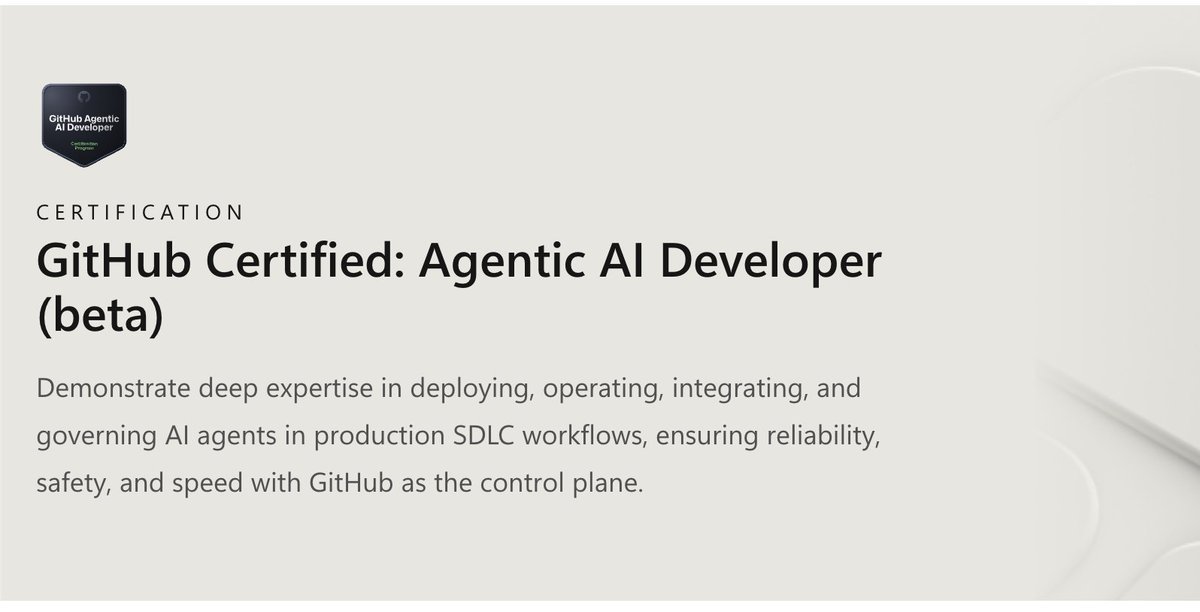
GITHUB JUST CREATED AN OFFICIAL CERTIFICATION FOR THE MOST IN-DEMAND DEVELOPER ROLE OF 2026. It is called Agentic AI Developer. GH-600. And it is the first formal signal that running AI agent teams is now a recognized engineering discipline with a credential behind it. Not a prompt engineer. Not a vibe coder. An Agentic AI Developer. The person who operates, supervises, and integrates AI agents across the entire software development lifecycle. The person who knows where agents fail in production. The person who understands how to build autonomous workflows that do not introduce catastrophic failure modes into CI/CD pipelines. The person every engineering team is going to need and almost none of them have right now. GitHub certifying this role changes the hiring conversation permanently. Before GH-600: "Do you work with AI agents?" is an interview question with no standard answer. After GH-600: the credential tells the hiring manager exactly what you know and what you can do before the interview starts. The engineers who get certified in the first wave of GH-600 will have a credential for a role that has more demand than supply for the next 3 to 5 years. The engineers who wait until it is mainstream will be competing with everyone who moved first. If you are already working with GitHub Copilot or building agent-driven workflows you are already doing this job. GH-600 is how you prove it. Bookmark this.
CyrilXBT tweet media
CyrilXBT@cyrilXBT

x.com/i/article/2071…

English
61
201
1.4K
129.4K