In 18 months, the competitive moat in enterprise AI won't be the model.
It'll be the team that owns a portable, independently auditable training data layer.
Models converge. Weights get leaked. Fine-tuning gets commoditised.
What doesn't converge: a data layer with provenance the competitor can't replicate.
Most of what the EU AI Act asks of high-risk systems lands on the storage layer, not the model.
Can you show what data went in, and prove it wasn't altered?
You can have a perfectly architected model and still fail that question if the training data's audit trail lives inside the provider's own system.
US teams should read this as a preview of where every regulated market is heading.
Most cloud storage asks you to trust the landlord doesn't keep a copy of the key, and trust that your neighbour can't see your unit.
Akave Cloud is built so tenant isolation, and deletion, are independently auditable.
You hold the keys, and any access is independently detectable.
Separation you can prove beats separation you're promised.
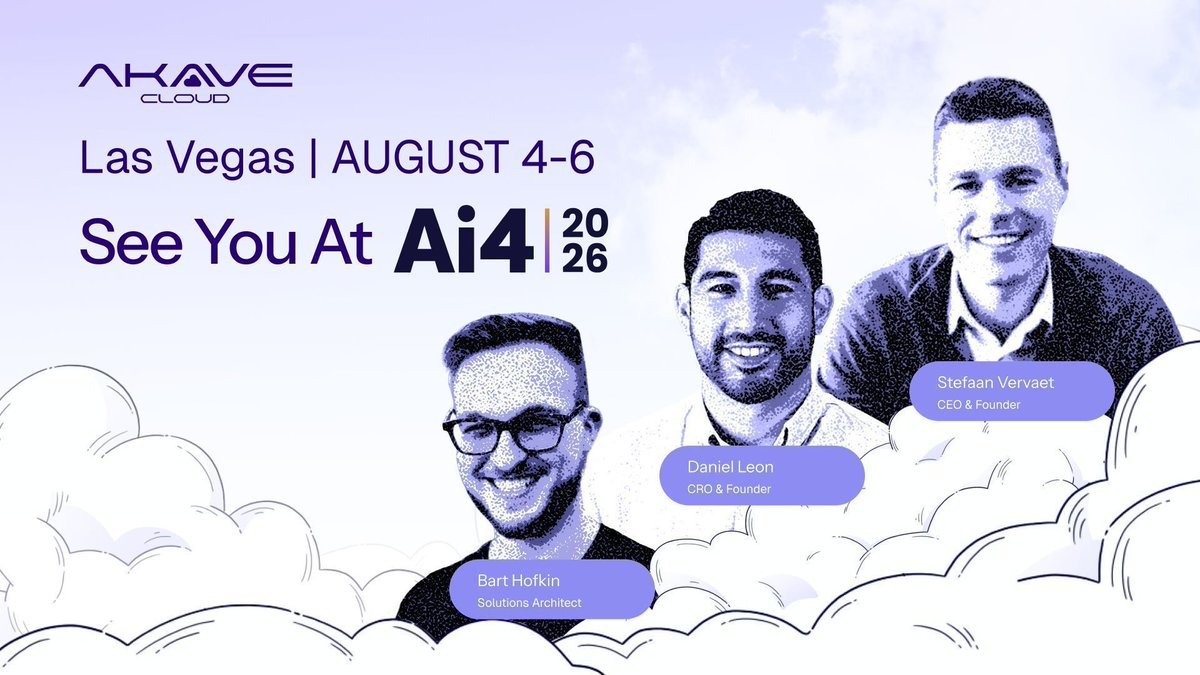
We'll be at @Ai4Conferences in Las Vegas, August 4–6.
If you're building AI infrastructure and want to talk storage, egress, and training data sovereignty, let's connect.
Book time with @stefaanweb3 and @dmleon10 before the conference fills up
See you there.
A quietly modified storage record is undetectable. Unless the audit trail lives outside the provider's system.
With most providers: you'd query their access log. Which they control. Which could itself have been modified.
That's the difference between encrypted and auditable.
With Akave Cloud: any modification is independently detectable on the immutable storage ledger.
The detection mechanism lives outside the provider's control.
Sovereign AI infrastructure has four requirements. Vendors usually address one.
1. Compute that can be swapped without re-architecting the data layer.
2. Storage that maintains an independent audit trail outside the compute provider's control.
3. A table format that travels with the data, not locked to the provider's platform.
4. $0 egress, so moving data between layers doesn't penalise the architecture.
None of this requires building your own data centre.
It requires choosing the right storage layer.
Most AI teams can't answer the question regulators will ask first.
Where did this training data come from, who accessed it, and was any of it modified before the training run completed?
Not because they were careless.
Because the storage layer wasn't built to produce that record independently.
An immutable storage ledger answers all three.
The next storage problem isn't capacity.
It's auditability at agent write-speed.
When AI agents are the primary writers to your storage layer, the audit trail question becomes: who verifies that the agent wrote what it claims to have written?
Not the agent. Not the agent's provider.
An independent, immutable storage ledger.
Compliance failures don't happen because teams ignored the rules.
They happen because the storage layer wasn't built to prove the rules were followed.
An audit log inside the provider's own system is not an independent record. Any modification is detectable only if the detection mechanism lives outside the provider's control.
That's what an immutable storage ledger does.
How to migrate off your current S3 provider without touching a single pipeline:
1) Confirm your storage layer is S3-compatible (Akave Cloud is)
2) Update the endpoint URL in your configuration
3) Rotate credentials
4) Flip DNS
5) Done
Your pipelines, integrations, and Iceberg table formats stay exactly as they are.
The egress bill does not.
Offering enterprise customers 'dedicated storage' usually means standing up dedicated infrastructure. Expensive. Slow. Hard to scale.
Siloed S3 endpoints per tenant on a shared backend get you provable isolation without the per-customer infra bill.
Same separation story. Different cost structure.
Neocloud acquisitions aren't just business news.
They're data sovereignty events.
The compute doesn't move. The legal jurisdiction of the new parent entity does.
If you store training data on a provider's infrastructure and that provider gets acquired, your data's legal exposure just changed without you making a single decision.
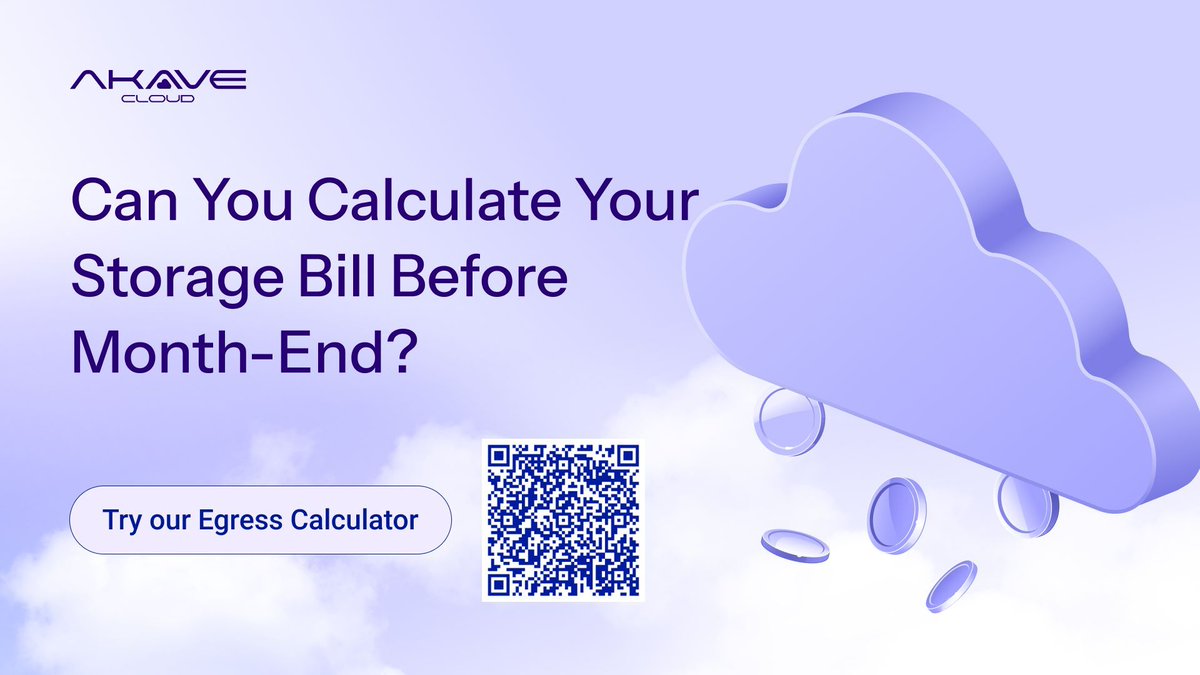
Most storage bills are a math problem you can't solve before the month ends.
Egress, per-request charges, cross-region transfers, retrieval fees: all variable, all invisible until the invoice arrives.
With Akave Cloud: $0 Egress. Try Egress Calculator to see the difference.
FinOps teams can actually model this.
Most AI and lakehouse platforms hardwire to one provider's S3 endpoint.
So even a fully compatible storage layer can't slot in. The lock-in isn't your contract. It's one endpoint they never let you set.
A configurable endpoint is the difference between renting and owning your data layer.
In 2026, egress fees will become the line item that kills AI infrastructure ROI before compute costs do.
Compute is visible. Teams budget for it.
Egress is invisible until the bill arrives. And it scales with everything that makes AI pipelines good, redundancy, experimentation, multi-region access.
What does cross-region data movement cost on most S3-compatible storage?
With most providers: $0.09/GB. Billed on every transfer.
With Akave Cloud: $0. Same API. Same pipeline. No rewrites.
The architecture stays the same.
The bill changes.