Alex Bezh 🇺🇦

754 posts

Alex Bezh 🇺🇦

Alex Bezh 🇺🇦

@alexbezhan

Entrepreneur, programmer

United Kingdom Katılım Nisan 2012
97 Takip Edilen215 Takipçiler
Alex Bezh 🇺🇦
Alex Bezh 🇺🇦@alexbezhan·
@sasajuric Business requirement -> critique (with my rules) -> test -> critique(with rules) -> implementation -> critique(rules) -> demo
English
0
0
0
9
Alex Bezh 🇺🇦
Alex Bezh 🇺🇦@alexbezhan·
@sasajuric That's where I landed in my AI approach too. Small incremental steps in TDD style. Every cycle is focused on observable business requirement, not implementation. And my attention and approval of every step. It's slow, but I can go long periods with this approach and not get tired
English
1
0
1
76
Saša Jurić
Saša Jurić@sasajuric·
I recently reviewed some AI assisted code (Elixir). The core approach of the produced solution was solid, but I spotted a number of various issues: - Overly complicated module API - Too elaborate and subtly incorrect process structure - Redundant pieces of information in state - Too complicated and slow tests - Overlapping tests - Lots of subtle duplication between tests - Some tests were checking internal implementation details, not observable behavior - Some tests were never running (the execution was depending on a condition which was never satisfied) It was clear to me that it's not worth doing a standard review here. It would drag on for too long, and the code probably wouldn't be cleaned up completely. My typical approach in such situation is to submit a proposal refactoring instead. It took me the entire day (with AI assistance, more on that later), but I was able to address all of the issues above & more, shaving off about 500 LOC (from the previous total of 1000 LOC, which I'd say is not too shabby). I think that the key reason for the original state of the code was that too much code was generated at once without reviewing and steering the AI. So it ended up producing something which is technically correct, but may be overcomplicated in various ways. Reviewing and working with such code then becomes harder both for humans and machines. The approach I've been using so far is working in very small (really micro) steps. I ask the agent to make me a small change. Something like 100 LOC is about the capacity of what I can review reasonably well. I look through the changes, maybe do a bit of refactoring, ask the agent to review my changes and update its context, commit, and move on to the next step. I used the similar approach to refactor this code. Picked one issue, gave 2-3 sentences to the agent, checked the code, rinse and repeat. Most of my 44 commits were 100% AI generated, though for a few things I estimated it was quicker and easier to just make the change in the code. This doesn't give me dramatic speed improvements, it's more like 10-20%. But it gives me a good balance of velocity and code quality. In general, based on my admittedly small experience with AI assisted coding so far, I remain skeptical about the quality of the code, especially with larger LOC vs prompt size ratio. Though to be fair, I've certainly seen a lot of much worse codebases produced by humans than AI could ever make 😅 When writing production-ready code which is supposed to be maintained over longer period of time in a team setting, I still like to keep tight control over its quality. Working in small steps is my current way of doing it.
English
22
25
253
18.5K
elvis
elvis@omarsar0·
The more I build with Claude Agent SDK, one thing is very clear: Claude Code is just scratching the surface. Agent SDK is a beast for building new agentic experiences. This weekend, I built a futuristic agent orchestrator with it. Productivity level of coding agents are 🤯.
English
37
20
341
67.8K
Wes Winder
Wes Winder@weswinder·
opus 4.5 with ralph wiggum and playwright is agi
English
72
59
1.5K
167.4K
Alex Bezh 🇺🇦
Alex Bezh 🇺🇦@alexbezhan·
@awesomekling Great job. Remember to not have sharp jumps of weight though. Not a good thing for longevity
English
0
0
0
37
Alex Bezh 🇺🇦
Alex Bezh 🇺🇦@alexbezhan·
@ThePrimeagen I used AI to implement my own advanced linting to force AI to produce good code. So linting is the way to go.
English
0
0
0
2
ThePrimeagen
ThePrimeagen@ThePrimeagen·
i often feel like i am missing something with ai all these tweets claiming it is the greatest thing ever... yet, i dont see the same thing. I have a list of activities where its incredible at, but none of them at the writing of code, more comprehension only wtf is wrong with me
English
592
61
2.6K
238.1K
Alex Bezh 🇺🇦
Alex Bezh 🇺🇦@alexbezhan·
@rsms There are programmers, and there are problem solvers. Most programmers don't solve problems. That's why
English
0
0
0
17
Rasmus Andersson
Rasmus Andersson@rsms·
It’s surprising to me that many programmers don’t believe in AI at all, like a full, hardline “no.” A thesis is that generative slop has such “stage presence” + being alarmingly bad that it become people’s mental model of “AI.” That, along with nonchalant “vibe coders” on social media strikes a nerve with some people. There is a whole category of actually useful, actually practical and truly valuable “AI” tools that help you make better software. I’m not talking about asking ChatGPT to write production code for you but tools like Codex and Cursor where an llm can “work” in a sandbox on your codebase. Have it improve your tests suite or ask it to write documentation or maybe summarize the general architecture. Or get a list of all “// TODO”s with context. Thinking of these tools as “a bunch of mediocre programmers who will do anything for you” seems to be a sweet spot. These tools won’t generally write high-quality code or make smart architectural decisions, but these tools can do a lot of “grunt work” for you.
English
38
12
287
28.5K
Alex Bezh 🇺🇦
Alex Bezh 🇺🇦@alexbezhan·
@hnordt I've been building my current company frontend solely on DOM API. It's amazing. Simple. Works. Well documented. Backwards compatible forever.
English
0
0
1
9
Heliton Nordt
Heliton Nordt@hnordt·
After 20 Years Building for the Web, I’m Starting From Scratch I’ve been building sites and apps since 2006. Back then the web APIs were not great, so I always used libraries and frameworks and rarely wrote vanilla code. After leaving my last job, I started working on personal projects and chose to use only the tools I enjoy. That means plain HTML, CSS, JS/TS, with no dependencies except Zod. Since I spent so many years working with abstractions, I went back to the beginning and started relearning the basics, starting with Hypermedia Systems, HTTP, the DOM API, etc. I realized I know very little about the real basics. The foundation is so powerful that I feel bad for not digging into it earlier. In almost 20 years, I learned many libraries and frameworks. None of that was wasted, but now I see that staying close to the platform is the best way to master a domain and save time. Libraries and frameworks come and go. Their best ideas often end up in the platform anyway. If you are just starting or already have decades of experience, my advice is the same: stay close to the platform. Avoid abstractions. Master the foundation. It will take you much further.
English
1
0
4
187
Alex Bezh 🇺🇦
Alex Bezh 🇺🇦@alexbezhan·
@platypii nowadays I don't even use web interface. just text/log files - perfect interface for LLMs to work with
English
0
0
0
8
Kenny Daniel
Kenny Daniel@platypii·
Today I'm excited to announce that we are launching @hyperparamapp, an AI-powered Swiss Army knife for massive LLM datasets. It lets you view, score, filter, label, and transform LLM data directly in the browser. I started Hyperparam one year ago because I knew that the world of data was changing, and existing tools like Python and Jupyter Notebooks were not built for the scale of LLM data. The weights of LLMs may be tensors, but the input and output of LLMs are massive piles of text. The training set of LLMs is a large corpus of text from various sources, meticulously cleaned and preprocessed. The output of LLMs is also text, and it’s being produced in even greater quantities than the training data. No human has the patience to sift through all that text, so we need better tools to help us understand and analyze it. That's why I built Hyperparam to be the first tool specifically designed for working with LLM data at scale. To accomplish this required rethinking how data analysis tools work. I started Hyperparam as a side project and wanted to see if I could build it entirely in the browser. No Python, no servers, just pure interactive web experience. I'm pretty excited about how it turned out. Hyperparam is fast, powerful, and easy to use. It can handle datasets with millions of rows of text and provides a rich set of tools for exploring and analyzing that data using LLMs agents for assistance. Every company is now producing volumes of LLM data. Chat logs, agent traces, coding agent logs, and more. Hyperparam is designed to help you make sense of all that data. If you're working with LLM data (and let's be honest... every company is producing LLM data now), I encourage you to give Hyperparam a try. It’s free while in beta. 🚀
English
5
6
13
952
Rob Palmer
Rob Palmer@robpalmer2·
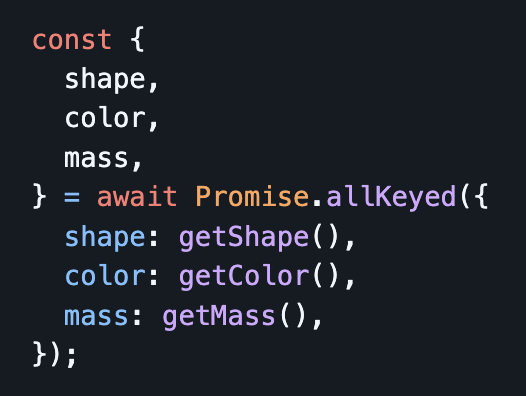
ECMAScript excitement 😉 Congrats to my coworker @acutmore @TechAtBloomberg on advancing Await Dictionary to Stage 2.7 at @TC39 today 🎉 Promise.all returns positional results as an array. Promise.allKeyed allows named results inside an object 👍
Rob Palmer tweet media
English
42
109
1.2K
84.4K
Alex Bezh 🇺🇦
Alex Bezh 🇺🇦@alexbezhan·
@platypii Usual tool for reducing code is abstraction. But for LLMs a repeatable boilerplate is cheap to produce and maintain. If you have the tests/guardrails
English
0
0
1
12
Kenny Daniel
Kenny Daniel@platypii·
How do you avoid abstraction? I look at the whole system and what it's goal is (eg- view data in the browser), and then ask what would be the minimal code required to achieve that goal if you included the ENTIRE stack (including frameworks, libraries, infra, etc). I think this would be a more fair accounting of complexity in a system, as opposed to counting just "your" code and not those beneath abstraction layers. If you look at the whole system, you start to see how abstractions always prevent you from fully utilizing the platforms you're running on. And so in a world where code is increasingly cheap to produce (thanks to llms), why wouldn't you custom design your whole system to be purpose-built, rather than build assembled from lego blocks? There's a ton of performance on the table if you do.
English
2
0
2
56
Kenny Daniel
Kenny Daniel@platypii·
What is the software equivalent of this? No dependencies, avoid abstraction, vertically integrate your software stack. Good engineering is subtraction.
Kenny Daniel tweet media
English
2
1
1
176
Alex Bezh 🇺🇦
Alex Bezh 🇺🇦@alexbezhan·
@Ex3NDR I see, thank you for the info. I'm using SQLite heavily, but want to keep an eye on something for heavy writes. Looked at TiKV, also looks promising. Nowadays having documentation for database is more valuable because of LLMs.
English
0
0
0
22
Steve Korshakov
Steve Korshakov@Ex3NDR·
hey, i didn’t bring it to my next companies. i was fine and i liked it, but i personally made a lot of mistakes in how to use and put too much pressure on it. for example it turns out that a single chat with 50k users to deliver message requires almost 10-20 random writes per member, which ended up having a single message produced ~1m writes. it scaled nicely but i highly doubt it was a sane way to build messenger. meanwhile i had performance problems because for 1m writes i often need 1m reads and each read is a new promise which made my app 99% of time running promises which is far from good. some storage with SQL like would served me better, i still like it a lot but its promise of linear scaling makes you to abuse this. haven’t tried tikv but it seems it became more developed solution for apps.
English
1
0
1
14
Alex Bezh 🇺🇦
Alex Bezh 🇺🇦@alexbezhan·
@Ex3NDR Hi, I saw your speech on Nodejs + FoundationDb. wdyt of it now, after 5 yearsd?
English
1
0
0
24
Coding Fiend
Coding Fiend@CodingFiend·
when you look at percentage of families that own their own home, you see countries like Romania in Slovakia, which are in the 90% range So by one measurement, these are among the richest countries in the world because they haven't let the financial people take over their housing
English
2
0
2
172
Cheng Lou
Cheng Lou@_chenglou·
Midjourney runs fully on Bun Server side routing: Bun Runtime: Bun Client side bundling: Bun Scripts: Bun Real-time generation previews: Bun No framework beside vanilla React and no data management library. This enabled us to scale the site to millions with only ~5 full-timers. Plus some other semi-public tricks I usually only divulge at random parties Maybe I should re-un-retire from conference talks and explain the stack one day...
English
107
93
2.7K
529.3K
Hongbo Zhang
Hongbo Zhang@bobzhang1988·
MoonBit may be an ideal language writing agents, very small native binary size, reliable, good concurrency support (promise with cancellation), great data processing support and robust error handling, the tools can be distributed in cross platform format!
English
1
1
8
2.2K
Coding Fiend
Coding Fiend@CodingFiend·
@Hasen_Judi it is an observable fact that only women can multitask We had a special job in our company called operations, which required you to juggle 15 to 20 simultaneous tasks and every single man failed within six months A Woman still has a job eight years later females can multitask
English
1
0
2
59
ハセン حسن
ハセン حسن@hasen_95dx·
Context switching between many different tasks kills me.
English
1
1
15
969
Roman Elizarov
Roman Elizarov@relizarov·
Frustrated with your AI agent? Got code that is not working or pure hallucinations? It mostly happens for two reasons: you either did not give it enough context to solve your problem or you are simply asking it to do something that is impossible.
English
6
1
18
3.5K