Alex Sofronas

444 posts

Alex Sofronas banner
Alex Sofronas

Alex Sofronas

@alexsofronas

Host of the Marketing x Analytics Podcast- on a break to build the future

United States Katılım Nisan 2014
98 Takip Edilen1.2K Takipçiler
Tyler
Tyler@rezoundous·
Can't explain it, but I trust GPT-5.5 more than Opus 4.7 right now.
English
351
81
3.8K
763.6K
Alex Sofronas retweetledi
stochasm
stochasm@stochasticchasm·
hey can you launch 4 sub-goblins to investigate each of these issues
English
17
62
1.5K
31.1K
Alex Sofronas
Alex Sofronas@alexsofronas·
@Mappletons Just blow it up and pick a new LLM things are moving too fast haha
English
0
0
0
38
Maggie Appleton
Maggie Appleton@Mappletons·
How is everyone managing their agent SKILL.md files? Is it just chaos? Global skills, repo-specific skills, keeping them in sync between machines, figuring out which ones you have installed, authoring new ones. What are we doing? Does anyone have a sane system?
English
232
13
686
105.8K
Alex Sofronas retweetledi
signüll
signüll@signulll·
the craziest part now is that the modern computer probably has to be entirely reinvented, from scratch. pretty much like how jobs & co brought apple ii to market. like not improved. not given a chatbot sidebar or something but really from the ground up like the iphone redefined what it meant to be a pocket computer. the current paradigm for computers was built around a human staring at a screen, moving a cursor, opening apps, managing windows, naming files, remembering where things live, & manually translating intent into interface actions. that made sense when the human was the runtime. but in an ai native world, it starts to look kinda ridiculous. you can see this ridiculousness when you use computer use agents… they are useful sure, but they’re also obviously transitional. they’re teaching ai to operate machines designed for humans, which is clever, but also kind of absurd. it’s like making a robot hand so it can use a doorknob instead of asking why the door needs a knob at all. yes i know humans also need to use a door knob, but maybe in the future humans don’t need to use a computer, or at least what we think of a computer today at all. this all leads to some interesting questions: - what is a file when the system understands context? - what is an app when intent can route itself? - what is a desktop when work can be decomposed, executed, monitored, & summarized by agents? - what is a browser when the agent can retrieve, compare, transact, & remember? - what is an operating system when the primary user is no longer just a person, but a person plus a swarm of delegated intelligences? or no person at all. the old computer assumed navigation. the new computer has to assume a new kind of intention. the old computer organized information. the new computer has to try to organize agency. we’re still in the hacky middle stage at the moment with sidebars, copilots, agents clicking through legacy ui, & automation layers sitting on top of 40 year old metaphors. the new computer is likely one where memory, context, identity, permissions, tools, agents, & interfaces are native primitives. this means desktop, mobile, browser, apps, files, folders deserves another first principles look.
English
372
673
6.6K
581.5K
Alex Sofronas retweetledi
Yohei
Yohei@yoheinakajima·
does anyone else "speed-type" when talking to AI? ignor spellign mistakes skip commas use agro abbrev etc
English
306
11
1.3K
104.6K
Alex Sofronas retweetledi
Vivo
Vivo@vivoplt·
No Claude, the project will not take me 2-3 weeks. We will finish it today.
English
107
264
5.6K
132.8K
Alex Sofronas retweetledi
tweet davidson
tweet davidson@andyreed·
my claude explore agent that hasn’t responded in 47m
tweet davidson tweet media
English
28
278
8.4K
172.2K
Alex Sofronas
Alex Sofronas@alexsofronas·
🥹
Dustin@r0ck3t23

Eric Weinstein just described the end of the mapped life. For ten thousand years, humans had to earn the right to exist. Pick a noun. Become the noun. Die as the noun. Accountant. Teacher. Radiologist. The box had a name. You climbed inside and stayed until retirement or death. Weinstein: “Every occupation that is named is over.” Not automated. Not replaced. Named. You picked a noun. It told the world who you were. Then it told you who you were. If your future has a title your parents recognize, that future is already dissolving beneath you. Weinstein: “A tsunami of a lifetime is coming and nothing your elders have seen is gonna prepare you.” People hear this and assume it’s about unemployment. It’s not. It’s about identity. The machines aren’t absorbing tasks. They’re dissolving the categories we built ourselves around. You spent your whole life becoming a noun. The noun is about to stop existing. When the label disappears, what’s left of you? Weinstein: “Get flexible. Get good on a bunch of different stuff. Learn how to think across disciplines.” Stop being a noun. Start being a verb. But the most important thing Weinstein said has nothing to do with strategy. It touches something much older. Something closer to the bone. In a world where AI is world-class at everything, what is the point of a human being? Weinstein: “I think you should be able to just have a life. I have a golden retriever. I don’t know that it’s the greatest golden retriever in the world.” For ten thousand years, human worth was measured by output. How much you could lift. How fast you could think. How much value you could squeeze from a single day. We trained ourselves to think like machines because machines didn’t exist yet. Now they do. And they will be better than us at every measurable thing. Most people hear that and feel terror. They should feel something closer to relief. When a machine can do it better, the metric dies. When the metric dies, the cage opens. You were never supposed to be a spreadsheet. You were never supposed to justify your breath with a job title. Your golden retriever doesn’t optimize. It doesn’t produce quarterly earnings. It doesn’t prove it’s worth to anyone. It just lives. And you love it anyway. That was always the offer. We just couldn’t afford it. Now we can. We spent ten thousand years trying to prove we were machines. The machines just arrived to tell us we never had to be.

ART
0
0
0
9
Alex Sofronas
Alex Sofronas@alexsofronas·
You make one wrong call - a false negative - and it’s hard to come back without nuking the memory. The truth is, nobody has the silver bullet for a harness yet.
Vishakha Singhal@vishisinghal_

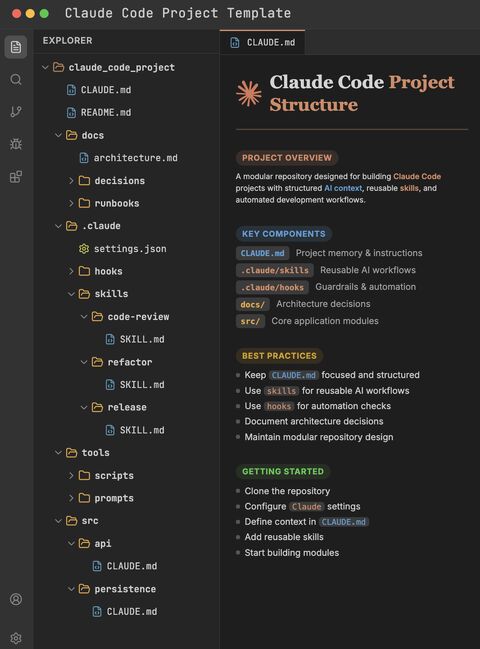
Holy shit. Someone just leaked the Claude Code project template teams are quietly using. This isn't prompting anymore. This is AI engineering infrastructure. ⚡ The entire setup revolves around one file: CLAUDE.md Every time Claude makes a mistake → you add a rule Every time you repeat yourself → you add a workflow Every time something breaks → you add a guardrail Claude literally trains itself on your project. And the structure is wild: • CLAUDE.md → project memory & instructions • skills/ → reusable AI workflows • hooks/ → automated checks & guardrails • docs/ → architecture decisions • src/ → actual code modules • tools/ → scripts + prompts You're not chatting with AI anymore. You're building an AI that knows your repo. The craziest part? You only configure this once. After that Claude: – reviews code automatically – refactors on command – enforces architecture rules – writes release notes – runs workflows from skills – remembers past mistakes And it keeps getting smarter. Most people: open ChatGPT → write prompt → copy paste → repeat This setup: open terminal → run skill → code shipped You're basically running AI teammates inside your repo. This template is the difference between: • using Claude occasionally • running Claude like infrastructure Drop it in any project. Your AI stops guessing — and starts operating.

English
0
0
0
17
Alex Sofronas retweetledi
Vishakha Singhal
Vishakha Singhal@vishisinghal_·
Holy shit. Someone just leaked the Claude Code project template teams are quietly using. This isn't prompting anymore. This is AI engineering infrastructure. ⚡ The entire setup revolves around one file: CLAUDE.md Every time Claude makes a mistake → you add a rule Every time you repeat yourself → you add a workflow Every time something breaks → you add a guardrail Claude literally trains itself on your project. And the structure is wild: • CLAUDE.md → project memory & instructions • skills/ → reusable AI workflows • hooks/ → automated checks & guardrails • docs/ → architecture decisions • src/ → actual code modules • tools/ → scripts + prompts You're not chatting with AI anymore. You're building an AI that knows your repo. The craziest part? You only configure this once. After that Claude: – reviews code automatically – refactors on command – enforces architecture rules – writes release notes – runs workflows from skills – remembers past mistakes And it keeps getting smarter. Most people: open ChatGPT → write prompt → copy paste → repeat This setup: open terminal → run skill → code shipped You're basically running AI teammates inside your repo. This template is the difference between: • using Claude occasionally • running Claude like infrastructure Drop it in any project. Your AI stops guessing — and starts operating.
Vishakha Singhal tweet media
English
35
76
658
36.5K