Sabitlenmiş Tweet
Ant Murphy
9.5K posts

Ant Murphy
@ant_murphy
Product Coach & Founder of @ProductPathways - Helping product people have greater impact and companies shift to the product model 🚀
Sydney, New South Wales Katılım Nisan 2019
816 Takip Edilen5.5K Takipçiler

Something I've noticed the best product leaders and teams I've worked with do; they're (almost annoyingly) specific.
They know the devils in the details and ambiguity leads to mis-interpretation.
Here's a few examples:
"Our goal is to increase active users”
What do we mean by active users?
- Is it those who login?
- What about those who bounce right away? do we count those also?
- Across what time horizon? Daily active users? weekly? monthly?
- How do we calculate it? Is it a rolling average? For how long?
- What about engagement? different levels of engagement?
- Why? To what end?
....
Here's another example.
"You're empowered"
Empowered to do what?
- Solve customers problems or just empowered to work out the 'how'?
- Ship a new product? or sunset the current one?
- Can I sign the company up for a new enterprise tool?
- Can I start a new business in our current business and be the CEO of it?
.....
Again I could go on and yes some are a bit ridiculous but hopefully you get the point.
Clarity is hard.
There's no shortcuts.
And it takes a lot of effort.
As I shared in the training I ran the other day; if things are misaligned, unclear, etc I would be spending 50% of my time communicating and trying to create clarity.
Because you can't scale or create leverage if your team aren't aligned or unclear.

English

Under-appreciated part that makes outcome-thinking hard to adopt.
There's no hiding.
You've either hit the outcomes or you didn't.
It also increases responsibility.
There's no "I did my part" and someone else is responsible for the outcome.
You're now responsible.
Not everyone is up for this.
English

Oh totally! I'm with you on that - just sharing the story but I agree - my younger brother who is significantly younger than me, still in his late 20s. He's that person. A year ago he had a perfect example of this when he called his bank up because he felt it was complex issue only to be told they can't help him unless he tries the chat in the app first. So he argued with them for 10 minutes in that time they probably could have resolved his issue, only for him to have to hang up, try the chat and call again 🤦♂️
English

@ant_murphy I used to build call center automation systems w/ voice and screen based interactions.
IME folks leaned into voice-to-agents when they had a complex situation that a screen-based solution simply couldn't support.
So that may not have been just "an old guy avoiding the internet"
English

Overhead a man on the train say "I shouldn't have to go out of my way to login online and submit my claim. Why can't I just call? I shouldn't have to use the internet."
Yes that's right. He said "I shouldn't have to use the internet"
From what I overheard he was trying to follow up on an insurance claim.
And you could say, well we should build for future generations.
Sure. That's a strategic choice but here's some food for thought.
He said he was 58 on the phone.
That means when the dotcom boom happened he was early 30s.
Makes you wonder how many people will be like this with Al in 25+ years??
(maybe everyone if we get too much AI generated content 😆)
But serious note.
It was a great 'touch grass' moment. With all this talk about Al it's a reminder that there's people still resisting the internet - and not people like my parents, older and retired - working age people.
It's food for thought because some of these people might be your customers.
And with the average life expectancy of ~85 he has many more moons to go. You might need to serve these customers for another 30+ years. So don't rush to building for agents just yet... consider this a friendly reminder to make sure you're building to your context.
(oh and close the laptop for a minute, go outside and touch grass 🙃🌾)
English

This cohort isn't for you if:
You think strategy is a slide with 3 pillars on it.
You want a 'fill-in-the-blanks' strategy template.
You believe it's something that you only do once a quarter in an offsite.
But if you're the kind of product leader that's:
Willing to get hands on.
Think via principles first.
Willing to embrace the messy part of strategy.
Want to see how AI can help you with product strategy.
Willing to put in the work and make the hard decisions.
Then this is built for you.
3 weeks. 5x 90 min workshops. Live. Starts 3rd June.
Worth a look? 👉 productpathways.com/course/product…

English

Register here to get an invite and the recording sent to your inbox 📷 streamyard.com/watch/3gkY8grG… Or join us live on YouTube: youtube.com/watch?v=D_AkhD…

YouTube
English

8 Habits of Highly Effective Product Leaders
1. They're still a Product Manager
2. Your team = the product
3. Stay close to the work
4. Default to coaching
5. Radically transparent
6. Improve clarity
7. Adapt their style
8. Recruitment = Top Priority
👇
youtube.com/watch?v=DJ82fS…

YouTube
English

I'm hosting a free mini-course on Product Strategy this Thursday!
Covering:
- What strategy actually is (and what it isn't)
- What makes up a good strategy
- Real product strategy examples
- and of course, we’ll chat about using AI in the strategy layer
Register here to get an invite and the recording sent to your inbox 👉 streamyard.com/watch/3gkY8grG…
Or join us live on YouTube: youtube.com/watch?v=D_AkhD…

YouTube

English

Don't fix discovery. Fix delivery first.
Seems counterintuitive but I've seen this play out a dozen times.
Companies adopts OKRs. Brings in product coaches. Run discovery workshops.
But 6 months later nothing has shipped to customers.
Roadmaps still look like plans.
Trust is still broken.
The problem is they didn't diagnose the problem correctly.
In all these cases the whilst yes the teams weren't doing discovery, strategy was absent, they weren't measuring outcomes.
Because they weren't able to!
They had big enterprise release cycles, decades of tech debt, loss in stakeholder trust, etc.
Outcome oriented thinking; discovery, OKRs, etc are only as effective as your ability to action them.
If you're stuck in quarterly releases and long 12+ month initiatives...
Introducing discovery will only lead to stale insights and missed opportunities.
OKRs won't work because you can't measure anything for 6-12 months. In the end they become a checkbox activity...
The only way you get to effective discovery and outcome thinking is through strong delivery foundations.
Fix that first.
And I get that this isn't sexy advice; "Fix delivery" doesn't get clicks or sell courses.
But every transformation or introduction of a new framework I've watched fail started with addressing the wrong constraint. They spent days at strategy off-sites with consultants or discovery training for product teams stuck in quarterly release cycles.
But this is the reality and work that needs doing.
I hope that helps.
Full piece: antmurphy.me/newsletter/fix…
English

P.s. I'm also running a free live stream next week on Product Strategy - basically a free mini course on the topic!
Covering:
- What strategy actually is (and what it isn't)
- What makes up a good strategy
- Real product strategy examples
- and of course, we’ll chat about using AI in the strategy layer
Register here to get an invite and the recording sent to your inbox 👉 streamyard.com/watch/3gkY8grG…
Or join us live on YouTube: youtube.com/watch?v=D_AkhD…

YouTube
English

Here's 8 strategy concepts every Product Manager should know.
Product Positioning:
Positioning = the space your product occupies in the customer's mind.
Differentiation = tangible differences vs. competitors.
You can change zero features and grow your product just by talking about it differently.
Flywheels:
From Jim Collins' book Good to Great. The concept of finding the single point of leverage in a reinforcing loop that drives momentum. e.g. YouTube: invest in creators (rev share, tools) → better videos → more views → more ad revenue → reinvest in creators.
Network Effects:
This is when the product becomes more valuable as more users/nodes join. WhatsApp, Visa/MasterCard, Tesla's Supercharger network, and marketplaces like eBay are all examples.
Switching Costs:
The more embedded a user becomes, the harder it is to leave.
Economies of Scale:
Amazon, Costco, Netflix are all examples of economies of scale where they have reached a scale where unit costs drop so low that competitors can't match at the same margin.
Intangible Assets:
Proprietary technology, trademarks, patents, or brand equity creating value independent of features.
Counter-Positioning:
Is where you create a business model that incumbents can't copy without cannibalizing themselves. Blockbuster vs. Netflix, Kodak suppressing digital cameras, Airbnb vs. hotels. This usually happens heavily when there's a new technology, like AI today. AI is creating new opportunities for counter-positioning right now.
Niching Down & Adjacency Growth:
Enter an underserved segment where incumbents won't compete (usually because it's too small), then expand in one-degree-of-separation steps. For example; Amazon (books → everything), Lululemon (yoga leggings → full activewear).
Note: none of these are a product strategy themselves.
They're techniques you apply within your strategy to make it more powerful.
Which also means you can combine them - many products leverage multiple (Network Effect + Flywheel)
===
FYI I cover all these in the 'Product Strategy in Practice' course. Next cohort kicks off in 3 weeks. Limited spots 👉 productpathways.com/course/product…

English

Discovery is often treated as a second class citizen
Showcases demo the new shiny thing we delivered
Roadmaps and updates are all focused on what we’re building and when.
It’s rarely about what we’re learning. The opporutnities. What experiments we’re running and the metrics.
You need to make discovery a first class citizen.
Add discovery to your:
- Showcases and sprint reviews
- Comms
- Stakeholder meetings
- Product Roadmap
- etc.
Any moment you're talking about delivery you should also talk about discovery.
Sprint planning for example - plan both!
What are you going to delivery AND what opportunities are you going to do discovery on this sprint?
youtube.com/watch?v=1wrJtp…

YouTube
English

Slow delivery, long enterprise release cycles are a symptom, not the root problem.
What they often actually mean is:
→ We have decades of tech debt that makes everything slow and hard.
→ We don’t have strong technical leadership and a clear tech strategy.
→ Because of 1 & 2; we have fragile releases, high regressions leading to low trust with product and engineering.
→ Low trust means decisions become top down.
→ People leave and we have a technical leadership gap
🔄 and repeat...
And btw giving everyone AI to code isn't going to solve any of this.
More in this week's newsletter 👇
Ant Murphy@ant_murphy
English

Most people think a product strategy is a generic looking slide that has vision on the top followed by 3-5 "pillars" like 'Best in class' or 'Efficiency' and 'Customer experience'.
But actual strategies are messy and detailed.
They’re post-its on walls, sketches, data, thinking and disagreements and importantly what NOT to do.
After coaching product leaders around the world I've seen far too many slides dressed up as product strategies and far too many situations where the product strategy was vague or missing.
I want to help change that.
Which is why I thought for next week's live stream, let's go back to basics and cover:
- What the hell is product strategy actually is (and what it isn't)
- What makes up a good strategy
- Walkthrough real product strategy examples
- and of course, cover how AI is changing the strategy layer
WHEN
Thursday 21 May 2026
- Sydney @ 5:30pm AEST
- London @ 8:30am BST
- Central Europe @ 9:30am CEST
Register to get an email invite plus the recording after 👉 streamyard.com/watch/3gkY8grG…
Or join on YouTube: youtube.com/watch?v=D_AkhD…

YouTube

English

A friendly reminder that:
More is not better.
Faster is not necessarily better.
Being first is not better either.
The best products aren't the ones with the most features - or the first to market.
They're the ones that stayed focused and ran their own race.
Which requires saying no to the stakeholder request that doesn't fit the strategy.
...no to the "quick win" that would add revenue at the cost of complexity and ongoing maintenance.
...no to that feature your key competitor just shipped.
...and no to adding AI for the sake of it.
As Michael Porter put it:
"The essence of strategy is choosing what not to do."
That's the job as a product manager.
More important now than ever 👇
Ant Murphy@ant_murphy
English

📌 p.s. if this resonated and you feel like you need help articulating your product strategy - I'm running a Product Strategy course in 3 weeks that might help. Worth a look? productpathways.com/course/product…
English

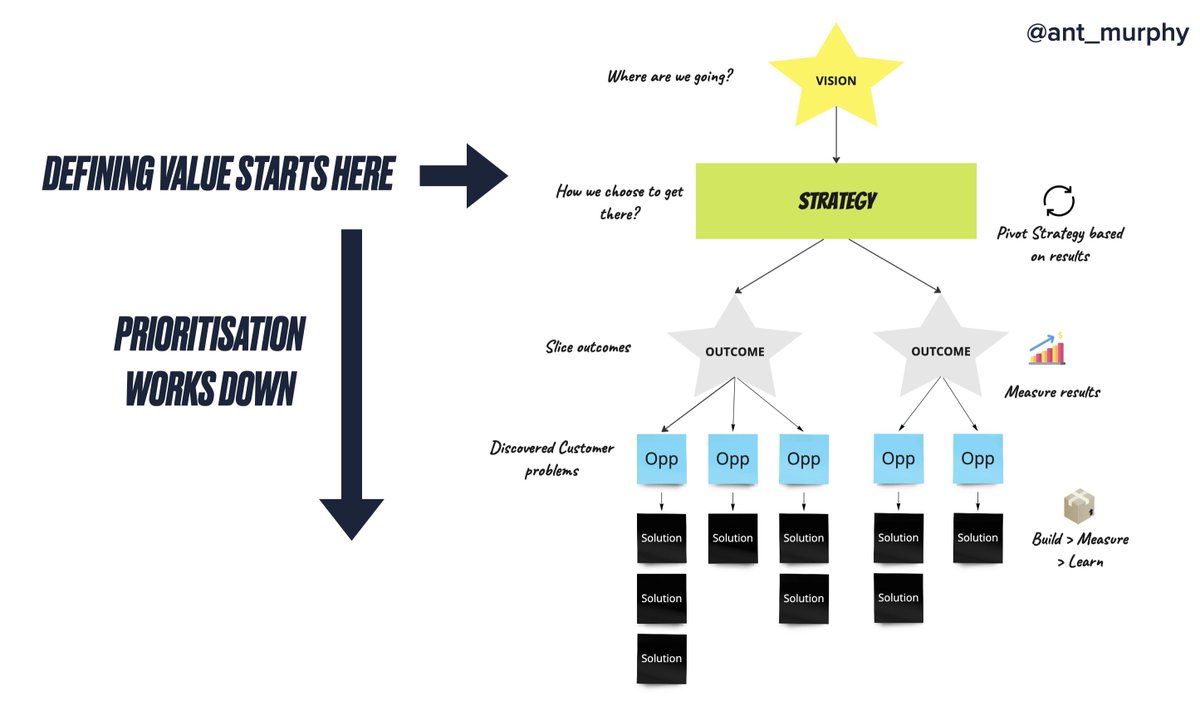
A mistake I see product managers make all the time is treating prioritization as something that only happens on their backlog.
The problem with this is you end up trying to prioritize a backlog that's 100s of items long.
Impossible. It's therefore no surprise that we revert to spreadsheets and formulas to try and make sense of it.
It took me a while to learn this but a much more effective way is to treat prioritization as a multi-step activity.
Something that starts at the top with your strategy. Prioritizing things like:
- What problems to solve?
- Who to target?
- How you intend to win (differentiation)?
- When and via what distribution channels?
etc...
And then stepping down to the outcome level: Breaking those chosen problems down and prioritizing what outcomes will give you the most leverage.
To opportunities: Prioritizing which opportunities will help you achieve the outcome.
And finally prioritizing which solutions best solve that opportunity.
Any time prioritization feels hard or challenging I step up a level - have we effectively prioritized here first - more often than not the answer is no and that's why it's hard.
===
p.s. if this resonated and you feel like your prioritisation problem is really a strategy one - I'm running a Product Strategy course in 3 weeks that might help. Worth a look?

English

A common challenge I see with the PMs I coach is they’re stuck ‘horse-trading’ between one executives idea vs another. They’ve also learn the hard way that RICE or prioritization spreadsheets aren’t going to save them.
If you’re stuck prioritizing at the backlog level and you have nothing above (vision + strategy + OKRs + roadmap + etc) then everything is fair game and you’re stuck in a corporate version of the hunger games.
Every week in the Product Mentorship on Product Pathways I share a weekly wrap up on a topic. This week I talk about why this happens and how fix it 👇
(thought it was worth sharing broader)
English