
Paul Boag

62K posts

Paul Boag banner
Paul Boag

Paul Boag

@boagworld

UX Strategist: 30+ years experience in UX, conversion optimization and design leadership. Consultant and Fractional lead.

England, United Kingdom Katılım Kasım 2006
220 Takip Edilen40K Takipçiler
Paul Boag
Paul Boag@boagworld·
75% of people who click "donate" on a charity website I am working on never complete the donation on mobile. I've been staring at that number for a while now, and it's the kind of stat that sounds made up until you realize what's causing it. In this case, a significant chunk of the problem comes down to where Apple Pay and Google Pay appear in the flow. They're there, which is good. But they only show up after the user has already filled in their name, address, and card details. So the whole point of tap-to-pay, which is that you don't have to type anything, evaporates completely. Move those options to the top of the flow and the phone auto-populates everything. Friction drops. Completions rise. The organization I've been working could recover around £3.7 million in donations a year from that change alone. Not from new campaigns, not from more traffic. Just from not making people type their address on a phone screen when the technology to skip that already exists in their pocket. The fix isn't technically complex. Getting it prioritized is another matter entirely. But that's a different post. #ConversionOptimization #UX #CharityDigital
English

1
0
5
298
Paul Boag
Paul Boag@boagworld·
The empathy that makes good UX research possible and the empathy required to work effectively inside an organization are the same skill. One gets practiced constantly. The other barely comes up. Designers who are rigorous about understanding user frustrations will often, in the same week, complain about developers not implementing designs correctly, get frustrated with finance directors over inadequate budgets, and resent marketing for blocking research access, all without much curiosity about what those groups are navigating. Asking everyone else to care about users while rarely extending the same interpretive charity inward doesn't tend to work out well as a professional strategy. A developer defending a technical constraint has a perspective worth understanding. So does a finance director who can only think quarter to quarter because that's how their organization has always operated. The research skills that make designers effective externally apply to internal stakeholders too. In my experience, practitioners who work that out tend to get further than those who treat organizational friction as the obstacle rather than part of the work. #UXDesign #DesignLeadership #StakeholderManagement
English
0
0
2
397
jason scherschligt
jason scherschligt@searchlight5·
@boagworld How about AI disclosure as some kind of metadata? Like a date, the writer's name, taxonomy info (categories, etc.), additional sources. Those are all helpful pieces of content that we associate with primary pieces of text to give readers context. Could we do that with AI?
English
1
0
0
5
Paul Boag
Paul Boag@boagworld·
I got some feedback recently that made me stop and think. Someone told me they could tell my LinkedIn posts were AI-generated before they finished the first sentence, and the giveaway wasn't the content, it was the opening. Always "last week" or "this week." AI writing patterns work until they don't. They become predictable enough that readers clock the formula before they've absorbed anything you've actually said. Once they've mentally labeled it as AI output, something shifts. The content stops landing with the same weight, even when the underlying observation is genuinely useful. I don't think this is entirely rational. An insight doesn't become less valuable because software helped draft it. But people process content differently when they sense it came from a formula rather than a person sitting with a genuine frustration or observation. Treating the AI draft as a first attempt helps. The question worth asking: would you actually say that opening out loud to a colleague? If the answer is no, rewrite it until you would. #LinkedInContent #ContentStrategy #AIWriting
English
1
0
1
423
Paul Boag
Paul Boag@boagworld·
@adeyeyeadegoke Yeah, but at least you can use AI to fast track discovery phases these days.
English
1
0
1
4
GK | Conversion Fixer
GK | Conversion Fixer@adeyeyeadegoke·
In my world, I see founders "vibe code" entire landing pages and funnels in an afternoon. They’re thrilled because the site is live, but then they wonder why the bounce rate is 90%. They built a solution for a problem that doesn't exist in the user's mind. 😭 Building fast is a superpower; building without discovery is just an expensive way to fail. AI lets you skip the labor, but you can’t skip the psychology. If you haven't sat in the "mud" with your users to understand their friction points, your high-fidelity prototype is just a polished paperweight. The cardboard groups aren't just "testing"; they’re de-risking the entire business model.
English
1
0
0
26
Paul Boag
Paul Boag@boagworld·
At a UX jam earlier this year, one group finished in about half an hour. They'd vibe-coded their prototype, it worked, it looked great, and they were quietly chuffed about it while everyone else was still cutting cardboard and arguing about sticky notes. Then they went out onto the streets to test it. The cardboard people came back with users who had actually changed how they thought about the problem. The vibe coders came back with polite confusion from the people they'd spoken to. What they'd built was technically impressive and completely useless. AI prototyping tools are genuinely brilliant. Getting from an idea to something clickable in half an hour would have been witchcraft five years ago. But "faster to build" and "worth building" are two completely different problems, and the second one still requires talking to actual users. What I'm watching now is the speed of vibe coding creating a feeling of progress. You've made a thing. It has screens. You can click through it. But all you've really done is move the discovery work from the start of the process to the end, where it's much more expensive to find out you were wrong. #UXDesign #UserResearch #ProductDesign
English
1
1
4
463
Paul Boag
Paul Boag@boagworld·
For most of my career I've treated design as a creative discipline, where rules were starting points and the interesting work happened when you knew which ones to break. I'm not entirely sure that's right. Most of what I produce day to day is rule-following. I'm applying comfortable line lengths and contrast ratios, working with patterns that reduce cognitive load and button placements shaped by research into where people look for things. These aren't creative decisions so much as applied knowledge, which means AI can learn them, and largely has. The tools I use now produce competent interfaces. Solid grid, clear hierarchy, no obvious accessibility failures. What they don't produce is a considered opinion about whether a product should feel playful or authoritative, or whether an onboarding flow should breathe rather than push. That accumulates from years of noticing what moves people and what doesn't. It doesn't compress into a prompt. Designers who've mostly been working in the rules layer are more exposed than they'd like to acknowledge. The ones who'll be fine are the ones with genuine opinions about what makes design good, not just technically correct. #UXDesign #AIDesign #DesignLeadership
English
0
0
4
295
Paul Boag
Paul Boag@boagworld·
Everyone in UX has been told at some point that the solution to inconsistent work is a better process. I've grown less convinced that's where the actual problem lives. Rigid processes assume you know at the start what the project will need. For straightforward work, that's often true. But the most useful design decisions I've made mid-project came from recognizing something unexpected and reaching for the right tool at that moment rather than the one next on the plan. Years ago I was a few weeks into a project and found myself in the middle of a navigation problem I hadn't anticipated. Running a discovery phase at the start wouldn't have surfaced it because I hadn't dug deep enough to know the right question yet. What I needed was a quick survey to understand which categories people actually used. That wasn't in the plan. It was just the right tool for that moment. The practitioners who adapt well to new tools and changing conditions aren't usually the ones with the most sophisticated process. They're the ones who treat their methods as a toolkit and pick up whatever fits the problem in front of them. That flexibility takes longer to develop than following a framework, but it's what keeps you relevant when the field shifts. #UXDesign #DesignThinking #CareerDevelopment
English
0
0
2
277
Paul Boag
Paul Boag@boagworld·
Getting your team to use AI tools is partly a technology problem and partly not at all. The technology part is real. Most AI tools produce mediocre results unless you brief them extensively with context, constraints, and examples of what good looks like. When a developer picks up Copilot for five minutes and gets code that does not match how they work, they are correct to be skeptical. The tool failed them, not the other way around. But then there is the other part. If a developer figures out how to use AI well and finishes a two-week project in four days, what actually happens? In most organizations, the organization keeps the margin and the developer gets the same paycheck. Occasionally a vague mention of good work in a team meeting. Rational people do not work hard to eliminate their own advantages. If getting good at AI means demonstrating that fewer people are needed, or that you can be squeezed for more output at the same cost, of course you are going to be slow to engage. The incentive structure is the problem, not the attitude. Profit sharing when a project comes in under budget. Time back when AI creates genuine efficiency. A clear commitment that productivity gains benefit the whole team, not just the business. Ask for adoption without addressing the incentive and you are asking people to act against their own interests. That rarely works, and it probably should not. #AgencyLife #AIAdoption #LeadershipThinking
English
0
0
0
360
Paul Boag
Paul Boag@boagworld·
Being organized is not a personality trait. It is a response to sufficient pain. I spent years assuming that people who managed their commitments without dropping things were just wired differently. Then in 2010 I hit a wall. Too many projects held in memory, too many promises made to too many people, and eventually I could not work properly. Antidepressants, colleagues propping me up, the full embarrassing picture. The common factor was not stress. It was a complete failure of system. Getting Things Done was basically a life raft after that. Not because it is a perfect framework, but because it gave me somewhere to put things that was not my own head. Stop holding everything in memory. Put everything in one consistent place. Triage what comes in rather than just reacting. Three ideas that barely qualify as ideas, but apparently I needed a crisis to implement them. What I have noticed since is that people stay disorganized for exactly as long as they can get away with it. The pain of muddling through has not yet exceeded the pain of building a proper system. The moment it does, they find a way. If you are dropping things regularly, missing deadlines, or feeling permanently behind, you are probably not a disorganized person by nature. Your current situation just has not been uncomfortable enough yet. Which is, come to think of it, a slightly grim thing to wait for. #Productivity #GettingThingsDone #ConsultantLife
English
0
0
3
294
Paul Boag
Paul Boag@boagworld·
Someone in the Agency Academy I run completed a full website build in about 30 hours across a few sessions. Not a landing page. A complete site, with his own WordPress conventions, design tokens rationalized from an inconsistent Figma file, and component architecture he assessed as better than what he would have produced manually in that timeframe. The approach was Claude Projects loaded with extensive context and custom Skills that generate detailed briefs, then Cursor with Rules aligned to his specific implementation preferences. Figma inspection feeding into the process so the design is actually understood rather than guessed at. What struck me was not just the speed. It was the quality. He said the system keeps suggesting conventions and best practices he would have had to consciously remember to implement himself. The accumulated context makes it more precise over time, not less. I have been using AI tools for a while now but mostly in isolation. Project-specific context in one place, writing in another, code in another. Watching this made me realize that the compounding effect of deeply embedded workflow integration is a different category of thing from using AI as a search replacement. The question I am sitting with is whether this represents a fundamental shift in what small agencies can produce, or whether it just raises the floor for everyone. Probably both, which creates its own interesting problems. #AIWorkflow #WebDevelopment #AgencyLife
English
0
1
8
481
Paul Boag
Paul Boag@boagworld·
I've been using AI in my UX work every week for the past two years now. Not experimenting with it. Actually using it. And the thing I keep coming back to is how much of my early hesitation came from treating it like an oracle rather than a particularly enthusiastic intern who needs good direction. That reframe changed a lot about how I approach research, design, and content work. I'm running a Smashing workshop in June where I'll share the specific techniques that have actually stuck. Four live sessions, two hours each, spread over two weeks so you have time to try things between sessions rather than just nodding along. If AI in UX is something you've been meaning to get properly into rather than just dabble with, this might be worth your time: smashingconf.com/online-worksho… #UX #UserExperience #AIDesign
English
0
0
1
200
Paul Boag
Paul Boag@boagworld·
@peterbowyer That is a big one and definitely a good thing. Take their money first, then ask for additional information.
English
0
0
0
8
Peter Bowyer
Peter Bowyer@peterbowyer·
@boagworld I've managed to get the "choose/update your mailing subscriptions" moved to after the donation is taken :) Little steps!
English
1
0
0
5
Paul Boag
Paul Boag@boagworld·
Sixty percent of donation traffic on a site I am reviewing comes in on mobile. Seventy-five percent of those people start the donation process and don't finish it. That's not a small leak. That's the bucket having no bottom. The frustrating part is that the form causing the abandonment isn't complicated to fix. It's just long. It asks everyone the same questions whether they're a first-time donor or a regular supporter. It doesn't surface Apple Pay or Google Pay until near the end, by which point most people have already given up and gone to do something else. Moving frictionless payment options to the front, trimming fields that are nice-to-have rather than essential, this kind of work doesn't feel like strategy. It feels like housekeeping. Which is probably why it sits on the to-do list for years while everyone argues about brand positioning and campaign creative. The highest-return work in conversion optimization is usually the dullest work. Nobody wants to write a case study about fixing a form. But fixing that form on a single website could be worth millions in additional annual revenue. I find that genuinely hard to ignore. #UXDesign #ConversionOptimization #MobileUX
English
2
0
0
196
Paul Boag
Paul Boag@boagworld·
@searchlight5 Yeah, I'm not sure that's feasible, if I'm honest, because very quickly we're going to be in a place where that's going to read like this post was typed on a keyboard. In other words, I think AI will soon be so ubiquitous that those kinds of disclaimers will be pointles.
English
1
0
1
12
jason scherschligt
jason scherschligt@searchlight5·
@boagworld I think a simple answer to debates about AI usage in writing is disclosure. E.g. "I used no AI to write this piece." "Some sentences were produced by AI." "The majority of sentences were produced by AI." Etc. We have established formats for quoting sources. Why not for AI?
English
1
0
0
17
Paul Boag
Paul Boag@boagworld·
@adeyeyeadegoke Absolutely. I often find that fear is a good motivator for people in situations like this. If you outline the risks of launching with the prototype and ask people directly to confirm that they're happy with those risks, people begin to take things more seriously.
English
0
0
1
9
GK | Conversion Fixer
GK | Conversion Fixer@adeyeyeadegoke·
This is the reality of the "Prototyping Paradox." AI allows us to build the "what" in a weekend, but the "how" (safety, privacy, regulation) remains a marathon. In high-stakes fields like healthcare, a polished UI is just a promise—the engineering is the proof. We have to get better at celebrating the "invisible" work that keeps users safe.
English
1
0
0
17
Paul Boag
Paul Boag@boagworld·
AI tools have made it genuinely easy to build things that look finished before they are. That is mostly brilliant, and occasionally a problem. The prototype speed is real. The production complexity is also real. The job, more and more, is making sure the people setting the expectations understand both at the same time. Recently there was a prototype that had been built in under a week for a mental health app. Voice-enabled, emotionally responsive, routing users through care pathways hands-free. Clinicians were enthusiastic. Stakeholders were excited. The engineering team, who had spent four months on a separate web app, were visibly less delighted, and I think they had a point. What I kept coming back to is the distance between a polished demo and something you can actually hand to a vulnerable person. In a clinical setting, that distance includes security testing, accessibility compliance, edge-case safeguarding, regulatory review. None of that shows up in a week-one build. None of it looks impressive in a boardroom. All of it matters enormously when the person on the other end has a mental health condition. #UXLeadership #AIPrototyping #DigitalHealth
English
1
0
2
331
Paul Boag
Paul Boag@boagworld·
A backlog is not a list of good ideas. It's a list of things you haven't said no to yet. The distinction matters because most backlogs grow faster than they're worked through, and nobody has a principled way to decide what comes next. Everything feels important. The loud stakeholder's request and the genuinely user-critical fix sit in the same unsorted pile. Scoring frameworks don't sound exciting, but they solve a real problem. Rate each item on user need (how painful is this for actual users?), business impact (what moves a metric you care about?), and effort (roughly how long would this take?). You don't need precise numbers. You need enough signal to have a defensible conversation about order. The useful thing isn't the score itself. It's that the scoring conversation forces everyone to agree on what they're actually optimizing for before arguing about which item comes first. I've seen teams spend three months debating backlog priority and thirty minutes on what the scoring criteria should be. The order of those conversations matters quite a lot. #uxdesign #productdesign #prioritization
English
0
0
1
225
Paul Boag
Paul Boag@boagworld·
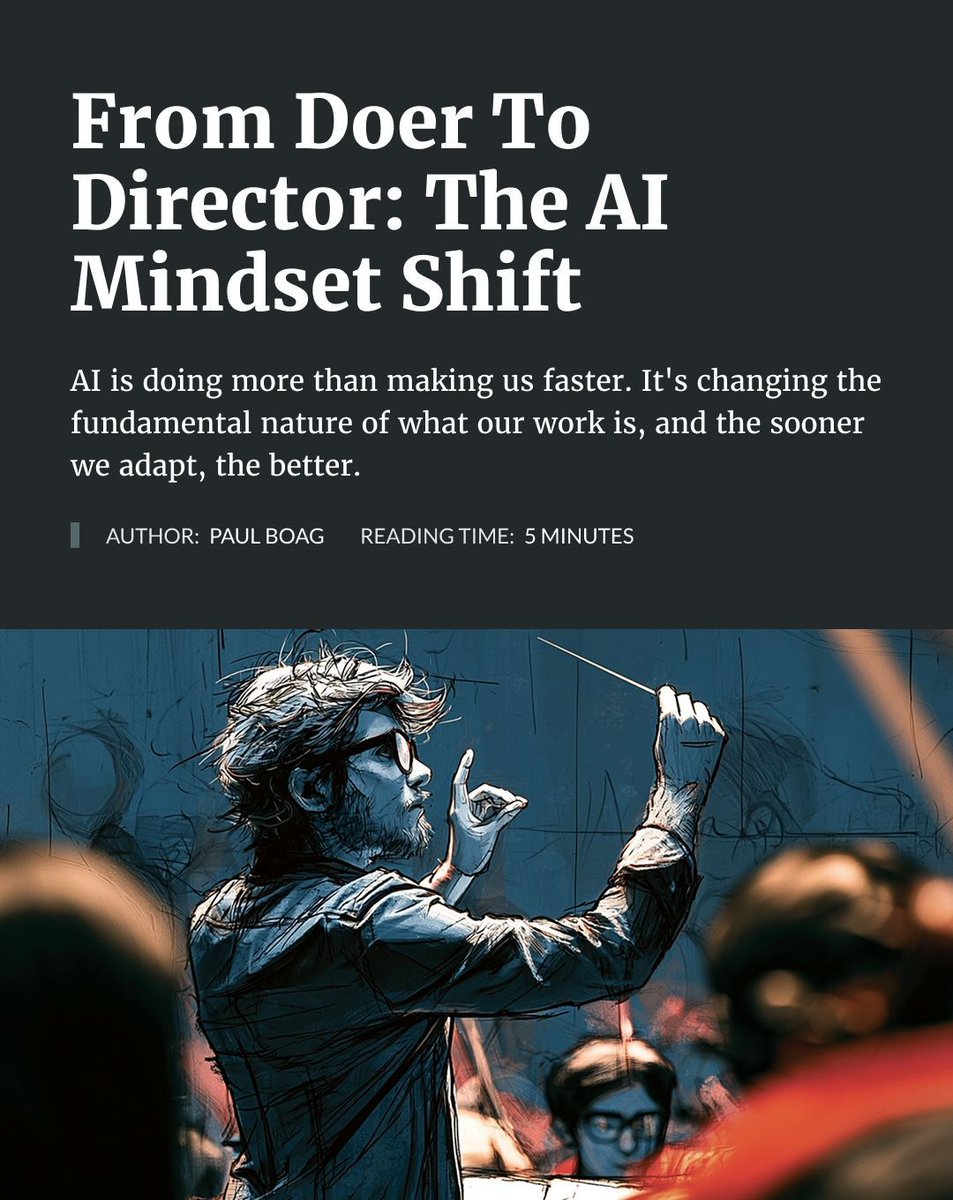
Something I don't hear talked about enough: AI burnout. Not the existential kind. The operational kind. When you're managing multiple AI agents all running in parallel, all completing tasks faster than any human team would, the cognitive load is significant. You're context-switching constantly. Things are finishing before you've reviewed the last thing. It's relentless in a way that managing people just isn't. Learning to pace yourself, batch your reviews, and build in actual breathing room isn't a soft skills conversation. It's becoming a core operational skill for anyone working seriously with AI. I touched on this in this week's newsletter, which is mostly about the broader mindset shift from doing work to directing it. But this bit stuck with me the most. Read more here: boagworld.com/emails/from-do… #AI #Leadership #Productivity
Paul Boag tweet media
English
1
0
1
208
Paul Boag
Paul Boag@boagworld·
Project funding is how large organizations control their budgets. It is also, rather inconveniently, how they ensure their digital products stay permanently half-finished. The mechanics of it are almost elegant in a depressing sort of way. A project gets funded, a team assembles, work gets done, everyone moves on. What's left behind is a product nobody has the mandate or budget to improve, because improvement doesn't come with a project code. I've been working through exactly this with a charity where a known problem in their mobile donation flow has been sitting unfixed for years. Nobody disputes it needs fixing. There's just no funded project for it, so there's no dev resource, and nothing happens. They're not unusual. Most large organizations I've worked with face the same thing. And the frustrating part is that what you actually need isn't a large ongoing investment. It's a small team with the mandate to keep iterating, which pays for itself extremely quickly when the thing in question is a leaking donation funnel. #DigitalStrategy #UXLeadership #ProductManagement
English
0
0
0
236
Paul Boag
Paul Boag@boagworld·
There's a transition that trips up a lot of talented designers when they move into leadership. They get promoted because they're brilliant at the work, and then spend the next year quietly sneaking back into Figma because they can't let go of doing. I've watched this happen more times than I can count. The micromanaging. The redesigning things that were already fine. The inability to operate at the level of abstraction that leadership actually requires. Working with AI agents is going to feel exactly the same. The temptation to wrestle with the AI until it produces precisely the output you had in your head, rather than accepting a good result and moving on, is going to be real. Learning to let go of that control is a skill in itself. The good news is that unlike a team of designers, you can't upset an AI by micromanaging it. You can just waste an enormous amount of time. Which rather defeats the point. I wrote about this shift in this week's newsletter. The move from doer to conductor is coming whether you prepare for it or not. Read more here: boagworld.com/emails/from-do… #AI #DesignLeadership #UX
Paul Boag tweet media
English
0
0
0
216