
Cameron Moll

29.7K posts

Cameron Moll banner
Cameron Moll

Cameron Moll

@cameronmoll

Executive Design + Leadership ᴇꜱᴛᴅ 1999. Design @ Desquared. Meta alumni, Authentic Jobs (acqd.), Buzzsprout. Love to see the temple. Teller of fine dad jokes.

Sarasota, Florida Katılım Aralık 2006
1.1K Takip Edilen45.8K Takipçiler
Sabitlenmiş Tweet
Cameron Moll
Cameron Moll@cameronmoll·
How a Chief Design Officer (yours truly) uses AI to design like an IC. This demo is for any designers that haven't yet embraced AI in their workflow. I’m one of two designers working on this plugin. I manage an organization of about 40 designers of various flavors, but I still keep myself in the trenches whenever possible. Lynt is one of these efforts. The examples I share are intentionally very simple to demonstrate how any designer at any level can leverage artificial intelligence to amplify and accelerate their human intelligence. AI is revolutionizing how we work as designers, yet I think of it more like a renaissance; a return to designing in consideration of the medium in which our designs are rendered, much like we did years ago when I first started. Arbitrarily, something like 80% of what we do as designers (in the act of designing) is exploration and iteration. For the past decade or more so much of that has happened in Figma and previously Sketch. These are great tools. But as a result of designing exclusively in a static environment, many have lost the ability to connect ideation with execution. Handholding your work from start to finish eventually gave way to handing off your work, and we never looked back. Artificial intelligence flips all of this on its head, positioning you (the designer) to be the one who first turns your design into code, iterate and iterate again, and experience using your work as users will, literally from day one of your design process. All the while freeing our engineering colleagues to focus on the work that only they can do, while designing alongside them.
English
17
43
731
57.8K
alban
alban@AlbanBrooke·
@cameronmoll This looks really familiar! Are you in Valley of Fire?
alban tweet mediaalban tweet media
English
1
0
1
50
Cameron Moll
Cameron Moll@cameronmoll·
Offline mode this week. Southern Utah.
Cameron Moll tweet mediaCameron Moll tweet mediaCameron Moll tweet media
English
4
0
29
1.1K
Cameron Moll
Cameron Moll@cameronmoll·
@marcm The red rock of southern Utah is definitely otherworldly.
English
0
0
1
24
Marc Mendell
Marc Mendell@marcm·
@cameronmoll Gorgeous - never been to Utah, but it’s been on my list for quite some time! Wind and time has made sculpture of the rocks.
English
1
0
1
37
Cameron Moll
Cameron Moll@cameronmoll·
@jonathaneckmier Santa Clara just outside St. George. For now we're sticking to spots just 10 min away from where we're staying.
English
0
0
1
33
Adrian Pelletier
Adrian Pelletier@adrianpelletier·
Appreciate you voicing this as design feels like the next area to evolve, similar to how development changed with LLMs earlier this year. Fable 5 is a turning point. We've reached a "design lottery" where a designer can one-shot a usable concept, whereas previously the LLM needed an existing design to produce a decent result.
English
1
0
2
57
Cameron Moll
Cameron Moll@cameronmoll·
There isn't enough discussion—or distinction for that matter—amongst designers about using AI to create vs. using AI to build. There are some nuances to this. I'm still debating myself what those nuances are. But I see the two often conflated, such as "AI didn't create a good first pass visually therefore it's useless for designing," failing to recognize we can design (build) in the medium in ways never before possible, even if we have to spend some time finessing the visuals. If AI-assisted tools are good for nothing else, and I don't believe this to be true btw, they are at least very good at iteration, fleshing out UI details that traditionally are done by hand, knocking out several fixes in a single quick pass, and making assumptions about design intent that are accurate more often than not. This is designing as much as it is building.
English
4
1
13
2K
Val Sopi
Val Sopi@valsopi·
I don’t think we’re ever going back. And as much as I don’t like AI doing what we used to do much faster, it’s going to be an unlock for us and not just in being more productive, but shifting the paradigm of why we do what we do. Yes, artists will struggle in the interim. But, at the end of the day AI is a tool. A crazy tool for sure. Not just a 0 to 1. But a 1 to ♾️. And as such, we will wield it as much as we can. As we always have. Fire included.
English
1
0
4
118
Cameron Moll
Cameron Moll@cameronmoll·
Homework assignment this weekend: Watch episode 6 from “Light & Magic” on Disney+. So many parallels between the seismic shift of CGI replacing stop motion while Jurassic Park (1993) was already in production, and the AI transformation we’re experiencing now. “The computer is great for these hallucinogenic things, but good luck doing a living, breathing creature [as compared to stop motion].” “When the transition happened to CG we thought it would take a little longer... It happened a thousand times faster than we anticipated.” “My world had evaporated... I just thought everything I ever worked for and built was into the trash can.” Then, after watching, contrast this with notable efforts by Christopher Nolan, Phil Lord and Christopher Miller (Project Hail Mary), and others to avoid CGI as much as possible, relying instead on traditional methods of filmmaking, props, and sets. However, note that we haven't come full circle yet as Lord & Miller did with Project Hail Mary. It's too early to call AI's bluff and return to the status quo of how we've designed and engineered the past few decades. We'll get there eventually, finding the right balance between human intelligence and artificial intelligence. But right now we're in the 1993-Jurassic-Park-era of AI. There's something to be learned from how industry titans navigated their seismic filmmaking shift to digital rendering, and how we can navigate ours.
Cameron Moll tweet media
English
3
0
18
1.5K
Cameron Moll
Cameron Moll@cameronmoll·
@joshpuckett Agreed. I think we've also created a gap between those two activities that's unnecessarily wide, as if they must happen linearly, when in reality sometimes (often) the most effective approach is more circular.
English
0
0
1
104
joshpuckett
joshpuckett@joshpuckett·
@cameronmoll I think this is because, in general, as a profession, design is still practice in an extremely amateur manner. Things like design direction/concept vs production and engineering (in the building sense) are routinely conflated.
English
1
0
8
859
Cameron Moll
Cameron Moll@cameronmoll·
@darylginn This is the correct analysis. The belief that taste will remain at the hands of humans only will, I worry, in hindsight sound as misled as the predictions that AI would never write production code.
English
2
0
3
1.3K
Daryl Ginn
Daryl Ginn@darylginn·
I feel like design wise, AI is still at the Will Smith spaghetti video stage. Look at AI video now. It’s almost indistinguishable from reality. To believe design is somehow untouchable is naive. I’m not saying designers are completely cooked, just like videographers aren’t completely cooked right now. I’m saying a vast amount of designers probably will be. Eventually. Right now AI design is still noticeable, and the argument that designers will survive because there will always be demand for more unique experiences is valid. For now. But just like every other area of AI, you can’t assume taste, design instinct and creativity won’t improve and ultimately become better and faster in a lot of ways. It’s a sad but likely reality that I think a lot of people already anticipate, but won’t admit. It’s more popular to lean on the “we’re safe” narrative.
English
41
17
365
31.1K
Cameron Moll
Cameron Moll@cameronmoll·
Asked my 12yo who's going to win France v Morocco. "VAR" was his answer.
English
1
0
8
1.1K
Cameron Moll
Cameron Moll@cameronmoll·
Nail, meet John Smothers’ hammer. This is such a fantastic description of where we've been the past decade and where the next decade is headed. "You cannot design a living thing in a medium that is fundamentally static. You can only draw a portrait of it and hope the translation survives the trip to code... "We accepted this gap for so long that we stopped seeing it as a gap. We called it 'handoff' and built an entire professional culture around managing this inefficient and lossy workflow... "What comes next is product design that happens in the medium. Where the thing you design is the thing that ships." This is a renaissance, not a revolution, of where we were just two decades ago. Ironically, what's next is what once was, with even greater tools for designing in the medium. John hit the head of the nail squarely on this one.
John Smothers@smothers_john

x.com/i/article/2074…

English
1
1
14
3.8K
Tommy Geoco 🇺🇸
Tommy Geoco 🇺🇸@designertom·
Designers: @ridd_design and I have an announcement to make. We're making a radio show. - Yes, it's made for eyeballs too - Yes, it's live once a week - Yes, the Mac Mini easter egg on our website is real I used to drive home from work listening to my favorite radio shows. Now I'm creating one. Come hang with us on Thursdays at 1pm PST / 4pm EST. Go play with this radio I made yesterday. Let me know what you find 😉
English
47
14
311
42.3K
CaTa
CaTa@catalystmic·
@cameronmoll when i was 14 my dad won a trip on the radio to rio de janeiro. mom couldn't go so i got to go. the locals let me jump into their soccer game on the beach. amazing experience. has nothing to do with u.s. soccer, just a love for the game.
English
1
0
1
40
Cameron Moll
Cameron Moll@cameronmoll·
Say what we will about America & youth soccer but this will always be one of my favorite family photos. My (then) 4yo son playing pickup, in sandals, wearing an Italia shirt, with a kid from another country, on the streets of Rome. This is what love of sport looks like.
Cameron Moll tweet media
Cameron Moll@cameronmoll

It's not for a lack of youth soccer (alone). I'd argue it's more about how commercial it is. We'll pay north of $3k for our preteen son to play competitive again this year—far greater amount than nearly any other country. This isn't accessible for many families.

English
1
1
27
2K
Cameron Moll
Cameron Moll@cameronmoll·
@peteburgess @FIFAcom It's a fair argument. The question of how far you can rewind the tape to spot any advantageous infractions not spotted by the on-field ref is the questionable grey area for me.
English
0
0
0
99
Pete
Pete@peteburgess·
@cameronmoll @FIFAcom @cameronmoll as an admitted Messi fan take my opinion with a big bias grain of salt. But I feel I’d honestly hold this opinion either way. A penalty that directly lead to an offensive advantage that lead to a score should be reviewed. The amount of field covered shouldn’t matter.
English
1
0
0
123
Cameron Moll
Cameron Moll@cameronmoll·
No thanks,@FIFAcom. If VAR is allowed for *any* infraction that occurs well in advance of a goal, a lot of us might just tune out going forward. Incredibly suspicious decision in favor of Argentina.
English
4
0
24
2.1K
Cameron Moll
Cameron Moll@cameronmoll·
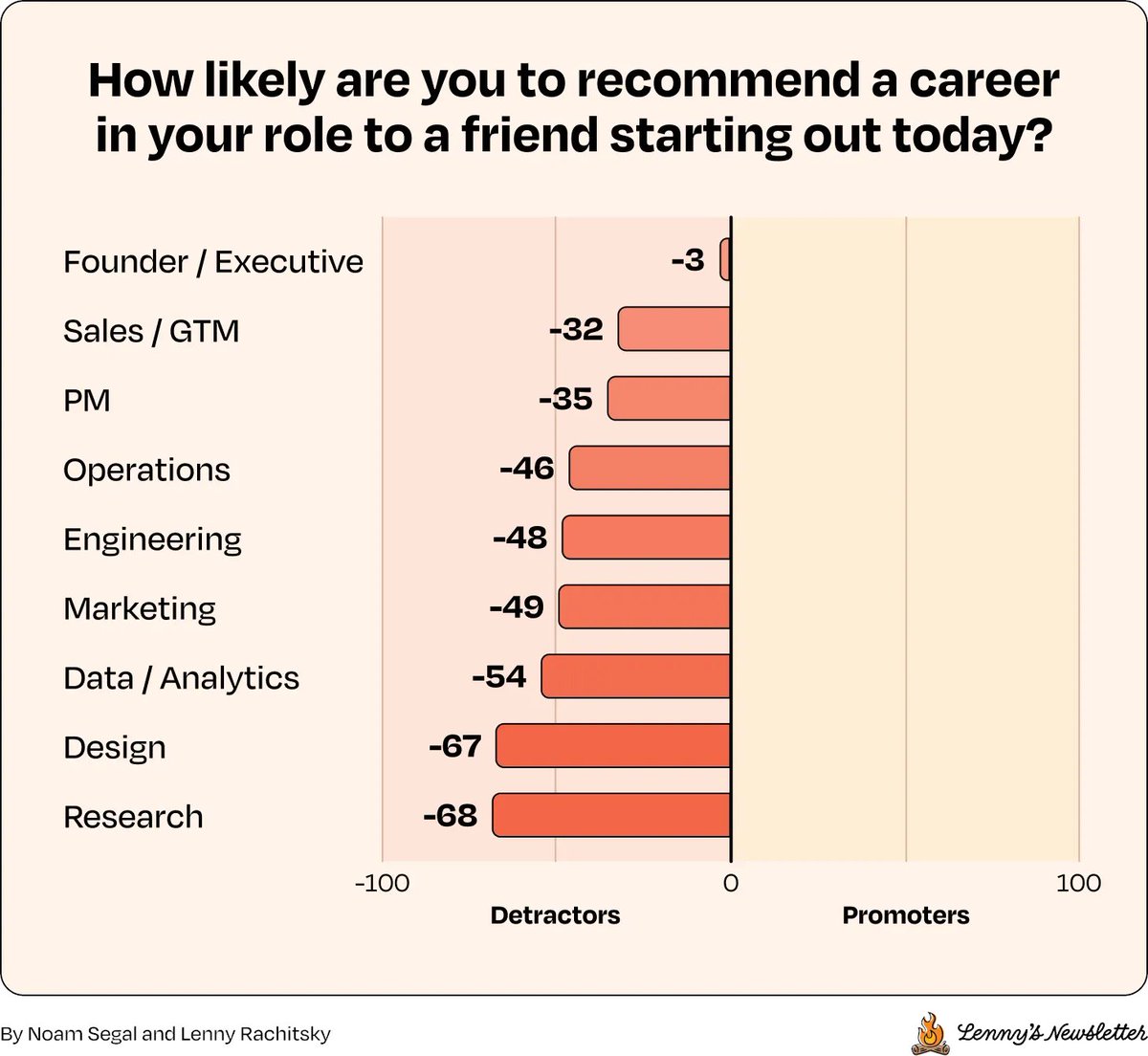
@lennysan Sadly but not surprising to me, this echoes my approach with our sons (4 of which are adults now): I've intentionally not paved a path for them to do what I do. If they chose to become designers in tech, of course I'd be supportive. But I didn't make it easy for them.
English
1
0
5
580
Lenny Rachitsky
Lenny Rachitsky@lennysan·
We asked my readers: On a scale of 0 to 10, how likely are you to recommend a career in your role to a friend starting out today? More than half of working tech professionals would actively steer a newcomer away from their career path. Founders are, by far, at least as pessimistic about their path (and also the happiest people in tech). Designers and researchers are the most bearish on the future of their roles. At the same time, though, people in these roles today are feeling happy about their career choice. In other words: “The water’s fine, but don’t come in.”
Lenny Rachitsky tweet media
Lenny Rachitsky@lennysan

The tech workforce is splitting in two A year ago, we ran the first large-scale survey of how tech workers feel about their jobs and careers. What emerged we summarized in four words: burned out, but optimistic. Today, we're back with the results from our 2026 survey, and it's a tale of two workforces. Half of tech right now feels amplified by AI—more capable, more confident, more excited than they've been in their entire career. The other half feels shaken by it—less sure of their value and whether there’s still a place for them. Which side of that line you fall on predicts how you feel about your career more than anything else, including your role, seniority, company size, or any other measure we collected. The workforce is bifurcating into two realities. A few other takeaways that surprised us: + Significant burnout jumped from 44.7% to 55.7% in one year, while career optimism fell from 54.8% to 48.7%. A worrisome trend. + 53% of tech workers would steer a newcomer away from a career in their own role, even when they're optimistic about their own future. + The biggest AI fear is of being squeezed to do more work. Only 22% worry about “losing my job to AI.” Far more worry about being expected to do more for the same pay, getting trapped in an unsustainable pace, and the quality of their work declining. The question that best predicts how a tech worker feels about their work, in 2026, is no longer "What do you do?" or "Where do you work?" It’s "What has AI done to your sense of who you are?" Read the full report here: lennysnewsletter.com/p/how-tech-wor…

English
30
8
199
52.1K
Cameron Moll
Cameron Moll@cameronmoll·
Ball don't lie. 👏
English
1
0
0
369
Cameron Moll
Cameron Moll@cameronmoll·
VAR needs to be shelved. This is ridiculous. 🇪🇬
English
4
0
9
1.1K